India–Australia Uranium Pact Redraws Indo
New deal boosts India's nuclear ambitions with Australian uranium.
Model Diplomat9 min readIndo-Pacific
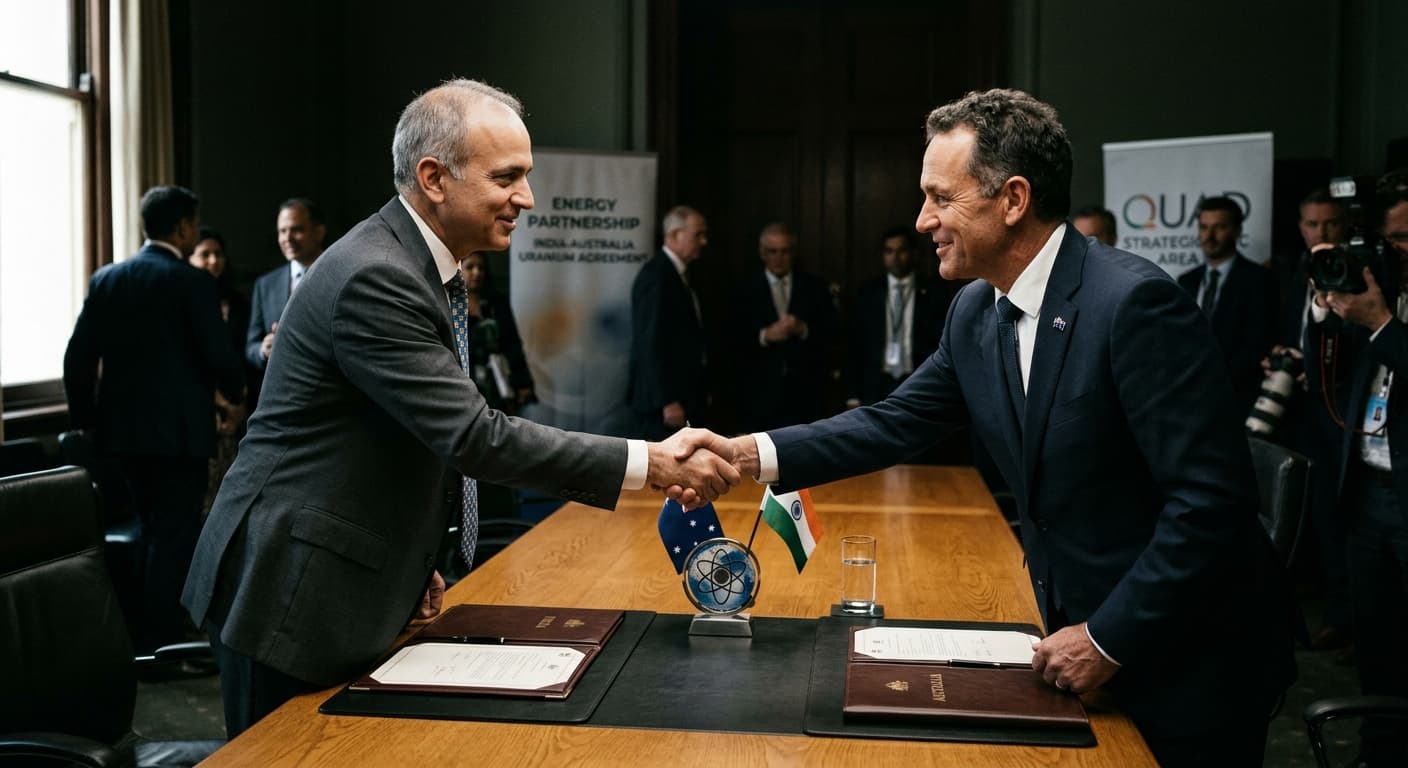
India–Australia Uranium Pact Redraws Indo-Pacific Energy Map
The Modi–Albanese deal signed in Melbourne on July 9, 2026 unlocks Australian uranium for India's 100 GW nuclear push — and pulls Canberra deeper into the Quad's anti-coercion architecture.
On July 9, 2026, in Melbourne, India and Australia signed the Administrative Arrangement that finally operationalises their 2015 Civil Nuclear Cooperation Agreement — the last legal layer needed before Australian uranium can flow at commercial scale to Indian reactors. The joint statement, released by Prime Minister Anthony Albanese's office, frames the deal as enabling "long-term Australian uranium exports to India for exclusively peaceful purposes and under IAEA safeguards." The thesis of this piece: the pact is less about uranium tonnage than about welding Australia's most strategic resource to India's civilian atomic programme at the exact moment the Quad is trying to build an ex-China supply architecture for the Indo-Pacific. The winners are New Delhi's fuel-security planners and Canberra's China-diversifying trade lobby. The loser, quietly, is Beijing — which had counted on India's uranium bottleneck as a structural constraint.
What was actually signed — and why 12 years late
The document Modi and Albanese endorsed is not a new treaty. It is the "administrative arrangement" contemplated by Article XI of the 2014 nuclear agreement — the plumbing that specifies safeguards accounting, transfer procedures and end-use verification for material moving from Australian mines to Indian reactors. According to the Third Australia–India Annual Summit Joint Statement published by the Australian Prime Minister's office, the leaders welcomed "finalisation and signature of the Administrative Arrangement, which will enable long-term Australian uranium exports to India for exclusively peaceful purposes and under IAEA safeguards." Canberra also formally reiterated its support for India's membership of the Nuclear Suppliers Group.
The 12-year delay tells the story. The Civil Nuclear Cooperation Agreement was signed by Tony Abbott and Narendra Modi in September 2014 and entered into force on 13 November 2015, according to a Government of India Press Information Bureau release. A first token shipment moved in 2017. Then almost nothing. The Australian Institute of International Affairs
documented the stall: "lacklustre development of trade of uranium to India, non-disclosure of 'limited' quantities supplied to India in 2017, other issues regarding safeguards, and the domestic politics of Australia" all conspired to keep the pipeline dry. What broke the stalemate in 2026 is not new safeguards logic — India's IAEA agreement INFCIRC/754 has been in force since 2009 — but a new political willingness in Canberra to sell an energy-transition mineral to a partner it now treats as a "cornerstone" defence relationship.
The 100-gigawatt problem
India's demand curve is the pact's centre of gravity. In the Union Budget 2025–26, the Modi government announced a Nuclear Energy Mission targeting 100 GW of installed nuclear capacity by 2047, up from roughly 8.7 GW today. The Prototype Fast Breeder Reactor at Kalpakkam achieved first criticality on 6 April 2026, opening Stage 2 of India's three-stage programme, according to a Press Information Bureau factsheet. Parliament also passed the Sustainable Harnessing and Advancement of Nuclear Energy for Transforming India (SHANTI) Act, 2025, opening the sector to limited private participation.
The problem is fuel. India holds one of the world's largest thorium endowments but only modest uranium reserves — around 1.79 lakh tonnes of uranium metal, per an earlier Department of Atomic Energy parliamentary answer. MP-IDSA's Manohar Parrikar Institute for Defence Studies and Analyses estimates that even after Jaduguda expansions, India's safeguarded reactor fleet "will require substantial imports over multi-decadal horizons," in a
June 2026 assessment of India's nuclear autonomy. Peer-reviewed modelling published on SSRN by Indian researchers is blunter: 100 GW by 2047 is achievable only by "securing international uranium agreements until India transitions to thorium-based reactors," per
The Road to 100 GW Nuclear Power in India.
That is the gap Australian uranium is meant to fill. Australia holds roughly 28–31% of the world's known recoverable uranium reserves — the largest deposit on earth — and the Olympic Dam mine alone could scale from 4,000 to 19,000 tonnes annually, according to reporting by the BBC. No other supplier can offer that headroom.
The real logic: three supply hedges, not one
Read alongside two other 2026 contracts, the Melbourne signing looks less like a bilateral favour and more like a deliberate portfolio play. In March 2026, Cameco and India's Department of Atomic Energy signed a Canadian contract covering roughly 22 million pounds of uranium oxide between 2027 and 2035 — worth CAD 2.6 billion, and the single largest publicly announced uranium contract in India's history, per MP-IDSA. Earlier in 2026, a new Kazatomprom anchor agreement superseded the older 5,000-tonne 2015–19 contract, positioning India as a structural customer for one of the world's largest producers.
Australia is the third leg of that stool — and the most strategically loaded one, because it doubles as a Quad member and an AUKUS principal. New Delhi has now diversified across five safeguarded suppliers: Kazakhstan, Canada, Russia, France and Australia, with Uzbekistan on a smaller ticket. This is a hedge against a specific scenario: any single supplier — Russia most obviously, given HALEU exposure — cutting India off during a regional crisis. The Observer Research Foundation has argued for years that "fuel is unlikely to be an inhibiting factor for India's projected reactors through to 2050" if this diversification holds. As of July 2026, it does.
The Quad angle — this is not just about electricity
The Melbourne joint statement pairs the uranium arrangement with a Joint Declaration on Defence and Security Cooperation, a new Annual Defence Ministers' Dialogue, and an in-progress MoU on the Provision of Defence Articles and Defence Services. That is a step-change. The second Annual Summit communique in Rio in November 2024 had only promised to "renew and strengthen" that defence declaration in 2025. It slipped by a year; when it landed, it arrived stapled to uranium.
The context is the Quad's transition — described by the United States Studies Centre in its June 2026 assessment How the Quad can deliver in a new strategic era — from "strategic rhetoric to operational delivery." At the Quad foreign ministers' meeting in New Delhi in June 2026, the four announced a framework agreement committing up to US$20 billion in public and private capital toward critical minerals projects, according to a separate
USSC report on operationalising the initiative. The Melbourne uranium deal is the bilateral echo of that framework: it takes the Quad's abstract "supply-chain resilience" promise and gives it a specific tonnage.
The Congressional Research Service in its running assessment India–U.S. Relations: Issues for Congress notes that the July 2025 Quad ministerial "narrowed cooperative efforts" to four hard-power priorities including "economic prosperity and security" via the Critical Minerals Initiative. Uranium is not on the CMI's formal list, but the strategic logic is identical: any commodity where China is a chokepoint supplier or dominant processor becomes a candidate for Quad-internal hedging. Australia's uranium is the archetype.

Who benefits, who loses
Winners. Indian energy planners get a supplier they can call in a crisis without transiting Central Asian pipelines or Russian ports. Australian miners — BHP at Olympic Dam most prominently — get a customer at a price point that could shift the economics of expansion; the Ramesh Thakur analysis in Australian Outlook argued that Indian demand "could give [uranium] the necessary boost to incentivise uranium exploration and production." Canberra's trade diversification lobby gets a marquee win: India is now Australia's fifth-largest trading partner, with two-way trade of A$54.4 billion (US$37.7 billion) in 2024–25, per figures reported by
Al Jazeera.
Losers. China's leverage over India's nuclear fuel cycle — always modest but real, given HALEU dependencies for advanced reactors — shrinks further. So does Russia's, though Rosatom retains its lock on the Kudankulam reactor fleet. And Pakistan loses again in the diplomatic sense: Islamabad has spent 18 years arguing that any NSG accommodation with India should extend to it. Canberra's explicit endorsement of India's NSG membership in the joint statement, without a Pakistan mention, closes that door tighter.
The non-proliferation community. The International Campaign to Abolish Nuclear Weapons and other groups had warned in 2014 that selling uranium to a non-NPT signatory "seriously undermines Australia's credibility as a responsible nuclear supplier," per the AIIA analysis cited above. That argument has now lost politically. It will not be revived.
The AUKUS shadow
Read against AUKUS, the pact acquires a second-order meaning. Australia's Nuclear-Powered Submarine programme requires highly enriched uranium fuel from the US or UK — Australia itself cannot enrich above 20%, per the RSIS analysis of AUKUS's uranium logic. But Canberra's raw uranium is what makes the extended Anglo-American maritime nuclear system economically viable over decades. By simultaneously locking in India as a peaceful-uses customer and remaining the anchor supplier to AUKUS, Australia positions itself as the indispensable uranium hub of the Indo-Pacific — a role Kazakhstan cannot play because it is landlocked and dependent on Russian transit, and Canada cannot play because it lacks Australia's proximity to Asian markets.
Perth USAsia Centre argues in a June 2026 essay that this makes Australia "a responsible and trusted nuclear steward in an increasingly complex strategic environment." That framing is generous to Canberra but analytically correct: if the Indo-Pacific nuclear map is being redrawn, Melbourne is now closer to the centre of the paper than at any point since the 1970s.
What could still go wrong
Three things. First, price and volume. The 2014 agreement produced only a token shipment. The Administrative Arrangement removes the legal excuse but not the commercial one; contract negotiations between Indian buyers and specific Australian miners are the next test. Second, Australian domestic politics. The Australian Institute of International Affairs has flagged how tightly uranium is bound up with the Environment Protection and Biodiversity Conservation Act; a hostile Senate or a court challenge could still slow shipments. Third, an Indian nuclear incident. Any accident at a safeguarded reactor using Australian-origin fuel would put the arrangement back on the front page of every Australian broadsheet.
Diplomat View
The correct read on Melbourne is that Australia has quietly become the Quad's most strategically leveraged member. It supplies the raw uranium underpinning both AUKUS submarines and — as of July 9 — India's civilian expansion, while sitting on 28–31% of global reserves and hosting the industrial rare-earths spine that Quad partners need to escape Chinese processing dominance. The forecast: within 18 months, Australia moves from a marginal uranium supplier to India (below 5% of imports) to a top-three source, alongside Kazakhstan and Canada. What would revise that call: a Labor-left revolt against expanded Olympic Dam output; a serious safeguards dispute over end-use verification; or a Chinese economic-coercion move against Australian iron ore designed to punish Canberra for the deal. The base case is that none of these materialise. The pact holds. The uranium ships. And by 2028 the phrase "India's fuel-security architecture" quietly comes to mean "the Quad plus Kazakhstan."
Forward look
- October 2026. Second USSC Quad Critical Minerals workshop; expect Australia to press for uranium's inclusion in a broader "strategic materials" framework.
- Late 2026. First commercial-scale Australian uranium contract negotiations with Indian buyers (Uranium Corporation of India Ltd., NPCIL); watch for BHP and Boss Energy as the likely counterparties.
- January 2027. Final Quad critical minerals outcomes report due; a public dollar figure on uranium off-take would confirm the thesis.
- 2027 Quad Leaders' Summit in India. Modi's hosting turn; if uranium volumes appear in the leaders' declaration, the deal has fully crossed from bilateral to multilateral logic.
The Bottom Line
The India–Australia uranium pact is the moment the Quad's supply-chain rhetoric acquires a specific commodity, a specific tonnage, and a specific customer. Australia now sits at the intersection of India's 100-gigawatt nuclear ambition and AUKUS's submarine fuel cycle — the indispensable uranium node of the Indo-Pacific. If the shipments follow the signatures this time, Beijing will find that one more lever it once expected to hold over New Delhi has quietly moved to Canberra.
Discover more

US Politics
SNAP Food Assistance Faces Legal Challenges
In 2026, SNAP faces stricter eligibility rules and mounting legal challenges, threatening food assistance for the millions of Americans who rely on the program.
US Politics
Congress Targets AI Chatbot Access for Terror
The House passed the Generative AI Terrorism Risk Assessment Act, focusing on AI's role in terrorism and potential surveillance implications.

US Politics
Next Generation Republicans
A leaked survey shows 39% of Republicans under 30 do not identify as MAGA, revealing a split in the GOP's future leadership.

Economics
Fed's Amex AML order puts correspondent banking on notice
Federal Reserve's Amex AML order requires board-level controls and a 90-day plan; OCC fined the bank $350 million over enterprise-wide deficiencies.