India-US Mineral Pact Exposes China Supply Ch
A new framework aims to secure critical minerals supply.
Model Diplomat3 min readAsia
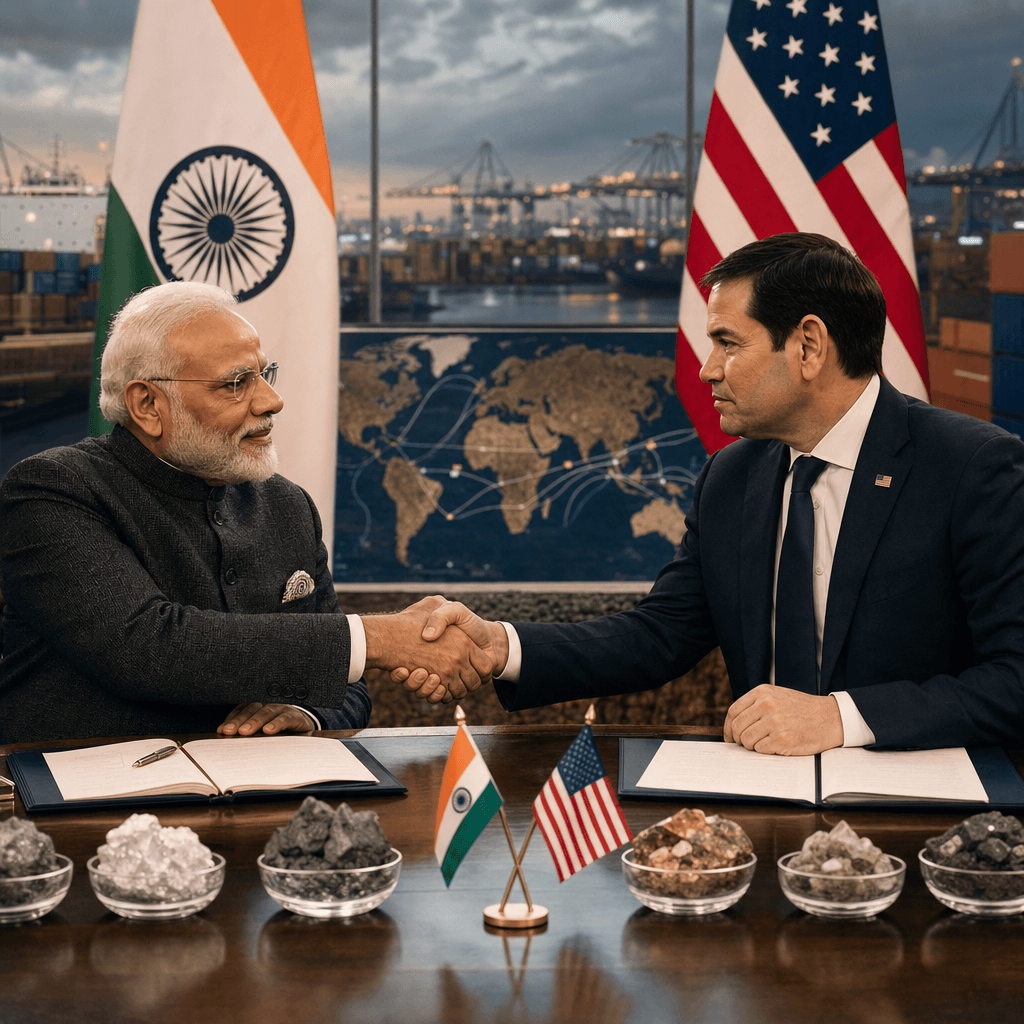
India-US Mineral Pact Exposes the China Supply Chokehold
[Jaishankar and Rubio turned rare earths into a hedge against China, but execution will hinge on mines, processing capacity and financing.]
India and the United States signed a bilateral framework on securing the supply of critical minerals and rare earths on Tuesday, with External Affairs Minister S. Jaishankar saying it covers mining, processing, recycling and related investment, according to The Indian Express and
The Hindu. The leverage point is obvious: Beijing’s export curbs on rare earths have made a narrow set of suppliers a geopolitical weapon, and New Delhi and Washington are trying to build a trusted alternative before the next disruption hits.
What each side is buying
For Washington, the deal is part of a broader effort to reduce dependence on single-source monopolies, a phrase Rubio used repeatedly in New Delhi, while the US embassy said the initiative is meant to keep foundational inputs for advanced technology and energy inside trusted networks, according to The Indian Express. That is not just rhetoric. The embassy said the US is already mobilising more than $30 billion in letters of interest, investments and loans tied to critical-mineral supply chains, which shows the administration is trying to turn diplomatic alignment into industrial policy (
The Indian Express).
India gets something different: a chance to move from being a consumer of strategic materials to a node in the supply chain. The framework’s language on financing, processing and recycling matters because India’s constraint is not access to minerals in the abstract; it is the capacity to refine, separate and scale them into usable industrial inputs, as both The Indian Express and
The Hindu reported. That makes the deal less about symbolism than about whether the two governments can crowd in private capital and create bankable projects.
Why the timing matters
The pact also tells you where the Quad is heading. Rubio said the groundwork was laid at February’s Critical Minerals Forum in Washington and later through India’s signing onto Pax Silica, while Jaishankar said the issue had already been discussed in the Quad format, according to The Indian Express. That is important because the Quad has been under pressure from questions about US consistency and from the wider US-China thaw: CNA reported that the New Delhi meeting was meant to restore momentum to a grouping some analysts had started to doubt, even as Washington and Beijing were recalibrating ties (
CNA).
The political dividend is real for both capitals. India can present itself as a partner in strategic industrial capacity, not just a security ally. The US can show it is building non-China supply chains without relying on sanctions or tariffs alone. But the gap between announcement and outcome is still wide: mining projects take years, processing plants take money, and rare-earth refining is where China still holds the most leverage.
What to watch next
The next test is whether this framework produces specific project announcements, financing commitments or a Quad-linked investment package before the next ministerial or leaders’ meeting, which Rubio said could happen later this year, according to CNA (CNA). Watch for three things: named private investors, a processing project in India, and whether the US keeps treating critical minerals as a strategic priority even if broader trade friction with New Delhi returns.
For the wider strategic picture, this is the kind of issue that sits at the intersection of Global Politics and
India: industrial policy now doubles as alliance management.
Discover more

India
India-South Korea $50B Trade Expansion Plan
India and South Korea target $50 billion in bilateral trade by 2030, focusing on industrial cooperation and strategic alignment amid US pressures.

Conflict & Security
Drone Warfare Killing Aid Workers at Unprec
Over 1,000 humanitarian workers killed in three years as cheap armed drones collapse legal protections. Gaza, Sudan, Ukraine, and DRC see deliberate targeting of aid convoys and hospitals with zero prosecutions.

Global
World Normalises Taliban as Afghan Women Eras
UN data shows Afghan women erased from public life as Russia recognises the Taliban, EU hosts officials in Brussels, and ICC warrants for gender persecution go unenforced.
Conflict & Security
West Africa Food Crisis: Three Shocks in 2026
Conflict, climate extremes, and the Strait of Hormuz closure drive a severe food crisis in West and Central Africa, with fertilizer prices surging 80% and millions displaced.