India Pivots to Uzbekistan for Minerals
New Delhi seeks Central Asian mineral supplies amid China's dominance
Model Diplomat3 min readAsia
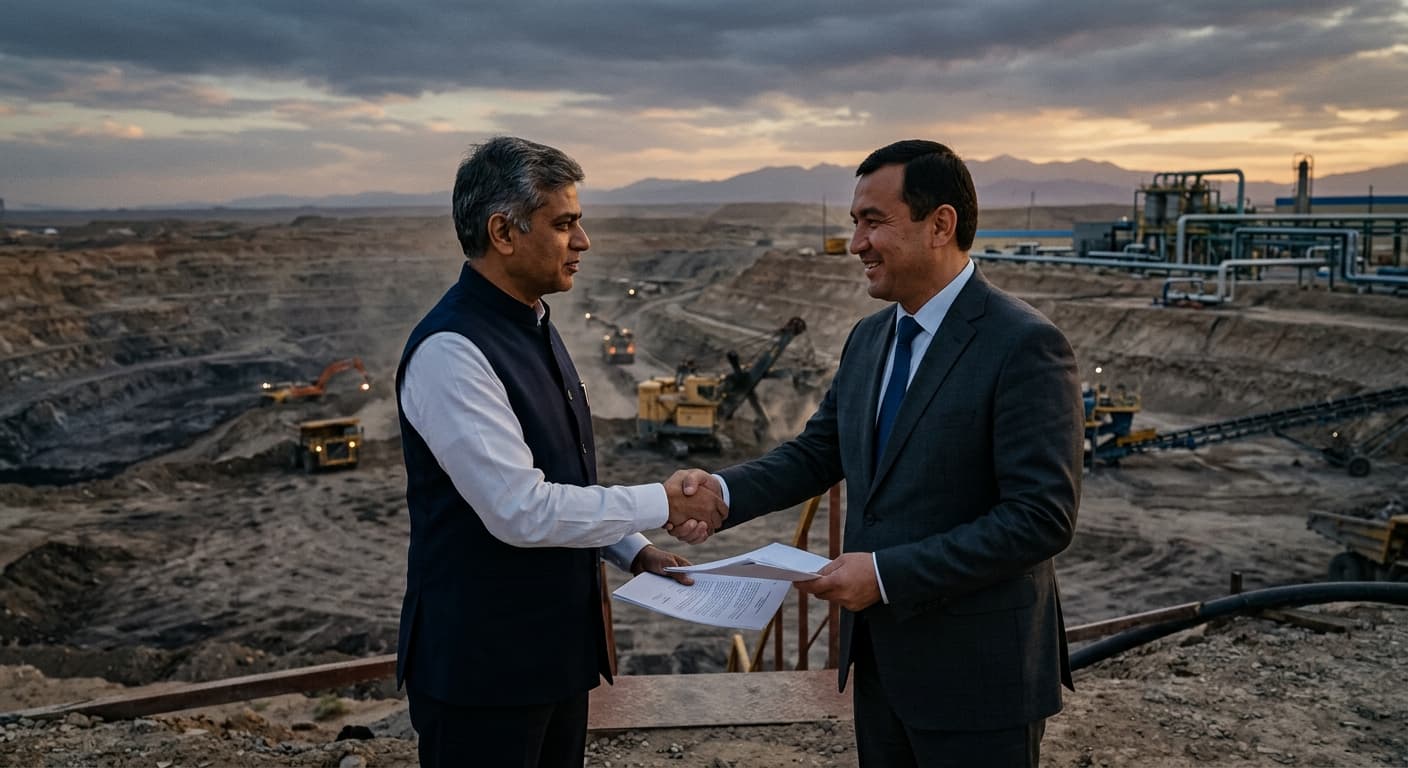
India Pivots to Uzbekistan for Critical Minerals Access
New Delhi is using energy cooperation and bilateral investment to secure Central Asian mineral supplies as China's grip tightens
India has flagged critical minerals supply as a central pillar of deeper energy cooperation with Uzbekistan, signaling a strategic shift toward regional sourcing to reduce reliance on China-dominated supply chains. During the 14th session of the India-Uzbekistan Intergovernmental Commission on Trade, Economic, Scientific and Technological Cooperation held June 18 in Tashkent,
the two sides agreed to deepen trade ties, address non-tariff barriers, and work toward doubling bilateral trade over the next three years.
The timing reflects New Delhi's widening aperture on Central Asia. In early June, as India's Minister of Heavy Industries H.D. Kumaraswamy met with Uzbekistan's Investment Minister Laziz Kudratov on the sidelines of the Shanghai Cooperation Organization, the focus was immediately on "attracting leading Indian companies to participate in the development of Uzbekistan's mineral deposits and to invest in metal processing projects," according to the Uzbek Ministry of Investment.
Bilateral trade had already reached $406 million in the first four months of 2026, with Indian investments in Uzbekistan totaling approximately $300 million in the first quarter — evidence of rapid capital deployment, not idle talk.
The leverage here is structural. Uzbekistan holds substantial critical mineral reserves—including tungsten, rare earths, and other elements essential for battery technology, magnets, and semiconductors. The country's estimated mineral resource value exceeds $3 trillion, though geological surveys cover only 40% of its territory. India, by contrast, faces a critical minerals deficit: it controls rare earths reserves but lacks the downstream processing capacity and cannot source all elements domestically. China refines over 90% of global rare earth elements, a chokehold that has animated both
New Delhi's $800 million rare earth magnet initiative announced in November 2025 and its emergency move to suspend exports of processed heavy rare earths to preserve domestic supply.
By anchoring mineral cooperation to energy partnership—Uzbekistan is energy-constrained in winter; India has capital and technology—New Delhi is creating a reciprocal relationship that insulates both capitals from Western-led supply agreements. This is notably distinct from India's May 2026 critical minerals framework with the United States, which sought to mobilize up to $20 billion across Quad partners. The Uzbekistan play is regional, bilateral, and designed to lock in access independent of Western conditions or Chinese extraction.
As of 2026, 397 enterprises with Indian participation already operate in Uzbekistan, providing the institutional scaffolding for scaled mineral and energy projects. Uzbekistan's own state strategy reflects this calculus: it has pivoted from exporting raw materials to processing—its Complex of Technology Metals has achieved a tenfold increase in tungsten capacity over two years and plans a 4,000-tonne cluster by 2030. Indian capital and technology are essential to hitting those targets on schedule.
The strategic context is China's overwhelming dominance. Beijing received approximately $25 billion in Central Asian investment in the first half of 2025 alone, with a record $213.5 billion in Belt and Road agreements globally. Much of this now flows into metals, mining, and processing—not extraction, but supply-chain control. The India-Uzbekistan deal is a deliberate counter: by deepening bilateral mineral sourcing before 2030, New Delhi reduces its exposure to Chinese monopoly pricing and secures feedstock for its own magnet and battery ambitions.
Watch the treaty text from the June Tashkent commission. Specifics on investment guarantees, export volumes, and pricing discipline will signal whether this is a political gesture or a binding commitment. If it includes joint ventures in Uzbek processing clusters and guaranteed offtake by Indian manufacturers, India has begun solving its lowest-cost supply problem. The next decision point is implementation: whether $300 million in H1 2026 flows accelerate to the $2 billion-plus scale required to move the supply needle.
Discover more

India
India-South Korea $50B Trade Expansion Plan
India and South Korea target $50 billion in bilateral trade by 2030, focusing on industrial cooperation and strategic alignment amid US pressures.
India
CPI(M) Calls to Decouple Quota from Delimita
CPI(M) advocates for a 33% women's quota in Lok Sabha by 2029, removing the need for delimitation and census linkage.

International Relations
Pakistan's Key Role in US-Israel-Iran Meddle
Pakistan is seeking to mediate the US-Israel-Iran conflict, balancing high-stakes diplomacy against severe economic pressures and steep regional challenges.

Conflict & Security
Drone Warfare Killing Aid Workers at Unprec
Over 1,000 humanitarian workers killed in three years as cheap armed drones collapse legal protections. Gaza, Sudan, Ukraine, and DRC see deliberate targeting of aid convoys and hospitals with zero prosecutions.