India-Indonesia Pact to Challenge China
A strategic minerals partnership to reduce reliance on China.
Model Diplomat7 min readAsia
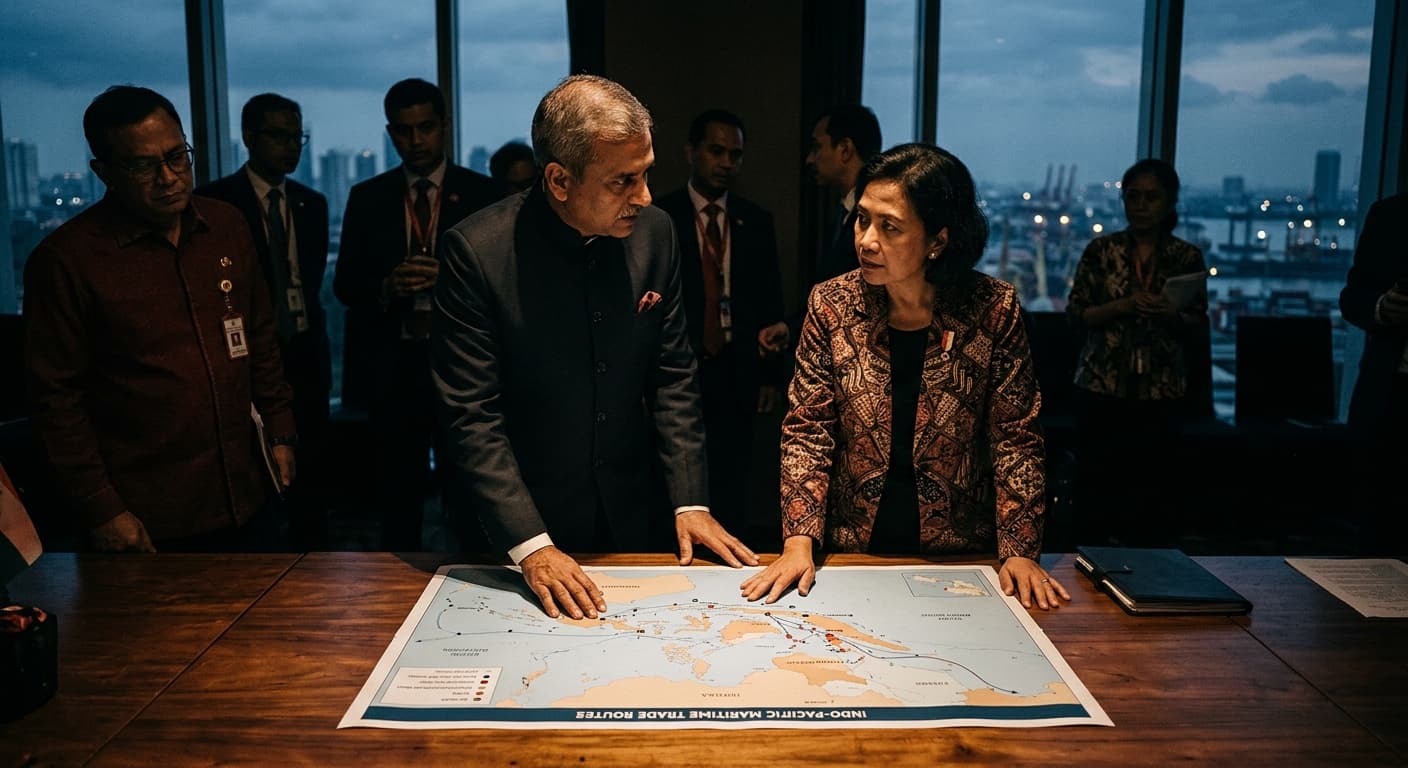
India-Indonesia Critical Minerals Pact Targets China's Chokehold
India and Indonesia signed a critical-minerals and rare-earths partnership on July 7, 2026 in Jakarta — a South-South bid to prise nickel and REE supply chains loose from Beijing's grip.
The India–Indonesia critical-minerals pact signed by Prime Minister Narendra Modi and President Prabowo Subianto in Jakarta on July 7, 2026 is not a mining deal — it is an attempt to build a nickel-and-rare-earths corridor between the world's largest reserve holder in Southeast Asia and the third-largest reserve holder in South Asia, inside a value chain that Chinese capital already controls at the refinery gate. Roughly a dozen agreements were signed, including a memorandum between India's NFTDC/Midwest and Indonesia's PERMINAS on rare earths, according to Rediff Moneynews and
The Hindu BusinessLine. The strategic bet: two G20 middle powers can co-produce the intermediates — battery-grade nickel, mixed hydroxide precipitate, separated rare-earth oxides — that today flow almost entirely through Chinese-owned smelters. If it works, it reprices Beijing's leverage over the EV transition. If it doesn't, it becomes another line item in a partnership that has "largely underperformed for long."
The leverage problem India is trying to solve
The trigger is not diplomatic. It is industrial. On April 4, 2025, China placed seven medium and heavy rare earths and most magnet-grade materials under an export-licensing regime, and Indian shipments effectively stopped, Al Jazeera reported. Bajaj Auto's flagship Chetak e-scooter produced 10,824 units in July 2025 versus 20,384 a year earlier — a near-halving, on the record, from executive director Rakesh Sharma. Then on October 9, 2025, MOFCOM Notice 61 extended those controls extraterritorially to any foreign product containing 0.1% Chinese-origin rare earths, according to
VIF India. Chinese customs data showed rare-earth magnet exports to India fell 58% between January and mid-2025.
That is the shock that reframes the Jakarta signing. India holds roughly 8% of global rare-earth reserves but produces under 1% of global output and imports 80–90% of its magnets from China, the BBC noted after India approved a ₹7,280-crore magnet PLI in November 2025. India's problem is not resource poverty. It is midstream absence: separation, alloying, magnet fabrication. Indonesia's problem is the mirror image — vast ore, but foreign-controlled processing. The Modi–Prabowo pact tries to marry both gaps.
Why Indonesia, and why now
Indonesia accounts for roughly 58% of the world's mined nickel and 45% of primary nickel refining, having built that position on the back of a 2014 raw-ore export ban tightened in 2020, according to a SOAS case study and CSIS. But ownership tells the harder story: Indonesian firms control only around 10% of that refined-nickel capacity, while Chinese companies — Tsingshan, Jiangsu Delong and affiliates — hold about 65% via the Morowali (IMIP) and Weda Bay industrial parks, per
CSIS. In 2024, China took 82% of Indonesia's nickel exports and supplies 80–90% of the refining machinery Indonesia's smelters run on.
Jakarta wants out of that funnel — not because it dislikes Chinese capital, but because concentration is a price risk. Nickel prices fell 21% in 2024 on Indonesian oversupply, forcing BHP to shut Western Australian mines and put 1,600 workers on notice, per the Australian Institute of International Affairs. Prabowo has since pushed 2025 amendments prioritising domestic use of minerals and hiking nickel royalties from a flat 10% to a progressive 14–19%, according to
ORF. A February 2025 order requires foreign-exchange earnings from natural resources to remain in Indonesian banks for a year. India's arrival is welcome partly because it is not China: it diversifies the funder mix without threatening the downstreaming regime.
What was actually signed
Beyond the headline critical-minerals language, the operational core is the memorandum between the Nonferrous Materials Technology Development Centre (NFTDC), its commercial partner Midwest Advanced Materials, and Indonesia's PERMINAS. NFTDC is the state R&D body under India's Ministry of Mines whose Molten Salt Electrolysis process anchors Midwest's 500-tonne-per-year neodymium magnet plant, scaling to 5,000 tonnes by 2030, backed by the Technology Development Board. Pairing that separation technology with Indonesian feedstock is the point: India brings a process; Indonesia brings the geology.
Around this sit the wider Jakarta deliverables — a BrahMos supply agreement estimated at roughly $450 million, integration of India's UPI with Indonesia's national payment system, and a maritime-security package covering Andaman–Aceh connectivity and the Sabang deep-sea port, per Orissa POST and
Sarkaritel. The mineral pact is the economic spine; the missiles and maritime ties are the political wrap that makes it durable.
The historical parallel Delhi is quietly copying
Japan has done this before. After China's 2010 rare-earth export halt over the Senkaku dispute, Tokyo cut its Chinese REE dependence from nearly 90% to about 60% by financing miners abroad and refining at home, according to ORF. The instruments were JOGMEC, JARE and Lynas Rare Earths — long-term offtake contracts and equity in overseas midstream. India is now assembling the same toolkit: KABIL for equity abroad, IREL for domestic refining, and now government-backed MoUs with Argentina, Australia, Brazil, the US, the EU and Indonesia inside 18 months.
The difference is that Japan built its diversification with a single adversary in mind. India is building it in a fractured market where both Washington and Beijing are willing to weaponise supply. The Quad Critical Minerals Initiative announced with the India–US framework on May 26, 2026 mobilises up to $20 billion for mining, processing and recycling; the
EU–India Comprehensive Strategic Agenda endorsed in New Delhi on January 27, 2026 commits both sides to "resilient, secure and diversified critical minerals supply chains." Indonesia is the missing Southeast Asian anchor in that lattice — and, crucially, one that has not joined the Quad's minerals bloc.
Who benefits — and who loses
The clear winner is India's magnet ecosystem. Midwest Advanced Materials, IREL, and the newly-incentivised private players under the ₹7,280-crore magnet PLI now have a plausible feedstock path that does not run through China. Indonesia's state miners gain a customer that isn't Chinese for their high-pressure acid leach (HPAL) output — the mixed hydroxide precipitate that feeds EV cathodes. Under India's Production Linked Incentive scheme, 50 GWh of battery-cell factories are being subsidised, and those cells need nickel that today only Indonesia can supply at scale.
The losers are quieter. Chinese processors in Morowali lose a monopsony premium if Indian buyers scale forward contracts; Australian nickel miners, already squeezed by Indonesian oversupply, gain nothing from a Delhi–Jakarta channel that bypasses them. Japan — which India told in June 2025 to suspend a decades-long neodymium export deal so IREL could redirect output domestically — is exposed to a pattern of Indian resource nationalism it once counted on being immune from.
The frictions that will decide it
Three frictions determine whether this pact matters in 2028 or joins the long list of India–Indonesia joint statements that never quite delivered.
First, ownership. Indonesia's 2025 mining-law amendments are designed to reward companies that build domestic processing. If Indian firms want offtake, they will be asked to co-invest in Indonesian smelters — capital-heavy plays that Indian conglomerates have largely avoided abroad. KABIL's overseas asset acquisition mandate under the National Critical Mineral Mission — targeting 50 sites globally by 2030–31, according to ORF — will be tested here.
Second, environmental optics. Indonesian nickel is "dirty nickel" — coal-fired HPAL, deforestation in Sulawesi and Halmahera. India's own "LiFE" initiative and the EU's Critical Raw Materials Act both push traceability. Joint India–Indonesia standards on "green nickel" were floated at the G20 in 2025; without them, Indian magnets made from Indonesian inputs will struggle to enter EU supply chains under the CRMA.
Third, China's response. Beijing's MOFCOM Notice 61 extraterritorial rule already covers products with trace Chinese REEs. If Indonesian refineries — 65% Chinese-owned — process ore alongside Chinese-origin reagents or use Chinese-supplied sulfuric acid, downstream Indian magnets could technically fall under Beijing's licensing regime. The pact does not solve that. It only builds an alternative around it.
What the Bandung inheritance really means
Modi and Prabowo have both invoked the 1955 Bandung Conference this year — the founding moment of Non-Aligned Movement diplomacy. It is not sentimental. Indonesia joined BRICS in early 2025, hosts a "free and active" foreign policy under Prabowo, and refuses to be seen as a US ally. India, similarly, is inside the Quad but outside AUKUS, and continues to buy Russian oil and French jets in the same fiscal year. A minerals pact between the two largest Indo-Pacific democracies, framed as South-South cooperation rather than a Quad annex, is the most credible non-aligned instrument yet built on this file. Gateway House's Rajiv Bhatia called January's earlier tranche a chance to "revitalise the special connect forged at the historic Bandung Conference." Jakarta's mineral wealth gives that language teeth it did not have in 1955.
What to watch next
- The Indonesian defence delegation's follow-up visit to Delhi, and whether the BrahMos $450 million contract closes on schedule — the political signal that the minerals track has patronage cover.
- The next Joint Economic and Financial Dialogue (JEFD), where an operational framework for KABIL–PERMINAS equity co-investment in Sulawesi HPAL projects should surface.
- The WTO Appellate Body ruling on Indonesia's nickel export ban, unresolved since 2022 — a decision against Jakarta could force policy changes that affect the terms Indian buyers face.
- Whether India's magnet PLI recipients — expected to be named in the second half of 2026 — publicly commit Indonesian feedstock in their bids.
The Bottom Line
The Jakarta minerals pact matters not because India and Indonesia will replace China in nickel or rare earths — they cannot, this decade — but because they are the first two Global South producers to try building a parallel midstream without either Washington's capital or Beijing's plants. If NFTDC's technology plus PERMINAS's ore produces a single tonne of neodymium magnet outside the Chinese licensing regime by 2028, the geometry of the EV transition shifts. If it doesn't, China's leverage over the world's electric future gets one confirmation stronger.
Discover more

US Politics
US Launches $166B Tariff Refund Portal
The US is launching a $166 billion tariff refund portal to aid importers hit by Trump-era tariffs, with major implications for trade and supply costs.
US Politics
U.S. House Passes Alert Act for Aviation
The House passed the ALERT Act 396–10, replacing the ROTOR Act after Pentagon intervention, impacting aviation safety regulations.
India
Women’s Reservation in India
India's 33% women's reservation law is enacted but won't take effect until after 2029 due to political setbacks and census delays.

Economics
Fed's Amex AML order puts correspondent banking on notice
Federal Reserve's Amex AML order requires board-level controls and a 90-day plan; OCC fined the bank $350 million over enterprise-wide deficiencies.