India Freezes Indus Treaty Over Terrorism
Rajnath Singh warns Pakistan on water flows and militancy.
Model Diplomat3 min readSouth Asia
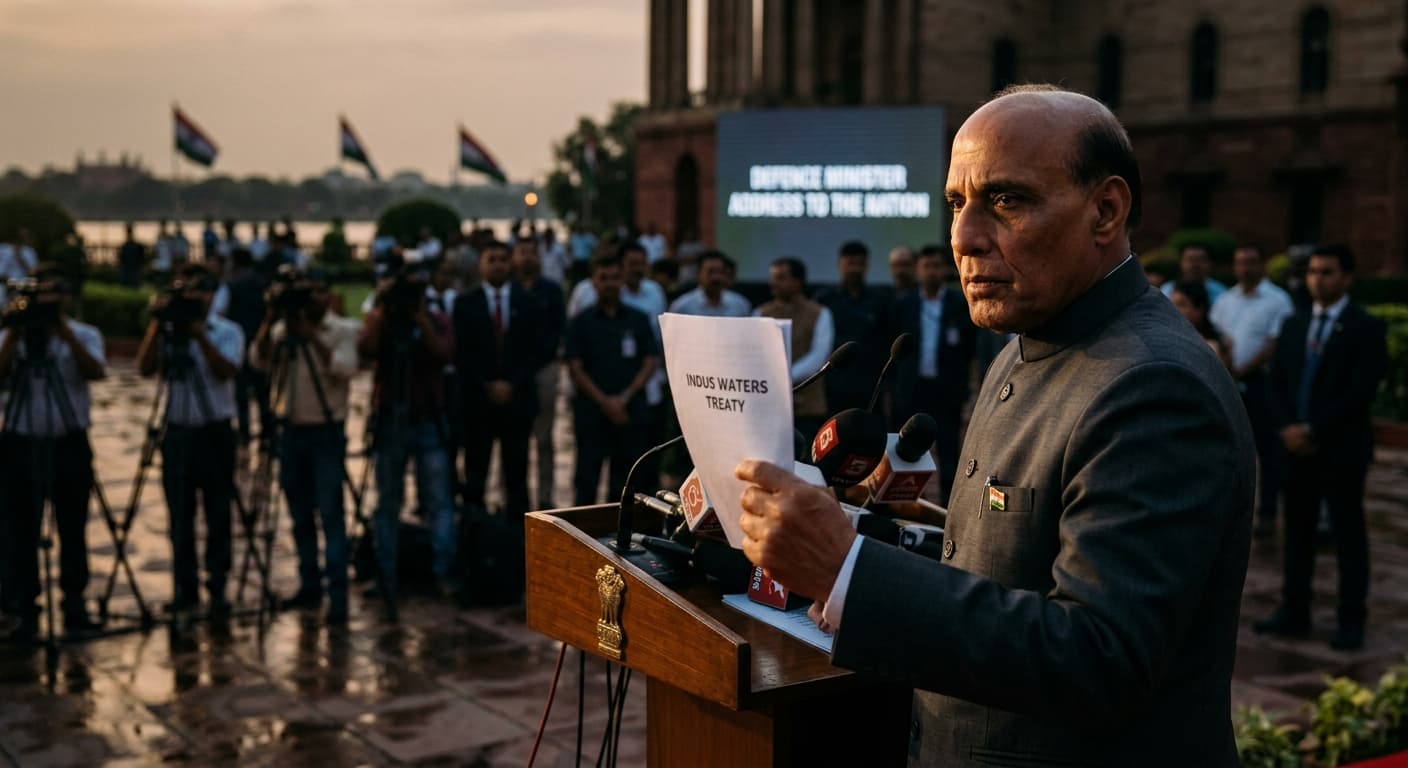
No Water for Terror: India Hardens Indus Treaty Freeze
Indian Defence Minister Rajnath Singh warns Islamabad that river flows are contingent on halting cross-border militancy, raising transboundary risks.
Indian Defence Minister Rajnath Singh issued a stark warning on June 13, 2026, declaring that New Delhi would tolerate "no Indus water for terror patrons" while praising the military's strategic resolve NDTV. Speaking on the legacy of "Operation Sindoor", India’s deep-penetration missile strikes against militant infrastructure, Singh asserted that the offensive proved India knows how to respond when peace is rejected
NDTV. The announcement signals that India's suspension of the 1960 Indus Waters Treaty (IWT) remains a permanent fixture of its regional leverage strategy.
The Legacy of Pahalgam and Operation Sindoor
The current crisis traces back to April 22, 2025, when gunmen from a group known as The Resistance Front (TRF) massacred 26 tourists in the Kashmiri mountain resort of Pahalgam Al Jazeera. Within 24 hours of the attack, New Delhi suspended its participation in the historic, World Bank-brokered IWT, citing Pakistan's failure to halt cross-border militancy
NPR. This escalatory measure was swiftly followed on May 7, 2025, by Operation Sindoor, during which Indian forces launched precision missile strikes against nine alleged militant camps located inside Pakistan and Pakistan-administered Kashmir
Al Jazeera.
While the direct missile exchanges cooled following Pakistani retaliatory strikes, the water front is increasingly defining the long-term geopolitical cost of the conflict Al Jazeera. For over six decades, the IWT survived three full-scale wars and was heralded as a model of
international resource management. However, by holding the treaty in abeyance, India has effectively weaponized its geographic advantage as the upstream riparian state, using hydrological flow to assert security leverage
BBC.
Weaponizing Hydrology
Under the 1960 pact, the Indus basin’s western rivers—the Indus, Jhelum, and Chenab—were allocated primarily to Pakistan, while India retained control over the eastern Ravi, Beas, and Sutlej rivers BBC. Because India has now suspended treaty operations, it no longer shares crucial daily hydrological and flood-forecasting data with Islamabad, a move that threatens agricultural planning and flood safety downriver
BBC. More critically, the freeze frees New Delhi to construct major upstream storage and run-of-the-river hydroelectric projects on the western rivers without sharing design documents or seeking Pakistani consent
BBC.
Pakistan, which relies on the Indus basin to sustain the agricultural lifelines of its 240 million citizens, has repeatedly termed the unilateral suspension an "act of war" Al Jazeera. Islamabad’s options remain severely constrained; while it has tried to challenge Indian dams like Kishenganga and Ratle through the Permanent Court of Arbitration in The Hague, New Delhi has systematically boycotted the hearings, claiming the tribunal has no standing in light of the treaty’s suspension
Al Jazeera. This leaves Pakistan in a highly vulnerable position as dry seasons exacerbate water scarcity
BBC.
Strategic Outlook and Next Milestones
Rather than moving toward diplomatic de-escalation, New Delhi is entrenching the freeze. Top political figures, including Home Minister Amit Shah, have explicitly stated that the treaty will remain in abeyance permanently until Pakistan "credibly and irrevocably" dismantles its militant proxies Al Jazeera.
The next major variables to watch are twofold. First, watch the progress of Pakistan's fast-tracked construction of its own diversion and storage dams, such as Mohmand and Diamer-Bhasha, as Islamabad attempts to buffer itself against potential dry-season water weaponization Al Jazeera. Second, monitor the monsoon season ending in September 2026, when the lack of bilateral flood-data sharing could lead to catastrophic, uncoordinated reservoir discharges, transforming a diplomatic stalemate into a humanitarian disaster along the Line of Control
BBC.
Discover more
India
UN Expert Albanese: India Violates Law
UN Rapporteur Francesca Albanese accuses India of breaching international law, spotlighting human rights concerns in Kashmir and prompting diplomatic pushback.

India
India-South Korea $50B Trade Expansion Plan
India and South Korea target $50 billion in bilateral trade by 2030, focusing on industrial cooperation and strategic alignment amid US pressures.

Conflict & Security
Drone Warfare Killing Aid Workers at Unprec
Over 1,000 humanitarian workers killed in three years as cheap armed drones collapse legal protections. Gaza, Sudan, Ukraine, and DRC see deliberate targeting of aid convoys and hospitals with zero prosecutions.

Global
World Normalises Taliban as Afghan Women Eras
UN data shows Afghan women erased from public life as Russia recognises the Taliban, EU hosts officials in Brussels, and ICC warrants for gender persecution go unenforced.