India Challenges USTR's 12.5% Tariff Proposal
India argues against USTR's forced-labour tariff evidence.
Model Diplomat8 min readNorth America
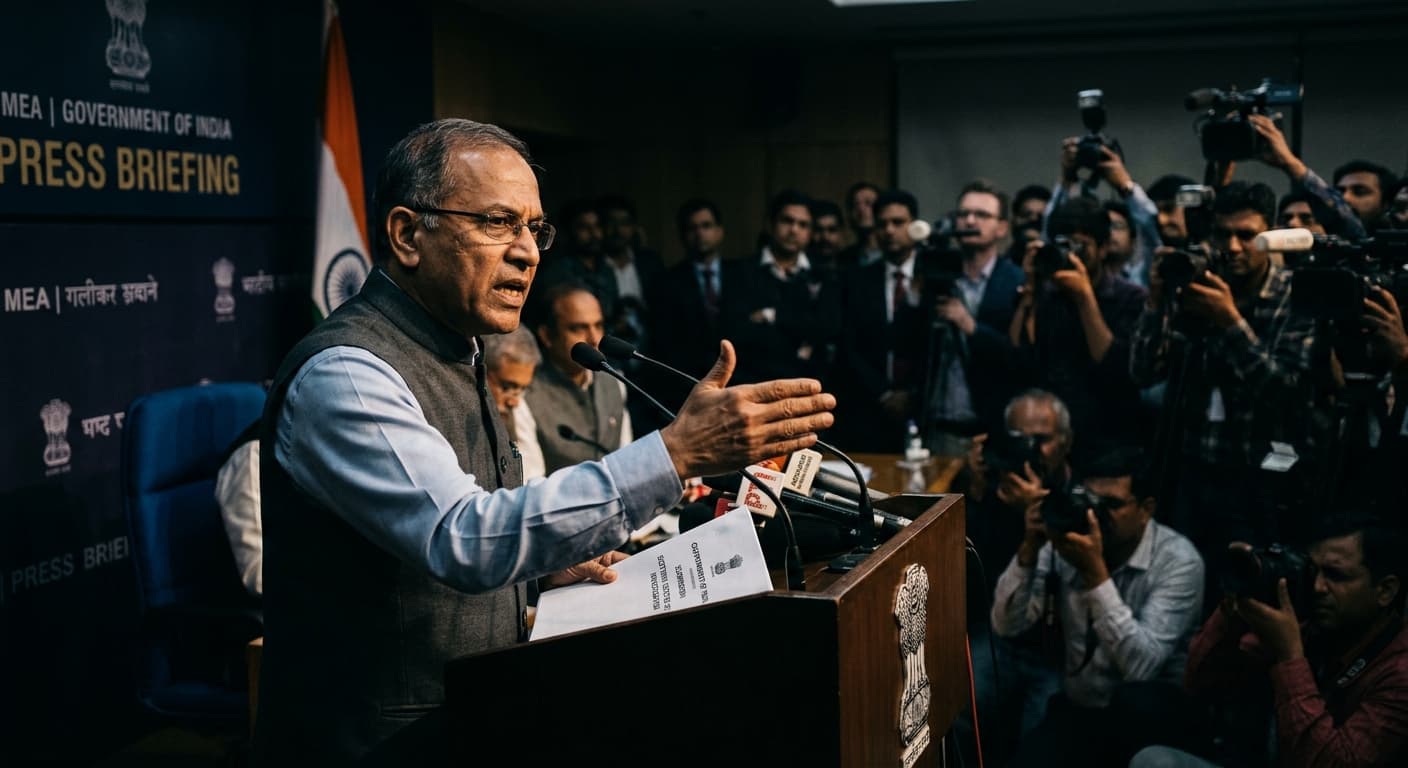
India Bets USTR Section 301 Case Collapses Under Its Own Evidence
India's nine-page brief to the USTR argues the 12.5% forced-labour tariff fails the Section 301(d) evidence test — a challenge that could unravel Trump's post-IEEPA tariff wall.
India's commerce ministry has told the Office of the U.S. Trade Representative that its proposed 12.5% Section 301 tariff on Indian exports is legally defective, arguing in a nine-page submission filed ahead of the July 7, 2026 Washington hearings that USTR failed to conduct the country-specific analysis Section 301(d) requires. The stakes are larger than the number. At 12.5%, the surcharge sits below the 18% reciprocal rate New Delhi already accepted in February, so India is not fighting the duty itself — it is disputing the legal architecture the Trump administration is using to rebuild the tariff wall the Supreme Court struck down. If India's evidentiary argument holds up in the record USTR is now closing, it becomes the template every plaintiff — corporate or foreign — will use in the litigation that starts the moment the tariffs land.
The mechanics: why 12.5% is a placeholder, not a price
The USTR concluded its Section 301 forced-labour investigation on June 2, 2026, and proposed an additional 10% tariff on 15 economies and a higher 12.5% surcharge on 45 others — including India, China, Vietnam, Japan, Australia, South Korea and Nigeria — under a Federal Register notice posted by USTR. Written comments closed July 6; public hearings ran July 7–9 at the U.S. International Trade Commission.
The urgency is procedural. After the Supreme Court's February 20, 2026 ruling invalidated tariffs imposed under the International Emergency Economic Powers Act, President Trump moved the same day to a 10% baseline surcharge under Section 122 of the Trade Act of 1974, later raised on his own to 15% — the statutory ceiling. That authority self-terminates after 150 days — on or around July 24, 2026 — unless Congress votes to extend it, an outcome the
Council on Foreign Relations has judged politically implausible ahead of the midterms. The Section 301 forced-labour tariffs, together with a parallel excess-capacity probe covering 16 economies including India, are the replacement chassis. A June 2026 Congressional Research Service brief on
Section 301 states plainly that USTR "might aim to finalize those tariff actions by late July 2026, when a 10% tariff imposed under Section 122 of the Trade Act of 1974 expires." That timing is not coincidence. It is the calendar around which the entire Section 301 process has been engineered.
Section 301 is procedurally slower than IEEPA — it requires a notice, an administrative record, public comment, hearings, and a legal determination — but as Brookings analysts Maricarmen Barrón Esper and Christopher Sands wrote, that record is precisely the point of vulnerability: the process "gives businesses, workers, and other stakeholders the opportunity to shape the factual and legal record on which any tariffs will rest." India read the same manual and is now putting evidentiary boobytraps into that record.
India's argument: attack the record, not the tariff
New Delhi's submission, filed by the commerce ministry and reported by The Times of India, reads like a pre-litigation brief structured around four claims:
- USTR conducted no country-specific analysis and instead made "a sweeping determination that all such approaches are inadequate."
- The June 2 report fails the causation test embedded in Section 301(d) — the statute requires a showing that the foreign practice is unreasonable and "burdens or restricts U.S. commerce" — and USTR did not link India's absence of a forced-labour import ban to any concrete US harm.
- The evidence cited by USTR is anecdotal and self-defeating. The ministry noted, per
The Economic Times, that US tobacco imports from India rose from $225,000 in 2021 to $3.5 million while imports from Malawi — the country flagged in the USTR narrative — remained at zero. US cotton imports from India climbed from $213 million to $392 million between 2021 and 2025, again with no displacement of American commerce.
- The remedy is disproportionate. Robust domestic labour enforcement and supply-chain due diligence — not tariffs on the importing partner — are the appropriate response.
India testified through Prof. James J. Nedumpara of the Centre for Trade and Investment Law, seated on Panel 12 alongside Pakistan on Day 2 of the ITC hearings, per USTR's published hearing schedule. Nedumpara is India's most experienced WTO litigator; the choice signals New Delhi intends to preserve every procedural point for downstream litigation. The
Day 2 hearing transcript shows the Section 301 Committee formally receives that testimony as part of the administrative record.
The critique lands on a documented weakness. William Reinsch of the Center for Strategic and International Studies, who correctly predicted USTR would find every economy guilty, wrote on June 12 that the 98-page USTR report devotes most of its length to arguing forced labour is bad in the abstract, while "the findings with respect to each of the 60 countries are two or three paragraphs each, simply asserting that the country in question 'failed to impose and effectively enforce a forced labor import prohibition.' No evidence is presented for that conclusion." That is precisely the gap India is pressing — and, Reinsch predicts, "the door to lawsuits arguing that the investigations were perfunctory."
Who else is arguing India's case — for free
The most consequential submissions in USTR's July docket did not come from foreign capitals. They came from Intel, IBM, Dell, Honeywell Aerospace, Ford, GE Appliances (now owned by China's Haier) and De Beers, according to The Economic Times. Intel told USTR the additional tariff would "make it more expensive to build in America than to build elsewhere, which runs directly counter to the administration's goal of expanding domestic manufacturing." Honeywell Aerospace warned that a tariff on hard-to-source aerospace inputs "would primarily increase the cost of maintaining and producing aerospace products rather than accelerate a feasible sourcing transition." De Beers made a parallel argument on natural diamonds: additional duties would "function primarily as a cost increase for US manufacturers, retailers, and consumers rather than encouraging domestic upstream substitution." Ford asked for exemption for four product categories already carrying Section 232 duties of up to 50%.
This corporate pushback is the second, quieter half of India's legal strategy. Section 301 requires USTR to weigh the economic impact of any remedy before imposing it. Having Intel, Dell, Ford and Honeywell on the record saying the duty raises US production costs is the kind of record evidence that judges read when the tariffs are challenged in the Court of International Trade. It is also politically potent — Ambassador Jamieson Greer's own June 2 statement framed the tariffs as protecting American workers from "an unlevel playing field," a claim now contradicted in the docket by the largest American manufacturers.
The counterintuitive read: 12.5% may actually help India
India's public posture is objection; its private calculation is closer to relief. The February 6 US-India Joint Statement locked in an 18% reciprocal rate on Indian goods — textiles, footwear, plastics, organic chemicals, home décor, certain machinery. India's own
Press Information Bureau fact sheet, dated February 9, notes that $30.94 billion of exports were cut from 50% to 18% and another $10.03 billion to zero. A Section 301 forced-labour surcharge that applies to India, China, Vietnam and Bangladesh alike preserves the relative advantage New Delhi bought in February — because a duty that hits every competitor is not a competitive disadvantage. As the Times of India noted, exporters "may find some relief if the existing 10% tariff is replaced by the proposed 12.5% levy, as the measure would apply to most of India's competing exporting countries."
That is why India's submission targets the legal predicate, not the rate. Winning on procedure lets New Delhi preserve the 18% deal Modi has already sold politically at home; keep the litigation door open for Indian exporters if the tariff is finalised and stacked on top of the 18% base — an outcome Reinsch flagged as likely because USTR called the duties "additional"; and signal to Washington that India will not be a passive test case for the post-IEEPA architecture the way it was for the 25% Russian-oil penalty Trump imposed under Executive Order 14329 in August 2025 and later rescinded.
The parallel to draw is not the 2018 China Section 301 case. It is the French digital services tax investigation of 2019, in which USTR proposed 25% tariffs and France's evidentiary counter-submissions helped drive the eventual OECD-brokered climbdown. India is running a version of that playbook — write for the record, litigate later, negotiate in parallel.
The real fight is coming: excess capacity
The forced-labour tariff is the appetiser. The larger threat to Indian exports is USTR's parallel Section 301 investigation into structural excess capacity, which targets 16 economies — China, India, Japan, South Korea, Vietnam, the EU, Mexico, Switzerland, Norway and others — that Greer's office says maintain subsidies and industrial planning "that allow factories to keep producing even when market conditions do not support it," per Brookings.
That probe cuts to India's export model in steel, chemicals and generic pharmaceuticals — sectors where the Modi government's Production-Linked Incentive scheme provides exactly the kind of state support USTR is scrutinising. The Peterson Institute for International Economics estimates the two combined investigations cover 80–90% of US imports, raising a constitutional question the courts have not yet answered: whether Congress delegated that much tariff authority to the president under Section 301. The Atlantic Council's Josh Lipsky and Marlene Chalecki modelled the full stacked regime at up to
$169 billion in annual revenue, broadly matching the $166 billion the IEEPA tariffs generated in 2025 — exactly the fiscal hole Treasury Secretary Scott Bessent has to fill.
Diplomat View
India's Section 301 submission is a well-aimed shot at the weakest point of USTR's post-IEEPA design. The forecast: the 12.5% duty gets finalised on or around July 24, 2026, stacked on top of the 18% reciprocal rate. Within 60 days, at least one US importer — likely in the aerospace, electronics or diamond supply chain — files suit in the Court of International Trade citing the evidentiary gaps India documented for free. New Delhi does not join that suit but benefits from it. The interim India-US framework survives, because both sides need it, and the excess-capacity probe becomes the venue for the substantive fight over PLI subsidies. What would change this forecast: a Trump-Modi deal in the next three weeks that exempts India from the forced-labour surcharge in return for accelerated purchases from the $500 billion commitment; or a Congressional extension of Section 122, which would remove the July 24 deadline pressure and let USTR rewrite a more evidence-based Section 301 record. Neither looks likely.
What to watch next
- July 24, 2026 — Section 122 authority expires. USTR expected to finalise Section 301 forced-labour tariffs at or before this date.
- Late July–early August 2026 — USTR preliminary findings due in the parallel excess-capacity investigation covering 16 economies including India.
- Q3 2026 — First importer lawsuits expected in the U.S. Court of International Trade challenging the evidentiary basis of the Section 301 forced-labour determination.
Discover more
Global Politics
US-Iran Tensions Rise
Tensions escalate in the Strait of Hormuz as Iran and the US clash over maritime control, with a ceasefire hinging on a contested MoU paragraph.
US Politics
U.S. House Passes Alert Act for Aviation
The House passed the ALERT Act 396–10, replacing the ROTOR Act after Pentagon intervention, impacting aviation safety regulations.

US Politics
White House Pressures Congress for Crypto Leg
The Trump administration's push for the CLARITY Act aims to reshape crypto regulation, impacting trillions in market value and the Trump family's wealth.

Economics
Fed's Amex AML order puts correspondent banking on notice
Federal Reserve's Amex AML order requires board-level controls and a 90-day plan; OCC fined the bank $350 million over enterprise-wide deficiencies.