India-ASEAN Trade Reset
Modi's strategy to enhance trade ties with ASEAN through payments.
Model Diplomat2 min readAsia
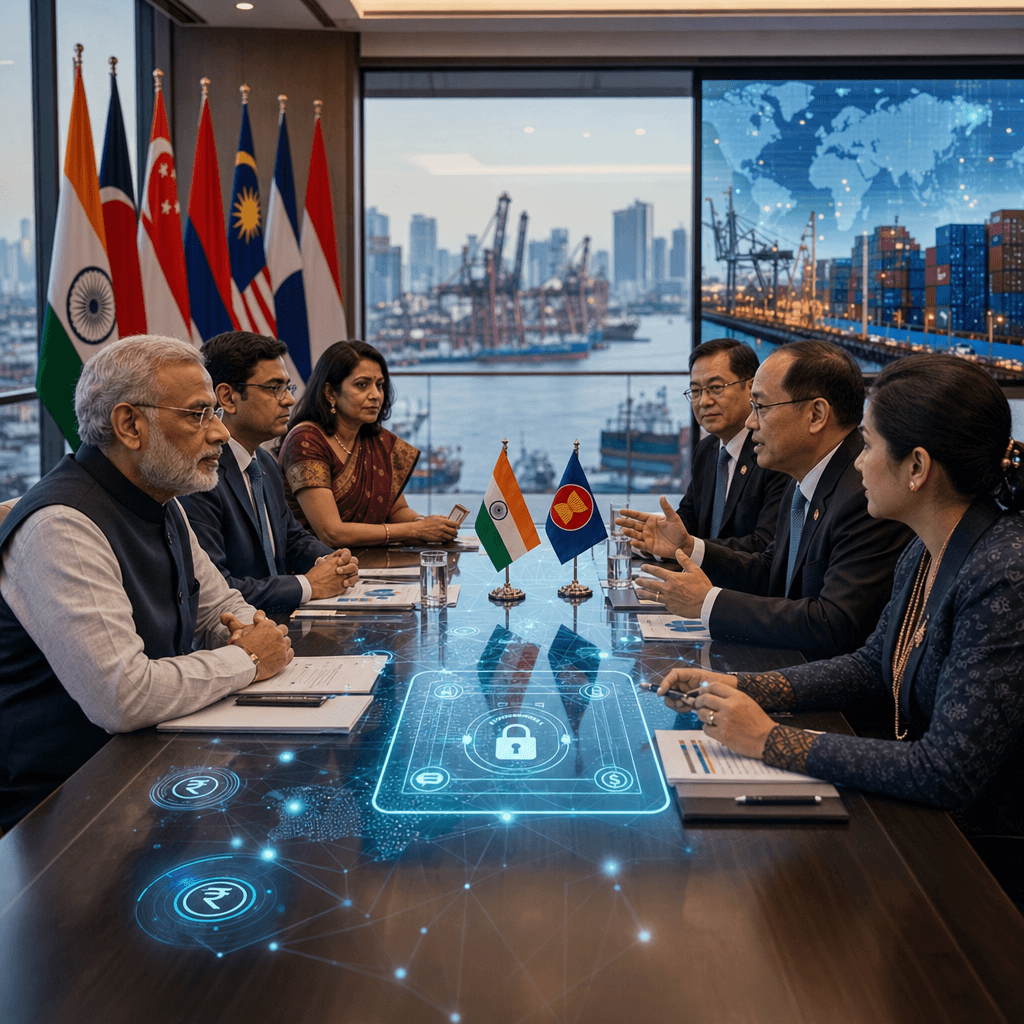
India-ASEAN trade reset now has a payments edge
Modi is pairing a long-stalled trade review with instant payments links. India wants leverage over ASEAN market access; ASEAN gets deeper retail connectivity.
India is trying to turn a familiar complaint — an unbalanced ASEAN trade pact — into bargaining power. PM Narendra Modi said the India-ASEAN trade agreement will be updated by year end, while UPI will be linked with Vietnam’s payment system, according to The Indian Express. That matters because New Delhi has been pushing to fix the 2009 ASEAN-India Trade in Goods Agreement after years of widening deficits and slow-moving negotiations. In 2024-25, India’s trade deficit with ASEAN reached $45.2 billion as imports rose much faster than exports, according to
The Hindu.
Why this is being accelerated now
The leverage is coming from India’s need to diversify. Washington’s tariff pressure in 2025 sharpened the case for a faster ASEAN deal, and Indian officials have already framed the review as a way to correct asymmetry, especially rules of origin that let third-country goods move through ASEAN markets, according to The Hindu. For India, the upside is obvious: better access for exporters, less leakage from Chinese supply chains, and a broader commercial base after walking away from RCEP in 2019. ASEAN, by contrast, wants to preserve market access to a large and growing market without reopening the pact on terms that would sharply reduce its own tariff protection. For the regional backdrop, see
Global Politics and
International.
Payments are the quieter prize
The UPI-Vietnam link is the second track, and it may prove easier to deliver than tariff renegotiation. India has already been moving on cross-border retail payments through Project Nexus, a BIS-backed platform meant to connect fast-payment systems across India, Singapore, Malaysia, Thailand and the Philippines. Vietnam joining that broader logic would give New Delhi a practical digital footprint in Southeast Asia, while giving ASEAN states cheaper remittances, faster tourism payments and more direct settlement rails outside Western card networks. The beneficiaries are India’s fintech ecosystem, the RBI’s internationalization push, and ASEAN governments that want financial connectivity without a full-blown trade concession.
What to watch next
The next test is whether the “by year end” promise survives the hard parts: rules of origin, tariff schedules and sectoral exclusions. Watch the next AITIGA negotiating round and whether India can show one concrete payment linkage — not just a political announcement — before the year ends. If it can, Modi will have turned ASEAN into both a trade offset and a digital showcase.
Discover more

India
India-South Korea $50B Trade Expansion Plan
India and South Korea target $50 billion in bilateral trade by 2030, focusing on industrial cooperation and strategic alignment amid US pressures.
India
CPI(M) Calls to Decouple Quota from Delimita
CPI(M) advocates for a 33% women's quota in Lok Sabha by 2029, removing the need for delimitation and census linkage.

Conflict & Security
Drone Warfare Killing Aid Workers at Unprec
Over 1,000 humanitarian workers killed in three years as cheap armed drones collapse legal protections. Gaza, Sudan, Ukraine, and DRC see deliberate targeting of aid convoys and hospitals with zero prosecutions.

Global
World Normalises Taliban as Afghan Women Eras
UN data shows Afghan women erased from public life as Russia recognises the Taliban, EU hosts officials in Brussels, and ICC warrants for gender persecution go unenforced.