India Arms Indonesia With BrahMos: Malacca's
A new missile deal reshapes Indo-Pacific dynamics.
Model Diplomat8 min readAsia
India Arms Indonesia With BrahMos: Malacca's New Missile Wall
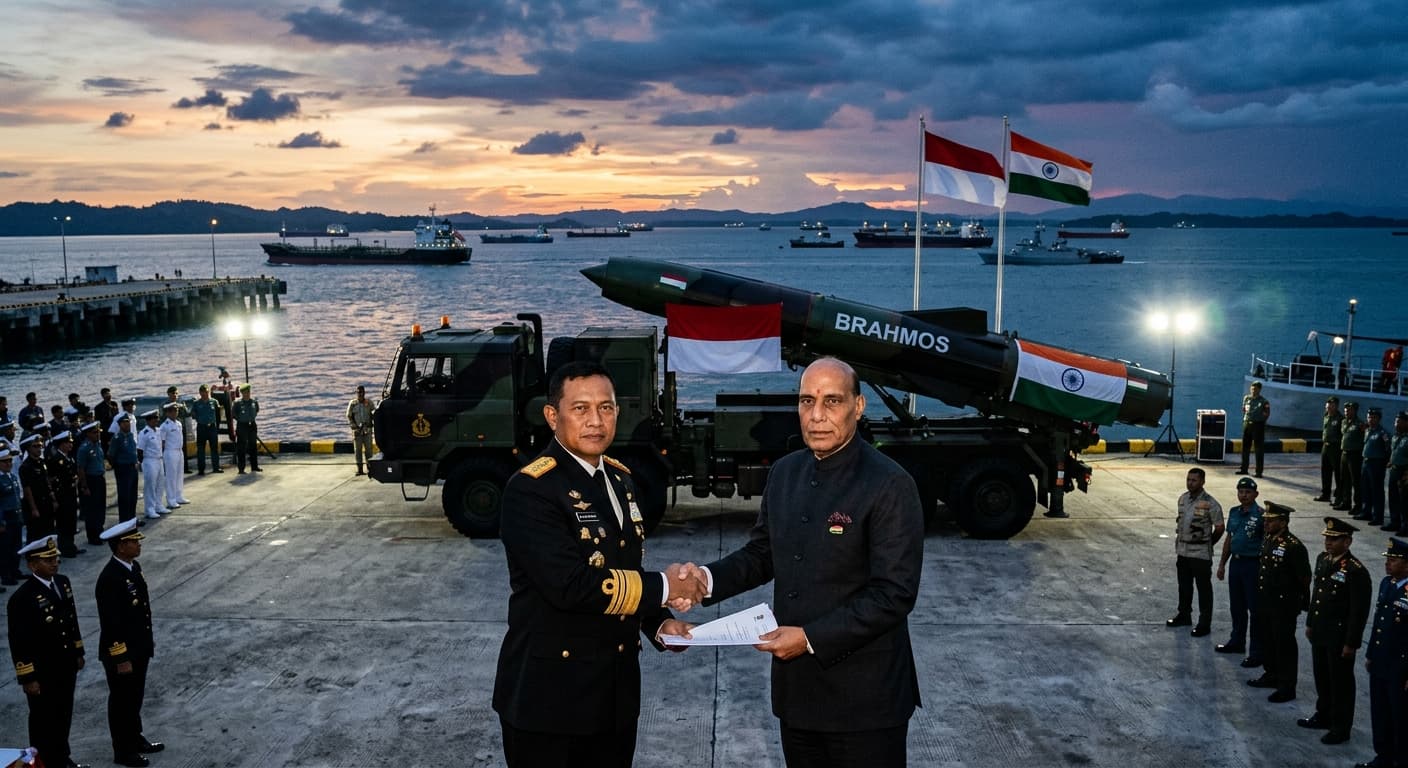
India's BrahMos and Astra sale to Indonesia turns the Malacca Strait into a two-sided missile chokepoint — the sharpest Indo-Pacific realignment of 2026, and the clearest signal yet that ASEAN's biggest state is done playing coy on China.
The BrahMos and Astra package 
The deal, in specifics
Fourteen agreements were signed after the Modi–Prabowo talks, covering critical minerals, steel supply chains, maritime security, medicines, outer space, telecommunications and food security, with two headline missile pacts on BrahMos supersonic cruise missiles and Astra beyond-visual-range air-to-air missiles, according to a around US$450 million; the Jakarta signature adds Astra on top, pushing the announced value above US$600 million. That makes this the first time two Indian defence export deals of this scale have been unveiled in a prime minister's presence.
Two paragraphs of the joint statement do the analytical heavy lifting. Modi and Prabowo underscored — without naming Beijing — "the importance of respect for sovereignty and territorial integrity, adherence to international law, including the 1982 UN Convention on the Law of the Sea (UNCLOS), freedom of navigation and overflight, while refraining from the threat or use of force." Read against Indonesia's 2016 restatement that China's nine-dash-line claim has "no basis in international law and does not accord with UNCLOS 1982", the language is not boilerplate. It is Jakarta re-anchoring itself to the same legal instrument it used to resist Beijing's Natuna incursions — while buying the weapon best suited to enforce it.
Sabang: the piece that changes the map
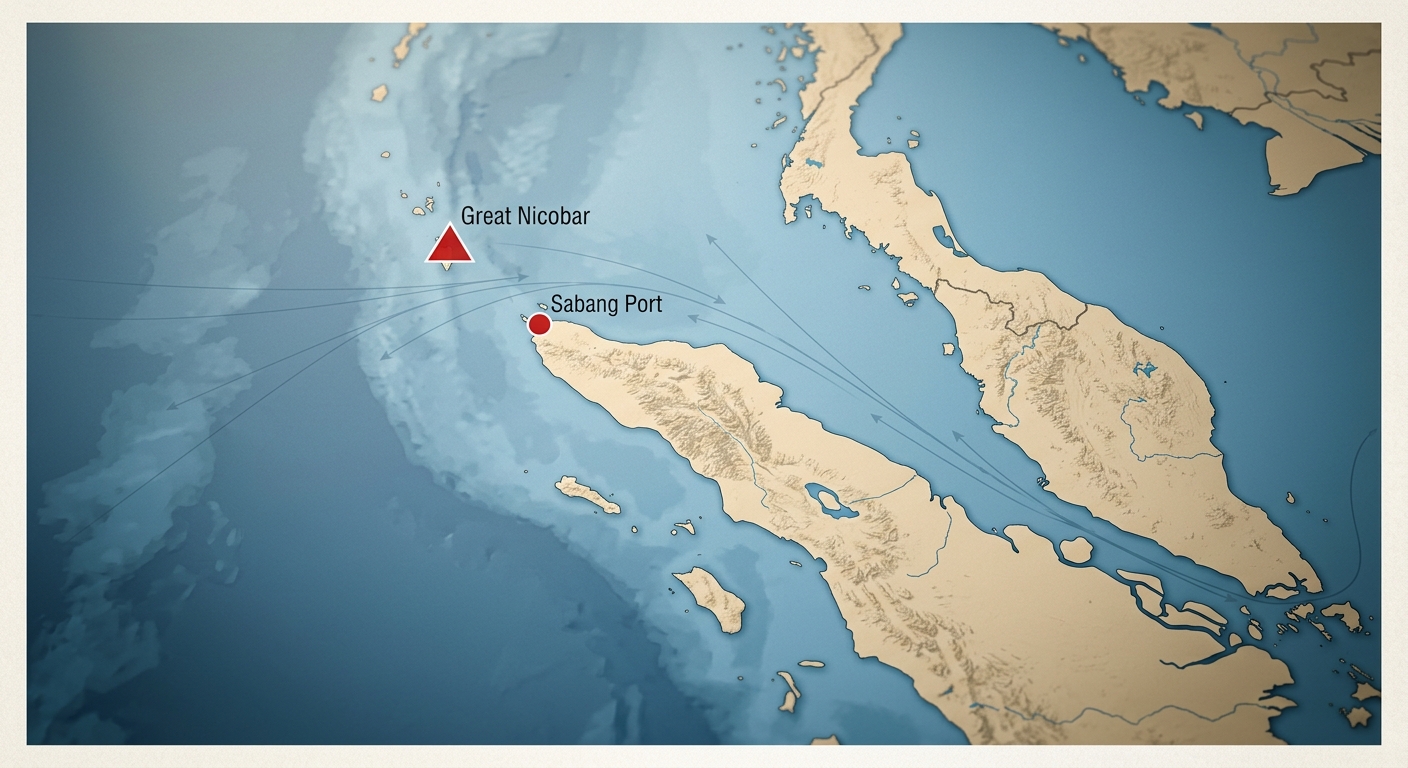
The pact that will most alarm Chinese planners is not the missile line item — it is the agreement to jointly develop Sabang Port in Aceh, roughly 100 miles from India's Great Nicobar. Prabowo, in remarks quoted by deep enough to dock submarines and warships, and that a Global Times editorial had warned of "disastrous consequences" if India developed Sabang into a strategic base. Eight years on, Prabowo has effectively adopted the language Beijing had feared.
Layered on top: the Great Nicobar Project, Malaysia's ISIS think tank observed last month, "is said to leverage on Great Nicobar's strategic location to strengthen India's national security, maritime and defense presence in the Indo-Pacific," including a dual-use civil–military airport. Bracket Sabang with Great Nicobar and roughly 40 per cent of global trade passing through Malacca now transits waters where the two coastal states are working from a shared operations map. Indonesia has also agreed to place a Liaison Officer at India's Integrated Fusion Centre–Indian Ocean Region, connecting Jakarta's maritime picture to New Delhi's in near real time.
Why Beijing should read this as escalation
Chinese analysts had been remarkably clear about BrahMos in Southeast Asia before this deal. In an assessment published in January 2025, ORF summarised the Chinese position: BrahMos deployment across the region can disrupt South China Sea stability, trigger an arms race, and have a "clamping effect" on the sea's western side if Vietnam fields the missile. Chinese scholars have called BrahMos a potential "troublemaker for international security." The Manohar Parrikar Institute for Defence Studies and Analyses has argued that supplying anti-ship missiles to Southeast Asian claimants
replicates against China the very A2/AD logic Beijing used against the US Navy.
The Indonesian variant carries a specific edge. The Philippines fields BrahMos on its west coast overlooking the Scarborough Shoal, roughly 250 km of coverage; Indonesia's Natuna waters sit inside the southernmost curl of China's nine-dash line, and Chinese coast guard and militia intrusions there prompted Prabowo in November 2024 to declare "we will always defend our sovereignty" after a poorly-drafted joint statement with Xi Jinping in Beijing accidentally acknowledged "overlapping claims." That episode is the immediate context for the Jakarta signing: Prabowo needed to demonstrate that the Beijing joint statement was not a concession. BrahMos plus UNCLOS is his answer.
The reluctant convert
Chatham House, writing after Prabowo's January 2025 New Delhi trip, warned that despite warm rhetoric there was a persistent "lack of substance in bilateral relations and the slow progress made in recent years". That January visit, chronicled by Gateway House's Rajiv Bhatia, produced a 55-paragraph joint statement but conspicuously
no BrahMos agreement, with defence-industry talks deferred to a later Indonesian delegation. Eighteen months on, the deferred conversation has produced the largest single defence transaction of the India–Indonesia relationship.
Two variables shifted in the interim. The first was Washington: an April 2026 US–Indonesia Major Defense Cooperation Partnership was quickly followed by reports that Prabowo had approved a US proposal for "blanket" overflight of Indonesian airspace — a leak that triggered a domestic backlash and left Prabowo needing a visible non-American security partner. The second was India's own export machinery. According to figures the Indian defence ministry has released and BBC Hindi reported, defence exports rose from ₹21,000 crore in FY2023-24 to roughly ₹38,000 crore in FY2025-26, with the ministry
targeting ₹50,000 crore by 2029-30. SIPRI's March 2026 update noted that
global arms flows increased 9.2 per cent between 2016–20 and 2021–25; India, historically a top-five importer, is now visibly climbing the export ladder into that expanding market.
The Russian angle nobody names
BrahMos is a joint venture between India's DRDO and Russia's NPO Mashinostroyeniya. Al Jazeera has previously reported that the missile is a merger of the Brahmaputra and Moskva rivers, capable of a 300 kg warhead at Mach 3 with sub-metre accuracy. That means each export deal requires Russian consent — and Russia has now cleared three consecutive sales to Southeast Asian states whose maritime interests directly clash with China's. ORF has argued this
"sends a signal to China that despite her growing strategic congruence with Russia, transfer of advanced weapons systems is not part of any strategic understanding". Moscow's willingness to keep signing off exposes the ceiling of the Sino-Russian entente, and hands India a diplomatic asset China cannot buy back.
Who wins, who loses
Winners. Prabowo secures a big-ticket, non-Western capability that plays domestically as sovereignty-restoration after the Beijing joint-statement episode and the leaked US airspace flap. India converts a decade of Act East rhetoric into a paying customer, third in a row, at a moment when Modi's own analysts describe the Indo-Pacific as needing an "arc of trust" drawn through Indonesia, Australia and New Zealand. BrahMos Aerospace crosses from one-country exporter to a genuine platform vendor. Russia keeps a hand in Southeast Asian defence markets it has no direct route into.
Losers. China loses the working assumption that Indonesia — long the most non-aligned of ASEAN's big states — could be kept out of the anti-ship missile club. Beijing also loses leverage over Russia's Southeast Asia weapons policy. Western prime contractors lose a mid-tier segment: Indonesia has now sourced BrahMos from India, Rafales from France, KHAN missiles from Türkiye, and is in defence-industry talks with Ankara on drones and armoured vehicles — a diversification pattern that squeezes the space for US or European exclusivity. And ASEAN's traditional consensus caution on offensive weapons — the "self-imposed restraint" the region used to observe — is now visibly gone.
The historical parallel
The last time India and Indonesia coordinated this openly on maritime doctrine was 1955, at the Bandung Conference that produced the Non-Aligned Movement. That was a diplomatic architecture built to keep both countries out of Cold War blocs. The 2026 architecture is inverted: multi-alignment used to acquire and deploy the very weapons the 1955 generation would have refused. The MEA's own bilateral brief traces the arc bluntly — from Sukarno as chief guest at India's first Republic Day in 1950 to Prabowo, 76 years later, signing for supersonic cruise missiles. Bandung has become BrahMos.
What to watch next
- Delivery timelines. The Philippines contract took roughly 27 months from signature to first delivery in April 2024. Watch whether Indonesia's first battery lands before the next ASEAN Summit — a stretched schedule would signal capacity constraints at BrahMos Aerospace, not political hesitation.
- Sabang milestones. A joint development plan and initial dredging tender is the near-term test of whether Prabowo will convert language into concrete. Global Times commentary on Sabang will be the earliest external signal.
- Astra follow-through. Indonesia flies Rafales; Astra is designed for Indian Su-30MKIs. Integration work with Dassault will be the first test of India's ability to sell weapons that fit non-Indian platforms.
- BRICS optics. Both states are now BRICS partners. Watch whether the missile sale is discussed at the 2026 BRICS Summit — and how China frames it.
Diplomat View
The BrahMos-plus-Sabang package is not a one-off arms deal; it is the operational proof that Indonesia's "free and active" foreign policy now has teeth, and that India's Act East policy has finally translated into recurring cash flows and joint infrastructure. Our forecast: within 24 months, the Malacca approaches will operate as a jointly-monitored maritime domain, and at least one more Southeast Asian buyer — Malaysia or Thailand — will open formal BrahMos negotiations. What would change that forecast: a Russian withdrawal of export consent under Chinese pressure, an Indonesian domestic backlash if any element of the missile deployment is publicly linked to a US basing arrangement, or a serious Sino-Indian border de-escalation that removes New Delhi's incentive to arm China's periphery. Absent those, the missile arc is now the region's baseline reality, not its speculation.
The Bottom Line
India's BrahMos and Astra sale to Indonesia, combined with joint development of Sabang Port, converts the Malacca Strait into a chokepoint bracketed by two coordinated coastal-defence states — the sharpest Indo-Pacific realignment of 2026. Beijing loses the assumption that Jakarta can be kept out of the anti-ship missile club; Moscow continues to underwrite exports its supposed partner opposes; India secures its third BrahMos customer in four years and a maritime doctrine with a paying anchor. The non-aligned playbook has been repurposed for the missile age.
Discover more
US Politics
SNAP Food Assistance Faces Legal Challenges
In 2026, SNAP faces stricter eligibility rules and mounting legal challenges, threatening food assistance for the millions of Americans who rely on the program.
India
Women's Reservation Bill 2026: A Political Sh
India's Lok Sabha rejected the Women's Reservation Bill, exposing a political maneuver to redraw electoral maps favoring the north over the south.
Global Politics
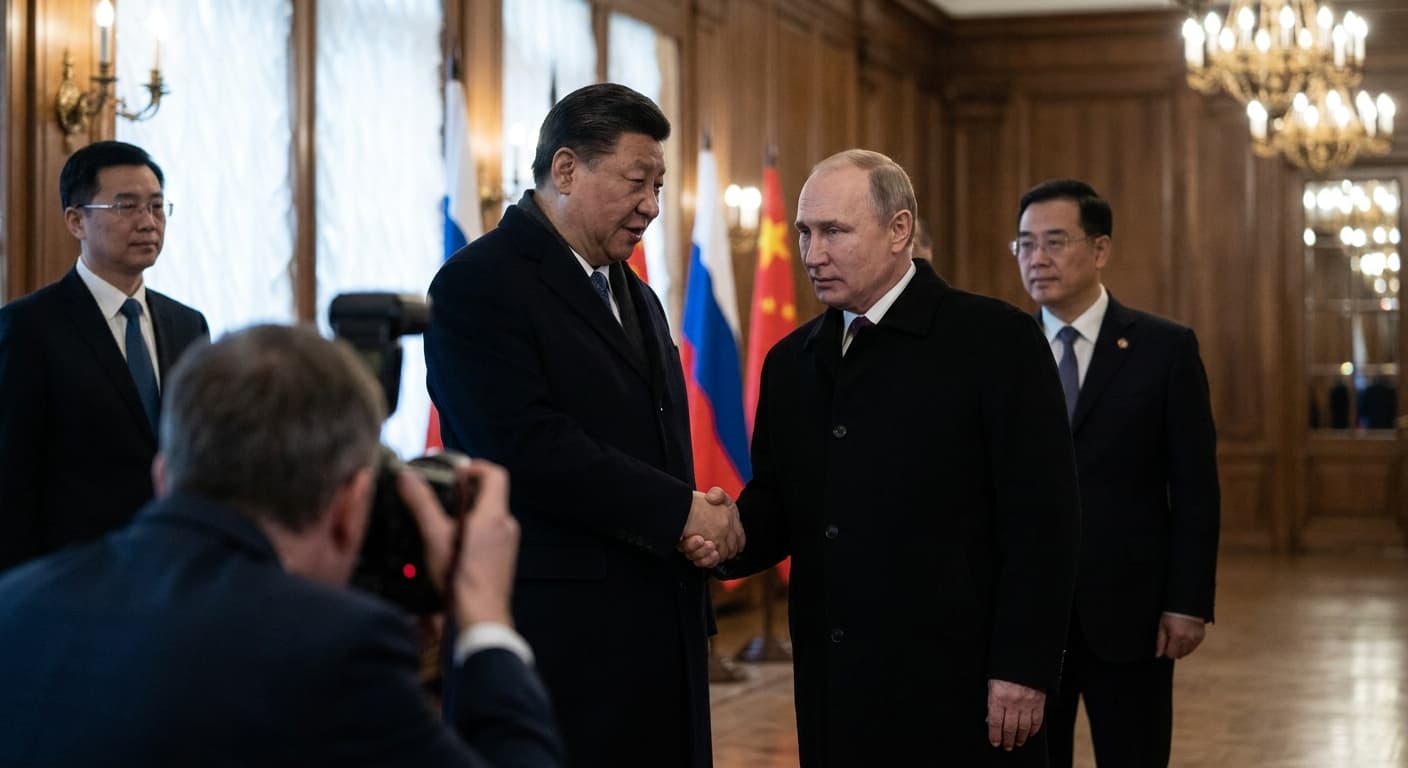
Xi Jinping Calls China-Russia Ties 'Precious'
Xi Jinping's description of China-Russia ties as 'precious' reflects a strategic imbalance, with Beijing dictating terms in the partnership.

Conflict & Security
Drone Warfare Killing Aid Workers at Unprec
Over 1,000 humanitarian workers killed in three years as cheap armed drones collapse legal protections. Gaza, Sudan, Ukraine, and DRC see deliberate targeting of aid convoys and hospitals with zero prosecutions.