ICJ's Climate Opinion Becomes Human Rights
UN vote transforms climate opinion into human rights mandate
Model Diplomat7 min readGlobal
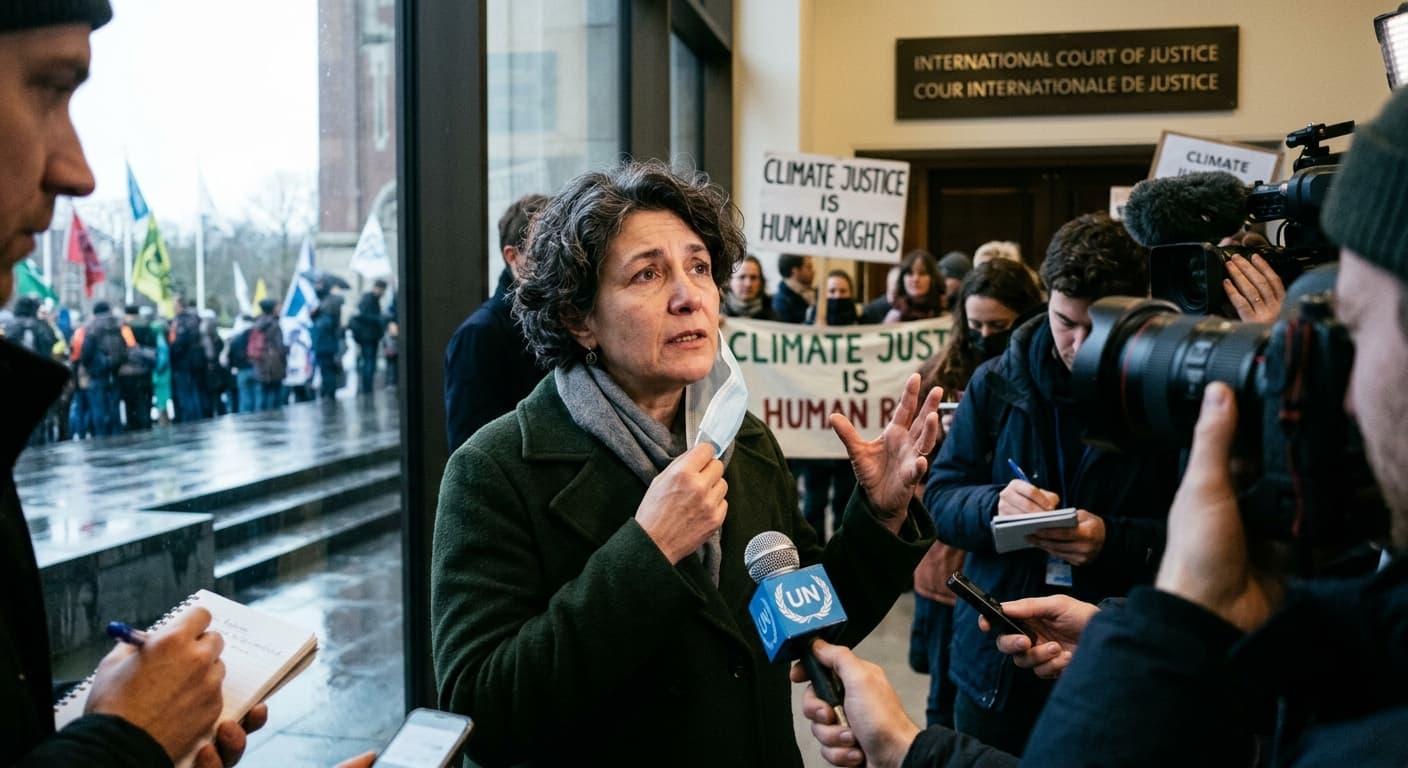
The ICJ's Climate Opinion Just Became a Human-Rights Mandate
The UN General Assembly's 141–8 vote on May 20, 2026 turns the ICJ's climate opinion into a human-rights mandate — and reshapes state liability for emissions.
On May 20, 2026, 141 UN member states voted to operationalise the International Court of Justice's July 23, 2025 advisory opinion on climate change; eight — Belarus, Iran, Israel, Liberia, Russia, Saudi Arabia, the United States and Yemen — voted against, and 28 abstained, according to UN News. The resolution's real effect is not on emissions targets but on international human-rights law: it politically ratifies the court's finding that a clean, healthy environment is a precondition for the rights to life, health and adequate living — and that failing to regulate fossil fuels can be an internationally wrongful act. The eight "no" votes map almost perfectly onto the states most exposed to the reparations doctrine the opinion opened up — and that is not a coincidence.
What the court actually did in July 2025
The ICJ's 15 judges answered two questions from UN General Assembly Resolution 77/276 unanimously. First, states are bound to act on climate change under both the Paris Agreement and customary international law — including the "no-harm" principle. Second, breach of those obligations triggers the ordinary law of state responsibility: cessation, guarantees of non-repetition, and full reparation. The court's own summary of the advisory opinion of 23 July 2025 frames the case as Obligations of States in respect of Climate Change, Case 187.
The opinion's human-rights architecture is the load-bearing element. The court declined to recognise a stand-alone right to a clean environment but held, at paragraph 393, that such an environment is a precondition for the enjoyment of every other human right, per the Carnegie Endowment's April 2026 review. It also ruled, per
Human Rights Watch, that "failure of a state to take appropriate action to protect the climate system from emissions — including through fossil fuel production, consumption, exploration or the provision of subsidies — may constitute an internationally wrongful act."
That single sentence is why Riyadh, Moscow and Washington spent nine months trying to bury the follow-up resolution.
The vote: who resisted, and why
Vanuatu introduced draft resolution A/80/L.65 on the afternoon of May 20, 2026, according to the UN Audiovisual Library record of the 83rd plenary. Algeria (A/80/L.66), Saudi Arabia (A/80/L.67 and L.69/Rev.1) and Kuwait (A/80/L.68) each tabled amendments designed to dilute the text — chiefly by removing references to fossil-fuel phase-out and to the ICJ's reparations framework. All were defeated before the main text passed.
The February 2026 US pressure campaign is the tell. A State Department cable circulated to every US mission and reported by Al Jazeera instructed diplomats to lobby governments to force Vanuatu to withdraw. The cable called the draft an attempt to "wield the Court's Advisory Opinion as a basis for creating an avenue to pursue any misguided claims of international legal obligations." That is not the language of a state confident it faces no exposure.
The Trump administration had by then already withdrawn from the Paris Agreement, quit the UNFCCC's core financing arms, and threatened sanctions on diplomats who supported the International Maritime Organization's shipping-fuel levy — each move designed to shrink the legal surface area before the vote. Yet the ICJ opinion, as BBC News noted at the time of its release, held that even non-parties to the Paris Agreement remain bound by broader customary law to protect the climate system. Withdrawal, in other words, does not extinguish liability — and that is the doctrinal move the eight "no" votes were trying, and failed, to contain.
Why this matters for human-rights law
The opinion is the third pillar in a fast-consolidating human-rights climate architecture built in a single 15-month window:
- The European Court of Human Rights held in Verein KlimaSeniorinnen Schweiz v. Switzerland (April 9, 2024) that Article 8 of the European Convention on Human Rights protects individuals from climate harm, per the
German Law Journal.
- The International Tribunal for the Law of the Sea, on May 21, 2024, found greenhouse gases to be marine pollution under UNCLOS.
- The Inter-American Court of Human Rights delivered Advisory Opinion OC-32/25 on climate emergency and human rights on May 29, 2025.
- The ICJ opinion on July 23, 2025 pulled the three strands into a single doctrine of state responsibility.
The May 2026 UNGA resolution is the political scaffolding that keeps that doctrine standing. It requests a report from the Secretary-General on "ways to advance compliance with all obligations clarified by the Court," per the Office of the High Commissioner for Human Rights. That report is now the institutional pipeline through which the ICJ's findings will filter into UNFCCC negotiations, the Loss and Damage Fund, and — critically — treaty processes on plastics, business and human rights, and disaster response.
The litigation front is already moving
The evidence that the opinion has legal traction is not rhetorical. In the months after the July 2025 ruling, at least two domestic courts and one regional tribunal have engaged with it directly. Carnegie's April 2026 review notes that a Dutch court, ruling on a claim brought by Bonaire against the Netherlands, cited the advisory opinion as evidence of "international consensus that the state has an obligation to take timely action" on climate adaptation and ordered the Dutch government to finance protection for the Caribbean island's residents. The Netherlands has appealed.
The European Court of Human Rights, in Greenpeace Nordic v. Norway (2025), cited the ICJ opinion but declined to go further than a procedural finding against Norwegian fossil-fuel licensing — a caution Carnegie's analysts read as the ECtHR "missing an opportunity" to align fully with the ICJ's stricter reading.
The pattern will matter more than any individual case. According to the Grantham Research Institute at LSE, in a study published on June 24, 2026, roughly one in five US climate cases is now "protective litigation" aimed at Trump administration rollbacks — a category that did not meaningfully exist eighteen months ago. The ICJ opinion, cited in national and international pleadings, is the doctrinal lever.
The counter-argument, from developing capitals
Not every objection to the opinion comes from petrostates. India's Observer Research Foundation warns, in a detailed critique, that the court's decision to treat fossil-fuel subsidies and exploration licences as potentially wrongful acts risks "transforming climate justice from a principle of equity into a mechanism of control." The concern is that a universalist rule ignores Common but Differentiated Responsibilities and could pin the same duties on India — which needs $1.3 trillion per year in climate finance through 2030, by New Delhi's own submission to the court — as on the historical emitters.
That tension is embedded in the resolution's text. It urges compliance with the Paris Agreement, references human rights, but does not name a specific reparations mechanism. The Policy Center for the New South, in a realist critique, argues the opinion "cannot compel state compliance in an anarchic system" but functions instead by "reshaping legitimacy, empowering litigation and civil society, and increasing the political costs of inaction." That is the more honest read of what the May 20 vote accomplishes — and it is enough.
Guterres put it more plainly in a statement from the Secretary-General:
"The world's highest court has spoken. Today, the General Assembly has answered. This is a powerful affirmation of international law, climate justice, science, and the responsibility of states to protect people from the escalating climate crisis."
Who benefits, who is exposed
The immediate beneficiaries are the Small Island Developing States that fought the case for six years — Vanuatu, the Marshall Islands, Palau, Micronesia — and, more broadly, African states now able to argue for debt relief and adaptation finance on legal, not moral, grounds. The South African Institute of International Affairs has already published a roadmap for using the opinion in sovereign-debt negotiations.
The exposed parties are the eight "no" voters plus the abstainers who host major fossil-fuel producers. The ICJ opinion permits jurisdiction only against states that have accepted its compulsory jurisdiction — which includes the United Kingdom but excludes the United States and China, per the BBC. But claimants no longer need The Hague. Any domestic court — a US federal court, an EU member-state tribunal, a Commonwealth bench — can now cite the opinion as the settled international-law backdrop against which a national government's fossil-fuel subsidy or licence is judged.
What to watch
- Secretary-General's compliance report: due back to the General Assembly on ways to advance compliance with the ICJ's clarified obligations. This is the concrete institutional lever the resolution created.
- COP31 (late 2026): the first major climate negotiation held under the shadow of both the advisory opinion and the UNGA resolution. Watch whether the SIDS bloc uses the opinion to demand a fossil-fuel phase-out timetable inside the Paris framework.
- The Bonaire appeal: the Dutch government's challenge to the first domestic ruling to cite the ICJ opinion on adaptation finance. A loss on appeal would be a signal to every claimant lawyer in Europe.
- US federal courts: the Vermont Climate Superfund Act litigation (2:25-cv-00463, D. Vt.) is one of several state-level cost-recovery statutes now working through the courts with the ICJ opinion in the background.
The Bottom Line
The May 20 UN vote did not create new law — the ICJ's July 2025 advisory opinion did. But by ratifying 141–8 that climate protection is a human-rights obligation and not a policy preference, the General Assembly stripped the eight "no" states of the argument they came to defend: that climate treaties are the sole source of climate duties. From here forward, in any court willing to hear it, the burden is on the polluter to explain why the ICJ's reasoning does not apply. That is a durable shift in the terms of political contestation — and the eight states that voted no understood it perfectly.
Discover more

International Relations
U.S.–Iran Peace Deal
A narrow US-Iran deal on nuclear and regional issues could reshape Middle East diplomacy, offering a pragmatic path forward despite grand bargain obstacles.
Global Politics
U.S. Maritime Pressure on Iran
Washington escalates maritime security operations and sanctions on Iran, disrupting Gulf shipping and reshaping global energy flows in a major strategy shift.

Global Politics
US Naval Blockade on Iran
The US fully imposed a naval blockade on Iranian ports, escalating tensions even as Trump hinted the conflict may soon end while serious risks of war remain.

Conflict & Security
Drone Warfare Killing Aid Workers at Unprec
Over 1,000 humanitarian workers killed in three years as cheap armed drones collapse legal protections. Gaza, Sudan, Ukraine, and DRC see deliberate targeting of aid convoys and hospitals with zero prosecutions.