ICJ Climate Ruling and UK Energy Policy
Policy Exchange warns of £4trn risk to UK energy policy.
Model Diplomat9 min readEurope
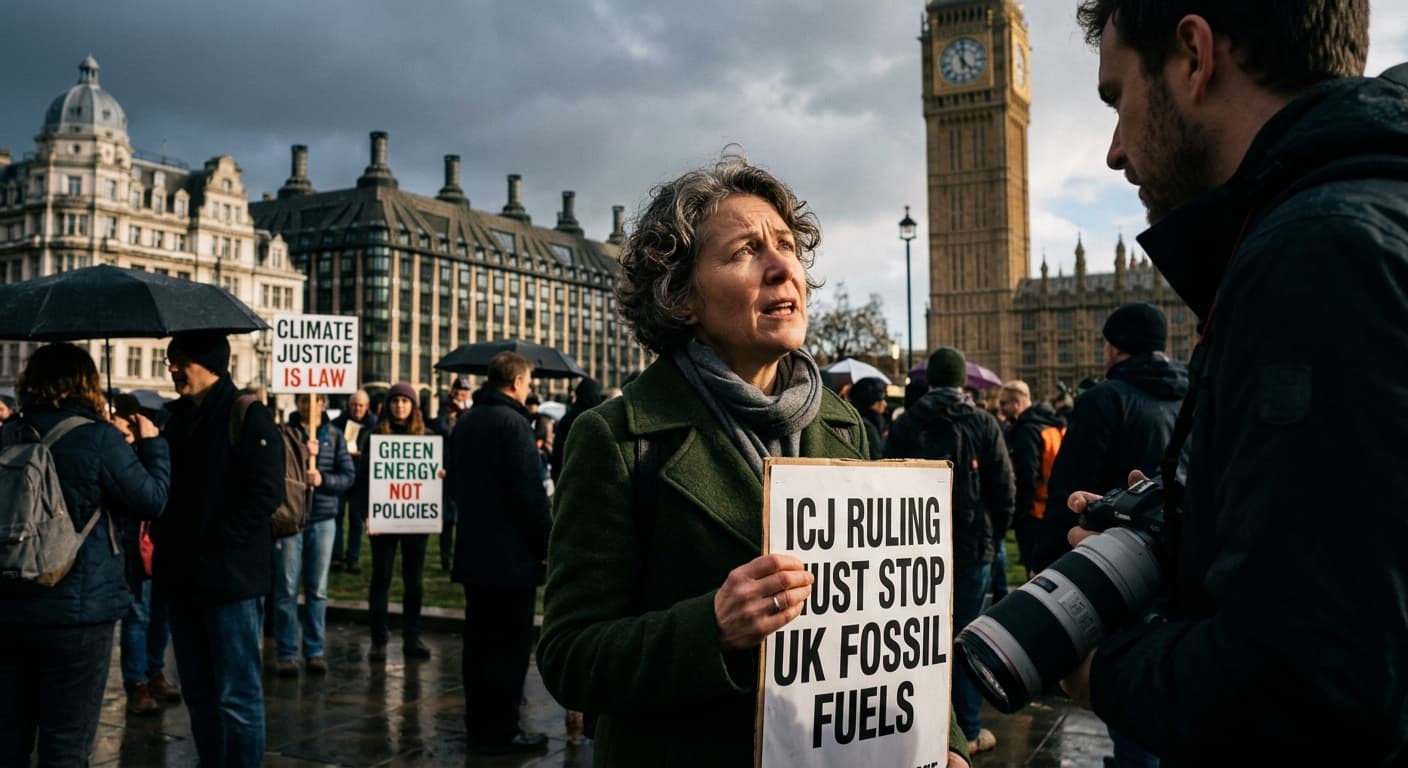
ICJ Climate Ruling Meets UK Energy Policy: The Real Risk Is Domestic
Policy Exchange warns the ICJ's 2025 climate opinion exposes the UK to £4trn in reparations and North Sea shutdowns. The harder problem sits in British courts.
The think tank Policy Exchange, in a report published on July 7, 2026, urged the UK to withdraw from the International Court of Justice's compulsory jurisdiction to shield itself from an "unprecedented" 2025 advisory opinion on climate change — an opinion the UK itself co-sponsored, voted to endorse at the UN General Assembly in May, and whose reasoning has already been absorbed into Scottish judicial review. The threat the report identifies is real, but it is misdirected. The Hague can only advise. Edinburgh and London can quash — and, as the Rosebank and Jackdaw decisions show, already have. The £4 trillion headline is a red herring; the operative risk to UK energy policy runs through Finch, not Iwasawa.
That is the thesis. The ICJ's opinion did not open a new legal front against British fossil-fuel policy. It ratified one that domestic courts, using domestic climate law and a UK Supreme Court precedent from June 2024, opened before the judges in The Hague had taken the bench.
What the Court actually said
On July 23, 2025, all 15 judges of the ICJ agreed unanimously that states have concrete obligations to mitigate climate change flowing not only from the Paris Agreement, but from customary international law, the UN Convention on the Law of the Sea, and international human rights law. The summary of the advisory opinion is on the Court's own record; the American Journal of International Law calls it "remarkable for its scope, ambition, and unanimity" in a
case note by John Knox.
The load-bearing paragraph for the UK is 427. It holds that a state's
"Failure … to take appropriate action to protect the climate system from GHG emissions — including through fossil fuel production, fossil fuel consumption, the granting of fossil fuel exploration licences or the provision of fossil fuel subsidies — may constitute an internationally wrongful act."
That sentence is why Policy Exchange is worried. It maps directly onto every disputed UK licensing decision of the last three years — Rosebank, Jackdaw, Whitehaven coal, Cambo. It also converts customary international environmental law into a lever that domestic courts can weigh when interpreting the Climate Change Act 2008 and the Environment Act 2021.
The Court went further on scope. It said in paragraph 340, per Knox's reading, that Part XII of UNCLOS applies to anthropogenic greenhouse gas emissions and requires state parties to take measures "as far-reaching and efficacious as possible" to prevent climate-driven harm to the marine environment — a finding relevant to North Sea drilling by definition. This was the ICJ agreeing with the May 2024 ITLOS advisory opinion, locking in a second body of international law that UK-based claimants can invoke.
Policy Exchange's numbers, unpacked
The report — authored by Dr Tom Grant, Yuan Yi Zhu, and Richard Ekins KC — argues the UK Government risks treating the opinion as a "legal straitjacket", shutting down debate on net zero and North Sea policy, and exposing taxpayers to "colossal" liabilities. According to edie's summary, the authors size that exposure at around £4 trillion. Coverage in
News Now UK framed it as lawyers "poised to launch a wave of litigation to punish the West for the Industrial Revolution."
The figure is not novel. It is a UK share of the $192 trillion global reparations estimate published by Andrew Fanning and Jason Hickel in Nature Sustainability in 2023, apportioned by the UK's roughly 3% cumulative share of emissions. Fanning and Hickel note that the United States, EU and UK together account for "around two-thirds of the total financial compensation from overshooting countries." An IMF working paper by Clements, Gupta and Liu,
Settling the Climate Debt, puts global climate debt from 1959–2035 at roughly $139 trillion using the social cost of carbon — a similar order of magnitude, a wholly different methodology.
Whether those numbers are the right ones depends on the counterfactual: which start year, which carbon budget, which discount rate. Whether they are ever collectable depends on jurisdiction. And there the Policy Exchange thesis runs into the wall the ICJ itself acknowledged.
The jurisdictional wall
The Court did not order anyone to pay anything. It answered the two questions the UNGA put to it in Resolution 77/276 — a resolution the UK co-sponsored, then-Ambassador James Kariuki telling the Assembly that an advisory opinion "may help to refocus efforts to deliver on climate commitments." That co-sponsorship is a fact the Policy Exchange report treats as regrettable; it is also the reason the UK has less standing than most to now reject the opinion's authority.
On remedies, the ICJ was cautious. As the International & Comparative Law Quarterly's case note puts it, the Court "sketches a pathway for establishing causation of harm that would become relevant if reparation were sought." Paragraph 445 leaves the specific consequences to be worked out "on the basis of the particular breach and the nature of the harm." That is not a bill. It is a template.
Interstate reparations would require a contentious case. The ICJ can only take one against a state that has accepted its jurisdiction. As Lavanya Rajamani observes in the American Journal of International Law, the United States, China and Russia — the three largest historical or contemporary emitters after the EU — have not consented. The UK has. That is what makes the Policy Exchange recommendation to withdraw legally coherent even if politically radioactive: it would put the UK in the company of Beijing, Moscow, and Washington on this specific question, at the same moment London is defending the rules-based order in every other portfolio.
The BBC's Justin Rowlatt reported that lawyers expect the opinion to be used in national courts within weeks, not decades. That is the correct frame. The UK's exposure is not a £4 trillion bill from The Hague. It is a rolling series of judicial reviews in Edinburgh and London, each capable of stopping a specific project or class of subsidy.
Rosebank, Jackdaw, and the domestic front
The mechanism was tested before the ICJ opinion existed. In Finch v Surrey County Council (June 2024), the UK Supreme Court held that environmental impact assessments must account for downstream — Scope 3 — emissions. In January 2025, Lord Ericht in the Scottish Court of Session applied Finch to quash the consents for Rosebank, the 300–500 million barrel field west of Shetland, and Jackdaw, Shell's North Sea gas project. The Institute for Government explainer sets out the sequence: consents reduced, work suspended, decisions returned to Energy Secretary Ed Miliband and the North Sea Transition Authority for retake. The BBC's
Kevin Keane covered the hearing at which the operators — Equinor, Ithaca, Shell — themselves accepted that in retrospect their licences had been granted unlawfully.
Miliband did not fight. The government dropped its legal defence in early 2025 and announced in November 2025 that no new licences would be granted, replacing them with a narrower "Transitional Energy Certificate" regime for near-field production, per the gov.uk statement on the North Sea future plan.
That is the operative baseline. The ICJ opinion arrives into a UK legal environment where the Supreme Court has already told regulators they must count downstream emissions, and where the Energy Secretary has already promised not to license new fields. The next Greenpeace or Uplift petition will cite paragraph 427 — but the binding law it needs is Finch. Which is why the Policy Exchange remedy, withdrawing from ICJ compulsory jurisdiction, would not restore a single lapsed licence. It fights the wrong court.
The energy-security angle Policy Exchange downplays
The report frames climate litigation as a threat to UK energy security. A closer look at what has actually happened to prices and supply since the Rosebank ruling suggests something more uncomfortable for both sides of the debate.
Miliband has argued, per the Institute for Government's account of his April 2026 announcement, that additional North Sea drilling would not "improve UK energy security or have any impact on energy prices" — this after an Iran-linked energy shock hit European gas markets in the spring of 2026. World Resources Institute analysis cited by edie has the UK on track to miss its 2030 emissions target by at least 25% — meaning the ICJ's due-diligence threshold, whatever its non-binding status, is already breached on the facts.
At the same time, the UK has quietly become a jurisdiction of choice for cross-border climate claims. In July 2026, upday reported that four Ugandan farmers filed a UK court challenge against TotalEnergies over the $5.6bn East African Crude Oil Pipeline — the world's longest heated crude project. The BBC has
previously reported that campaigners estimate EACOP will generate 34 million tonnes of CO₂ annually;
NPR's Willem Marx documented some 100,000 people displaced along its 900-mile route. The claim does not target the British state. It targets a French major, in a British court, using the ICJ opinion as interpretive scaffolding on top of Vedanta-line jurisdiction principles.
That is the model. Not sovereign reparations at The Hague. Corporate liability, in London and Edinburgh, with the ICJ opinion supplying the standard of care.
The historical parallel that should worry the government more than reparations
The Carnegie Endowment's April 2026 analysis by Erin Sikorsky and colleagues draws the useful comparison: it took two decades for the 1996 ICJ Nuclear Weapons opinion to yield the Treaty on the Prohibition of Nuclear Weapons. Advisory opinions do not transform state practice overnight. They lay a normative floor that a coalition of states and civil-society actors then builds on.
The floor is now laid. On May 20, 2026, the UN Secretary-General welcomed the General Assembly's adoption of the follow-up resolution.
Al Jazeera reported the tally: 141 in favour, 8 against — Belarus, Iran, Israel, Liberia, Russia, Saudi Arabia, the United States, Yemen — and 28 abstentions. Amnesty International
described the outcome as "consolidating opinio juris" — the technical term for what happens when repeated state practice hardens into customary international law. That, not reparations, is the mechanism to watch. Every UK vote, every ministerial statement, every court citation of the opinion is now evidence a future tribunal or claimant can point to.
Diplomat View
The Policy Exchange report reads the ICJ opinion as a sovereignty problem and prescribes a sovereignty remedy: withdraw from compulsory jurisdiction, insulate UK policy from The Hague. That is a category error. The binding constraint on North Sea licensing is Finch, decided in London by British judges applying British statute. Withdrawing from the ICJ's compulsory jurisdiction — a step no G7 peer is contemplating — would forfeit British influence over how the opinion is operationalised elsewhere without altering a single domestic case. The bigger question for the Starmer government is not whether to fight the opinion, but whether to codify a Finch-compliant licensing framework before the next judicial review does it for them. Forecast revision triggers: a successful damages claim against a UK-domiciled fossil-fuel firm citing the ICJ opinion; a Commonwealth state filing an ICJ contentious case against the UK; or a Conservative manifesto commitment to withdraw from ICJ compulsory jurisdiction.
What to watch
- Autumn 2026: NSTA's redetermination of Rosebank and Jackdaw consents under the Finch downstream-emissions test.
- November 2026: COP31 in Türkiye — the first COP since UNGA endorsement of the ICJ opinion; watch for reparations language in the cover text.
- 2026–27: The Ugandan farmers' EACOP claim against TotalEnergies in UK courts — the first live test of the ICJ opinion as interpretive authority in an English court.
The Bottom Line
The £4 trillion headline is theatre. The real UK exposure from the ICJ's climate opinion is not sovereign reparations from The Hague — it is a domestic judicial-review pipeline running through Finch, in which the opinion supplies the standard of care while British courts do the quashing. Withdrawing from ICJ compulsory jurisdiction, as Policy Exchange urges, would not save a single North Sea licence. It would only cost the UK its seat at the table where the opinion is being turned into customary international law.
Discover more

International Relations
U.S.–Iran Peace Deal
A narrow US-Iran deal on nuclear and regional issues could reshape Middle East diplomacy, offering a pragmatic path forward despite grand bargain obstacles.

US Politics
SNAP Food Assistance Faces Legal Challenges
In 2026, SNAP faces stricter eligibility rules and mounting legal challenges, threatening food assistance for the millions of Americans who rely on the program.

US Politics
House Ethics Committee Pushes Sexual Miscond.
The House Ethics Committee has shifted responsibility for sexual harassment settlement records to the Office of Congressional Workplace Rights, complicating disclosure efforts.

Economics
Fed's Amex AML order puts correspondent banking on notice
Federal Reserve's Amex AML order requires board-level controls and a 90-day plan; OCC fined the bank $350 million over enterprise-wide deficiencies.