ICJ Affirms Right to Strike Under ILO
Court rules on workers' strike rights, leaving key questions open
Model Diplomat8 min readGlobal
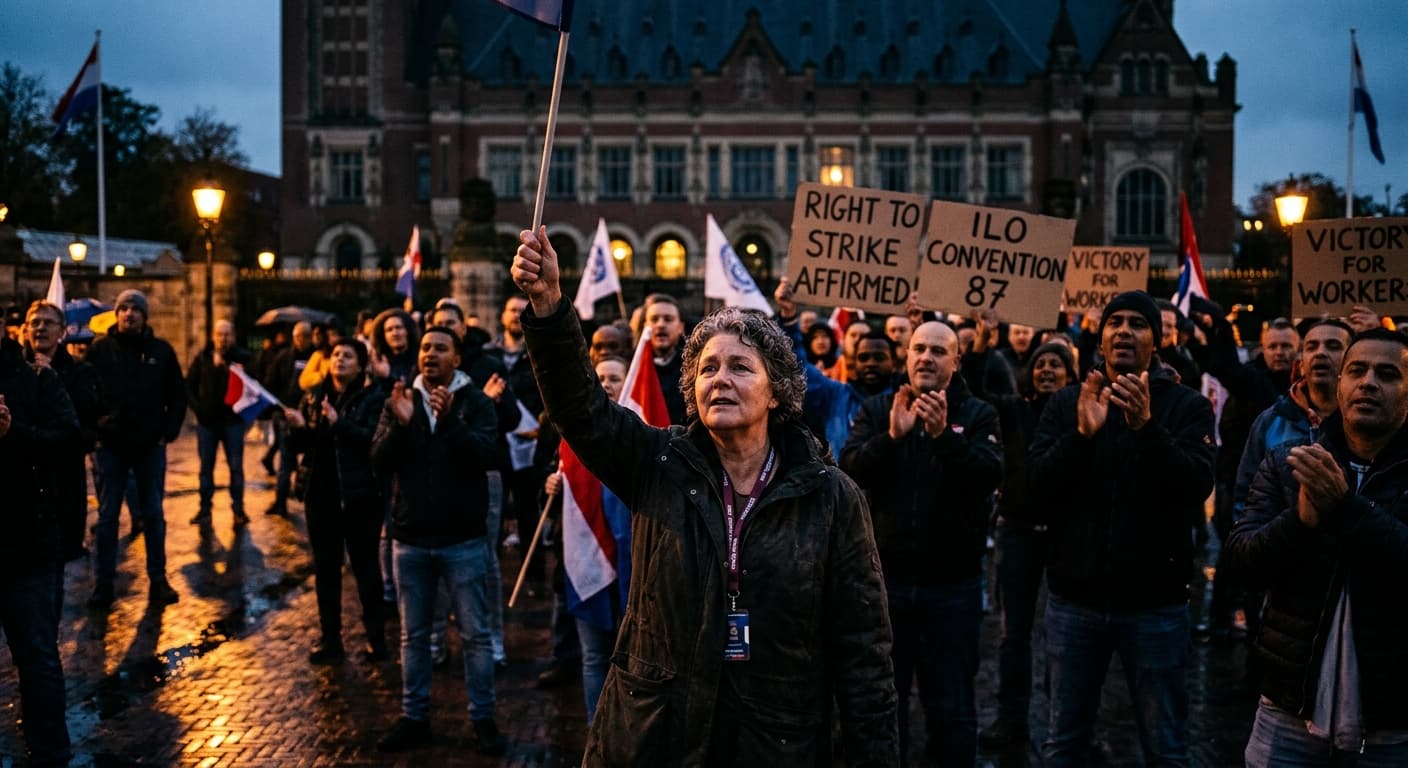
ICJ backs right to strike but leaves scope to states
The International Court of Justice ruled 10–4 on May 21, 2026 that ILO Convention No. 87 protects the right to strike — while explicitly declining to define its content, limits or enforcement.
The International Court of Justice ruled by ten votes to four on May 21, 2026 that the right to strike of workers and their organisations is protected under the International Labour Organization's Freedom of Association Convention (No. 87) of 1948 — but the same opinion states that the finding "does not entail any determination on the precise content, scope or conditions for the exercise of that right." That single sentence is the story: the world's highest court affirmed a right in principle while leaving every contested question — essential-services carve-outs, public-sector bans, sympathy strikes, and the binding authority of the ILO's supervisory bodies — to national law and future ILO politics. The advisory opinion resolves the narrow legal question the ILO put before the Court on November 10, 2023. It leaves the harder ones open by design — and that design is what will drive the next decade of labour litigation from Dhaka to Geneva.
What the Court actually decided
The question referred by the ILO Governing Body was deliberately narrow: "Is the right to strike of workers and their organizations protected under the Freedom of Association and Protection of the Right to Organise Convention, 1948 (No. 87)?" According to the ICJ's own press release, the referral came under Article 37(1) of the ILO Constitution — a route used only once before, when the Permanent Court of International Justice interpreted the Night Work of Women Convention in 1932. In
nearly 80 years of the ICJ's existence, this was the first ILO referral it had received.
Convention No. 87 does not mention strikes. That silence is the entire dispute. Applying Articles 31 and 32 of the Vienna Convention on the Law of Treaties, the Court concluded that the absence of the word does not equal exclusion. Strike action, the majority reasoned, falls within the "ordinary meaning" of the "activities" that workers' organisations are entitled to organise under Article 3, and within the mandate under Article 10 to "further and defend" workers' interests. The 43-page opinion described strikes as "one of the main activities engaged in and tools used by workers and their organisations to promote their interests and improve conditions of labour." President Yuji Iwasawa read the operative paragraph in open court;
UN News quoted it: "the right to strike of workers and their organizations is protected" under Convention No. 87.
Then came the qualifier that defines the ruling. According to the CEBRI Journal analysis of paragraphs 55–61 and 140 of the opinion, the Court was "deliberate in circumscribing what its conclusion does and does not determine" — the recognition carries "no determination as to its precise content, its scope, or the conditions for its lawful exercise." Those questions, paragraph 140 states, remain matters for national law and the ILO supervisory bodies, or for a future dedicated Convention adopted by the International Labour Conference.
The dissents that matter more than the vote
Four judges — Peter Tomka, Ronny Abraham, Xue Hanqin and Yusuf Hmoud — dissented from the central conclusion, while joining the unanimous finding that the Court had jurisdiction to answer at all. Their reasoning is not procedural nit-picking; it is a challenge to the interpretive method the majority used.
Judge Tomka argued the majority stretched the Convention beyond what states had agreed, protecting the "formation, autonomy and internal administration" of unions but not "specific forms of collective economic action." Judge Xue was blunter, telling the Court its opinion read as "an exercise of human rights advocacy rather than treaty interpretation," according to the UN News summary of her dissent — a signal that the Court's swing towards purposive interpretation of labour standards is contested from within the bench itself. All four dissenters rejected the majority's use of the International Covenant on Economic, Social and Cultural Rights and the ICCPR as "relevant rules of international law" under VCLT Article 31(3)(c). As the
CEBRI Journal records, they argued that the ICESCR's separate, explicit enumeration of the right to strike in Article 8(1)(d) arguably distinguishes it from freedom of association — the opposite inference the majority drew.
That split matters because Convention No. 87 sits inside the ILO's 1998 Declaration on Fundamental Principles and Rights at Work, which binds all 187 ILO member states regardless of ratification. A 10–4 split — with the President of the Court in the majority — is authoritative enough to end the interpretive war, but thin enough to keep the political one alive. The
Global Labour University's Varlamov brief notes that the Court's answer was "unambiguous," yet observes that the underlying dispute since the 1990s has always been as much about institutional authority as about textual meaning.
Who was fighting, and who lost
The referral traces to what the ILO itself called an "institutional crisis." Since 1989, and dramatically at the June 2012 International Labour Conference, the Employers' Group had challenged both the substantive interpretation that Convention No. 87 protects strikes and — more consequentially — the authority of the Committee of Experts on the Application of Conventions and Recommendations (CEACR) to issue interpretations at all. The historical account by Janice Bellace in the International Labour Review argues that this 2012 challenge broke a positive consensus the Employers' Group itself had supported before 1989. A parallel
SSRN historical study frames the 2012 revolt as a "new position of power that is historically contingent" — a bid to reduce ILO influence over national labour law, not just to relitigate a treaty clause.
By 2012, the Employers refused to agree the annual list of countries to be examined for non-compliance, and the ILO's supervisory machinery seized up. As Hofmann and Schuster documented at the Global Labour University, a partial 2015 truce papered over the fight but never resolved it. The Governing Body's 2023 referral to the ICJ, passed 33–21 with two abstentions per the
CEBRI Journal accounting, was the constitutional escape hatch after 14 years of failed tripartite negotiation.
The immediate loser is the International Organisation of Employers, whose lead advocate Roberto Suárez Santos told the Court in October 2025 that reading a strike right into Convention No. 87 would impose "a prescriptive regime … that could disrupt nuanced national labour systems," as reported by UN News. That argument was defeated on the merits. The immediate winner is the International Trade Union Confederation, represented by former US State Department Legal Adviser Harold Koh, and the ILO's supervisory bodies whose seven decades of jurisprudence the Court described as carrying "great weight" as a supplementary means of interpretation.
The subtler loser is a group of governments — including Bangladesh, Costa Rica, Japan and Switzerland — that filed submissions arguing no such right could be derived from the treaty. Out of 158 states parties, only 31 states and organisations filed written statements, and 22 delegations appeared at the October 2025 oral hearings. The United States, admitted under Article 66(3) of the ICJ Statute as an ILO member despite not being a party to Convention No. 87,
filed a written statement but later withdrew its written comments; the United Kingdom did the same. That withdrawal, in retrospect, looks like anticipatory hedging by two of the world's most restrictive strike-law jurisdictions.
The hard questions the Court refused to answer
This is where the opinion earns the "ducked" charge. Four decades of CEACR jurisprudence has built a detailed body of principles on when strikes may be restricted. The ILO documents filed with the Court record the CEACR's position that general strike prohibitions are incompatible with Convention No. 87, that the right must extend to federations and confederations, and that restrictions are permissible only in "essential services in the strict sense of the term," during acute national emergencies, or for public officials exercising authority in the name of the State. National governments routinely test those limits — the same volume records the CEACR's engagement with Nigeria's Industrial Disputes Decree No. 7 of 1976, the Philippines' Labour Code Section 263(g), and Trinidad and Tobago's Industrial Relations Act No. 18 of 1986.
The ICJ took none of it on. The opinion neither endorses nor rejects the CEACR's essential-services doctrine. It does not say whether a general prohibition on public-sector strikes violates Convention No. 87, whether sympathy or solidarity strikes are protected, whether requisitioning striking workers is permissible, or whether "minimum service" laws pass muster. It gives the CEACR's pronouncements — together with those of the Committee on Freedom of Association and five Commissions of Inquiry — "great weight" as supplementary means of interpretation, according to paragraph 118 as summarised by CEBRI. But it stops short of declaring the CEACR's output authoritative or binding, which is the very question the Employers' Group has contested since 1989.
That silence is the second-order story. The Leaflet's analysis calls the opinion an "unfinished promise" precisely because the "larger constitutional question regarding the ILO's Committee of Expert is left unanswered." The
SIDIBlog commentary by Francesca Marinelli reaches a similar verdict: the Court "provided important guidance on the place of the ILO supervisory bodies in that interpretative framework," but on the decisive question of whether CEACR interpretations are legally authoritative for states, it declined to rule. The
Wolters Kluwer labour blog had flagged this as the political heart of the case before the ruling — a question of whether an independent expert panel of jurists, not a tripartite consensus body, could bind states through interpretive practice.
The consequence: every future dispute — a public-sector strike ban in India, a "minimum service" law in France, an anti-strike injunction in a common-law jurisdiction — will still turn on national courts and the CEACR, not on paragraph 140 of an advisory opinion. State sovereignty over the scope of labour rights has been reinforced even as the principle has been globalised. That is a workable political compromise. It is not a legal endgame.
What to watch next
The next test is not in The Hague but in Geneva. The International Labour Conference — the ILO's tripartite plenary — now has the option, expressly signalled in paragraph 140 of the opinion, to adopt a dedicated strike Convention or protocol that would fix scope, essential-services carve-outs, and public-sector limits in binding text. Whether governments and employers agree to reopen that door, when the current interpretive ambiguity works to some of their advantage, is the political question of the next Conference cycle. Watch also for the first national court to cite the opinion — Latin American constitutional courts, already primed by the Inter-American Court of Human Rights' 2021 Advisory Opinion OC-27/21, are the likeliest first movers.
The Bottom Line
The ICJ has given the global labour movement a legal anchor it did not have on May 20, 2026, and given governments a sovereignty clause they can live with on May 22. The right to strike is now protected under Convention No. 87 as a matter of international law; what a strike is, when it may be banned, and who gets to decide remain matters of national politics and ILO supervision. The 10–4 vote closes a 14-year institutional crisis without settling the constitutional question underneath it — and that unfinished business, not the headline, is what will shape international Global Politics around labour rights for the next decade.
Discover more

US Politics
White House Pressures Congress for Crypto Leg
The Trump administration's push for the CLARITY Act aims to reshape crypto regulation, impacting trillions in market value and the Trump family's wealth.
Global Politics
US-Iran Tensions Rise
Tensions escalate in the Strait of Hormuz as Iran and the US clash over maritime control, with a ceasefire hinging on a contested MoU paragraph.

US Politics
US Military Funding Request for Iran Looms
The White House Budget Director signals a formal funding request for military operations against Iran, foreshadowing rising tensions and congressional clashes.

Economics
Fed's Amex AML order puts correspondent banking on notice
Federal Reserve's Amex AML order requires board-level controls and a 90-day plan; OCC fined the bank $350 million over enterprise-wide deficiencies.