Hungary's 1.7% Inflation Clears MNB Rate Cuts
Hungary's CPI drop opens door for monetary easing.
Model Diplomat8 min readCentral Europe
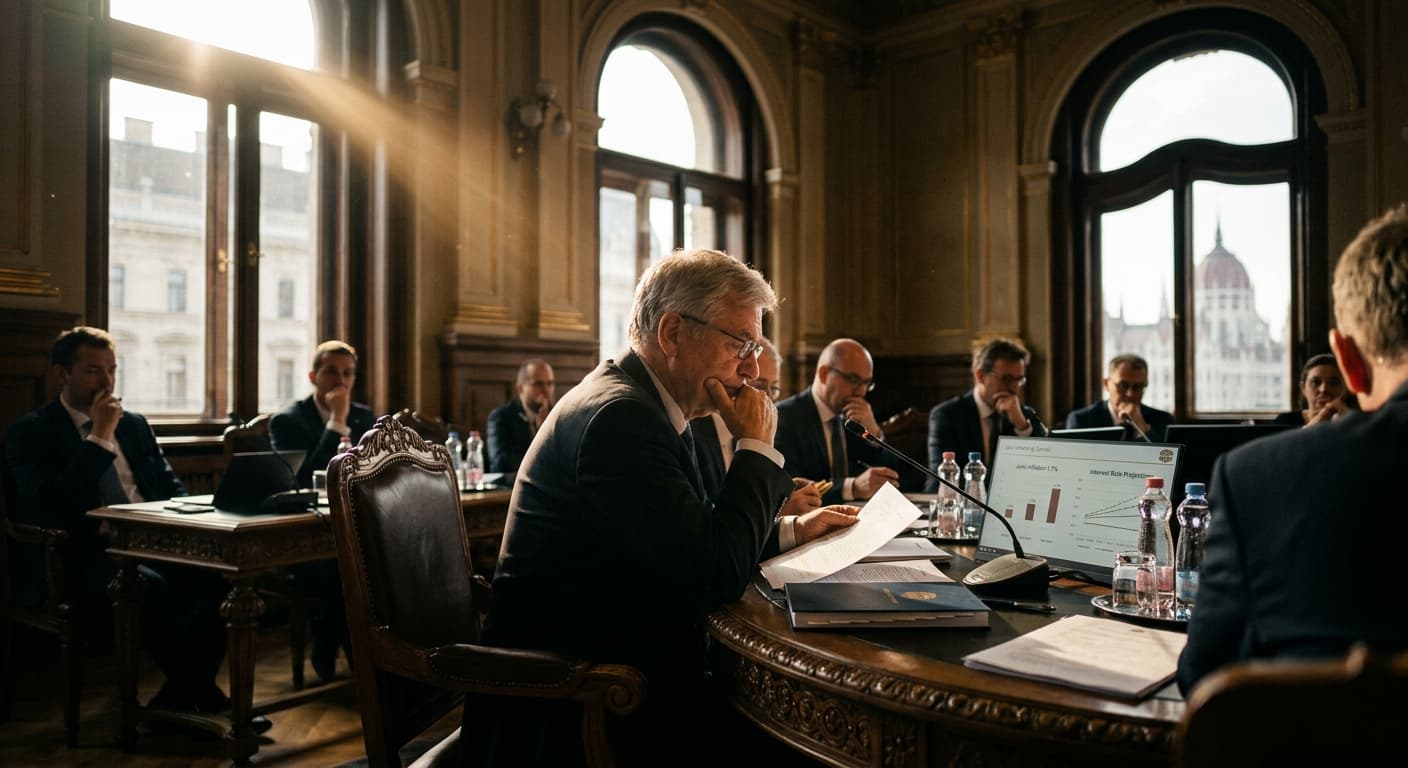
Hungary's 1.7% Inflation Print Clears Runway for MNB Rate Cuts
Hungary's June CPI fell to 1.7%, a stronger forint and Magyar's EU thaw hand the MNB the deepest real rate in the EU — and licence to cut.
Hungary's consumer-price index rose just 1.7% year-on-year in June 2026, a four-month low that sits a full percentage point below the National Bank of Hungary's tolerance band and hands new governor Mihály Varga the clearest mandate for a summer rate-cutting cycle in Central Europe. The Hungarian Central Statistical Office release on July 7 confirms that the disinflation is being driven by a forint that has repriced upward since April's political earthquake — not by weak demand — which means the country is exiting a two-year currency crisis by way of a rate-cutting boom, not a recession. That is the story markets are pricing, and it is the story that quietly reshuffles the CEE monetary map.
The load-bearing number is the real policy rate. With the MNB base rate at 6.00% after the June 23 Monetary Council meeting and headline inflation at 1.7%, ex-post real rates sit at roughly +430 basis points — the widest gap in the European Union and, on the MNB's own numbers, more than double the central bank's estimated 2% neutral rate. ING's Peter Virovacz called the print sufficient to "effectively seal the deal on a rate cut in July," with an August cut also "highly likely," in a
note published July 7. Citi's economists reached the same conclusion, telling clients they now expect the MNB to run what Varga has branded a "mini" easing cycle straight into autumn, according to
Investing.com. The market-implied terminal rate is now near 5.00% — the level ING flags as the likely floor.
What actually moved the needle
The June disinflation is a currency story dressed as a food-price story. Food inflation collapsed to essentially zero year-on-year in June — food prices rose 0.2% on the year but fell 2.4% excluding restaurant services, according to Budapest Business Journal reporting of the KSH data. Durable-goods prices dropped for a third straight month. Both categories are import-heavy, and both track the forint with a lag of two to three months.
The forint that is doing this work is a different animal from the one the IMF was writing about a year ago. In the 2025 Article IV Staff Report, Fund staff described a currency under "renewed pressures" in March 2025 amid the EU's cancellation of €1 billion in suspended cohesion funds and a period-average of 395.4 HUF per euro. By July 2026 the forint trades meaningfully stronger, and the
IMF's official reference rates show the euro at $1.1383 on July 1 — a cross that has translated into a durable one-way move for Hungarian import prices.
Two political events did most of the repricing. First, Péter Magyar's Tisza party won an outright supermajority on April 12, taking 138 of 199 parliamentary seats and ending 16 years of Fidesz rule, as the BBC reported at the time. Second, the European Commission unlocked €16.4 billion in previously frozen cohesion and Recovery and Resilience Facility (RRF) funds in May, after Magyar's government committed to joining the European Public Prosecutor's Office and passing anti-corruption and judicial-independence reforms, per a further
BBC account. The MNB's own June statement acknowledges the mechanism explicitly: "The lower risk premium on domestic assets remained, to which the agreement between Hungary's government and the European Commission, related to EU funds, contributed."
The Varga pivot the market is still underpricing
The Monetary Council's June 23 statement is worth reading carefully because it inverts nearly every priority the MNB has held since 2022. Where the 2024 Article IV had warned that "the exchange rate is likely to also be a binding constraint on the pace of loosening," Varga now describes the forint as a disinflationary tailwind. The council's own words:
"The inflation path in the June forecast significantly shifted downwards compared to the March Inflation Report. The stronger forint, as well as the decline in energy and food prices has resulted in lower inflation… For the rest of this year and next year the rate of price increases will remain below the central bank's 3 percent target."
Read plainly, the MNB is telling markets it expects to undershoot its target through 2027. That is a licence to cut faster than the 25-basis-point-per-meeting pace implied by the June move. ING has revised its 2026 inflation forecast to 2.1%, versus the MNB's own 1.8% projection. Both sit at or below the tolerance band midpoint — territory Hungary has not occupied since 2017.
Who benefits? Three actors, in order:
- Hungarian mortgage holders and SMEs. Roughly 60% of new household loans in Hungary are variable-rate or linked to short-term BUBOR, meaning a 100-basis-point cutting cycle transmits into disposable income within a quarter. The MNB's own
Selected Issues Paper on monetary transmission flagged this channel as unusually fast in Hungary.
- The Magyar government. Lower rates cut debt-service costs on a stock of government paper that the IMF projects at above 70% of GDP through 2028. Every 100 bps saved on the base rate is worth roughly 0.4% of GDP annually in interest expense, on the
- The Czech and Polish central banks. Both the CNB and NBP have been reluctant cutters, boxed in by sticky services inflation. Hungary going first, and going fast, gives regional peers cover — and a live experiment in how far a CEE central bank can ease before the currency snaps back.
The regional map is redrawing
For most of 2023–2025, Hungary was the outlier on the wrong side of the CEE inflation trade — the country with the EU's highest headline print and the currency most punished by rule-of-law disputes. Al Jazeera's post-election coverage noted that Hungary "had the highest inflation in the EU in 2023, and has had among the highest in the years since." June's print flips that ranking. The Financial Times's
global inflation tracker now shows Hungarian CPI running below the eurozone average of 2.8% for the first time in the current cycle — a rare event outside deep recessions.
This has second-order consequences for the euro-adoption debate that Chatham House flagged in an April analysis of the election. Magyar's government has not committed to a euro accession timeline, but the MNB's June statement made a striking addition: "Hungary's risk assessment will be primarily influenced by expectations regarding the fiscal path and the adoption of the euro." That is the first time a Hungarian central bank statement has treated euro adoption as an active variable in risk pricing since the Orbán government took office in 2010.
The trap sits in services. Services inflation ran at 4.0% year-on-year in June and accounts for roughly two-thirds of the headline CPI, per the ING breakdown. Labour-intensive categories — rent, personal care, telecommunications — are still repricing off wage growth from the 2022–2024 shock. The Budapest Times noted that "consumers still feel the squeeze from services" even as the headline print collapsed. When voluntary price-margin caps on food retail expire later this year — a commitment the Orbán government made and Magyar's team has signalled it will honour temporarily before phasing out — the mechanical bounce will land in Q4. The MNB has pre-committed to looking through it: the June statement says explicitly that repealing the price caps "would not endanger price stability."
What could break the trade
Three catalysts could force the MNB to pause the mini-cycle before it reaches 5.00%:
- EU funds implementation slippage. The €10 billion RRF tranche unlocked in May carries super-milestones that must be delivered before a formal August deadline, per the
BBC. Failure to legislate the anti-corruption package on schedule would reverse the risk-premium compression that made the forint's rally possible.
- A renewed energy shock. The MNB's June statement flagged "the prolongation of the conflict in Iran" as the one factor lifting corporate price expectations. Chatham House noted separately that Hungary's Paks nuclear plant supplies "around half of the country's electricity" and depends on Rosatom financing — an underappreciated tail risk that would show up first in the forint, not in bills.
- Fiscal slippage under Magyar. The IMF's
Diplomat View
The trade to watch is not the next MNB decision — it is whether the forint holds below 395 to the euro through August. If it does, Varga will deliver back-to-back 25-basis-point cuts on July 22 and August 26, and the "mini" cycle becomes what ING now openly calls a "midi" cycle ending near 5.00% by year-end. That would take Hungary from having the EU's most restrictive real policy rate to something closer to neutral in six months — the fastest normalisation of any CEE economy since the 2013–2014 disinflation. The bet is defensible for one specific reason: the disinflation is being manufactured by a political re-rating (Magyar in, EU funds flowing), not by demand destruction, so the growth cost of easing is minimal. The forecast breaks if the RRF August milestones slip, if Magyar's honeymoon government leaks fiscal slippage into the 2027 budget draft, or if a fresh energy shock repriced the forint above 400. Two of those three are political, not monetary — which is why this rate-cut cycle is really a bet on Péter Magyar's first hundred days, priced through the front end of the HUF curve.
Forward look:
- July 22, 2026 — Next MNB Monetary Council meeting; consensus (Citi, ING, JPMorgan) is a 25 bp cut to 5.75%.
- August 15, 2026 — Deadline for Hungary to legislate the RRF super-milestone reforms unlocked by the European Commission in May.
- August 26, 2026 — Second MNB meeting of the summer; watch guidance on whether the "mini" cycle extends into autumn.
- September 9, 2026 — KSH release of August CPI; the first print to capture the removal of the fuel-price cap in late June.
The Bottom Line
Hungary's 1.7% June inflation print is not a data quirk — it is the price signal of a political regime change, transmitted through a stronger forint into cheaper food and cheaper imports. The MNB now holds the widest real policy rate in the EU and the clearest mandate to cut it since 2016, and the beneficiaries are Hungarian borrowers, the Magyar government's debt-service line, and CEE peers who have been waiting for someone to go first. If the forint holds, this becomes the fastest normalisation cycle in the region in a decade; if EU-fund milestones slip in August, it stops in its tracks.
Discover more

India
Congress Advocates 33% Women’s Quota
Congress calls for a 33% women's reservation in the existing 543 Lok Sabha seats, countering Modi's plan to expand the house to 850 seats.
India
Congress Accuses Modi of Stalling Women's Law
Congress accuses Modi of stalling women's reservation law by linking it to delimitation, revealing a deeper electoral strategy.
India
BJP's Misunderstanding of Women's Quota Needs
The BJP's linking of the Women Reservation Bill to delimitation risks delaying women's empowerment in India, misreading the aspirations of female voters.

Economics
Fed's Amex AML order puts correspondent banking on notice
Federal Reserve's Amex AML order requires board-level controls and a 90-day plan; OCC fined the bank $350 million over enterprise-wide deficiencies.