Howard Lutnick's Senate Testimony on 2027 Bud
Senate appropriators reject Lutnick's budget cuts proposal.
Model Diplomat7 min readUnited States

Lutnick's FY2027 Commerce Budget Hits a Senate Wall
Howard Lutnick defended a 12.2% cut to Commerce and a 54% cut to NIST before Senate appropriators — but the numbers Congress is drafting look nothing like the ones he asked for.
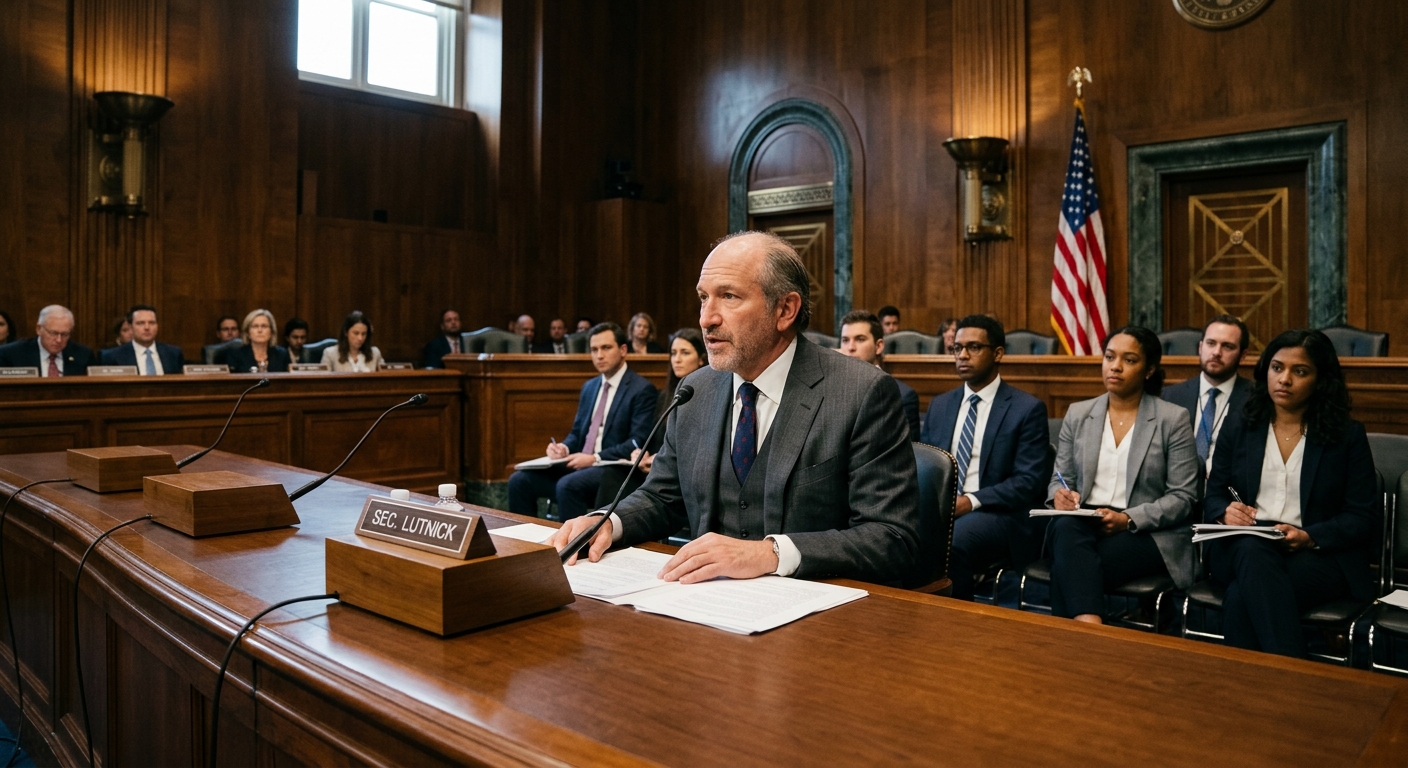
Commerce Secretary Howard Lutnick sat in Dirksen 192 on April 22, 2026, and asked Senate appropriators to cut his own department by $1.3 billion — including a 54% reduction at the National Institute of Standards and Technology — and left with a subcommittee chair who has already signaled he will not deliver it. The FY2027 request is a political document, not a spending plan: the House CJS bill reported three weeks later restores NIST to $1.3 billion and NOAA to $5.85 billion, meaning the fight worth watching is not what Lutnick proposed, but how much of the Trump industrial-policy realignment survives a Republican-controlled Congress that has spent the last year quietly ignoring him on research funding.
What Lutnick actually asked for
The FY2027 Commerce request, transmitted by the Office of Management and Budget on April 8, 2026, seeks $9.2 billion in discretionary budget authority — a 12.2% cut from the FY2026 enacted level, according to the Budget of the U.S. Government published by OMB. Inside that number is a deliberate reshuffle rather than an across-the-board haircut: the request adds $215 million to the Bureau of Industry and Security — described by OMB as "the largest [investment] in the bureau's history" — to hire "hundreds of new Special Agent law enforcement officers" and expand Section 232 national-security investigations. It boosts trade enforcement at the International Trade Administration by $10 million and stands up a $100 million U.S. Investment Accelerator under Executive Order 14255.
Everywhere else, the axe falls. The proposal cuts NIST by 54% to $853 million, terminates a swath of NOAA education and ocean-observation programs the administration labels "scam programs," and consolidates Endangered Species Act and Marine Mammal Protection Act permitting under Interior — pulling authority out of NOAA entirely. Lutnick defended those cuts before Senator Jerry Moran's Commerce, Justice, Science and Related Agencies subcommittee, according to a notice posted by the Senate Appropriations Committee, telling members the department was being "refocused on core responsibilities."
The pitch, delivered again the next morning to Representative Hal Rogers's House CJS subcommittee, tracked the industrial-policy speech Lutnick has been giving all year: bring leading-edge semiconductor fabrication home, target 40% domestic market share, and use tariffs plus BIS enforcement — not research grants — as the tools. At the Center for Strategic and International Studies in February, Lutnick told the audience the administration's goal was "$1.2 trillion of semiconductor manufacturing" on U.S. soil, per a transcript posted by CSIS. The FY2027 request is the fiscal expression of that bet.
Why the request is dead on arrival
Congress has already written the counter-offer. The Commerce, Justice, Science and Related Agencies Appropriations Bill, 2027 — H.R. 8845, reported by the House Appropriations Committee on May 15, 2026 — provides $77.34 billion in total discretionary authority and $1.299 billion for NIST, a cut of $547 million from FY2026 but roughly $450 million above what Lutnick requested. The full text of that mark and the accompanying House Report 119-652 explicitly ring-fence CHIPS R&D priorities the administration wanted to trim, directing NIST to protect advanced packaging, lithography, quantum, and "ultra-pure materials" work.
The Senate side is even less receptive. In July 2025, Moran's committee reported S. 2354, the FY2026 CJS bill, at $82.6 billion — $7 billion above FY2025 — and stiff-armed the administration's proposed 57% cut to the National Science Foundation, keeping NSF at roughly $9 billion, as
Science reported. Moran told his own colleagues at the markup that the panel would not "rubber stamp" the administration's research cuts. That pattern is the reason Lutnick's 2027 request lands as posture rather than policy: the same appropriators he was addressing on April 22 had spent the prior nine months writing bills that reject his premises.
There is a further constraint that makes the request even less negotiable. Republicans hold 53 Senate seats; any CJS appropriations bill must clear a 60-vote cloture threshold, giving Democrats — including Senator Chris Van Hollen of Maryland, ranking on the subcommittee — an effective veto on the deepest cuts. The last time the administration tried to force research reductions through, Senator Tammy Baldwin's amendment to restore 1,500 canceled NSF grants failed 14–15 on a party-line vote, but Moran openly offered to negotiate a narrower version on the floor. Bipartisan appetite to protect NIST, NSF, NOAA weather services, and NASA science is durable enough that OMB's passback figures function mainly as opening bids.
The Epstein overhang the room could not ignore
Lutnick's problem is not only the numbers. He arrived at the April 22 hearing under active congressional scrutiny for his relationship with the late sex offender Jeffrey Epstein. On February 10, at an earlier Senate Appropriations hearing ostensibly about broadband, Van Hollen produced 2012 correspondence and forced Lutnick to confirm that he, his wife, four children and nannies had eaten lunch on Little St. James — Epstein's private Caribbean island — seven years after Lutnick had publicly claimed he cut ties. "The issue is not that you engaged in any wrongdoing," Van Hollen said, per the BBC, "but that you totally misrepresented the extent of your relationship." Lutnick told the panel he had "done absolutely nothing wrong" and described the visit as "boring."
The DOJ released roughly 3 million pages of Epstein material on January 30, 2026, under the Epstein Files Transparency Act. According to NPR, Lutnick's name appears more than 100 times in that trove, including on same-day 2012 agreements to buy stakes in a digital advertising firm called Adfin, and in communications as recent as 2018. Representatives Ro Khanna (D-Calif.) and Thomas Massie (R-Ky.) — co-sponsors of the transparency law — have both called on him to resign. On May 6, Lutnick sat for a closed-door House Oversight interview; Chair James Comer told reporters afterward that his prior account "wasn't 100% truthful," but committee Democrats confirmed Comer had decided no wrongdoing occurred, per
Al Jazeera.
Van Hollen used part of his April 22 questioning on the same topic, according to MS.NOW, which reported that Lutnick declined to engage on the Epstein questions. The point is not the answers — it is that the administration's chief tariff negotiator and industrial-policy architect is spending time on the defensive over a topic unrelated to trade. Every hour Lutnick trades on Epstein is an hour not spent whipping votes for BIS agents or Investment Accelerator funding.
Who wins if the request fails — and who loses
Read the numbers as a leverage map and the beneficiaries snap into focus.
The Bureau of Industry and Security wins either way. The $215 million plus-up has bipartisan support because it funds export-control enforcement against China; Moran's July 2025 Senate report already directed Commerce to design a whistleblower incentive program at BIS for illegal semiconductor exports. Congress will fund the enforcement build-up even as it rejects the offsetting cuts.
NIST, NOAA, NSF and NASA science programs win by attrition. The FY2026 pattern — administration proposes, appropriators smooth — is repeating. NIST loses roughly $547 million on the House mark instead of the $1 billion Lutnick sought. NOAA loses $320 million rather than $1.6 billion.
Semiconductor incumbents win regardless. Micron's $100 billion Idaho fab, TSMC's Arizona expansion, and Intel's advanced-packaging work all sit inside CHIPS R&D lines that Congress is protecting even where OMB is not.
The clearest loser is the theory of the case Lutnick has been advancing since confirmation: that trade tools and BIS enforcement can substitute for the research and standards apparatus at NIST and NOAA. Senate Republicans do not buy it. Senator Susan Collins, who chairs full Appropriations, has protected research budgets on every markup this cycle. So has Moran. Trump's own subcommittee chairs are refusing to zero out the agencies OMB wants to hollow out.
What to watch next
- September 30, 2026 — expiration of current continuing resolution funding. A CJS deal, a short-term CR, or a shutdown fight becomes unavoidable. Watch whether the Senate marks its own FY2027 CJS bill before recess; as of the week of the
House vs. Senate markup calendar, the Senate side has still not scheduled a full-committee vote on the FY2027 measure.
- Section 232 tariff dockets — BIS is expected to complete national-security investigations across critical sectors this fall, using the exact enforcement budget Congress is likely to fund. Those findings, more than the appropriations bill, will determine whether Lutnick's "America First" industrial policy has teeth in 2027.
- Any second Oversight referral on Epstein testimony — Massie has publicly floated it. A perjury referral would change Lutnick's political capital on the Hill overnight and could force the White House to choose between defending him and passing a budget.
Diplomat View
Lutnick's FY2027 Commerce request will not become law in anything close to its submitted form, and the White House likely knows it. The document's real function is to shift the fiscal Overton window — anchoring the negotiation at a 12.2% cut so the compromise settles at 3–5%, and using BIS as the sweetener Republicans cannot refuse. The forecast: NIST lands between $1.25 billion and $1.35 billion in final FY2027 numbers; NOAA between $5.7 billion and $5.9 billion; BIS gets most of the $215 million plus-up; the Economic Development Administration takes the deepest structural cut because it has the fewest Senate defenders. What would change this call: a floor vote on a full-year CR that freezes FY2026 numbers (which would kill both the cuts and the BIS boost), a perjury referral out of House Oversight that forces Lutnick from Cabinet before markup, or a Trump reversal on CHIPS R&D that hands appropriators cover to gut NIST after all. Absent one of those triggers, the Senate will write the 2027 Commerce budget — not the Secretary of Commerce.
Related: US Politics
Discover more
US Politics
Congress Targets AI Chatbot Access for Terror
The House passed the Generative AI Terrorism Risk Assessment Act, focusing on AI's role in terrorism and potential surveillance implications.
US Politics
House Ethics Committee Pushes Sexual Miscond.
The House Ethics Committee has shifted responsibility for sexual harassment settlement records to the Office of Congressional Workplace Rights, complicating disclosure efforts.
Global Politics
Trump's Conflicting Messages on Iran War
Trump's mixed messages on Iran reflect a strategy of audience management, benefiting Tehran amid a complex geopolitical landscape.

Conflict & Security
Drone Warfare Killing Aid Workers at Unprec
Over 1,000 humanitarian workers killed in three years as cheap armed drones collapse legal protections. Gaza, Sudan, Ukraine, and DRC see deliberate targeting of aid convoys and hospitals with zero prosecutions.