Hormuz Traffic Collapses as Iran Gains Power
Iran's control over Gulf shipping tightens amid US-Iran tensions.
Model Diplomat8 min readMiddle East
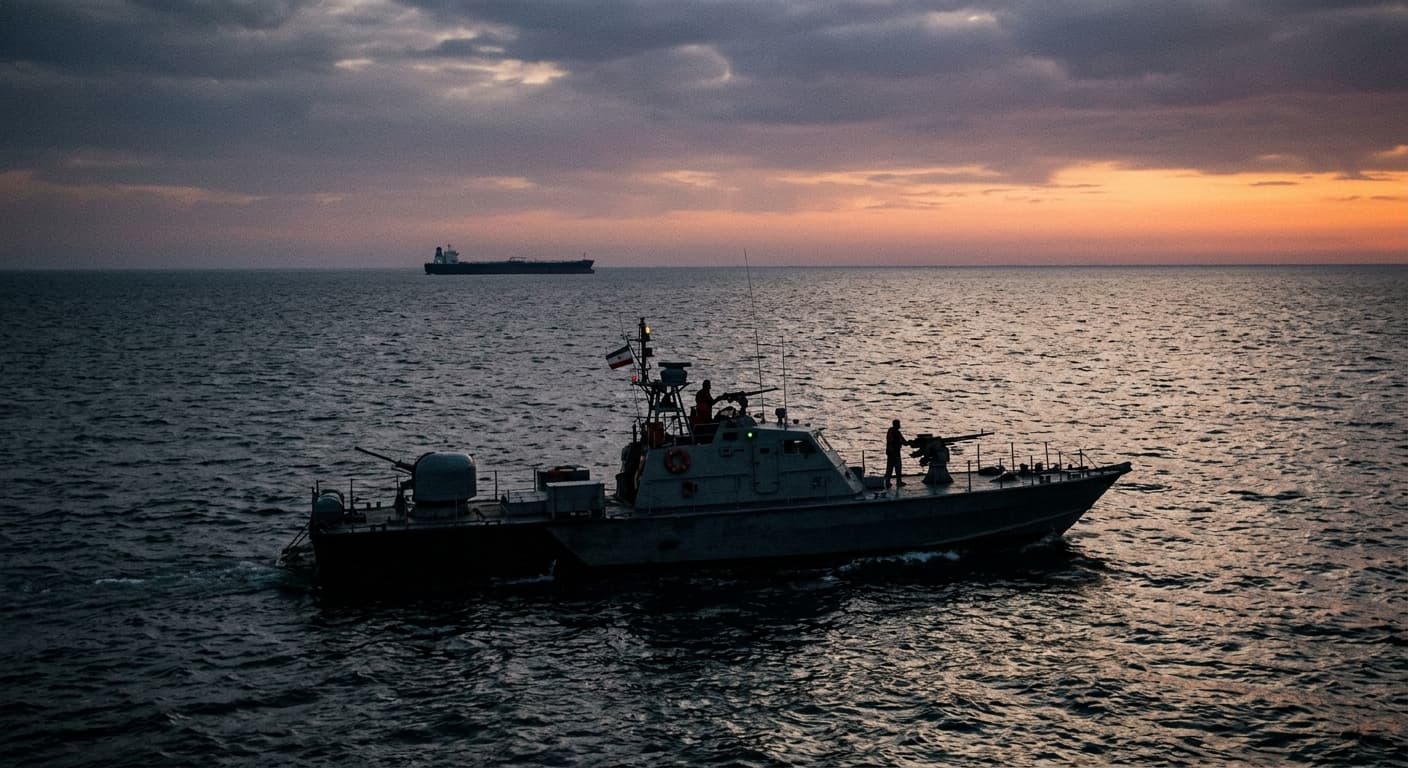
Hormuz Traffic Collapses as Iran Rewrites the Rules of the Gulf
Ship transits through the Strait of Hormuz fell to 23 on July 8, 2026 as US-Iran strikes shattered the June truce — and quietly handed Tehran what it wanted: a veto over Gulf shipping.
Only 23 tankers and cargo ships crossed the Strait of Hormuz on Wednesday, July 8, down from 47 a week earlier and a pre-war baseline of 138, according to Kpler data cited by BBC News. The number is a symptom of the real story: Iran has used three weeks of a fragile US-brokered peace to convert a wartime blockade into a de facto administrative regime over the world's most important oil chokepoint — and neither the Gulf monarchies nor Washington has found a way to dislodge it without restarting a war none of them want. Tehran is not losing this crisis. It is codifying its gains.
The MoU that reopened the strait — on Iran's terms
The 14-point memorandum of understanding signed in Doha on June 17, mediated by Pakistan and Qatar, was sold in Washington as a US victory: a naval blockade lifted only after Iran agreed to reopen the waterway. Read closely, it did something else. Article 5 commits Iran to use "its best efforts for the safe passage of commercial vessels with no charge for 60 days only," and to open talks with Oman on "the future administration and maritime services in the Strait of Hormuz."
That last phrase — "future administration" — is the diplomatic hinge. As Council on Foreign Relations analysts put it, the MoU effectively obliged Trump "to pay what is in essence a massive bribe to Iran to let merchant traffic flow," in exchange for a sixty-day reprieve on transit fees and a soft acknowledgment of Iranian regulatory authority over an international waterway, per CFR. Iranian officials read the same clause more expansively. Ebrahim Azizi of Iran's parliamentary national-security commission wrote on X this week: "Recognise the new and Iranian order in the Strait of Hormuz," as reported by
Al Jazeera.
The dispute is not academic. On June 25 the IRGC struck a Singapore-flagged ship transiting the IMO-endorsed Omani corridor. On July 7 it hit three more — the Qatari LNG tanker Al Rekayyat, the Saudi supertanker Wedyan, and the Liberian-flagged Cyprus Prosperity — all on or near that same US-recommended route. All were following international guidance. All were, in Iran's telling, off-piste.
Two nights of strikes, no change to the map
US Central Command retaliated in two waves. CENTCOM said it hit more than 80 targets on the night of July 7–8 — Iranian air-defence radars, coastal missile sites and "more than 60 IRGC small boats in and near the strait" — and roughly 90 more the following night, including two railway bridges on the Mashhad route, per Al Jazeera. The US Treasury simultaneously revoked General License X1, the sixty-day waiver that had permitted Iranian crude sales during the negotiating window, according to
OFAC's Iran sanctions page.
Iran's answer went sideways — literally. The IRGC fired missiles and drones at US bases in Bahrain (5th Fleet headquarters), Kuwait, Qatar and, according to Amman, at targets over Jordan; Kuwait said it intercepted three ballistic missiles, a cruise missile and ten drones, per the Associated Press via NPR. The Gulf Cooperation Council, in a statement from Secretary-General Jasem Mohamed AlBudaiwi, called the strikes "a flagrant violation" of Bahraini and Kuwaiti sovereignty. Trump, in Ankara for the NATO summit, said the MoU was "over" and called Iranian leaders "scum," while adding that US negotiators could keep talking, per the
BBC.
The exchange has not changed the underlying picture at the waterway. On the day CENTCOM said its strikes had "further degraded Iran's ability to threaten freedom of navigation," Iranian traffic-control centres continued to route the handful of vessels willing to move — down the northern, Iranian-approved lane. Zero ships used the Omani corridor on Wednesday, according to Kpler data cited by the BBC. Two days of high-intensity US bombing produced no observable widening of the safe channel.
Who holds leverage, and why they're using it
The power dynamic is the story. Iran's calculation, articulated bluntly by Majid Shakeri, an adviser to chief negotiator Mohammad Bagher Ghalibaf, on state television: "Either we hold on to this strait, or we go and become martyrs for it one by one" — extracting revenue, he added, "is subordinate to control." That is not the language of a state seeking concessions. It is the language of a state that has already banked them.
Three factors explain why Tehran can hold this line despite absorbing US bombing:
Mines and geography. CFR estimates roughly 80 Iranian sea mines remain in the strait's main navigation channels, with no agreed clearance timetable. The central lane — historically the workhorse — is effectively unusable. That forces ships onto either the Iranian-controlled northern route or the shallower Omani southern route, both closer to hostile shores. Airpower cannot demine a strait. Only Iran can.
The GCC's split. Publicly, Riyadh, Doha and Abu Dhabi condemned the tanker attacks; Saudi Arabia's foreign ministry named the Wedyan; Qatar's spokesperson Majed Al Ansari held Iran "fully responsible" for the Al Rekayyat strike, per the BBC. Privately, the Qatari prime minister spent Thursday urging both sides to "commit to diplomacy" in a call with Iranian Foreign Minister Abbas Araghchi, and Oman continues to shuttle between Muscat and Tehran on strait "administration." The Gulf capitals want US deterrence — but not a second war. That gap is Iran's operating space.
Oil the Gulf can no longer fully move. More than a fifth of global oil and LNG transits the strait — about 20 million barrels a day, per the US Energy Information Administration via Al Jazeera reporting. Saudi Arabia's Petroline (7 mbd), UAE's Habshan-Fujairah line (1.5 mbd) and the Iraq-Türkiye pipeline (1.6 mbd, currently pumping around 200,000 bpd) collectively cannot replace Hormuz volumes, per the
S. Rajaratnam School of International Studies. ADNOC's new West-East line, at 50% complete per the
Gulf International Forum, will not be commissioned before 2027.
The Gulf-diplomacy angle: from patron to hedge
The reduced traffic is not just an energy story. It is reshaping how Gulf states think about Washington. For twenty years, the implicit deal was straightforward: US Navy 5th Fleet protection in exchange for oil-market cooperation and dollar-denominated arms deals. This week Iran hit that fleet's home base in Manama and Kuwait's Ali al-Salem airbase — and the US response, however forceful in tonnage, did not restore the Omani corridor. That is the metric Gulf capitals are watching.
The consequences are already visible in three moves:
First, Oman has become the region's indispensable state. Muscat's dual role — hosting the US-backed IMO corridor and negotiating with Tehran on future "maritime services" — makes it the only actor with veto influence on both sides. Iranian adviser Shakeri went further this week, insisting Oman must permit Iranian inspections in its own territorial waters, per Al Jazeera. That is a demand no Arab state has faced from Iran in modern memory.
Second, Saudi and Emirati capital is being redirected toward Hormuz-free infrastructure with new urgency. ADNOC CEO Sultan Al Jaber told an executive meeting in late May that full Hormuz flows will not return before Q1-Q2 2027, and that "over one billion barrels of oil" have been lost globally from the closure. That timeline — not the MoU's 60 days — is what Gulf planners are budgeting against.
Third, Doha's mediation stock has risen while its exposure has grown. Qatar co-brokered the June 17 deal, and its LNG carriers now transit an active shooting gallery. QatarEnergy's phased LNG restart — 80% of export capacity within two months, per the company — is contingent on a corridor Iran has demonstrated it can close at will.
What to watch next
- August 21, 2026. The 60-day MoU window and the Treasury sanctions grace period both expire. Iran has publicly signalled it will introduce transit fees the moment the free-passage clock runs out; Trump has said fees would be "unacceptable." Absent an extension, this is the next collision date.
- Iran-Oman "administration" talks. No breakthrough has been announced. If Muscat concedes any Iranian inspection role in its own waters — even nominally — it will constitute the first legal acknowledgement of Iranian jurisdiction over parts of Hormuz. Watch for a communiqué in the next two weeks.
- Insurance markets. War-risk premiums for Gulf transits and the willingness of P&I clubs to cover the Omani corridor are the leading indicator of whether traffic recovers or seizes. A withdrawal of cover by a major London club would do more to close the strait than any Iranian missile.
- Bushehr. Iran accused the US of striking near its sole nuclear power plant on July 9. If confirmed, that widens the target set to civilian nuclear infrastructure — and puts the IAEA on the map of this crisis.
Diplomat View
The evidence points one way: Iran is winning the Strait of Hormuz not by closing it, but by pricing entry. The June 17 MoU, sold as a US-brokered reopening, quietly conceded the linguistic and operational premise Tehran needed — that the strait now has an "administration," and that Iran is part of it. Two nights of CENTCOM strikes have destroyed radars and small boats without altering the basic map: the Iranian route is open, the Omani route is empty, the central channel is mined. If the August 21 deadline passes with Iranian "user fees" tolerated even implicitly, the freedom-of-navigation regime that governed the Gulf since 1988 is finished — replaced by a toll booth Washington helped ratify. The forecast changes if two things happen: Oman refuses any inspection role for Iran in its waters, and Gulf insurers restore the Omani corridor's coverage. Absent both, expect a permanent premium on every barrel that leaves the Gulf — and a Gulf security architecture in which mediation, not deterrence, is the operative currency. For readers tracking Global Politics, the lesson is older than this crisis: chokepoints reward whoever is willing to bleed for them.
The bottom line: The steep fall in Hormuz traffic on July 8-9 is not the collapse of a peace deal — it is the deal working as Iran designed it. Tehran has traded sixty days of free passage for a permanent seat at the table that governs the world's most important oil corridor, and neither US airpower nor Gulf diplomacy has yet found a lever to take it back.
Discover more
US Politics
House Ethics Committee Pushes Sexual Miscond.
The House Ethics Committee has shifted responsibility for sexual harassment settlement records to the Office of Congressional Workplace Rights, complicating disclosure efforts.
US Politics
SNAP Food Assistance Faces Legal Challenges
In 2026, SNAP faces stricter eligibility rules and mounting legal challenges, threatening food assistance for the millions of Americans who rely on the program.
Global Politics
Xi Jinping Calls China-Russia Ties 'Precious'
Xi Jinping's description of China-Russia ties as 'precious' reflects a strategic imbalance, with Beijing dictating terms in the partnership.

Economics
Fed's Amex AML order puts correspondent banking on notice
Federal Reserve's Amex AML order requires board-level controls and a 90-day plan; OCC fined the bank $350 million over enterprise-wide deficiencies.