Harena's $4.84M DFC Deal Is a Strategic Down
US DFC's $4.84M deal signals strategic shift to secure critical minerals before China
Model Diplomat9 min readAfrica
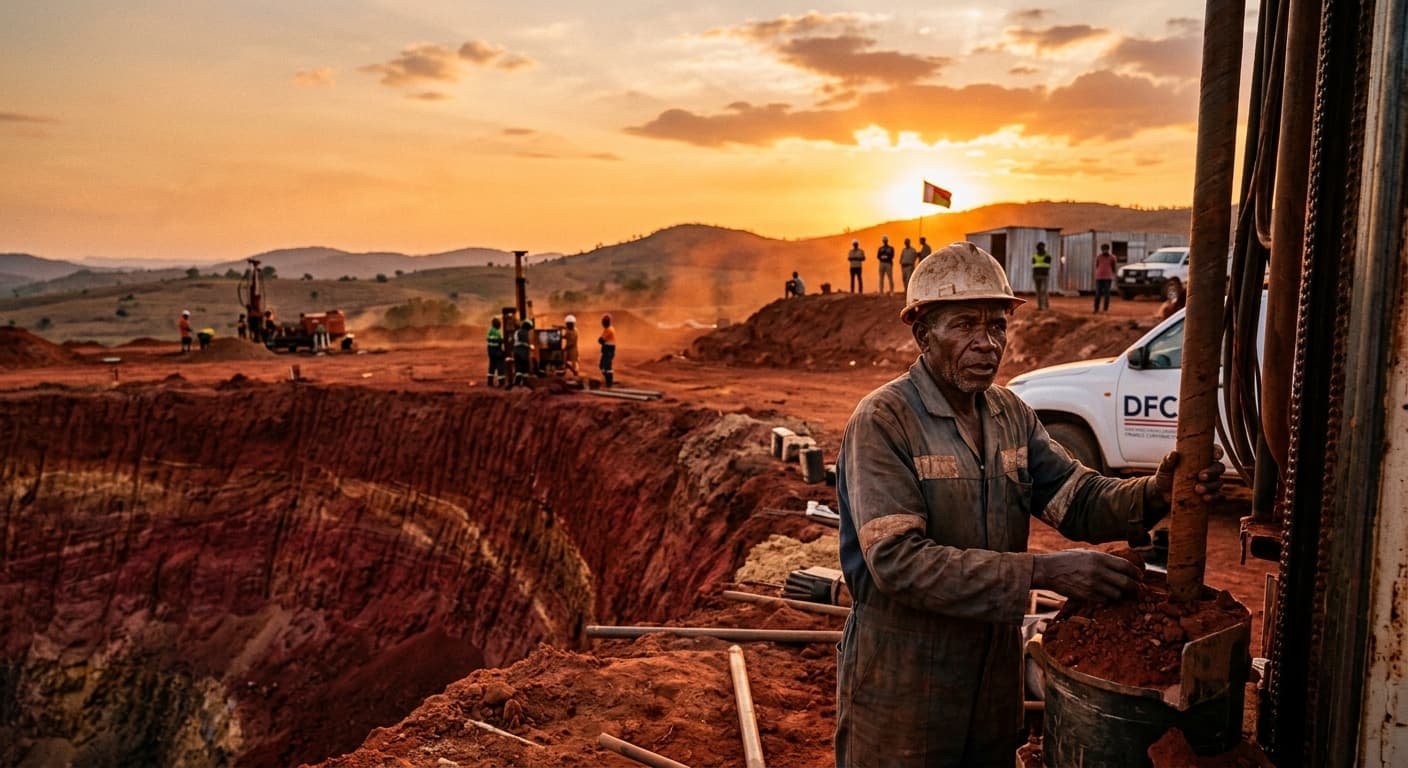
Harena's $4.84M DFC Deal Is a Down Payment — Not the Real Prize
The US government's first direct financing of Madagascar rare earths is less about the cash and more about what it signals: Washington is now acquiring strategic mineral assets before China does.
LONDON — Harena Rare Earths Plc shares surged 25% on July 22, 2026 after securing up to $4.84 million in US government-backed funding for its Ampasindava rare earths project in Madagascar. It marks the US International Development Finance Corporation's first direct financial commitment to the deposit. The stock touched 2.78p in early exchanges before settling at 2.41p, giving the company a market capitalisation of roughly £13.17 million Financial Times.
The sum is modest; the signal is not.
The DFC, created by Congress in 2018 explicitly to counter China's Belt and Road Initiative, has retained the right "to be considered for a much larger future financing or investment role" at construction decision, subject to due diligence Proactive Investors. For a pre-revenue explorer with a market cap smaller than the DFC's eventual potential commitment, that clause transforms the company's financing trajectory overnight.
Executive Chairman Ivan Murphy called the agreement "a real turning point" and "a powerful endorsement of Ampasindava's importance as a Western-aligned source of critical magnet rare earths" Proactive Investors. The drawdown is already underway, with Harena's technical team on the ground. The funding will cover permitting, environmental and social studies, and construction of a proof-of-concept pilot plant — all prerequisites for the definitive feasibility study that unlocks the larger financing.
The architecture of a strategic bet
The DFC-Harena agreement did not emerge in isolation. It sits inside a whole-of-government US push to build rare earth supply chains outside China's control that has accelerated dramatically since April 2025.
That month, Beijing imposed export licensing requirements on seven heavy rare earth elements and permanent magnets in retaliation for US tariffs, triggering "temporary but serious supply disruptions" across global manufacturing supply chains IMF, April 2026 World Economic Outlook. In October 2025, China expanded those restrictions with a foreign direct product rule — asserting jurisdiction over any product containing even trace amounts of Chinese-origin rare earths — before a Trump-Xi truce suspended enforcement in November
CSIS.
The lesson for Washington was unambiguous: even a temporary Chinese export squeeze can halt automotive and defense production lines. Diversification became an operational urgency, not a policy aspiration.
The US response has been sweeping. In July 2025, the Department of Defense acquired a 15% stake in MP Materials for $400 million, becoming its largest shareholder, while extending a $150 million loan for heavy rare earth separation and committing to a 10-year price floor of $110 per kilogram for neodymium-praseodymium output BBC News. In February 2026, the White House announced Project Vault, a $12 billion initiative to establish a US Strategic Critical Minerals Reserve
Congressional Research Service. By May 2026, the Export-Import Bank had issued nearly $4 billion in letters of intent for rare earth supply chain investments
CSIS.
All of these, however, were focused on domestic processing and magnet manufacturing. The missing piece was overseas feedstock — securing ownership of deposits before Chinese firms acquired them. The Harena deal fills that gap.

The cautionary tale: Ngualla
The rationale for acting now, rather than waiting for Ampasindava to be de-risked, is written in the fate of Peak Rare Earths' Ngualla deposit in Tanzania.
Ngualla was one of the world's most significant undeveloped rare earth resources, discovered by an Australian company with plans for a fully integrated supply chain processing material in the United Kingdom. That vision unraveled in May 2025 when Shenghe Resources, a Chinese state-backed firm, acquired Peak Rare Earths for approximately AU$158 million. A last-minute US-backed counterbid failed. By October, Peak had been delisted from the Australian Securities Exchange, and control of Ngualla had passed to Beijing CSIS. China is now on track to receive all rare earth production from Tanzania by 2029.
The CSIS assessment is blunt: "The United States has built financing tools for mine development. It has not built financing tools for mine acquisition" CSIS.
The DFC commitment to Harena — at a pre-construction, pre-feasibility stage — is a deliberate attempt to avoid repeating Ngualla. Lock in the asset before it becomes an acquisition target.
China's dominance is structural: it mines roughly 60% of global rare earths and processes and separates approximately 90%. It manufactures about 94% of rare earth-based magnets. For heavy rare earths — dysprosium, terbium, the elements that give magnets thermal stability for defense applications — China has historically processed 99.9% of global supply Congressional Research Service. Its own ionic clay deposits in southern China, once the world's primary heavy rare earth source, are depleted and largely shut down due to environmental damage — making overseas ionic clay deposits like Ampasindava strategically irreplaceable
RUSI.
The deposit: what Ampasindava actually is
Ampasindava is not a speculative greenfield. It is one of the largest ionic clay rare earth deposits outside China, with a JORC 2012 compliant Mineral Resource Estimate of 699 million tonnes at 868 parts per million total rare earth oxides, containing 606,000 tonnes of TREO Financial Times / Harena RNS. The deposit stretches along a 20-kilometre near-surface ore body on the Ampasindava Peninsula in northern Madagascar.
Critically, approximately 22% of the resource is associated with magnet metals — neodymium, praseodymium, dysprosium, and terbium — the elements that go into the neodymium-iron-boron permanent magnets essential for electric vehicles, wind turbines, drones, missile guidance systems, and F-35 fighter jets Financial Times / Harena PFS.
The pre-feasibility study, completed in January 2026, models a project ramping from 2.5 million tonnes treated per annum to 5 million tonnes by year five, producing an estimated 4,000 tonnes of TREO annually — dispatched as 6,700 tonnes of mixed rare earth carbonate concentrate with an annual value of approximately $250 million Financial Times / Harena PFS.
The economics are robust. Base case post-tax NPV10 is $249.6 million, with a real internal rate of return of 30%. Under spot pricing assumptions, NPV10 rises to $510 million, according to broker SP Angel, which initiated coverage with a Buy recommendation and a 9.4p target price — roughly 4.5 times the July 22 closing price Financial Times / SP Angel Research. The project is projected to deliver $220 million in gross royalties and $320 million in corporate tax to Madagascar over its 20-plus-year life
Financial Times / Harena PFS.
The company is pre-revenue and held cash of just £599,567 at December 31, 2025. It has since raised £1.23 million (August 2025), £450,000 from RAB Capital (October 2025), and £2 million from a prominent international investor (February 2026) Financial Times / Harena Interim Results. The DFC funding, modest as it is, provides non-dilutive runway to the next value catalyst.
The Madagascar political calculus
The DFC commitment also amounts to a geopolitical bet on Madagascar's stability.
A military transitional government took power in October 2025. The Atlantic Council noted that the coup "has the potential to harm US and allied critical mineral supply chains and alter Chinese, French, and Russian influence in the surrounding Indian Ocean" Atlantic Council. Madagascar is the world's second-largest graphite producer and holds significant nickel, cobalt, and ilmenite deposits, yet most commercially viable deposits remain undeveloped.
The transitional government moved quickly to reassure international investors. In January 2026, it lifted a 16-year moratorium on mining permits — a move the Harena board described as a "positive development supporting the Directors' assessment" of the project's viability Financial Times / Harena Interim Results. The company is now processing the conversion of its exploration licence to an exploitation licence through the Bureau du Cadastre Minier de Madagascar, a step that broker SP Angel listed as a first-half 2026 catalyst
Financial Times / SP Angel Research.
The risk is not trivial. As the American Enterprise Institute observed, "pro-sovereigntist juntas that took power in West Africa in recent years have altered their mining codes and aggressively targeted foreign mining companies to renegotiate deals" AEI. The transitional government has had little time to signal an economic strategy. Yet the DFC commitment suggests Washington has concluded that the risk of inaction — losing another African rare earth deposit to Chinese acquisition — outweighs the political risk of engagement.
The Congressional Record from January 2026 confirms the administration's posture: DFC has "financed — or is preparing to finance — mineral projects in a number of AGOA countries, including Angola, Mozambique, Tanzania, and Zambia," with rare earths identified as a priority sector Congressional Record. The Harena deal is the first direct rare earths investment to close.
The DOD clock is ticking
The financing push has a hard deadline. The Department of Defense has set a requirement barring the use of rare earth materials and magnets from China, Russia, Iran, and North Korea in defense supply chains by January 1, 2027. CSIS assesses that "unless significantly more capacity comes online in the next eight months, adhering to this requirement may not be feasible" CSIS.
Harena's production timeline — pilot plant operations by Q2 2027, definitive feasibility study completion in 2026, and final investment decision by Q4 2027 — means its output will not meet the 2027 deadline Financial Times / Harena PFS. But the longer arc matters more. The DOD's stated goal, articulated in 2023, is a complete mine-to-magnet supply chain by 2027. Most analysts consider that timeline aspirational. NPR reported in October 2025 that experts predict "it could be close to 10 years before the US — with help from its allies — gains full control over its supply"
NPR.
In that context, Ampasindava — with first production realistically in the early 2030s — is a medium-term play. The DFC's signal of a "much larger role" at construction decision positions the US government as an anchor financier for a project whose $249.6 million NPV dwarfs Harena's current £13 million market cap.
Harena's wider play: California
The Madagascar project is not Harena's only card. In March 2026, the company entered into an exclusivity agreement to evaluate the acquisition of Paradigm Critical Minerals Limited, owner of heavy rare earth and uranium exploration assets in San Bernardino County, California — approximately 100 miles from MP Materials' Mountain Pass mine, North America's only operating rare earth facility Financial Times / Harena RNS. If consummated, the acquisition would give Harena a US-domiciled asset in the same geologic province as the country's flagship rare earth operation.
MP Materials has received substantial US government funding to expand domestic processing, and Mountain Pass is being positioned as a hub capable of processing feedstock from multiple sources. Harena's Paradigm assets represent potential domestic feedstock for that ecosystem. The combination of a Madagascar ionic clay deposit rich in heavy rare earths and a California exploration portfolio creates a diversified play on Western rare earth independence.
What to watch
Three near-term catalysts:
-
Exploitation licence conversion (H2 2026). SP Angel identified this as a first-half 2026 catalyst; it has not yet been announced. The BCMM process requires a ministerial order for final approval, introducing political risk.
-
DFC construction financing decision (2027). The agency's retained right to a larger role is non-binding, but the signal is unusually explicit. A follow-on commitment in the tens of millions would validate the strategic logic and likely trigger institutional re-rating.
-
Strategic or offtake agreement. Harena's PFS noted that offtake discussions are ongoing. A deal with a Western magnet manufacturer or automaker — along the lines of Apple's $500 million offtake with MP Materials in July 2025 — would de-risk the revenue side of the project.
The bottom line
The DFC's $4.84 million commitment to Harena Rare Earths is a strategic down payment, not a development budget. It positions the US government as a future anchor financier for one of the largest ionic clay heavy rare earth deposits outside China — and signals that Washington has learned the lesson of Ngualla. The real prize is the construction-phase financing DFC has explicitly reserved the right to provide. If that materialises, Harena's £13 million market cap prices only a fraction of the project's $249 million base-case NPV. The trade is a bet that the US government, racing China for critical mineral assets, will not let this one slip away.
Discover more

US Politics
Next Generation Republicans
A leaked survey shows 39% of Republicans under 30 do not identify as MAGA, revealing a split in the GOP's future leadership.

US Politics
House Ethics Committee Pushes Sexual Miscond.
The House Ethics Committee has shifted responsibility for sexual harassment settlement records to the Office of Congressional Workplace Rights, complicating disclosure efforts.

India
Women’s Reservation in India
India's 33% women's reservation law is enacted but won't take effect until after 2029 due to political setbacks and census delays.

Conflict & Security
Drone Warfare Killing Aid Workers at Unprec
Over 1,000 humanitarian workers killed in three years as cheap armed drones collapse legal protections. Gaza, Sudan, Ukraine, and DRC see deliberate targeting of aid convoys and hospitals with zero prosecutions.

