Hamas Dissolves Gaza Government Amid Ceasefi
Hamas cedes civilian rule to US-backed committee, retains arms.
Model Diplomat9 min readMiddle East
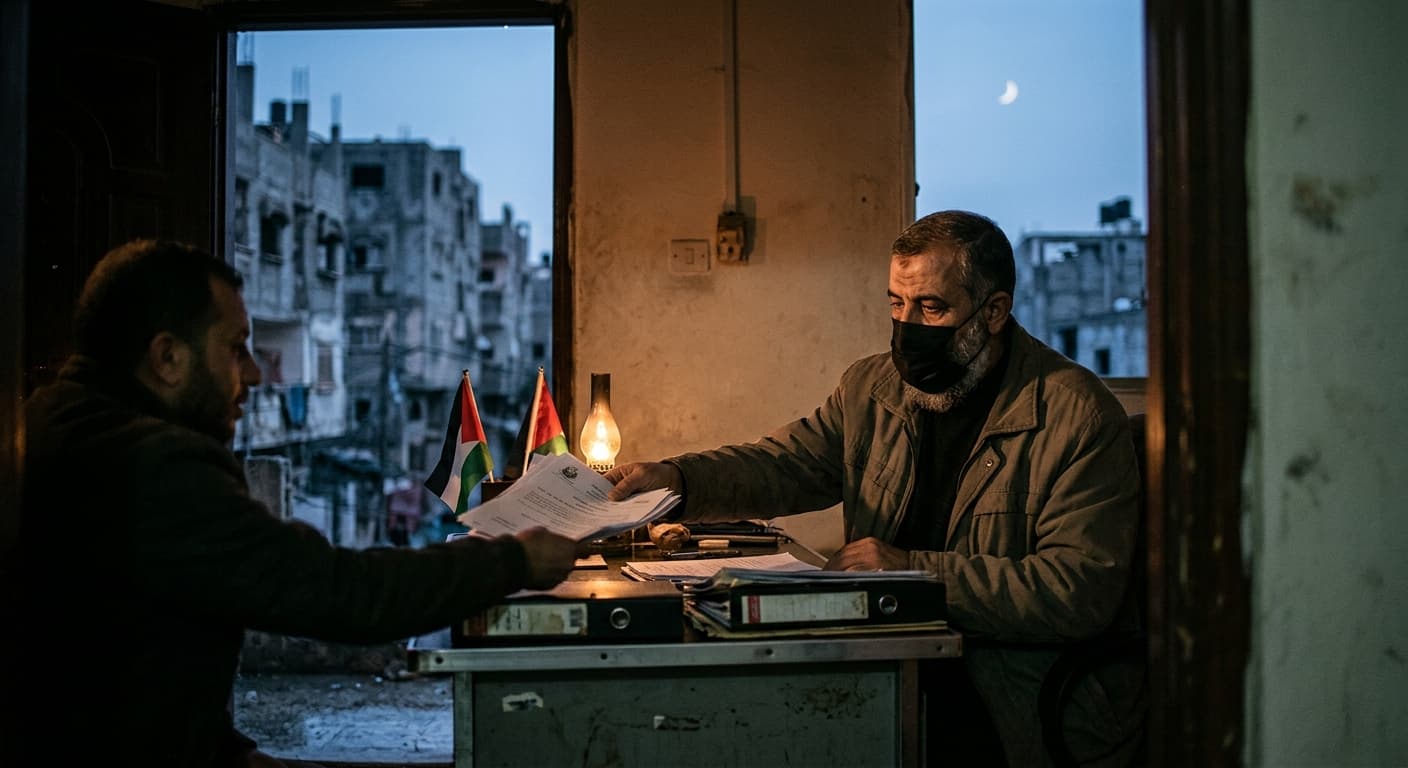
Hamas Dissolves Gaza Government, Testing Fragile Ceasefire
Hamas dissolved its Gaza governing body on July 6, 2026, ceding civilian rule to a US-backed technocratic committee while refusing to disarm — a move that shifts pressure onto Israel and the stalled Trump peace plan.
Hamas announced on July 6, 2026 the dissolution of the Government Emergency Committee that has administered the Gaza Strip since 2007, formally clearing the way for the Cairo-based National Committee for the Administration of Gaza (NCAG) to assume civilian rule under U.S. President Donald Trump's 20-point peace framework. The concession, delivered in a statement from Hamas's Government Media Office in Deir el-Balah, is calibrated: it surrenders the civilian shell of Hamas rule — already hollowed out by 21 months of war — while pointedly preserving the group's weapons, its Al-Qassam Brigades, and its political leadership abroad. In doing so, Hamas has transferred the unresolved question of Gaza's future onto Israel and the Board of Peace, and the next 60 days of Cairo talks will decide whether the ceasefire that began on October 10, 2025 survives.
The Government Emergency Committee's chief, Mohammed al-Farra, "decided to submit his official resignation from his position and to announce the dissolution of the Government Emergency Committee, as a demonstration of the seriousness of these measures, in implementation of the agreed arrangements, and to facilitate the administrative transition process," the statement read, according to Al Jazeera. Hamas spokesman Hazem Qassem told AFP the group "will no longer be in charge of the Gaza Strip, in order to remove any pretexts for the occupation." NCAG chair Ali Shaath said his 15-member committee was "fully prepared to assume its national responsibilities as soon as the necessary resources and capabilities are available."
What was dissolved — and what was not
Hamas dissolved a body that had, in practical terms, already ceased to function. A senior Hamas security officer told the BBC earlier this year that the group had lost roughly 80% of its territorial control and that its command-and-control system had "completely collapsed" under sustained Israeli strikes, with an estimated 95% of security leadership killed. Six armed clans, most notably the Yasser Abu Shabab network in southern Gaza — which Israel has publicly confirmed arming — have moved into the vacuum. Foreign Affairs, in a July 2026 essay titled
"The End of Hamas," reported that Hamas first signaled it would abolish its administrative bodies in January 2026 and characterised the July dissolution not as a tactical concession but "as a distress signal."
What Hamas has not dissolved is the Izz ad-Din al-Qassam Brigades, its remaining rocket and light-weapons stockpile, or the political bureau in Doha — now split between Khalil al-Hayya's Iran-aligned faction and Khaled Mashal's Sunni-diplomatic wing. Al Jazeera's Hani Mahmoud, reporting from Gaza City on July 6, said the move "doesn't mean that Hamas is relinquishing its political or military role in Gaza, but rather stepping back from the direct civilian government." Political bureau member Husam Badran told Al Jazeera on June 5 that once the NCAG enters, "there will be no visible weapons in the streets and alleys of Gaza except the official weapons belonging to this committee" — but added, unambiguously: "We are not talking about handing them over."
The distinction matters legally. Under Mladenov's 15-point roadmap, presented to the Security Council in May 2026, "no Palestinian armed group will be required to transfer its weapons to Israel"; arms would be moved to the NCAG under a phased, Palestinian-led decommissioning tied to IDF withdrawal. Hamas's July 6 statement exploits that gap — surrendering the institution it controlled while leaving the fate of arms to a "national framework" it has yet to convene with Fatah, Palestinian Islamic Jihad, and the PFLP.
The trap the announcement sets for Israel
The dissolution is best read as leverage. For nine months, Israel and the Board of Peace have argued that phase two — reconstruction, aid at scale, IDF withdrawal — could not begin until Hamas surrendered both governance and weapons. Hamas has now surrendered the first without conceding the second, and it did so publicly, in Ismail al-Thawabta's press conference at Al-Aqsa Hospital, precisely to force a decision on the second.
That decision falls hardest on Prime Minister Benjamin Netanyahu. Israel has rejected both a return of the Palestinian Authority to Gaza and the entry of the NCAG so long as Hamas retains arms, with the BBC reporting in late June that Israel was considering resuming "operations" and expanding the "Yellow Line" that already places roughly 60% of Gaza under IDF control. Finance Minister Bezalel Smotrich told Sderot mayor Alon Davidi on June 29,
as Al Jazeera reported, that Israel must "complete the conquest of the remaining area, defeat Hamas and establish a belt of Jewish settlements that will serve as a security buffer." Michael Eisenberg, an adviser cited by the BBC, put the Israeli hardline more bluntly: "Hamas must disarm, demilitarise, and deradicalise. That's the future of Gaza according to the 20-point plan."
With Hamas having now dissolved the government, that maximalist position becomes harder to sell to Washington, to the Gulf donors funding the Board of Peace, and to an Israeli reserve army that former operations chief Israel Ziv has described as exhausted after averaging 80 days of service in 2026, per Al Jazeera reporting. Gaza analyst Mamoun Abu Amer, quoted in the same piece, argued that resuming the war "would spell the collapse of the flagship US peace initiative, a move Netanyahu can ill afford while seeking coordination with Washington against Iran."
The load-bearing figure is $17 billion — the sum Gulf and other donors pledged at a February 2026 conference in Washington and have since withheld, according to Al Jazeera's July 1 reporting from Ayia Napa, Cyprus, where Board of Peace officials met to redesign the reconstruction plan. Nickolay Mladenov, the Board's High Representative for Gaza, told Israeli broadcaster i24 that "reconstruction financing will not follow where weapons have not been laid down." Hamas's dissolution reframes that logic: with no Hamas government left to point to, donors and Arab capitals now face pressure to unlock funds against the more limited condition of a policing arrangement rather than full decommissioning. Egypt and Jordan have agreed to train Gaza's new police force; Albania, Kosovo and other states have committed troops to the ISF under U.S. Major General Jasper Jeffers III,
according to the Council on Foreign Relations.
The primary document: Resolution 2803 and its unfinished business
The legal architecture Hamas has now formally deferred to is UN Security Council Resolution 2803 (2025), adopted November 17, 2025 by a vote of 13-0 with China and Russia abstaining. The resolution authorises the Board of Peace and an International Stabilization Force under Jeffers to "ensure the process of demilitarizing the Gaza Strip, including the destruction and prevention of rebuilding of the military, terror, and offensive infrastructure, as well as the permanent decommissioning of weapons from non-state armed groups." That mandate runs through December 31, 2027,
as the UN press release records, with the Board required to submit a written progress report every six months.
The resolution ties IDF withdrawal directly to demilitarization progress:
"As the ISF establishes control and stability, the Israel Defense Forces (IDF) will withdraw from the Gaza Strip based on standards, milestones, and timeframes linked to demilitarization... save for a security perimeter presence that will remain until Gaza is properly secure from any resurgent terror threat."
That is the sequencing that has broken down. Under-Secretary-General for Humanitarian Affairs Tom Fletcher told the Security Council on June 18, 2026 that "diplomacy requires your full, unified weight to implement UNSCR 2803, including a genuine ceasefire, the disarmament of Hamas and civilian leadership in Gaza." Fletcher reported that more than 67,000 Palestinians had been killed before the ceasefire and that nearly 1,000 more, including over 250 children by UNICEF's count, had been killed since October 10, 2025 despite the truce. OCHA's
June 5 situation report put the ceasefire-era toll at 936 fatalities and 2,903 injuries as of early June, citing Gaza's Ministry of Health, and noted that Kerem Shalom remained the only functional cargo crossing after Israel closed Zikim on May 24.
Who benefits, who loses
The immediate beneficiary is not the NCAG — which cannot yet enter Gaza — but the Board of Peace itself, chaired by Trump and populated on its founding Executive Board by six Americans including Jared Kushner, Steve Witkoff, Marco Rubio and World Bank President Ajay Banga, alongside former UK Prime Minister Tony Blair, per the BBC's roster. Hamas's exit gives the Board a plausible political win to present to Gulf donors and to Congress at a moment when the CFR notes Trump has floated a $1 billion permanent-membership fee and several EU states, including Italy under Giorgia Meloni, have declined to join on constitutional grounds. Witkoff,
announcing the launch of phase two in January 2026, had promised the plan would move Gaza "from ceasefire to demilitarisation, technocratic governance, and reconstruction" — a formulation that has, until this week, produced only the first step.
The clearest institutional loser is the Palestinian Authority. Trump's plan envisages the PA taking over Gaza "once it has completed reforms" — a threshold Israel has publicly said the PA has not met and, per the July 6 Al Jazeera dispatch, Israel has "rejected a direct takeover by the Palestinian Authority... at this stage." Ali Shaath, a former PA deputy planning minister, is thus running a body that structurally supersedes the institution he came from, under a Board chaired by a foreign head of state — an arrangement that Palestinian analysts and even the Vatican have described as reminiscent of a mandate. The Beijing Declaration of July 2024, which had committed Fatah and Hamas to a joint interim government in Gaza, has been quietly buried; the NCAG is not that government.
The second-order loser is Iran. Foreign Affairs documents that when the US and Israel bombed Iran on February 28, 2026, Hamas's political leadership in Qatar issued a statement urging Tehran to "avoid targeting neighboring countries," while the military spokesman in Gaza praised Iran's war effort — a public split within the group. Hamas's willingness to dissolve its civilian arm and negotiate a hudna, or long-term truce, rather than resume armed governance advantages the Mashal wing over the Hayya wing, and diminishes the value of the axis Tehran spent two decades constructing through Hezbollah, the Houthis and the Iraqi Shia militias.
The historical parallel that reframes this: what is emerging around Gaza looks less like the post-Oslo Palestinian Authority — a Palestinian-led institution with contested sovereignty — and more like the Coalition Provisional Authority in Iraq or the international mandates that governed post-1918 territories. Trump's Board of Peace has a foreign head of state as chair, an American general commanding its stabilisation force, and a technocratic Palestinian committee positioned beneath a Board dominated by foreign appointees. Al Jazeera's Israeli-affairs expert Mustafa noted that Article 17 of the plan, permitting "temporary reconstruction" only in Hamas-free zones, would leave Hamas with "no people, no land, and no resources." That is population engineering by another name, and it is the strategy Hamas's July 6 announcement is designed to complicate.
What to watch
- Cairo talks, mid-July 2026. Egyptian and Qatari mediators are pressing Hamas to accept a version of Mladenov's 15-point roadmap, which sequences decommissioning of rockets, then explosives, then assault rifles over 281 days across five stages. A written Hamas response is expected before the end of July.
- Tal as-Sultan pilot. The Board of Peace is scheduled to launch a "Hamas-free" reconstruction pilot near Rafah "within weeks," according to Israel Hayom via Al Jazeera. Whether the NCAG participates — and whether Hamas tolerates it — will signal the operational viability of Article 17.
- Board of Peace six-month report. Resolution 2803 requires a written progress report every six months; the next is due in November 2026, ahead of the mandate's December 31, 2027 expiry, and will trigger a Security Council reauthorisation vote where China and Russia have leverage.
- Israeli elections, October 2026. Netanyahu faces a vote with Smotrich's Religious Zionism demanding annexation and the security establishment warning against a renewed ground campaign. The election, not the Cairo talks, may determine whether the ceasefire holds.
The Bottom Line
Hamas's July 6 dissolution of its Gaza government is not a surrender — it is a bet that Israel cannot politically justify blocking a technocratic Palestinian administration once the ostensible reason for doing so has walked off the stage. By separating civilian rule, which it was losing anyway, from military capability, which it still holds, Hamas has shifted the burden of proof onto Netanyahu, the Board of Peace, and the Gulf donors sitting on $17 billion in undisbursed pledges. The next 60 days in Cairo will decide whether that bet unlocks phase two of the Trump plan or triggers the renewed war Israeli officials have been openly rehearsing.
Discover more

Tech Policy
EU AI Act enforcement exposes governance gap
EU AI Act high-risk obligations take effect August 2, 2026. Most organizations lack visibility into their AI systems, creating a governance gap that concentrates penalty risk among firms without compliance infrastructure.
Global
Sahel Jihadists Now Govern, Tax and Drone-St
UN envoy warns Sahel jihadists now govern territory, tax trade, and use drones, as ECOWAS-AES split lets the threat metastasize toward coastal West Africa.
Global
Zanzibar Accord: Tanzania's Isles Break Cycle
The Zanzibar Accord signed by CCM and ACT-Wazalendo aims to end election violence and reform the electoral process in Tanzania's semi-autonomous region.
Elections & Campaigns
Keiko Fujimori asume con Senado propio
Keiko Fujimori wins Peru's presidency by 49,641 votes, backed by a Senate designed by her party, ensuring legislative control.