Zanzibar Accord: Tanzania's Isles Break Cycle
A historic pact aims to end post-election violence in Zanzibar.
Model Diplomat4 min readAfrica
Zanzibar Accord: How Tanzania's Isles Broke the Post-Vote Violence Cycle
After 518 election deaths on the mainland, CCM and ACT-Wazalendo signed a July 9, 2026 pact rewriting Zanzibar's rules — a template for East Africa.
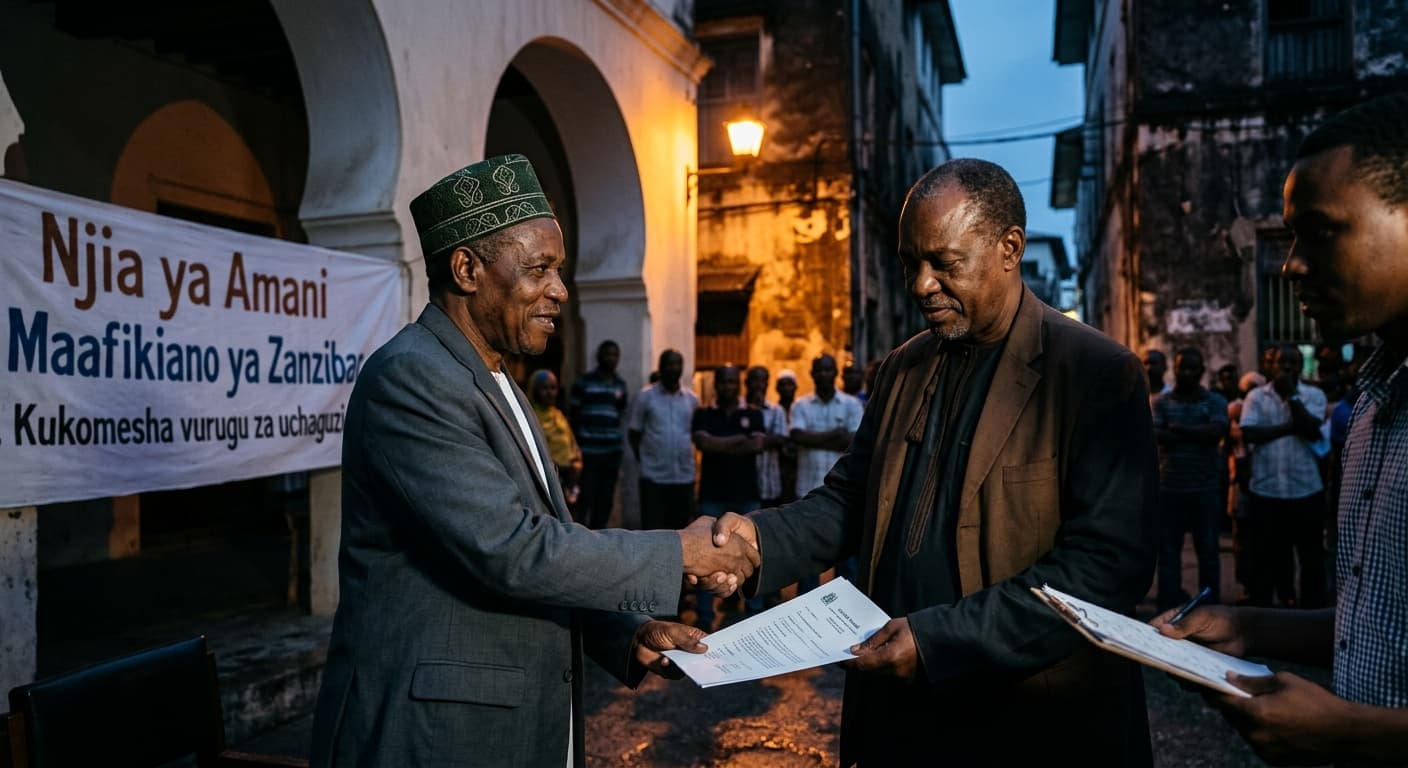
President Samia Suluhu Hassan stood between the two men who nearly refused to be photographed together, and on July 9, 2026, at Zanzibar State House, watched them sign a document that quietly does what neither Tanzania's mainland politics nor the wider East African region has managed in a generation: it removes an election from the hands of the party that runs the police. The Joint Political Reconciliation Declaration between Chama Cha Mapinduzi (CCM) and ACT-Wazalendo commits, in writing, to restructuring the Zanzibar Electoral Commission, depoliticising the judiciary, decentralising local government and reopening the constitutional file — the same bundle of reforms whose absence, according to a presidential commission of inquiry chaired by former Chief Justice Mohamed Chande Othman, helped kill 518 Tanzanians last October. The implication for the neighbourhood is uncomfortable: the most durable post-election settlement in the region right now is being written on a semi-autonomous archipelago of 1.9 million people, and the mainland — where Chadema is banned and Tundu Lissu sits in jail on treason charges — is not part of it.
What the accord actually does
The document was signed by ACT-Wazalendo National Chairman Othman Masoud Othman and Zanzibar President Hussein Ali Mwinyi, who is also CCM's vice-chairman for the isles. According to Streamline, it commits both parties to a joint implementation committee across four pillars: constitutional overhaul, restructuring of the Zanzibar Electoral Commission (ZEC) to guarantee "verifiable vote tabulation", depoliticisation of the judiciary, and decentralisation of local administration — including the appointment of mashehe, the neighbourhood-level officials long accused of gate-keeping opposition voters off the register.
The accord also unlocks the constitutional machinery that had jammed shut. Zanzibar's 1984 constitution, as amended by referendum in 2010, requires a Government of National Unity in which the runner-up party receives the First Vice Presidency and a proportional share of the cabinet. ACT-Wazalendo had refused to take up its GNU positions after the October 2025 vote, citing what it called "massive fraud" — a charge Al Jazeera reported the party made publicly the day after ZEC declared Mwinyi the winner with 78.8 percent. The July 9 signing formally ends that boycott.
University of Dar es Salaam political scientist Richard Mbunda told The Citizen the deal's meaning lies less in ministerial appointments than in whether "political inclusion extends beyond ministers and deputy ministers." Analyst Onesmo Kyauke, quoted in the same report, was blunter: the accord is only worth what CCM has conceded on the electoral machinery, particularly the security-force advance-voting mechanism that turned Zanzibar's 2020 and 2025 votes into two-day operations with the first day reserved for police and military.
Why the mainland gave ground on the isles
The power reading here is straightforward. Samia won the mainland. She did not win a legitimacy contest. The BBC reported in April 2026 that the Othman commission put the confirmed death toll at 518, with 197 shot dead, more than 2,000 injured, and 21 children among the dead. Seventeen Western embassies, according to
BBC reporting, issued a joint statement citing "credible reports" of "extrajudicial killings, disappearances, arbitrary arrests" and body concealment. UN Human Rights Chief Volker Türk demanded a full investigation, saying in an
OHCHR statement on November 11, 2025 that security forces had reportedly been "seen removing bodies from streets and hospitals and taking them to undisclosed locations."
Samia's response was to fight the international story on the mainland — she accused Western capitals of interfering and defended the security response — while quietly conceding the argument on Zanzibar, where the ruling party actually needs the opposition to run the government. That asymmetry is the accord's real logic. Mwinyi took only 78.8 percent in Zanzibar's presidential race, per Al Jazeera, against Samia's mainland-wide 97.66 percent according to
Al Jazeera's final tally. Pemba island, ACT-Wazalendo's stronghold, remains ungovernable without a settlement; the 2001 Pemba killings, in which Human Rights Watch documented 35 deaths, still shape voting behaviour there a quarter-century on.
Zanzibar is the pressure valve. The mainland is not.
The Kenyan comparison — and why this one might hold
The accord's drafters have openly borrowed the language of 2018's Kenyan "Handshake" between Uhuru Kenyatta and Raila Odinga, but the constitutional architecture is different — and probably sturdier. Kenya's Building Bridges Initiative collapsed in 2022 when the Court of Appeal, and later the Supreme Court, ruled the president lacked authority to initiate popular constitutional amendments. Zanzibar's GNU is already in the constitution. It was endorsed by 66.4 percent of Zanzibari voters in the July 31, 2010 referendum, and the Cambridge-published Journal of Modern African Studies argues its 2010–2015 iteration was "position sharing" rather than genuine power sharing — a distinction the 2026 accord is designed to close by tying appointments to institutional reform of the ZEC, judiciary and local government.
The academic literature is cautious. A 2021 Africa Today article on the breakdown of Zanzibar's first GNU traced its collapse to the collision between reconciliation and the constitutional-review process — the moment CCM and CUF discovered their partnership could not survive an honest conversation about union structure. That is precisely the fault line the July 9 accord now walks toward: it commits to reopening constitutional talks, which is where every prior maridhiano has died.
Discover more

US Politics
White House Pressures Congress for Crypto Leg
The Trump administration's push for the CLARITY Act aims to reshape crypto regulation, impacting trillions in market value and the Trump family's wealth.
US Politics
Washington's Scrutiny of Iran War Prediction
The Iran war prediction market scandal exposes political ties and regulatory challenges in Washington, as insider trading concerns rise.

Global Politics
US Naval Blockade on Iran
The US fully imposed a naval blockade on Iranian ports, escalating tensions even as Trump hinted the conflict may soon end while serious risks of war remain.

Economics
Fed's Amex AML order puts correspondent banking on notice
Federal Reserve's Amex AML order requires board-level controls and a 90-day plan; OCC fined the bank $350 million over enterprise-wide deficiencies.