Habeas Corpus: Firewall Against Trump's Deten
Habeas rulings challenge Trump's mass deportation efforts.
Model Diplomat7 min readNorth America
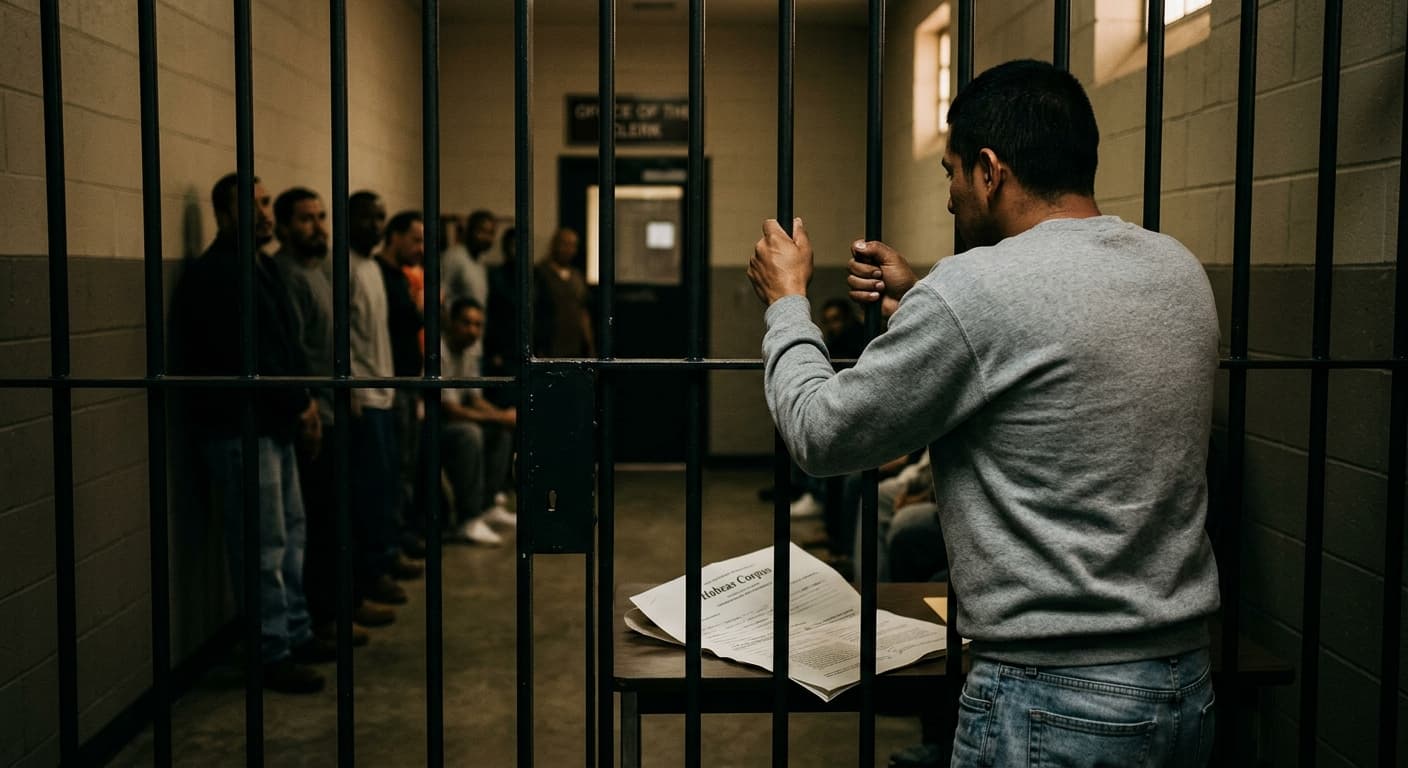
Habeas Corpus Is Now the Firewall Against Trump's Mass Detention
A cascade of 2025–2026 habeas rulings has forced the Trump administration into a district-by-district trench war over 72,000 immigration detainees — and set up a Supreme Court showdown.
The single legal instrument that has done more to slow President Donald Trump's mass-deportation machine than any other is not a treaty, an injunction, or an act of Congress — it is the writ of habeas corpus. Between the Supreme Court's April 7, 2025 ruling in Trump v. J.G.G. and the Second Circuit's April 28, 2026 rejection of blanket mandatory detention, federal courts have converted habeas into the primary check on an enforcement apparatus now holding more than 72,000 people on any given day. The result is a legal system in open circuit conflict, a White House that has publicly floated suspending the writ, and a Supreme Court term that will decide whether the 1789 protection still reaches non-citizens picked up inside the United States.
The ruling that turned every deportation into a habeas case
The pivot came on April 7, 2025. In Trump v. J.G.G., the Supreme Court held that Venezuelans challenging removal under the Alien Enemies Act "must be brought in habeas" — and only in the federal district where they are physically confined, according to the per curiam opinion. Because most Alien Enemies Act detainees are held in North Texas, the ruling looked, on its face, like a win for the administration: it forced litigation into a single conservative circuit and killed nationwide injunctions out of Washington.
It backfired within six weeks. On May 16, 2025, the Court itself blocked a summary removal flight from the Bluebonnet Detention Facility, holding in A.A.R.P. v. Trump that 24 hours' notice, without instructions on how to file a petition, "does not satisfy constitutional requirements." Justice Kavanaugh's concurrence framed the reasoning bluntly: courts must "decide whether these Venezuelan detainees may be lawfully removed under the Alien Enemies Act before they are in fact removed." Habeas, in other words, is not optional plumbing — it is the constitutional predicate for every removal the administration wants to expedite.
That combination — habeas as the only forum, plus meaningful notice as a precondition — is what makes the writ the operative constraint on mass deportation today. Every fast-track category the White House has tried to build, from AEA removals to speech-based revocations of student status, now runs through §2241 petitions filed one detainee at a time.
Why Stephen Miller talked about suspending the writ
The administration understood the trap immediately. On May 9, 2025, White House deputy chief of staff Stephen Miller told reporters the government was "actively looking at" suspending habeas corpus, describing it as a "privilege" that could be lifted if "the courts do the right thing," according to the BBC. CNN reported Trump was personally involved in the discussions.
The suspension talk was not a serious operational plan. The Suspension Clause sits in Article I of the Constitution and reserves the power to Congress; UC Berkeley's Amanda Tyler, one of the country's leading habeas scholars, told NPR the answer to whether a president can suspend habeas alone is "a categorical no," with the writ having been suspended only four times in American history — most memorably by Lincoln during the Civil War, and even then only with subsequent congressional authorization.
But the trial balloon was a tell. It signalled that the White House sees the habeas docket, not the immigration courts, as the binding constraint on how many people ICE can actually deport in a given month.
A circuit split the Supreme Court cannot avoid
The lower courts have since fractured along predictable lines. On April 28, 2026, a Second Circuit panel — including Trump-appointed Judge Joseph F. Bianco — struck down the Department of Homeland Security's reading of §1225(b)(2), which treated long-resident non-citizens as "applicants for admission" ineligible for bond hearings. Bianco warned that DHS's interpretation "would send a seismic shock through our immigration detention system and society," according to Al Jazeera. He noted the panel was aligning with more than 370 lower-court judges who have rejected the administration's position.
The Third Circuit went the other way in the highest-profile case of the crackdown. On January 15, 2026, a 2-1 panel vacated the release of Columbia University graduate student Mahmoud Khalil, holding that the Immigration and Nationality Act's petition-for-review process displaces habeas for removal challenges, Al Jazeera reported. Judge Arianna Freeman's dissent warned that "it is most unlikely that Congress intended to foreclose all forms of meaningful judicial review" over speech-based deportation claims. The en banc court split 6-5 against rehearing on May 22, 2026; Khalil's team
filed to the Supreme Court the same day.
The Fifth Circuit sides with the administration on mandatory detention. The Ninth Circuit has ordered class-wide bond hearings in Maldonado Bautista v. Noem, with district courts in Miami and San Diego already granting individual habeas petitions in January 2026 that expressly reject the Board of Immigration Appeals' Matter of Yajure Hurtado decision, per orders on CourtListener.
That is a textbook cert vehicle. The Court will almost certainly take one of these cases in the October 2026 term.
The money changed the math
Habeas is a case-by-case remedy. Mass detention is a volume problem. The One Big Beautiful Bill Act, signed July 4, 2025, tilted the ratio decisively in the government's favor. The law appropriates roughly $170 billion for immigration and border enforcement, including $45 billion for detention — a 265% increase over ICE's fiscal 2024 detention budget, according to Al Jazeera's analysis of the American Immigration Council numbers. The White House
fact sheet states the funding is calibrated for "at least one million annual removals" and an average daily detention population of 100,000.
The detention footprint is already there. NPR's analysis of ICE FOIA data through the Deportation Data Project counted more than 220 detention sites nationwide, with 750,000 book-ins since Trump took office. Since October 2025, 26 people have died in ICE custody, putting fiscal year 2026 on track to be the deadliest in the agency's history.
Habeas is the mechanism by which that population contests its confinement. If the Supreme Court sustains the Third Circuit's Khalil reading — that the INA's administrative review process displaces the writ — the practical effect is to funnel tens of thousands of detainees into immigration courts that sit inside the Department of Justice, not the independent judiciary. If instead the Court sustains the Second Circuit's reading of §1225(b)(2), the government must run individualized bond hearings for the bulk of the detained population, and the 100,000-bed target becomes politically and logistically implausible.
What the primary sources actually say
The Supreme Court has, so far, refused to give the administration either the doctrinal shortcut or the venue lockdown it wants. In A.A.R.P., the Court cited Trump v. J.G.G. to hold that AEA detainees must receive notice "in such a manner as will allow them to actually seek habeas relief" before removal. In Trump v. J.G.G. itself, even the majority acknowledged that "the Government expressly agrees that 'TdA members subject to removal under the Alien Enemies Act get judicial review.'" That concession is now the load-bearing constitutional beam of every deportation challenge in the country.
The Constitution Annotated frames the doctrinal floor: "At the absolute minimum, the Suspension Clause protects the writ as it existed in 1789. At its historical core, the writ of habeas corpus has served as a means of reviewing the legality of Executive detention, and it is in that context that its protections have been strongest." That sentence, from INS v. St. Cyr, is doing more work in
immigration litigation right now than any provision of the Immigration and Nationality Act.
What to watch
- Supreme Court cert grant in Khalil v. Trump. The petition, filed after the Third Circuit's 6-5 en banc denial in May 2026, tees up the question of whether habeas remains available for non-citizens targeted on First Amendment grounds. A cert grant in the October 2026 term would be the single most consequential immigration case of Trump's second term.
- The §1225(b)(2) circuit split. The Second Circuit's April 28, 2026 ruling in the Barbosa da Cunha case conflicts directly with the Fifth Circuit. The administration has signalled it will seek cert; a grant would let the Court decide whether ICE can categorically deny bond hearings to non-citizens picked up inside the country.
- ICE custody death toll. The 26 deaths since October 2025 have generated congressional oversight demands. The Office of Detention Oversight was shut during the fall 2025 government shutdown; watch whether the FY2027 appropriations cycle restores independent monitoring or lets DHS self-audit at 100,000 beds.
- Any renewed suspension talk. If the Supreme Court sides with detainees in Khalil or a mandatory-detention case, expect the White House to revive the Miller framing. The BBC and NPR both confirmed Trump was personally briefed on suspension in May 2025. The clause requires "rebellion or invasion" — a predicate the administration has already asserted through Proclamation 10903.
The Bottom Line
Habeas corpus, not the immigration courts and not Congress, is now the operative constraint on Trump's second-term deportation program. Every fast-track category the White House has designed — Alien Enemies Act removals, speech-based revocations, mandatory detention for long-resident non-citizens — has been narrowed or blocked by §2241 petitions filed one detainee at a time. The Supreme Court's coming term will decide whether that firewall holds or whether the 100,000-bed detention system the administration is now funding operates largely outside Article III review.
Read today's full |
Discover more
US Politics
House Ethics Committee Pushes Sexual Miscond.
The House Ethics Committee has shifted responsibility for sexual harassment settlement records to the Office of Congressional Workplace Rights, complicating disclosure efforts.

US Politics
Next Generation Republicans
A leaked survey shows 39% of Republicans under 30 do not identify as MAGA, revealing a split in the GOP's future leadership.

India
Romanian Coalition Party Demands PM Resign
Romania's Social Democrats withdrew from coalition, joining far-right AUR to topple PM Bolojan, risking €10 billion in EU funds by August 2026.

Economics
Fed's Amex AML order puts correspondent banking on notice
Federal Reserve's Amex AML order requires board-level controls and a 90-day plan; OCC fined the bank $350 million over enterprise-wide deficiencies.