Guterres' AI Governance Push Reframes US-Tech
UN chief calls for AI rules amid US-China rivalry
Model Diplomat8 min readGlobal
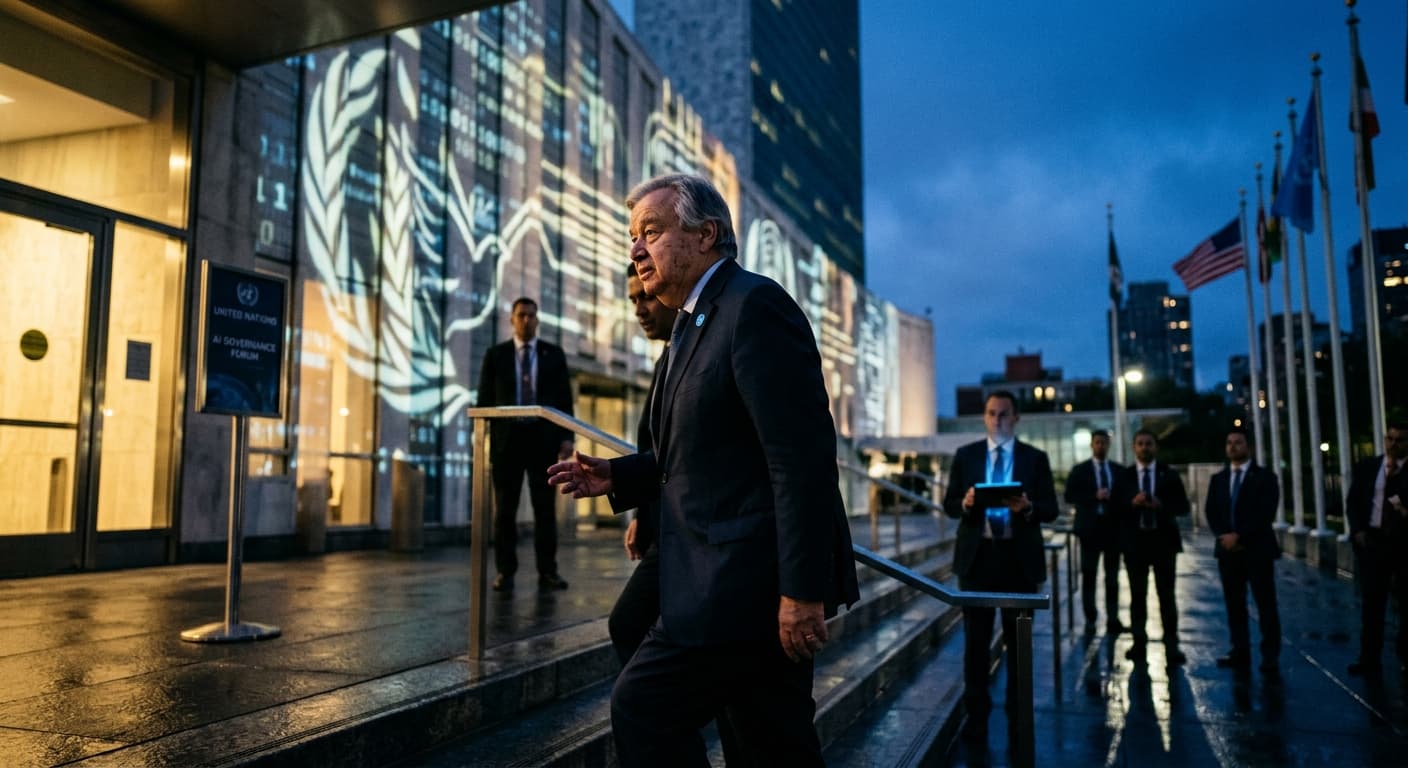
Guterres' AI Governance Push Reframes the US-China Tech Fight
UN chief opens first Global Dialogue on AI Governance in Geneva with a call to ban lethal autonomous weapons — and a bid to reclaim jurisdiction from Washington and Beijing.
The real story from Geneva on July 6, 2026 is not that António Guterres asked the world to ban "killer robots" and warned against "vibe-coding" humanity's future. It is that he did so at the first UN meeting on AI where every one of 193 member states had a seat — after Washington publicly declared it wants no such meeting to matter. Guterres is trying to make the United Nations the default forum for AI rules precisely because the United States has walked away, and China is moving to fill the vacuum. That contest — not the deepfakes, not the child-safety pledge — is what will decide whether the Global Dialogue on AI Governance ends up as a serious rulemaking track or a Global South consolation prize.
What actually happened in Geneva
Speaking at the Palexpo convention centre, Guterres told delegates that "an experiment is being run on our own societies — without a plan, and without consent," according to the as-delivered remarks published by the Secretary-General's office. He named four priorities — safety, equal access, an evidence base and a ban on lethal autonomous weapons systems — and launched a new AI Child Safety Pledge. On weapons,
UN News reported he repeated his standing demand that member states "prohibit lethal autonomous weapon systems that operate without meaningful human control."
Channel News Asia captured the line that will travel: the world "cannot vibe-code the future of humanity."
The Dialogue was mandated by the 2024 Global Digital Compact and formally established by General Assembly resolution A/RES/79/325. It sits on top of a new Independent International Scientific Panel — 40 experts drawn from 2,600 applicants, co-chaired by Turing laureate Yoshua Bengio and Nobel journalist Maria Ressa — whose
Preliminary Report, released on July 1, warns that "current safeguards cannot keep pace with the growth of AI's capabilities" and that a handful of firms and states now control the compute, data and talent behind frontier models.
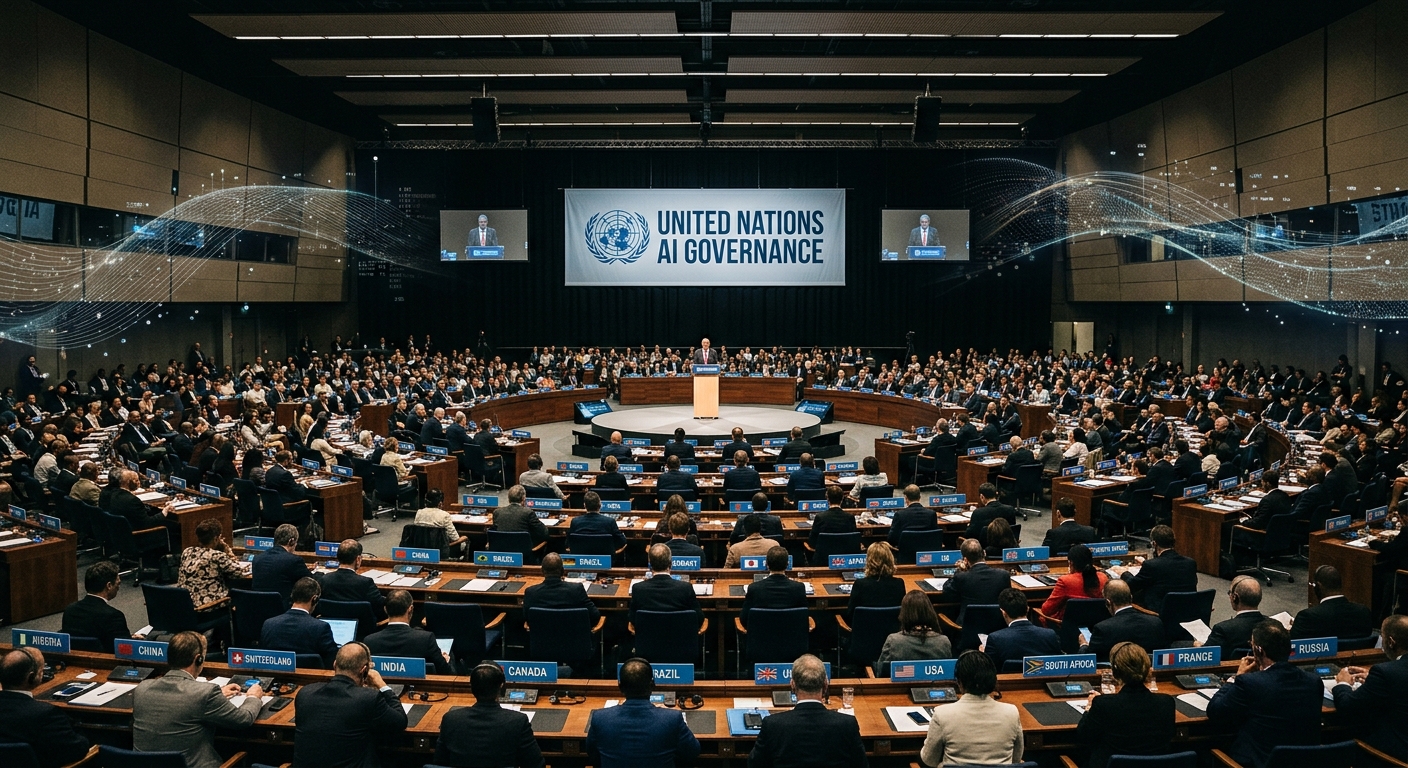
The jurisdictional fight the speech was really about
Guterres' rhetoric is soft, but the play is hard. The Dialogue is being launched into a landscape where the two largest AI powers have deliberately incompatible positions on whether it should exist at all.
The United States is out. In February 2026, White House Office of Science and Technology Policy director Michael Kratsios told the India AI Impact Summit that "we totally reject global governance of AI," singling out "the U.N.'s Global Dialogue on AI Governance" for what he called an "atmosphere of fear," per the White House transcript. That built on July 2025's
America's AI Action Plan, which lists "Counter Chinese Influence in International Governance Bodies" as a formal policy action and names the UN, OECD, G7, G20 and ITU as venues where the US will resist "burdensome regulations" and "cultural agendas that do not align with American values." Washington's strategy is diffusion: export the full American AI stack — Nvidia and AMD silicon, US models, US standards — and let de facto dominance settle the rules.
China is in — loudly. Analysis by the Center for Strategic and International Studies notes that Beijing published its own Global AI Governance Action Plan three days after Washington released its plan in July 2025, casting the UN as the "main channel" for AI rulemaking and proposing a World AI Cooperation Organisation (WAICO). Vice Foreign Minister Ma Zhaoxu, at a UN Security Council debate on AI last autumn, condemned "high fences around a small yard" — a direct hit at US semiconductor export controls. Carnegie's Karman Lucero and colleagues describe the shift as
China's pivot from exporting infrastructure to "recrafting global rules, norms, and institutions of AI governance," with the UN as the preferred stage.
That is the vacuum Guterres is trying to occupy. His speech was pitched to keep the Global South convinced that the UN track offers something real — capacity-building, common safety baselines, access to open models — without letting Beijing turn the process into a China-vs-America referendum.
The killer-robot deadline nobody wants to name
Read the LAWS section of the Guterres speech alongside his own 2023 New Agenda for Peace and the timing snaps into focus. That earlier document, quoted in a May 2026 Finnish Institute of International Affairs briefing paper, asked states to "conclude, by 2026, a legally binding instrument to prohibit lethal autonomous weapons that function without human control." The deadline expires this year. So does the mandate of the CCW Group of Governmental Experts on lethal autonomous weapons, which meets for a Review Conference in November 2026.
The bargaining position is fragile. In December 2024, the General Assembly adopted resolution 79/62 on LAWS by 166 votes to three, according to FIIA; Russia, Belarus and North Korea voted no, but China, India, Israel and Iran abstained — the militaries that most matter.
Human Rights Watch, backing the Stop Killer Robots coalition, argues the CCW has "run its course" and wants states to shift to a stand-alone General Assembly-mandated process, citing more than 110 countries that have publicly supported a treaty. If the November review fails, expect the Global Dialogue to become the political vehicle where a coalition of the willing pushes toward a General Assembly-mandated negotiation outside the CCW's consensus rule.
The European wildcard: rules that travel
While the US disengages and China lobbies, the European Union is doing something more consequential: it is putting a working regulatory model on the shelf and daring everyone else to copy it. Under Regulation (EU) 2024/1689 on EUR-Lex, most of the AI Act begins to apply on August 2, 2026 — less than a month after the Geneva Dialogue closes. General-purpose AI obligations, backed by a Code of Practice the
European Commission published in July 2025, are already in force for new models.
Brussels has trimmed the sails to stay ahead of political backlash. On June 11, 2026, the European Parliament approved a digital omnibus by 423 votes to 57, postponing high-risk AI obligations to December 2027 while banning AI "nudifier" apps outright. An
EPRS enforcement briefing notes that as of March 2026, only eight of 27 member states had designated the single national contact points the law required by August 2025 — a warning that the Brussels effect depends on execution the AI Office has not yet delivered.
For Guterres, this is both help and hazard. The AI Act gives the Global Dialogue a template the Panel can point to when it talks about "common baselines for frontier systems." But if the EU stumbles on enforcement, Kratsios' line — that Europe offers "fear and overregulation" and no one should follow — gains traction with the middle powers Geneva is trying to court.
Who wins, who loses
The immediate winner is the UN Secretariat itself. Establishing the Scientific Panel gives the Secretary-General a scientific interlocutor independent of both Washington and Beijing — the closest thing yet to an IPCC for AI. Bengio's presence on the co-chair line ties the Panel to the Bletchley-era safety consensus; Ressa's presence links it to information-integrity concerns that neither superpower likes to discuss.
The second winner is the Global South. For the first time, small states have a UN table where AI capacity-building and open-source access are default agenda items rather than side sessions. Beijing knows this and is showing up; the Group of Friends for International Cooperation on AI Capacity-Building, co-chaired by China and Zambia, now runs to 80 members.
The clearest losers are the middle powers that had hoped to hedge. India, Japan, Korea, the UK, the UAE and Saudi Arabia are being asked to choose between the American AI Exports Program — hardware and models bundled with US governance preferences — and a UN process the US has publicly disowned. Chatham House's Isabella Wilkinson warned in July 2025 that "the Action Plan should be a wake-up call for middle powers" because it defines the rest of the world "as a market" rather than a partnership. Geneva is where those governments will now have to decide which side of that framing they accept.
The other loser is arms-control orthodoxy. If the CCW mandate expires in November without a negotiating mandate on lethal autonomous weapons, the field will have to migrate — either into the General Assembly, into a stand-alone treaty process, or into the Global Dialogue's next round in New York. Each path erodes the P5's traditional veto over what counts as arms control.
What to watch
- August 2, 2026 — bulk of the EU AI Act applies. Watch whether the Commission's AI Office begins its first GPAI enforcement action; a slow start hands Washington's talking points to allies. See
Regulation (EU) 2024/1689.
- November 2026 (Geneva) — CCW Review Conference. If the GGE fails to adopt a negotiating mandate on lethal autonomous weapons, the Stop Killer Robots coalition will push a General Assembly First Committee process before year-end.
- May 2027 (New York) — second Global Dialogue on AI Governance and the Panel's first comprehensive annual report. The test: does the US send a delegation? Does China try to seed WAICO under the UN tent? Does the Panel name specific frontier systems, or stay generic?
Diplomat View
Guterres' Geneva speech is a strategic bid, not a moral one. The UN Secretariat has read the geopolitics correctly: Washington has ceded the multilateral track on AI; Beijing wants it; the Global South wants the argument on capacity, not chips. By coupling a scientific panel (Bengio, Ressa) with a normative demand (a LAWS ban) and a soft-power win (a Child Safety Pledge), Guterres is trying to make the Dialogue too legitimate for Washington to ignore and too broad-based for Beijing to capture. The forecast: through mid-2027, the Dialogue will not produce binding rules, but it will become the de facto standards-setter for the roughly 130 countries outside the US and Chinese technology spheres — the exact ground China's WAICO is chasing. That call would be wrong if any of three things happen: the Trump administration reverses course and sends a senior delegation to New York in May 2027; the November CCW meeting delivers a negotiating mandate, restoring the older forum; or a frontier AI incident — a serious misuse, a market crash, a cyber operation — forces the P5 into an emergency bilateral track that bypasses Geneva entirely. Until one of those happens, the UN is quietly becoming AI's default rulemaker.
Read today's full |
Discover more

US Politics
SNAP Food Assistance Faces Legal Challenges
In 2026, SNAP faces stricter eligibility rules and mounting legal challenges, threatening food assistance for the millions of Americans who rely on the program.
India
Congress Accuses Modi of Stalling Women's Law
Congress accuses Modi of stalling women's reservation law by linking it to delimitation, revealing a deeper electoral strategy.
India
Rajnath Singh's Durga Squad for 2026 Polls
Rajnath Singh's Durga Squad promised women's safety in Bengal but has since disappeared from the agenda, revealing BJP's true priorities.

Economics
Fed's Amex AML order puts correspondent banking on notice
Federal Reserve's Amex AML order requires board-level controls and a 90-day plan; OCC fined the bank $350 million over enterprise-wide deficiencies.