Green Alliance Backs De la Espriella, Isolats
Colombia's political landscape shifts post-election
Model Diplomat7 min readLatin America
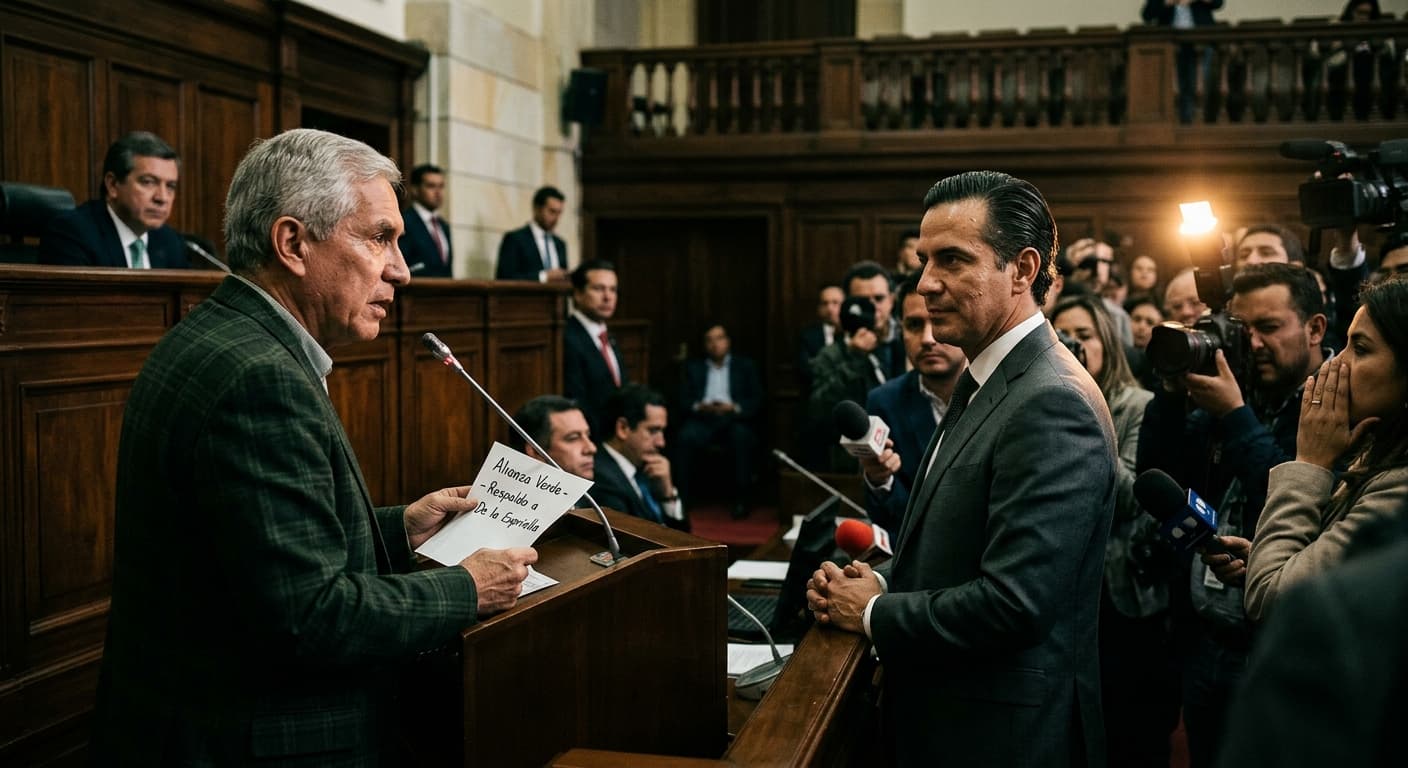
Green Alliance Recognizes De la Espriella, Isolating Petro
Colombia's Alianza Verde formally recognized Abelardo de la Espriella as president-elect on July 8, 2026, breaking with Iván Cepeda and Gustavo Petro after the CNE certified a 250,000-vote runoff win.
The party that helped bankroll Iván Cepeda's presidential run has recognized his rival Abelardo de la Espriella as Colombia's legitimate president-elect — a move that leaves President Gustavo Petro's fraud narrative without a plausible parliamentary vehicle, hands the incoming right-wing government its first institutional concession from the left, and quietly ends the Pacto Histórico as a governing coalition thirty days before it loses power. The Green Alliance's July 8 communiqué does not just accept the count. It reframes Petro's refusal to accept it as an attack on the Constitution.
The break
The Alianza Verde's statement, published Wednesday, is short and clinical. "The Green Alliance Party recognises the official result of the presidential election, in accordance with the certification and declaration issued by the competent electoral authorities, which certified the victory of Abelardo de la Espriella as President and José Manuel Restrepo Abondano as vice president-elect," it reads, according to the text reproduced by ColombiaOne. It demands that Petro deliver a "transparent, responsible and timely" handover and that political disputes "be processed exclusively through the mechanisms provided by the Constitution and the law," as the regional outlet
Vive el Meta reported from the communiqué.
The context is unusual. On April 24, 2026, the Green Alliance signed a "political and programmatic agreement" with Cepeda's campaign, backing him in both rounds. The agreement contained a clause the party is now invoking: "the principles of political alternation and non-reelection will be respected as measures to strengthen democracy." Cepeda's own campaign wrote that sentence, in capitals, into the founding document — and the Verdes are using it against Petro's post-election posture.
The numbers are not close enough to sustain a fraud claim. According to the Registraduría Nacional, De la Espriella won 12,959,542 votes (49.66%) to Cepeda's 12,708,712 (48.70%), a gap of 250,830 votes on record turnout of 63.6% — the highest in any Colombian second round since the 1991 Constitution, BBC Mundo reported. The full judicial escrutinio deviated from the preliminary preconteo by 0.003%, and Cepeda conceded on June 24 in what he called "an act of democratic responsibility," per
BBC Mundo's coverage of his address.
Why Petro is now alone
Petro has spent the two weeks since the certification arguing the opposite of his own candidate. He has publicly asserted that Cepeda was the real winner, blamed Donald Trump for "interference," suspended the transition process indefinitely, and called Colombians into the streets for July 20 — Independence Day — under a banner of "civil disobedience." Cepeda, for his part, has called a separate demonstration for August 6, a day before the constitutional handover, to "pay tribute to the president," according to reporting compiled by ColombiaOne and the Bogotá-based
City Paper.
The Green Alliance defection punctures that strategy in three concrete ways.
First, it removes Petro's institutional cover. The Verdes were, together with the Partido Liberal, the swing bloc that gave Petro's 2022 coalition a working majority in both chambers, as Real Instituto Elcano documented at the time in its analysis of the 2022 electoral geometry. Losing them in July 2026 means Petro's fraud narrative has no path through Congress — no procedural device, no impeachment counter-move, no committee inquiry. It becomes street politics only.
Second, it hands De la Espriella a legitimacy asset he did not earn on the ballot. The president-elect ran with the backing of just four senators from Movimiento Salvación Nacional and a fragmented Cambio Radical, per BBC Mundo's Senate mapping. The Verdes' 11 senators are the first plausible bridge to a legislative coalition — not for his agenda, but for his authority. His transition team, which had asked international observers to monitor the handover according to the
City Paper, no longer needs to lean solely on Washington. It has a domestic left-of-centre party validating the count.
Third, it isolates Cepeda from his own reservoir of centrist and centre-left votes. In BBC Mundo's post-election interview with Cepeda, he framed his opposition around De la Espriella's U.S. citizenship and threatened "civil disobedience" if the incoming government moves against Petro-era reforms. That posture works if the entire progressive bloc holds. The Verdes have just announced it will not.
The evidence the Verdes cite — and Petro cannot refute
The party's communiqué anchors itself in the primary electoral record. The Consejo Nacional Electoral (CNE) proclaimed De la Espriella president-elect on June 24, 2026, and separately dismissed a petition to revoke his candidacy over his U.S. citizenship, ruling — as BBC Mundo quoted the resolution — that "no cause of ineligibility or disqualification constitutionally provided for aspiring to the Presidency of the Republic has been proven." CIDOB's political biography of the president-elect confirms the
CNE's June 24 proclamation and the August 7 inauguration date under the 1991 Constitution.
The European Union's observation mission — deployed at Colombia's invitation and led by European Parliament Vice-President Esteban González Pons, per an official European Parliament briefing — declared the first-round vote "transparent, orderly, and smooth" after deploying 143 observers to 591 polling stations, as
Al Jazeera reported. MEP Leire Pajín Iraola, who led the European Parliament delegation, stated: "Despite the polarization, disinformation and tensions that marked the campaign, election day proceeded peacefully, in an orderly manner, with broad citizen participation and respect for democratic institutions."
The ColombiaOne piece notes that more than 1,200 international observers, including the EU mission, endorsed the transparency of the process — a fact the Verde communiqué explicitly leans on when it invokes "the competent electoral authorities."

The historical parallel — and why it matters
The closest analogue in Colombian politics is not the 2022 Petro–Hernández race, which ended in a clean concession. It is 1994, when the Ernesto Samper–Andrés Pastrana contest triggered years of allegations that ultimately damaged the winner more than the loser. What is different in 2026 is that the loser's coalition itself is fracturing before the transition even completes. The Green Alliance is doing to Petro what no one did to Samper: publicly, in writing, and in the name of the party's own democratic charter.
That has second-order consequences the Casa de Nariño appears not to have priced in. The Verdes are Petro's most-cited exit ramp for after August 7 — the party many analysts assumed would house him in a "moderate progressive" opposition. By breaking with him now, the party is signalling that a post-presidential Petro will not command a natural home on the institutional left. As Yann Basset of the Universidad del Rosario had already warned BBC Mundo before the election, "If Cepeda were president, Petro could be an even more problematic ex-president than Uribe has been" — the calculation now runs in reverse. It is the ex-president that the party is walling off from, not the successor.
What the incoming government gets — and what it still lacks
De la Espriella still faces a Congress in which the Pacto Histórico is the largest bloc, with an estimated 26 Senate seats to Centro Democrático's 17, according to projections cited by BBC Mundo. Even with the Verdes' 11 senators and a portion of the 13 liberales, he does not automatically command a majority. What the Verde recognition delivers is not votes on his legislative agenda — the party has been clear it will negotiate reforms bill by bill — but a floor of constitutional legitimacy that Petro's rhetoric had been trying to erode.
International Crisis Group's pre-election assessment warned that both De la Espriella and Cepeda would inherit a country in which "polarisation and fragmentation" would make governance nearly impossible without cross-bloc pacts. The Green Alliance is now the first party to signal it is available for exactly that kind of pact — on institutional, not programmatic, grounds.
What to watch
- July 20, 2026: Petro's Independence Day mobilisation. Turnout will indicate whether "civil disobedience" is a mass phenomenon or an elite performance. Watch whether Verde figures attend.
- August 6, 2026: Cepeda's "tribute to the president" march. A large turnout complicates the handover; a small one confirms the Verde reading that Petro is now politically isolated.
- August 7, 2026: Inauguration. The constitutional line. De la Espriella's inaugural address — conciliatory in Barranquilla on June 21, according to
BBC Mundo — will signal whether he treats Verde recognition as an opening or an opportunity to press further.
- Late August 2026: First congressional session under the new government. The Verdes' voting pattern on De la Espriella's initial cabinet confirmations will show whether the July 8 communiqué is a one-time institutional gesture or the start of a durable working relationship.
The Bottom Line
The Green Alliance's July 8 recognition of Abelardo de la Espriella is not a defection — it is a constitutional veto on Gustavo Petro's post-election playbook. By choosing the 1991 Constitution over Petrista loyalty, an eleven-senator bloc has denied the outgoing president the parliamentary cover he needs to sustain a fraud narrative, handed the incoming right-wing government a legitimacy asset it did not win at the ballot box, and quietly ended the Pacto Histórico as a coherent political force thirty days before it loses the Casa de Nariño. What comes next in Colombia is not a contested transition — it is a contested opposition.
Discover more

Global Politics
US-Iran Tensions Rise
Tensions escalate in the Strait of Hormuz as Iran and the US clash over maritime control, with a ceasefire hinging on a contested MoU paragraph.

Global Politics
US Naval Blockade on Iran
The US fully imposed a naval blockade on Iranian ports, escalating tensions even as Trump hinted the conflict may soon end while serious risks of war remain.
Global Politics
U.S. Maritime Pressure on Iran
Washington escalates maritime security operations and sanctions on Iran, disrupting Gulf shipping and reshaping global energy flows in a major strategy shift.

Economics
Fed's Amex AML order puts correspondent banking on notice
Federal Reserve's Amex AML order requires board-level controls and a 90-day plan; OCC fined the bank $350 million over enterprise-wide deficiencies.