Equatorial Guinea's Foreign Policy Strategy
Malabo's hedging across great powers for survival
Model Diplomat4 min readafrica
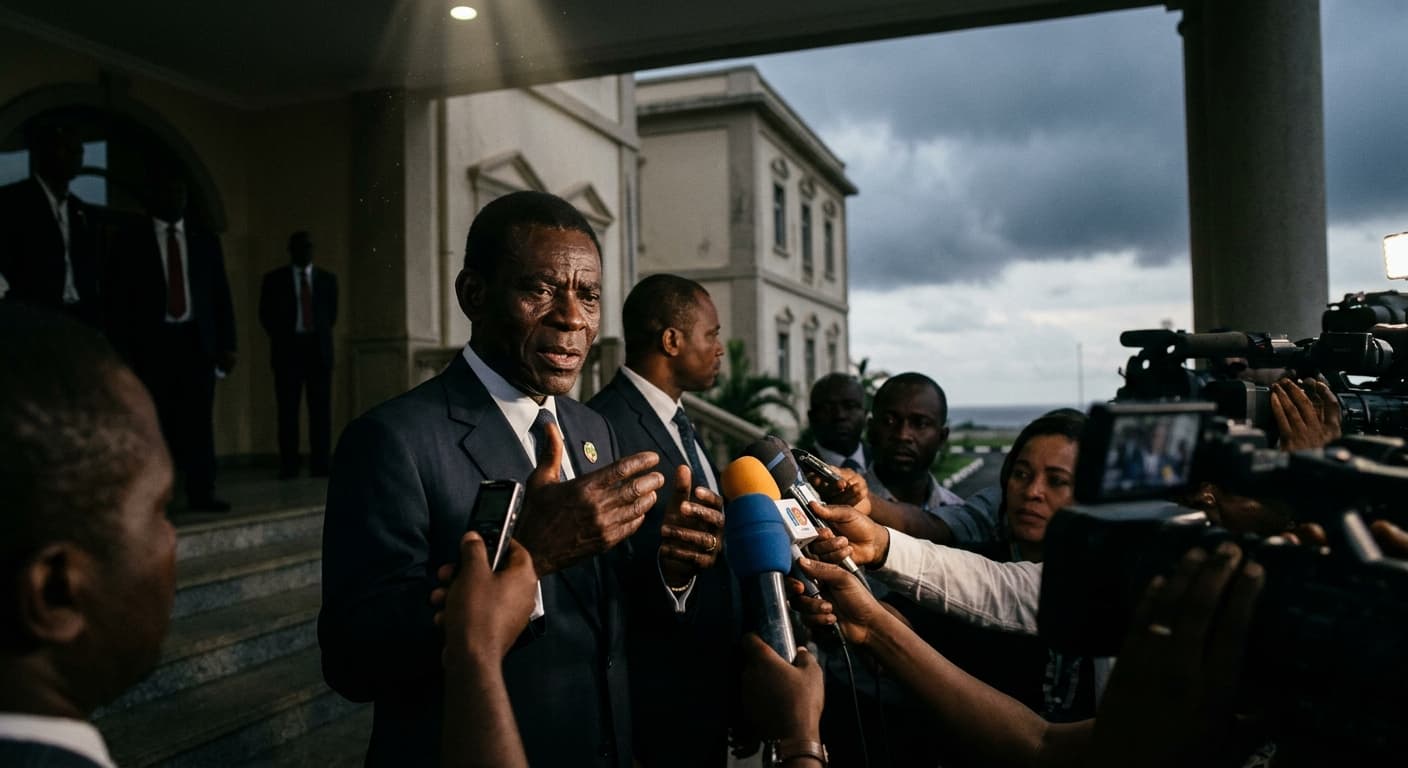
Oil and Survival: Inside Equatorial Guinea's Triangulated Foreign Policy
With oil reserves projected to exhaust by 2035, Malabo is hedging across three great powers — Russia for regime protection, China for infrastructure credit, and a dormant U.S. relationship it would revive if the price were right.
The Model Diplomat's newly published country profile on Equatorial Guinea confirms what recent events have already made visible: President Teodoro Obiang Nguema Mbasogo runs a foreign policy whose first priority is staying in power, its second is monetizing dwindling hydrocarbons, and development comes a distant third. The framework explains three moves in the past 18 months that would otherwise look disjointed — Russian boots on the ground, a landmark ICJ territorial win, and the quiet deepening of China's footprint.
The one-sentence foreign policy
Everything flows from the presidency. Obiang, in power since seizing it in a 1979 coup, was reelected in November 2022 with 94.9% of the vote, and his PDGE party holds nearly every legislative seat World Bank. Formally a presidential republic with a prime minister — Manuel Osa Nsue Nsua, appointed August 2024 — the state operates as a centralized personal regime. Foreign policy is not made in the Foreign Ministry; it is made in the presidency, and it serves one objective above all: preventing the kind of elite rupture or external isolation that could end Obiang's tenure.
That imperative has become more urgent as the hydrocarbon base erodes. The IMF's 2025 Article IV consultation confirms the economy contracted in seven of the last nine years, hydrocarbon production is in secular decline, and foreign reserves at the regional BEAC central bank have gone negative IMF Country Report 25/224. The World Bank projects GDP will contract a further 3.5% over 2026–27, with poverty rising to 61%
World Bank. The fiscal balance flipped from a 2.4% surplus in 2023 to a deficit in 2024. Debt is now the binding constraint: the IMF and authorities have agreed a 50%-of-GDP anchor, with external balance restoration targeted by 2029.
Russia, China, and the ICJ: three hedges, one logic
Russia. In November 2024, the BBC reported that Russia had deployed between 100 and 200 military instructors — likely from Corps Africa, the rebranded Wagner — to train elite presidential guards in Malabo and Bata BBC. President Obiang thanked Vladimir Putin publicly in September for "strengthening Equatorial Guinea's defense." The deal is the purest expression of regime-security diplomacy: Moscow gets a Gulf of Guinea foothold with no human-rights conditionality; Obiang gets a Praetorian guarantee external patrons won't supply.
China. Beijing's presence is older and deeper, but its logic is infrastructure-for-access. CSIS documented how the Export-Import Bank of China financed the Port of Bata, the China Road and Bridge Corporation upgraded it, and the Industrial and Commercial Bank of China announced a $2 billion support package in 2015 CSIS. In December 2021, the Wall Street Journal reported China was exploring a permanent military facility — a prospect that prompted U.S. diplomatic pushback in 2022. Beijing denies it, but the pattern is set: nonconditional credit in exchange for strategic positioning on the Atlantic.
The ICJ. The third prong is legal. In May 2025, the International Court of Justice ruled in Equatorial Guinea's favor in its decades-old dispute with Gabon over the islands of Conga, Mbanié, and Cocoteros — virtually uninhabited but sitting in waters thought to hold significant oil deposits BBC. The ruling, based on a 1900 colonial treaty, requires Gabon to withdraw its soldiers from Mbanié. For a regime watching its proven reserves run toward the 2035 exhaustion point, every barrel of potential new production matters — and Malabo just secured a legal claim to a contested basin.
What to watch
The triangulation has limits. Oil revenues still account for roughly 80% of government income, and without diversification, the fiscal math is terminal. The World Bank's first-ever Country Economic Memorandum, issued in March 2025, was blunt: major reforms to tax policy, sovereign wealth fund deployment, and business climate are needed, and none are yet underway at scale World Bank CEM.
Three dates matter next. First, the post-ICJ Gabon negotiations — whether Libreville complies with the troop withdrawal order or drags it out. Second, the IMF's SMP review cycle, which tests whether Malabo can sustain the fiscal adjustment needed for a future financing arrangement. Third, Obiang himself: at 84, the succession question is the regime's ultimate vulnerability. His son, Vice President Teodoro Nguema Obiang Mangue, has been sanctioned abroad for corruption and lavish spending. Whether Russia's instructors are protecting the father or positioning the son is a question the foreign policy framework doesn't answer — because it can't.
Equatorial Guinea is a case study in what happens when a petro-state runs the regime-survival playbook past the point the oil runs out. The great powers are pricing that risk. The people of Equatorial Guinea are living it.
Discover more
US Politics
House Ethics Committee Pushes Sexual Miscond.
The House Ethics Committee has shifted responsibility for sexual harassment settlement records to the Office of Congressional Workplace Rights, complicating disclosure efforts.

US Politics
Senate Repeals Minnesota Mining Ban for Twin
The Senate's repeal of a 20-year mining moratorium in Minnesota allows Twin Metals to proceed, raising concerns over environmental impacts and foreign ownership.

US Politics
White House Pressures Congress for Crypto Leg
The Trump administration's push for the CLARITY Act aims to reshape crypto regulation, impacting trillions in market value and the Trump family's wealth.

Conflict & Security
Drone Warfare Killing Aid Workers at Unprec
Over 1,000 humanitarian workers killed in three years as cheap armed drones collapse legal protections. Gaza, Sudan, Ukraine, and DRC see deliberate targeting of aid convoys and hospitals with zero prosecutions.