Equatorial Guinea's Election: Obiang's Power
Obiang moves election to curb succession tensions
Model Diplomat3 min readafrica
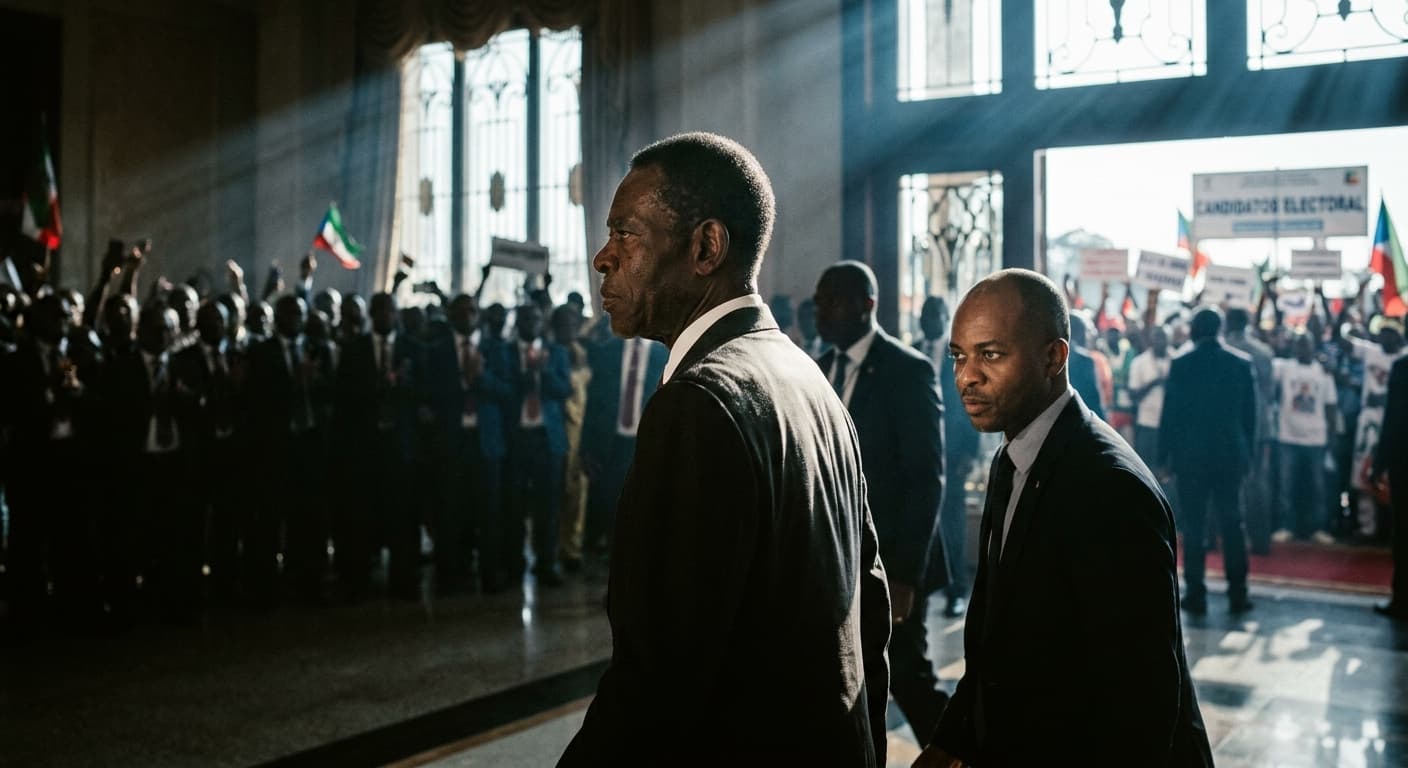
Equatorial Guinea's Snap Election: Obiang Moves to Freeze the Succession Fight
Teodoro Obiang brought forward the presidential vote to November 2022 not to save money — but to shut down an escalating power struggle between his son and the regime's old guard.
On September 20, 2022, Teodoro Obiang Nguema Mbasogo issued a decree moving Equatorial Guinea's presidential election forward by five months to November 20, combining it with legislative and municipal ballots. The official justification was fiscal: grouping costly polls amid economic strain from the Ukraine war and COVID-19. The real reason was to freeze an intra-family succession battle that had begun spilling into the open.
The Democratic Party of Equatorial Guinea (PDGE), which holds 99 of 100 seats in the lower house and all 70 Senate seats, had been expected to anoint Vice President Teodoro "Teodorin" Nguema Obiang Mangue as its presidential candidate at a party congress in November 2021. That didn't happen. Instead, the congress produced what observers described as "unprecedented quarrels" between supporters of Teodorin and loyalists of his 80-year-old father, according to The Maravi Post. The party adjourned without naming a candidate — a conspicuous failure in a system where no genuine electoral competition exists.
By accelerating the timeline, Obiang forced resolution. On September 23, just three days after the decree, the PDGE unanimously nominated him for a sixth term, The Africa Report confirmed. The speed left no room for the succession faction to organize. Teodorin himself announced the nomination on Twitter, framing it as inevitable given his father's "charisma, his leadership and his political experience" — language that signaled, for now, deference.
The succession machinery, stalled
The dynamic here is structural, not personal. In Equatorial Guinea's patronage system, elections serve primarily to reshuffle internal power within the PDGE. Regional party chiefs deliver votes through networks of favors and coercion, and in return they extract positions and resources. Teodorin, 52, has spent years building parallel patronage networks through his control of the vice presidency and the defense portfolio. He is the regime's enforcer — feared, omnipresent, and publicly flamboyant.
But the old guard, the caciques who built the regime alongside Obiang after the 1979 coup that ousted his uncle Francisco Macías Nguema, see Teodorin as a liability. His 2020 French embezzlement conviction, his 2021 UK sanctions under anti-corruption laws, and the US Department of Justice's seizure of his assets — including a Malibu mansion and Michael Jackson memorabilia — make him internationally toxic. The regime has been trying to rehabilitate its image, abolishing the death penalty in September 2022 in a move praised by the UN, BBC News reported. Handing power to a convicted embezzler would undercut that project.
By running again himself, Obiang keeps both factions in check. Teodorin remains heir-apparent but not heir-now. The old guard gets continuity. And the 80-year-old president buys time to manage the transition on his own terms — or outlast it.
Pre-election repression sets the stage
The regime tightened its grip in the weeks before the vote. In late September, security forces stormed the headquarters of the banned Citizens for Innovation (CI) party after a siege lasting more than a week. The assault left five dead — four activists and one policeman — and more than 150 arrested, including CI leader Gabriel Nse Obiang Obono, Al Jazeera reported. Rights campaigner Anacleto Micha Nlang was detained and transferred to Black Beach prison, the regime's most notorious facility.
The crackdown was justified by state media as countering a "foiled plot" by the opposition to attack embassies and ministries — a familiar script in a country where independent media barely exists and Reporters Without Borders ranks it 164th out of 180 countries for press freedom. The message to any potential dissent was unambiguous ahead of the vote.
What to watch
Obiang secured nearly 95% of the vote on November 20, extending his 43-year rule, BBC News later confirmed. The outcome was never in doubt. The question that matters is what happens next inside the PDGE: whether the 2021 congress was a one-time rebellion by the old guard, or the first fracture in a succession process that will become harder to contain the longer it is deferred. The death penalty abolition and other reputational gestures suggest a regime that understands its international isolation is deepening. The contradiction between that project and Teodorin's unresolved legal exposure abroad will define the next phase.
Discover more
India
Women's Reservation Bill 2026: A Political Sh
India's Lok Sabha rejected the Women's Reservation Bill, exposing a political maneuver to redraw electoral maps favoring the north over the south.
Global Politics
Trump's Conflicting Messages on Iran War
Trump's mixed messages on Iran reflect a strategy of audience management, benefiting Tehran amid a complex geopolitical landscape.
India
Rajnath Singh's Durga Squad for 2026 Polls
Rajnath Singh's Durga Squad promised women's safety in Bengal but has since disappeared from the agenda, revealing BJP's true priorities.

Conflict & Security
Drone Warfare Killing Aid Workers at Unprec
Over 1,000 humanitarian workers killed in three years as cheap armed drones collapse legal protections. Gaza, Sudan, Ukraine, and DRC see deliberate targeting of aid convoys and hospitals with zero prosecutions.