Ghana's $700m Eurobond Prepayment Explained
Ghana's debt prepayment sets a new standard for Africa.
Model Diplomat7 min readSub-Saharan Africa
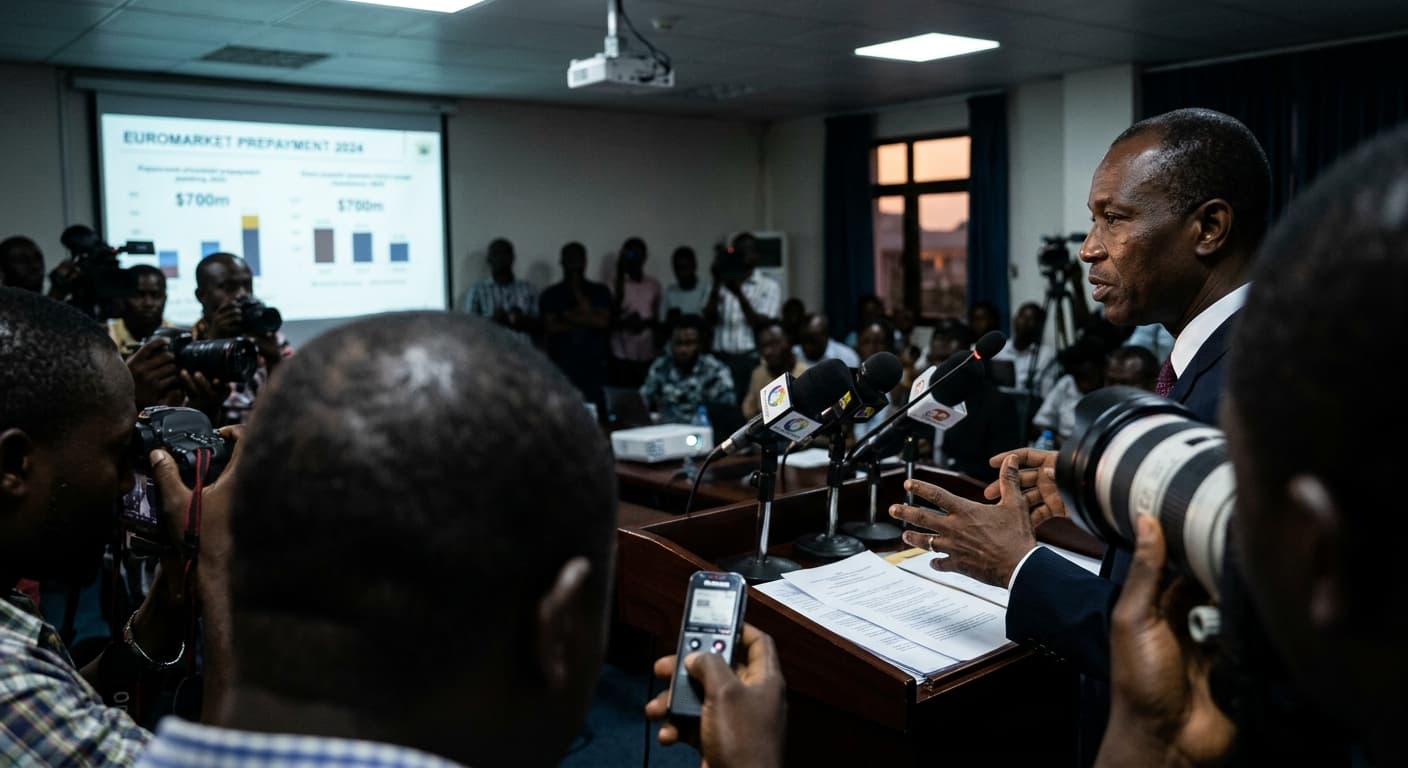
Ghana's $700m Eurobond Prepayment: A Debt Playbook for Africa
Ghana prepaid $700 million of restructured Eurobond debt on July 6, 2026, taking total post-default payments to $2.1 billion — the sharpest turnaround in Sub-Saharan Africa's current debt cycle.
Ghana's $700 million Eurobond prepayment on July 6, 2026 — settled ahead of schedule and lifting cumulative payments under the restructured programme to $2.1 billion — is less a debt event than a demonstration effect: it signals that the G20 Common Framework can produce a debtor that pays early rather than perpetually reschedules, and it raises the bar for Zambia, Ethiopia and the next wave of African defaulters. According to Accra's Ministry of Finance, the transfer comprised $525.2 million in principal and $174.8 million in interest, funded from reserves the Bank of Ghana no longer needs to defend the cedi. The subtext for a Sub-Saharan Africa where 22 low-income countries remain in or at high risk of debt distress: the Ghanaian model — front-loaded IMF anchor, fast bondholder deal, aggressive gold-backed reserve build — is now the template creditors will demand from everyone else.

The mechanics of a fast recovery
The July 6 payment is the second scheduled tranche since Ghana's restructured Eurobonds began servicing again. An earlier disbursement of about $349.5 million cleared in early 2026, and a $350 million payment landed in July 2025, per the IMF's fifth-review staff report. What made this week's transfer notable was its size and timing: the Ministry of Finance settled the obligation early, framing it as a way "to avoid placing excessive pressure on Ghana's foreign exchange reserves" while trimming the outstanding stock of restructured paper.
That framing is credible because the underlying macro numbers have moved decisively. Real GDP grew 5.7% in 2024 and 6% in 2025 on services and mining strength, according to the World Bank's country brief, while headline inflation collapsed to 3.3% in February 2026 from north of 23% at end-2024. The cedi appreciated 36% against the dollar in the ten months to end-October 2025 — an unprecedented run for a post-default African sovereign, driven, per the
IMF's fifth-review documents, by a current-account surplus of 3% of GDP at mid-2025 and roughly $9 billion in one-off FX supply from gold sales.
The gold story is decisive. Bank of Ghana Governor Johnson Asiama told an IMF interview in December 2025 that the GoldBod initiative — which centralised purchasing, selling and exporting of artisanal and small-scale gold from March 2025 — had generated "about $8 billion" for reserves through a revolving mechanism, lifting import cover from two weeks at the depth of the 2022 crisis to roughly four-and-a-half months. That is the balance sheet from which the $700 million was written.
The Common Framework's first success story
Ghana's arc from moratorium to prepayment is now the shortest on the board. The World Bank's own Policy-Based Guarantee factsheet recorded the December 19, 2022 suspension of Eurobond service; the Eurobond exchange, covering roughly $13 billion, settled in October 2024, per the
IMF third-review report. The interval between default and re-servicing was under two years — half the time Zambia needed, and shorter than any comparable case under the G20 Common Framework so far.
President John Mahama's predecessor, Nana Akufo-Addo, argued in an Atlantic Council essay that speed was the deliberate strategy: African-embedded advisers, rapid alignment of the finance ministry to creditor timelines, and a bondholder deal designed as a straight refinancing rather than a Zambia-style haircut fight. Ghana's Eurobond exchange delivered NPV relief consistent with programme parameters — around 37% for holders in the base scenario — but avoided the multi-year comparability-of-treatment (CoT) impasse that has bedevilled other cases. The
Global Sovereign Debt Roundtable co-chairs' April 2026 progress report confirms that Ghana's residual non-bonded commercial creditors now represent under 5% of the debt perimeter.
Compare that with Ethiopia, where an agreement in principle reached with bondholders in early 2026 was rejected by the Official Creditor Committee for failing the CoT test, per the same GSDR document. Or Zambia, which the
IMF's Executive Board declared substantially complete only after four years and multiple public rows with Beijing's official-lending arms. Ghana leapfrogged those fights by getting bondholders and the OCC to move roughly in parallel — which is why bond investors got their coupon back on time and a prepayment offer in year two.
Who wins, who loses
The obvious winners are the holders of Ghana's new Eurobonds. Restructured paper that traded around 40 cents on the dollar in 2023 was north of 90 cents by early 2026 as the cedi rallied and prepayments materialised. Franklin Templeton, Amundi, and the ad hoc bondholder committee members that accepted the exchange are being paid principal three-plus years earlier than the pre-restructuring baseline assumed — a rare positive tail for restructured African credit.
The less-visible winner is the IMF. Ghana is on track to complete its Extended Credit Facility and roll into a non-financing Policy Coordination Instrument, per the Fund's May 15, 2026 press release on the sixth review — the reform-focused surveillance instrument reserved for graduates from crisis support. The Fund is quietly using Ghana as its counter-example to critics who argue the Common Framework has failed. The concrete milestone: a legislated debt anchor of 45% of GDP by 2034, with the Minister of Finance removable from office if the fiscal rule is breached more than twice, an unusually stringent institutional lock-in.
The losers are subtler. First, holdouts and litigious creditors elsewhere in Africa lose a talking point — Ghana's cooperative model is now the benchmark. Second, credit rating agencies face reputational drag. The Brookings Africa Growth Initiative estimates 16 African countries pay more than $74 billion in excess debt-service costs because ratings agencies mis-price their risk; Ghana's swift return to prepayment status will be cited in every future push to build the African Credit Rating Agency by 2026. Third, domestic critics of the Mahama administration have lost the fiscal-populism argument: with a 2.5% primary surplus in 2025 versus a 1.5% target, per the
World Bank, spending pressure ahead of the next electoral cycle is being contained by an enforceable rule.
The historical parallel — and its limits
There is a 2018 echo worth noting. According to the IMF's 2019 country report, Ghana in May 2018 used a $1.5 billion Eurobond issuance partly to buy back most of a $750 million 2022 bond — a textbook liability-management operation that eased near-term rollover pressure. It worked, briefly. Within four years, Ghana was in default. The lesson: prepaying restructured debt is meaningful, but sustaining market access is a decade-long discipline, not a headline event.
The IMF and the Global Sovereign Debt Roundtable are trying to institutionalise that discipline. The Roundtable's April 2026 Liability Management Operations manual is essentially a rulebook drawn from post-restructuring cases like Ghana, formalising cost-benefit tests, credit-enhancement structures, and reverse-auction mechanics for future prepayments. Ghana's Debt Management Office already has IMF technical assistance on liability-management operations and a sinking-fund architecture designed to smooth the large 2027–28 domestic-debt exchange maturities. The plumbing behind this week's headline is exactly the plumbing the Fund wants every restructured sovereign to build.
There is also the awkward parallel Chatham House flagged in its June 2026 Kenya brief: Kenya, which never defaulted, still faces debt service consuming over a third of revenues and a shilling wobble linked to Chinese-currency conversions on its standard-gauge railway loans. Ghana has, in a real sense, traded a lost decade for a cleaner balance sheet. Whether that trade-off is replicable — or whether it required the specific commodity tailwind of gold hitting record prices as GoldBod scaled up — is the open question for Zambia's post-programme phase and for anyone modelling Angola's or Nigeria's next Eurobond redemption.
What to watch next
The near-term catalysts are concrete:
- IMF Executive Board approval of the sixth ECF review and the 36-month PCI, expected in the third quarter of 2026. Board sign-off unlocks the pivot from crisis financing to surveillance, and validates the debt trajectory that makes further prepayments possible.
- Sinking-fund operations for the 2027–28 domestic-debt-exchange maturities. Per the
IMF fifth-review report, two sinking funds were created in the mid-year budget review to buffer these; execution is a test of debt-management credibility.
- Ethiopia's next bondholder round. If Addis Ababa can strike a CoT-compliant deal by year-end, the Ghana template becomes doctrine. If not, expect louder African calls at the G20 to reform the Common Framework — a demand echoed by the
Atlantic Council's 2026 Africa debt analysis and the
South African Institute of International Affairs under Pretoria's G20 presidency.
Diplomat View
Ghana's prepayment is real progress, but it is not a permanent victory — it is a windfall being managed responsibly. The base call: with gold prices near record highs, a legislated fiscal rule, and IMF surveillance extended through 2029 via the PCI, Ghana will make at least one more scheduled Eurobond payment in the next twelve months and re-enter international bond markets on an opportunistic basis before the 2028 election cycle. The forecast breaks in one of three specific ways: a 20%+ correction in gold prices that removes the GoldBod tailwind; a breach of the 45% debt-to-GDP anchor that triggers the removal clause for Ato Forson and shakes investor confidence; or a repeat of the 2024 pre-election spending slippage the IMF's 2025 country report documented in detail. Absent one of those, Ghana is the case study creditors will wave at every African finance minister for the rest of the decade — and the case study African finance ministers will resent for exactly that reason.
The Bottom Line
Ghana's $700 million prepayment matters because it converts the G20 Common Framework from an object of ridicule into a working template — one that will now be imposed on Ethiopia, held over Zambia's residual creditors, and cited against any African sovereign asking for a longer haircut. The debt playbook that ends with a debtor paying early is the playbook that gets replicated. What Accra pulled off in twenty months, the IMF will spend the next five years asking everyone else to copy.
Discover more
International Relations
Economist Impact Sustainability Week 2026
Economist Impact Sustainability Week 2026 spotlights the energy transition, AI in clean technology, and supply chain resilience as themes for global leaders.

US Politics
SNAP Food Assistance Faces Legal Challenges
In 2026, SNAP faces stricter eligibility rules and mounting legal challenges, threatening food assistance for the millions of Americans who rely on the program.
Global Politics
Trump's Conflicting Messages on Iran War
Trump's mixed messages on Iran reflect a strategy of audience management, benefiting Tehran amid a complex geopolitical landscape.

Conflict & Security
Drone Warfare Killing Aid Workers at Unprec
Over 1,000 humanitarian workers killed in three years as cheap armed drones collapse legal protections. Gaza, Sudan, Ukraine, and DRC see deliberate targeting of aid convoys and hospitals with zero prosecutions.