Ghana's $700M Eurobond Payment Resets Debt
Ghana pays off Eurobond early, signaling credit recovery.
Model Diplomat7 min readSub-Saharan Africa
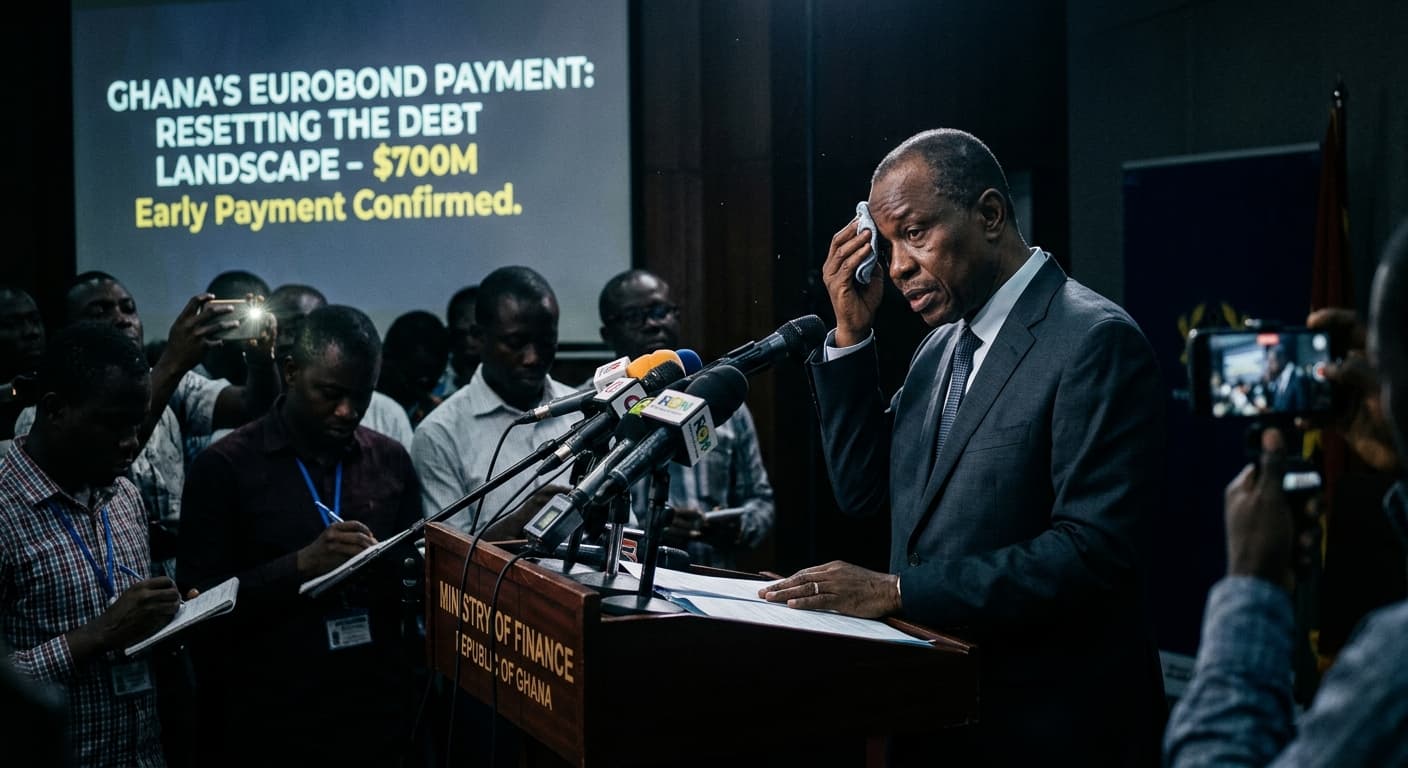
Ghana clears $700m Eurobond early — resetting Africa's debt bar
Ghana settled a $700m Eurobond on July 2, 2026, ahead of schedule — a signal to investors that Sub-Saharan Africa's biggest defaulter has re-anchored its credit.
Ghana's Ministry of Finance said on July 6, 2026 that the government wired $700 million to Eurobond holders on July 2 — $525.2 million in principal and $174.8 million in coupon — ahead of the payment date set out in its 2024 debt exchange, according to Businessfront. The transaction lifts cash paid to bondholders since January 2025 to $2.1 billion. The real story is not the cheque — it is that Ghana is now the first defaulter of the 2022 cohort to be paying commercial creditors early with reserves it did not have 18 months ago, and that fact is quietly repricing risk across the region. Investors from Nairobi to Abidjan are the beneficiaries; holdout creditors in Ethiopia are the losers.
The mechanics of the payment
The obligation cleared was a scheduled disbursement under Ghana's Eurobond Debt Exchange Programme, the instrument that in October 2024 replaced roughly $13 billion of pre-crisis paper with new bonds carrying nominal haircuts and stretched maturities. In its statement, reported by Nairametrics, the ministry stressed that the payment was made "through the Government's planned financing arrangements without undue pressure on the country's foreign exchange reserves."
That claim is verifiable. According to the Bank of Ghana's January 2026 Monetary Policy Committee release, gross international reserves stood at $13.8 billion at end-December 2025 — 5.7 months of import cover — up from $9.1 billion and 4.1 months a year earlier. The current account swung from a $1.5 billion surplus in 2024 to a provisional $9.1 billion surplus in 2025, driven by gold. Finance Minister Cassiel Ato Forson signed off the cheque; Bank of Ghana Governor Johnson Pandit Asiama, in office since February 2025, has warehoused the dollars.
Ghana still owes bondholders. As the High Street Journal noted, the Ministry of Finance had pencilled in $1.409 billion of Eurobond debt service for calendar 2026, the largest single-year external bond bill since restructuring. Clearing $700 million of that in one shot before the due date is a decision about signalling, not just cash management.
Why this repositions the neighbourhood
Ghana defaulted alongside Zambia (2020), Sri Lanka (2022) and Ethiopia (2023). Four years on, the class is diverging sharply. The IMF's Global Sovereign Debt Roundtable co-chairs' progress report of April 2026 records that Ghana and Zambia are "close to full completion" of their restructurings, with residual non-bonded commercial creditors representing less than 5% of Ghana's perimeter. Ethiopia, by contrast, "is yet to be reached" with bondholders. Sri Lanka needed emergency financing in December 2025 after a cyclone.
The distinction matters because bond markets price the successful cases as templates. Global asset allocators no longer ask whether a G20 Common Framework restructuring can end — Ghana just showed the exit. They now ask which sovereigns look like Ghana's pre-2022 trajectory (Kenya, Angola) and which look like its post-2024 one (Zambia, Ivory Coast).
The pricing is already reflecting the shift. The IMF's April 2026 Regional Economic Outlook for Sub-Saharan Africa counted $14 billion of African Eurobond issuance in 2025 and $5.5 billion in just the first two months of 2026, with ratings upgrades in Ghana, South Africa and Zambia. Ivory Coast in June 2026 drew $6.3 billion of orders for a $1.3 billion 15-year bond priced at 5.39% — a spread that would have been unthinkable during the 2022-24 "funding squeeze" described in earlier IMF work.
The G20 Common Framework, vindicated by one country
For three years the Common Framework was widely written off as slow, opaque and creditor-unfriendly. Council on Foreign Relations analyst Brad Setser argued in a 2023 CFR essay that the process had taken "far too long" even where it produced relief. Ghana's own path was contested: the domestic debt exchange forced onto Ghanaian pensioners was described in academic work by Isaac Akolgo in
Development and Change as producing pensioner protests and a former chief justice calling it "wicked, disrespectful, unlawful and totally wrong."
But by the numbers, the framework worked here. The IMF's fourth review staff report of July 2025 concluded that Ghana's public debt was "assessed to be sustainable" and projected the country reaching moderate risk of debt distress by 2028, with international reserves at three months of imports at program end. Ghana blew past that reserves target. The 2025
World Bank country brief records real GDP growth of 5.8% in 2024 and 6.0% in 2025, headline inflation down to 3.3% in February 2026, and a 2.5% primary fiscal surplus against a 1.5% program target.
The IMF's own read is unusually direct. In its May 15, 2026 staff-level statement closing the sixth and final ECF review, mission chief Ruben Atoyan wrote that Ghana's program "has delivered substantial stabilization gains," with "the primary surplus overperforming the program target in 2025, while the public debt ratio declined sharply."
Ghana's next chapter is a 36-month non-financing Policy Coordination Instrument. As Ghana's presidency announced, the PCI is pitched as a signal to private investors and "a move to achieve 'Investment Grade' status." That is aspirational — Ghana remains multiple notches below investment grade — but the direction of travel is now the story.
Who benefits, who does not
Three winners:
Peer African sovereigns rolling debt in 2026-27. Kenya, which the IMF Regional Economic Outlook flags as facing sizeable amortisations, gains most from a Ghana-driven compression in the "African premium." IMF working paper research by Alter and co-authors,
published in 2025, argues the African premium in normal times is "modest" once fundamentals are controlled for. Ghana's payment gives that thesis a live case study.
Bondholders who took the 2024 exchange. Funds that accepted Ghana's haircut — including specialists such as Abrdn, whose Kevin Daly told the Financial Times in 2022 the default was "largely priced in" — are recovering cash on an accelerated timetable, not the extended one their models likely assumed.
The G20 Common Framework itself. Every early payment from Accra weakens the argument, popular with Sri Lanka and holdout Ethiopian bondholders, that the Framework is a value-destroying process.
Two losers:
Ethiopia and its holdouts. The gap with Ghana widens. If Addis wants a deal on Ghana-like terms, the reference case is now a country paying early, not a country still in default.
Ghanaian households. The Southern African Times noted debt sustainability was purchased at real domestic cost — pensioner haircuts, tighter fiscal policy, and rising electricity tariffs the World Bank flags as a continuing drag. Businessfront's own related coverage points to inflation nearly doubling in June from May on higher transport costs, rents and school fees, a reminder that the macro numbers do not yet translate to consumer relief.
Risks that would break the story
The rebound is not immunised against reversal. The IMF's April 2026 outlook warns explicitly that "several sovereigns face sizable amortizations" and that "a sudden tightening of global financial conditions could sharply raise borrowing costs and force abrupt adjustment." Ghana's own May 2026 MPC transcript shows the central bank increasingly focused on debt-sustainability metrics and on a $1 billion Ghana Cocoa Board issuance in the pipeline — precisely the sort of quasi-sovereign borrowing that inflated the pre-2022 debt stock.
Ghana has also legislated a 45%-of-GDP debt anchor by 2034 under an enhanced fiscal responsibility framework, per the IMF's May 2026 staff statement. Holding to it will require political discipline through the next electoral cycle. President John Mahama's National Democratic Congress, returned in December 2024, owns the current path; a reversion to the 2019-22 pattern of pre-election spending would undo the signalling value of the July 2 payment quickly.
What to watch next
- IMF Executive Board approval of Ghana's sixth ECF review and the 36-month PCI, expected in the coming weeks after the
May 15, 2026 staff-level agreement.
- Fitch and Moody's rating actions on Ghana through Q3 2026. A further one-notch upgrade would put Ghana on track for the same territory Ivory Coast currently occupies (Fitch BB-).
- Ethiopia bondholder talks. Any breakthrough — or breakdown — will reprice the residual "restructuring risk" priced into Kenya and Angola.
- Ghana's remaining 2026 Eurobond service (~$709 million more) and the 2027-28 DDE domestic bond maturities, for which the Ministry of Finance set up two sinking funds in its mid-year budget review.
Diplomat View
Ghana's early $700 million payment is a marker, not a milestone. It works as a signal because it is falsifiable: pay early, on planned dollars, without shredding reserves, and the market prices you as a real sovereign again. Our call: within twelve months, at least one major rating agency lifts Ghana another notch, Ivory Coast and Kenya price 2027 Eurobonds at least 75 basis points tighter than they would have absent the Ghana precedent, and the G20 Common Framework — pilloried through 2024 — is retrospectively defended as the mechanism that produced this outcome. Revision conditions are specific. If Ghana slips on any of the three PCI fiscal anchors, if cocoa or gold receipts fall by more than 20% year-on-year, or if Ethiopia's bondholder talks collapse in a way that drags peer spreads wider, the signal weakens and the wider re-rating trade stalls. The wider lesson for Ghana's African peers is unromantic: default cleanly, restructure fast, then over-perform against your own program. Investors reward that sequence — and, this week, they are being paid to notice.
Read today's full |
Discover more
US Politics
SNAP Food Assistance Faces Legal Challenges
In 2026, SNAP faces stricter eligibility rules and mounting legal challenges, threatening food assistance for the millions of Americans who rely on the program.
India
UN Expert Albanese: India Violates Law
UN Rapporteur Francesca Albanese accuses India of breaching international law, spotlighting human rights concerns in Kashmir and prompting diplomatic pushback.
International Relations
Economist Impact Sustainability Week 2026
Economist Impact Sustainability Week 2026 spotlights the energy transition, AI in clean technology, and supply chain resilience as themes for global leaders.

Conflict & Security
Drone Warfare Killing Aid Workers at Unprec
Over 1,000 humanitarian workers killed in three years as cheap armed drones collapse legal protections. Gaza, Sudan, Ukraine, and DRC see deliberate targeting of aid convoys and hospitals with zero prosecutions.