Ghana Burns $2bn to Steady the Cedi
Bank of Ghana's intervention raises IMF concerns
Model Diplomat7 min readAfrica
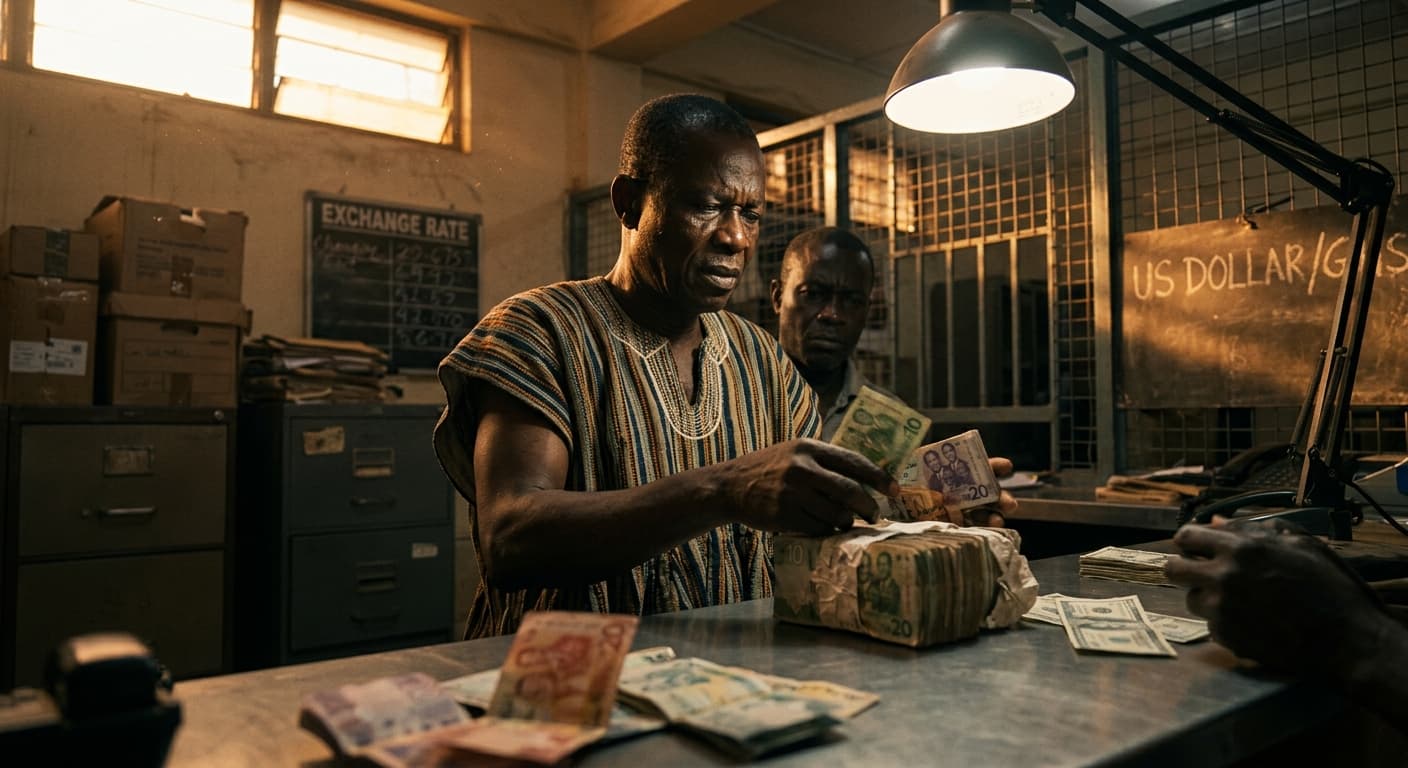
Ghana Burns $2bn to Steady the Cedi — And the IMF is Watching
The Bank of Ghana sold $2.01 billion in June 2026 to force the cedi's first monthly gain of the year. The intervention worked — but at a cost the Fund now wants counted.
The Bank of Ghana pumped $2.01 billion into the foreign-exchange market in June 2026 — its heaviest single-month intervention this year — to engineer a 3.3% monthly appreciation, the cedi's first positive month of 2026, according to reporting by MyJoyOnline citing JoyBusiness. The number that matters is not the gain; it is the price of it. With bids at BoG auctions outstripping supply by roughly $3.42 billion, Ghana's central bank is now spending down hard-won reserves to hold a currency the IMF has openly said it is intervening in too aggressively — and the balance-sheet losses from the gold-purchase programme that finances those reserves are, per the Fund, becoming a fiscal problem in their own right.
What the BoG actually did in June
The intervention came in two channels. The Forex Intermediation Programme (FIP), the BoG's weekly bank auction, sold $1.2 billion across the month — up from $1.0 billion in May, when the central bank had already stepped up support as the cedi came under renewed pressure, The Ghana Report noted at the time. A separate $811 million was routed through the direct FX Intervention Programme — bilateral sales into the market to smooth spot volatility.
The market response was immediate but incomplete. Over two weeks in mid-June, Citi Newsroom reported the cedi rallied roughly 6%, narrowing year-to-date losses from near 11% to about 6%. Yet by end-June the currency was still 7.9% weaker on the year, and by July 2
ModernGhana tracked the retail rate at GH¢12.30 to the dollar against a BoG interbank reference of GH¢11.36 — a spread wide enough to reveal that the parallel and wholesale markets still doubt the official rate.
The demand overhang tells the real story. On June 24, before the month's second auction closed, ModernGhana reported that FX demand was running nearly four times BoG supply, driven by importers rebuilding inventories, fuel distributors, and manufacturers front-loading dollar needs before the third-quarter energy-import cycle. Auctions cleared their targets; they did not clear the queue.
Why this matters: the IMF has changed the subject
For most of 2025, Ghana's story was recovery. The cedi appreciated 36% year-to-date through end-October 2025, headline inflation collapsed to 3.3% by February 2026 per the World Bank's Ghana overview, and gross international reserves crossed the equivalent of 5.7 months of imports on the back of high gold prices and the Domestic Gold Purchase Programme (DGPP), which lets the BoG buy artisanal-mined gold in cedis and monetise it as FX reserves. The Extended Credit Facility (ECF) approved in May 2023 for $3 billion was, by any programme metric, working: the
IMF's fifth review, completed December 17, 2025, disbursed a further $385 million and confirmed that all quantitative performance criteria had been met.
That is the frame the Bank of Ghana wants investors to keep. It is not the frame the Fund now uses.
In the May 15, 2026 staff-level agreement announcing the sixth and final ECF review plus a new 36-month Policy Coordination Instrument, mission chief Ruben Atoyan named the pressure point directly:
"The losses associated with the Domestic Gold Purchase Programme (DGPP) underscore the importance of increasing transparency and limiting quasi-fiscal activities that weaken the central bank's balance sheet. Efforts to protect the Bank of Ghana's balance sheet from DGPP-related quasi-fiscal risks and budget recognition of future costs would help enhance accountability and oversight."
Translate that from Fund-speak: the gold Ghana is buying to build reserves and stabilise the cedi is being bought at prices that leave the BoG carrying losses that should sit on the government's books. The June $2 billion FX sale is exactly the kind of "footprint" the Fund's 2025 Article IV staff report warned about, when it recorded FX sales tripling to roughly $3 billion in 2024 — including $2 billion in Q4 alone — and continuing at a $1.4 billion Q1 2025 pace, per IMF Country Report No. 25/…. Full-year 2025 FX sales ended around $9 billion, per the Fund's fifth-review staff paper.
The Fund has been consistent for three years on what it wants: an FX intervention policy framework, auctions open to all banks with allocations set purely on price, and a smaller central-bank footprint in the market. The BoG's June action moved in the opposite direction.
The quiet trade-off: gold reserves for cedi stability
The DGPP is the mechanism that lets Ghana square this circle — for now. Under a legal reset in April 2025, President John Mahama's government created the Ghana Gold Board (GoldBod) as the sole buyer, seller and exporter of artisanal gold, banning foreigners from local gold trading and requiring transactions to price off Bank of Ghana rates, as the BBC reported. Finance Minister Cassel Ato Forson framed the goal as "boost foreign exchange inflows and stabilise the local currency." Ghana's gold exports were $11.64 billion in 2024, nearly $5 billion of that from small-scale miners.
Al Jazeera, reporting on the continent-wide central-bank gold pivot on June 27, 2026, quoted S&P Global Market Intelligence's Thea Fourie linking Ghana's expansion of the DGPP to "a broader geopolitical shift towards de-dollarisation." That is the strategic gloss. The tactical reality is more prosaic: gold bought in cedis becomes dollars the BoG can sell into the FX market. Every $2 billion month is, mechanically, a partial liquidation of gold-reserve accumulation earned in the previous quarter.
The IMF's 2025 fifth-review staff report already flagged the arithmetic: of the $2.6 billion increase in gross international reserves in 2025 through September, more than $500 million was gold valuation gain and over $800 million came from a rule change requiring foreign-currency cash reserve requirements to be held in FX rather than cedis. Underlying reserve accumulation from operations was materially smaller than headline figures suggested. Ghana's reserve buffer is real; it is also more fragile to interventions of the June scale than the top-line 5.7-months-of-imports figure implies.
The policy contradiction the July auction will expose
Two things are simultaneously true. Governor Johnson Asiama's Monetary Policy Committee cut the policy rate by a cumulative 1,000 basis points to 18% between July and December 2025, a cycle the IMF's fifth-review staff report endorsed as "cautious" and warranted by disinflation. And the same central bank is now spending $2 billion in a single month to defend a currency whose weakness would ordinarily argue against further easing.
Analysts at IEA Ghana have long argued this tension is the cedi's structural problem, not a cyclical one — the Institute of Economic Affairs documented a 74% cumulative depreciation over 2022–2024 as evidence that the FX supply-demand gap is chronic. Peer-reviewed work in the Journal of African Economies by
Bleaney, Morozumi and Mumuni found that BoG monetary policy reaction functions are technically sound; the inflation and currency overshoots come from the fiscal-financing side, not the rate rule. That diagnosis has aged well. It also means BoG interventions are treating a symptom.
The BoG's own guidance for July — MyJoyOnline cites planned FIP auctions of about $1 billion, back to May levels — is the tell. Either July demand really does moderate (importer inventory-rebuild is a Q2 phenomenon), or the central bank blinks and tops up mid-month as it did in June. Ghana Report's earlier reporting confirmed the pattern: monthly caps get revised upward when spot pressure builds. The reserves cushion allows this, but does not make it costless.
What to watch next
- IMF Executive Board decision on the sixth ECF review and the new PCI, expected in the weeks after the May 15 staff-level agreement. The final ECF disbursement is roughly $370 million; the PCI is non-financing, which means Ghana's post-programme reserve replenishment must come from gold, exports and market access — not the Fund.
- July 2026 FIP auction sizes and clearing rates. If auctions again exceed guidance, the "improving market conditions" narrative in the BoG's June briefing dies.
- BoG Monetary Policy Committee meeting — the July MPC decision will test whether Governor Asiama holds the 18% rate or resumes cuts against still-negative real cedi returns, per the
Fund's macroprudential TA report description of the seven-member MPC's schedule.
- Ghana Gold Board disclosures on DGPP purchase prices and volumes. The IMF's demand for "budget recognition of future costs" implies a fiscal line-item that Finance Minister Forson has not yet published.
Diplomat View
The June intervention is a tactical win that quietly widens a strategic gap. Ghana has spent three years rebuilding reserves under IMF supervision precisely so that the central bank would not have to defend the cedi with the intensity it did between 2022 and 2024. That the BoG is now selling $2 billion in a single month — while the Fund publicly names the DGPP losses that are, in effect, the collateral — suggests reserve accumulation has become a means to a currency-defence end rather than a buffer against genuine external shocks. Our call: if July FIP settles at or below $1 billion with bids no more than 1.5x cover, the June operation was demand-smoothing and the cedi holds a range around GH¢11.50–12.00. If July auctions again clear at 3x or higher cover and the BoG tops up mid-month, expect the IMF, in the Executive Board write-up of the sixth review, to formalise the FX intervention policy framework as a structural benchmark under the PCI — and expect the cedi to give back most of June's gain by end-Q3. The forecast revises materially if gold prices break above $3,400 per ounce sustainably, which would refill the DGPP faster than sales drain it; or if the government issues a Eurobond in H2 2026, which would displace the BoG as marginal FX supplier and let Governor Asiama actually shrink his footprint rather than announce that he intends to.
The Bottom Line
Ghana's $2 billion June intervention bought a month of cedi appreciation with reserves accumulated through a gold-purchase scheme the IMF now says is quietly damaging the central bank's balance sheet. It is a stabilisation that looks like success on the wire and like a slow-motion policy trap on the Fund's spreadsheets — and the next four weeks of auction data will decide which reading holds.
Discover more
International Relations
Economist Impact Sustainability Week 2026
Economist Impact Sustainability Week 2026 spotlights the energy transition, AI in clean technology, and supply chain resilience as themes for global leaders.
Global Politics
Trump's Conflicting Messages on Iran War
Trump's mixed messages on Iran reflect a strategy of audience management, benefiting Tehran amid a complex geopolitical landscape.
India
Rajnath Singh's Durga Squad for 2026 Polls
Rajnath Singh's Durga Squad promised women's safety in Bengal but has since disappeared from the agenda, revealing BJP's true priorities.

Economics
Fed's Amex AML order puts correspondent banking on notice
Federal Reserve's Amex AML order requires board-level controls and a 90-day plan; OCC fined the bank $350 million over enterprise-wide deficiencies.