Ghana's Foreign Policy as Economic Engine
Mahama's strategy pivots diplomacy for development.
Model Diplomat3 min readafrica
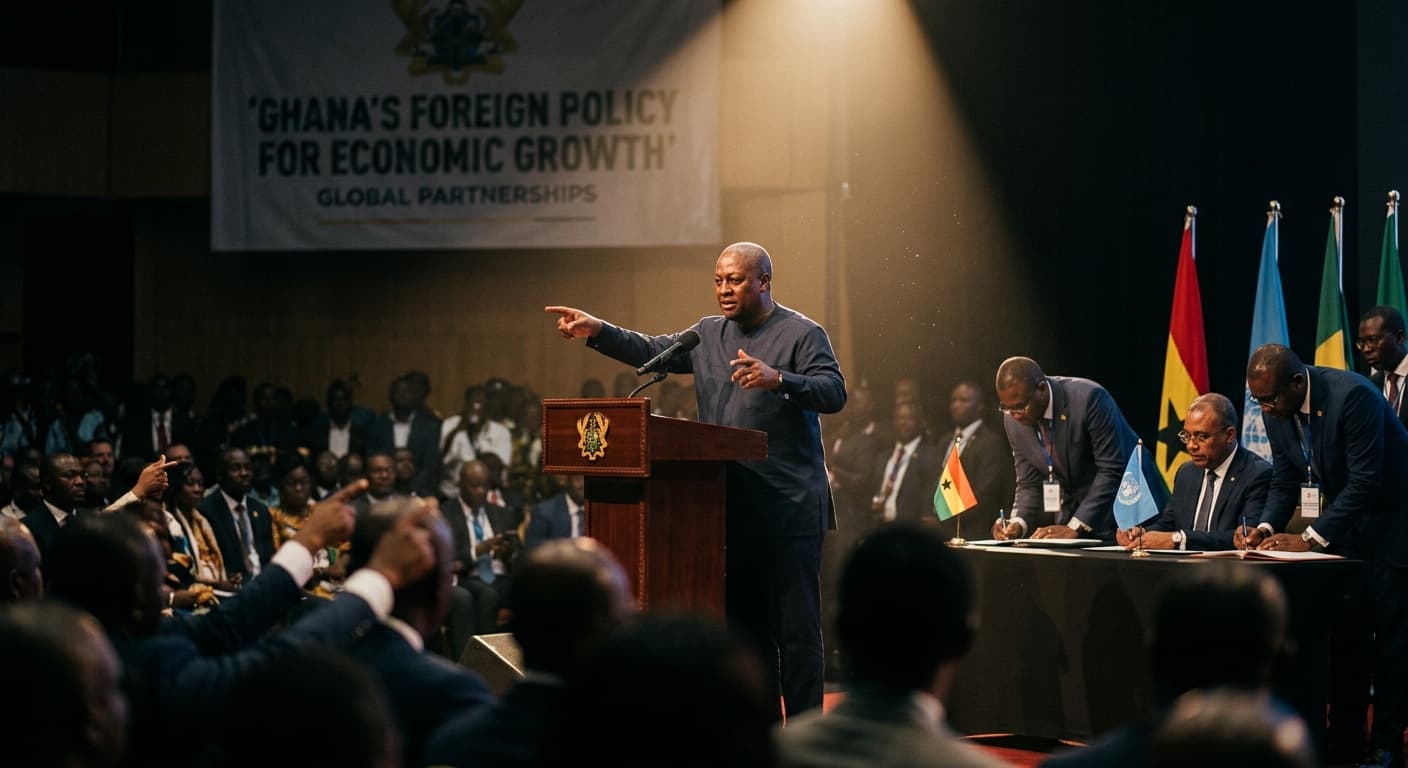
Ghana Turns Foreign Policy Into an Economic Engine — and a Bid for Continental Leadership
Mahama is executing the most deliberate foreign-policy pivot in a generation: diplomacy as development tool, bridge-builder to a fractured Sahel, and platform for the AU's top job.
The numbers tell the story before the speeches do. Ghanaian diaspora remittances hit $7.8 billion in 2025 — the largest annual inflow ever recorded, President John Dramani Mahama told Parliament in his February State of the Nation address. That figure, larger than most foreign direct investment flows into West Africa, is the clearest signal yet that Accra is treating foreign policy not as diplomatic theater but as a direct pipeline to household income, currency stability, and development finance. Ghana News Agency
Mahama, who returned to the presidency in January 2025, has spent his first 18 months turning Ghana's external relations into an instrument of domestic economic recovery — and positioning himself as West Africa's indispensable diplomat in the process.
The strategy has three legs. First, economic diplomacy with measurable targets: the Foreign Ministry now operates under key performance indicators across Ghana's 72 missions worldwide, with trade promotion elevated to a core function alongside traditional diplomacy. Vice President Naana Jane Opoku-Agyeman told Foreign Ministry staff in April that missions must become platforms for Ghanaian business expansion under the African Continental Free Trade Area, whose secretariat Ghana hosts. "How many Ghanaian businesses do we have in those countries?" she asked, demanding a strategy reset. Ghana News Agency
Second, regional bridge-building aimed at the most dangerous fracture in West African politics — the withdrawal of Mali, Burkina Faso, and Niger from ECOWAS to form the Alliance of Sahel States. Mahama appointed a special envoy to the AES capitals, personally led diplomatic missions, and invited the three junta-led governments to Accra for ECOWAS's 50th anniversary launch in April 2025. Foreign Minister Samuel Okudzeto Ablakwa told reporters the invitation "did not receive any resistance." At Chatham House in March 2026, Ablakwa argued that disengagement risked "heightening vulnerabilities in a region already grappling with terrorism and political instability." Ghana News Agency
GNA
The ECOWAS Authority left the door open for AES reintegration until July 29, 2025. That deadline has passed without formal return — but Accra's position as the bloc's chief interlocutor with the Sahelian states gives it outsized influence regardless of the formal outcome.
Third, institutional positioning for continental leadership. West African leaders have declared Mahama their sole candidate for African Union Chairperson when the rotating position returns to the region in 2027. Ghana simultaneously holds three AU champion roles — on reparations, African financial institutions, and gender equality. Ablakwa secured passage of a landmark UN resolution declaring the transatlantic slave trade "the gravest crime against humanity," and Accra will host a high-level reparations conference on June 18–19, 2026. Chatham House
Ghana News Agency
Domestically, the policy is delivering. The IMF confirmed in May 2026 that Ghana's ECF-supported program has produced "substantial stabilization gains" — inflation declining, reserves rebuilt, the cedi stabilizing — and that engagement is now transitioning to a non-financing 36-month Policy Coordination Instrument focused on structural reform. The World Bank backed Ghana's new AgriConnect Compact in June, targeting 2.6 million jobs by 2035 with $3.5 billion in phase-one financing. IMF
World Bank
The Op-Ed framing from Graphic Online — Ghana's foreign policy as rooted in national interest, multilateralism, and economic diplomacy — is not wrong. But it undersells the real story: Mahama is weaponizing that tradition for concrete gain, in a geopolitical moment where middle powers that can build bridges are suddenly indispensable.
What to watch
June 18–19, 2026. The reparations conference in Accra will test whether symbolic leadership translates into a diplomatic coalition broad enough to pressure former colonial powers. If it does, Ghana's AU chairmanship bid in 2027 becomes nearly unstoppable. The parallel track — whether Mali, Burkina Faso, and Niger re-engage with ECOWAS — remains the region's most consequential open question, and Accra is the only capital with channels open to both sides.
Discover more
Global Politics
Trump's Conflicting Messages on Iran War
Trump's mixed messages on Iran reflect a strategy of audience management, benefiting Tehran amid a complex geopolitical landscape.

US Politics
SNAP Food Assistance Faces Legal Challenges
In 2026, SNAP faces stricter eligibility rules and mounting legal challenges, threatening food assistance for the millions of Americans who rely on the program.
India
Congress Accuses Modi of Stalling Women's Law
Congress accuses Modi of stalling women's reservation law by linking it to delimitation, revealing a deeper electoral strategy.

Conflict & Security
Drone Warfare Killing Aid Workers at Unprec
Over 1,000 humanitarian workers killed in three years as cheap armed drones collapse legal protections. Gaza, Sudan, Ukraine, and DRC see deliberate targeting of aid convoys and hospitals with zero prosecutions.