Gaza's Property Crisis: The Hidden Veto on Re
HLP rights assessment reveals the hidden veto on Gaza's recovery
Model Diplomat9 min readMiddle East
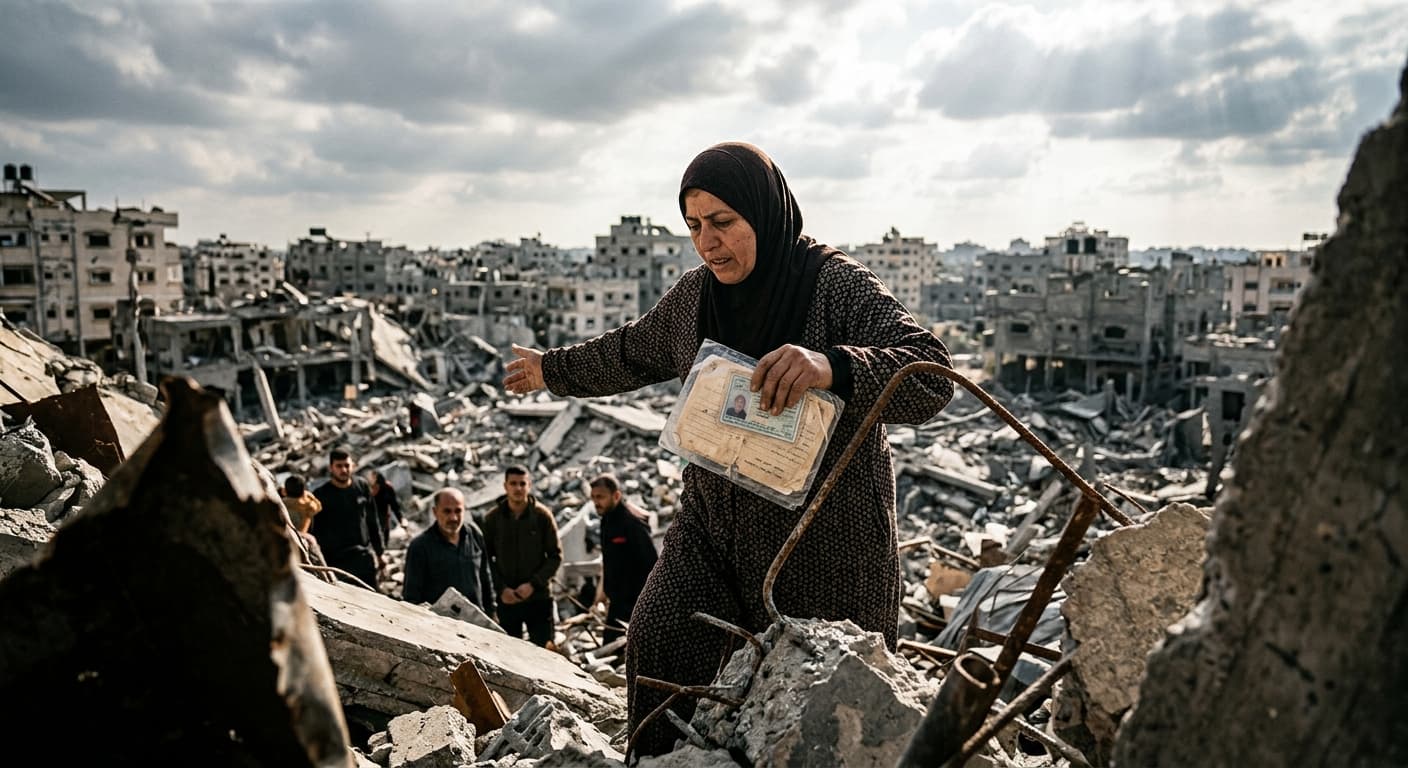
Gaza's Property Crisis: The Hidden Veto on Reconstruction
HLP rights assessment reveals that the collapse of Gaza's land documentation system — not rubble or funding — is the decisive obstacle blocking $71.4 billion in reconstruction, with women and the displaced bearing the heaviest losses.
The October 2025 ceasefire ended active hostilities in Gaza, but it did not unlock reconstruction. Nine months later, the decisive obstacle is not the $71.4 billion price tag, nor the 68 million tonnes of debris, nor even Israel's continuing restrictions on cement and steel imports. The binding constraint is the destruction of Gaza's property rights system — the land registries, court records, boundary markers, and legal institutions that determine who owns what, and who has the right to rebuild. A new assessment of Housing, Land, and Property (HLP) rights in the Gaza Strip, published on ReliefWeb, finds that the war produced not only mass destruction of housing but a "profound systemic crisis" in tenure security that threatens to make equitable recovery impossible — regardless of how much money is pledged or how many materials are allowed through the crossings.
The Numbers Behind the Crisis
The scale of physical destruction is documented across three successive joint assessments by the World Bank, the United Nations, and the European Union. The most recent — the Rapid Damage and Needs Assessment released in April 2026 — estimates $35.2 billion in direct infrastructure damage, with housing accounting for 51 percent ($18.0 billion) of the total. The assessment counts 371,888 housing units damaged or destroyed across the Gaza Strip between October 2023 and October 2025. An earlier interim assessment in February 2025 had put the figure at over 292,000 homes and estimated $53.2 billion in recovery needs; the April 2026 update raised that to $71.4 billion.
According to the World Bank's press release, housing was "by far the hardest hit sector, accounting for 53% of total damages."
The HLP assessment on ReliefWeb identifies three interlocking crises. First, the combination of mass destruction and mass displacement — roughly 90 percent of Gaza's 2.2 million residents were displaced — has produced overlapping ownership claims, secondary occupation of abandoned homes, fragmentation of traditional tenure patterns, and the physical loss of property boundaries and landmarks. Second, documentation systems have collapsed: a "substantial portion of records" have been lost or damaged, and the reliability of surviving ownership data is further compromised by the pre-war prevalence of informal, unregistered transactions. Third, dispute resolution mechanisms and legal aid systems have been gutted by institutional destruction, legal ambiguity, and the absence of a unified governing authority.
The RAND Corporation, in a December 2025 commentary, framed the property question as the foundational prerequisite for any reconstruction. RAND analyst Shelly Culbertson wrote that "every plot of land belongs to someone, yet ownership is often unclear," noting that even before the war, Gaza's property system was "a patchwork of local, Israeli, Ottoman, British, and Egyptian laws mixed with informal claims and missing records, fueling persistent disputes." A separate RAND research report found that at the pre-war reconstruction pace of 992 housing units per year — the rate achieved after the 2014 and 2021 conflicts — rebuilding Gaza's 79,000 completely destroyed homes would take 80 years. Even at five times that pace, completion would stretch to 2040.
The RAND report concluded that "hundreds of thousands of Gazans will need interim shelter for a decade or longer."
The Legal Patchwork — and Why It Now Matters More Than Ever
Gaza's property regime was never clean. The land administration framework, as documented in World Bank project appraisals, consists of overlapping layers of Ottoman land law, British Mandate regulations, Egyptian administration law (applicable in Gaza from 1948 to 1967), Israeli military orders (post-1967), and Palestinian Authority legislation promulgated since 1994. A World Bank social assessment noted that "these inconsistencies and fragmentation within the sector have contributed significantly to the low levels of registration" — even before the current war. In the West Bank, only about 38 percent of land was registered by 2018. In Gaza, the registration rate was lower still.
The war has now compounded this pre-existing dysfunction. The HLP assessment reports that the destruction of court infrastructure, the disruption of Palestinian Land Authority operations, and the loss of physical records mean that even the partial registration that existed before October 2023 may no longer be verifiable. Partial digital archives exist and "could be built upon," the assessment notes, but "they remain incomplete." The World Bank's Second Real Estate Registration Project (RERP II), approved in March 2025, had by June 2024 registered 169,514 titles in Areas A and B of the West Bank — exceeding its target — but the project does not operate in Gaza. According to the RERP II project document, 75 percent of Area A and B land in the West Bank had been registered by mid-2024, representing a 53 percent increase since 2019. But this progress is irrelevant to Gaza, where the Palestinian Authority's land administration institutions have no operational presence and where the de facto governing authority — Hamas, until its dissolution on July 6, 2026 — was not internationally recognized.
The international framework for addressing post-conflict property restitution is the Pinheiro Principles, adopted by the UN Sub-Commission on Human Rights in 2005. A World Bank analysis of restitution and compensation explains that under these principles, "restitution is considered as a preferred remedy" to dispossession, with compensation envisaged "only when restitution is impossible or when it is the choice of the displaced." The principles extend restitution rights beyond formal ownership to "tenants, social occupancy rights holders, and other legitimate occupants or users of housing, land and property." In Gaza, where informal tenure and secondary occupation were widespread even before the war, applying this framework requires a functioning adjudication system that does not currently exist.
Who Loses: Women, the Displaced, and the Informally Housed
The HLP assessment identifies women, children, and the elderly as facing "heightened risks of losing their homes or being unable to prove their rights." This is not a generic vulnerability. The World Bank's social assessment of Palestinian land registration found that inheritance is "the key avenue for women to acquire independent ownership of land and property" in both rural and urban Palestine, governed by Sharia law through Legacy Restriction Certificates issued by the Sharia Court. But the same assessment documented that women face "fear of family boycott" and social criticism for claiming inheritance rights, with many relinquishing their claims to maintain family relationships — relationships that serve as their primary safety net in the absence of independent income. Palestinian women account for only 18 percent of the labor force,
according to a World Bank blog on women's land rights, making property ownership their principal route to economic security.
The war has shattered this fragile equilibrium. Women whose husbands, brothers, or fathers were killed now face the dual challenge of proving inheritance through a destroyed court system while lacking the male relatives who, under customary practice, served as their "lifelong protectors" and de facto tenure guarantors. The HLP assessment's finding that physical landmarks and property boundaries have been obliterated means that even women with valid Legacy Restriction Certificates may be unable to locate the plots to which they hold title. The RERP II project reported that 32.8 percent of registered property ownership holders in the West Bank were women — a figure that exceeded targets. In Gaza, no comparable registration is underway.
The broader displaced population faces a parallel crisis. The HLP assessment describes "overlapping ownership claims" and "the proliferation of secondary occupation" — situations where displaced families return to homes now occupied by other displaced families, or where the homes no longer exist as identifiable structures. Without a functioning dispute resolution mechanism, these conflicts will be settled by force, political influence, or informal tribal arbitration — none of which the HLP assessment considers adequate for equitable recovery.
Who Holds Leverage: Israel's Materials Veto and the Governance Vacuum
Reconstruction requires three things: money, materials, and a legal framework for determining who gets to rebuild where. The first is partially resolved — at the February 2026 Board of Peace meeting in Washington, nine nations pledged approximately $7 billion, and the United States committed an additional $10 billion, according to the Council on Foreign Relations. The second remains blocked. Israel's "dual-use" restrictions continue to bar or tightly control the entry of cement, steel, heavy equipment, and other construction materials into Gaza,
as documented by Al Jazeera in April 2026. Palestinians have resorted to building shelters from mud, salvaged stone, and even human hair collected from barbershops,
Al Jazeera reported.
The third — the legal framework — depends on governance arrangements that remain in flux. The National Committee for the Administration of Gaza (NCAG), formed in January 2026 under UN Security Council Resolution 2803, is a body of Palestinian technocrats reporting to the Board of Peace, the US-led transitional administration. The CFR analysis notes that the NCAG includes an Osama Al-Sa'dawi as Commissioner of Land and Housing — a former general manager of the Palestinian Housing Council in Gaza. But the NCAG has not been permitted to enter Gaza,
Al Jazeera reported on July 6, 2026, due to Israeli objections. Hamas's announcement that day that it would dissolve its governing body and transfer authority to the NCAG removed one obstacle but did not resolve Israel's refusal to allow the committee to operate inside the Strip.
Board of Peace High Representative Nickolay Mladenov has proposed an eight-month phased disarmament plan linking Hamas's decommissioning of weapons to Israel's lifting of restrictions on reconstruction materials, the BBC reported. "The people of Gaza want reconstruction, and reconstruction requires the decommissioning of weapons," Mladenov told the UN Security Council. But a Palestinian source close to Hamas told the BBC that the group expected to reject the plan, viewing it as contradicting the October 2025 Sharm el-Sheikh agreement. The linkage between disarmament and materials access means that Israel retains a de facto veto over reconstruction — a position analysts have characterized as "sovereignty by flow."
As one analyst told Al Jazeera: "Whoever owns the oxygen of Gaza — the cement faucet — owns its political and security shape."
The Historical Parallel — and Why It Cuts Both Ways
The HLP assessment's phased approach — emergency legal aid in the humanitarian phase, institutional capacity-building in early recovery, comprehensive legal reform in reconstruction — mirrors the sequence used in post-conflict Bosnia, where the Commission for Real Property Claims of Displaced Persons and Refugees adjudicated over 300,000 property claims between 1996 and 2003. The Pinheiro Principles were partly distilled from that experience. But Bosnia had a functioning international protectorate, a recognized sovereign government, and a pre-war property registry that, while incomplete, was physically intact. Gaza has none of these. The Board of Peace is not a protectorate; it is a coordinating body without direct administrative authority. The Palestinian Authority's reform program — a precondition for its eventual assumption of governance — has no defined completion date. And the property records that survived the war are fragmented across multiple institutions with no central authority to consolidate them.
The RAND Corporation's spatial vision for Gaza, developed with Israeli, Palestinian, and US planners, offers a more optimistic frame: reconstruction as an opportunity to build modern infrastructure rather than merely restore what was destroyed. Culbertson wrote that "Gaza's cities could join other great economic powerhouse cities of the Middle East." But she acknowledged that "creating a framework for ownership, compensation, and dispute resolution is essential before new communities can rise and existing communities can be restored."
What to Watch
- The NCAG's entry into Gaza. The technocratic committee cannot begin addressing HLP documentation, dispute resolution, or property verification until Israel permits its physical presence in the Strip. Hamas's dissolution of its government on July 6 removed one objection but did not secure access.
- The disarmament-for-materials linkage. Mladenov's eight-month phased proposal is the current negotiating framework. If Hamas rejects it, Israel's restrictions on cement and steel remain in place, and no reconstruction — HLP or otherwise — can proceed at scale.
- The Palestine Land Authority's digital archive. The HLP assessment notes that "partial digital archives exist and could be built upon." Whether the RERP II project's digital systems — which digitized property records in 15 PLA offices in the West Bank — can be extended to reconstruct Gaza's cadastral records from surviving fragments is an open technical question with enormous political consequences.
- The Egyptian-led reconstruction summit. A date has not yet been set,
the BBC reported. Donor pledges will depend on whether a coherent HLP framework exists — or whether donors are being asked to fund reconstruction on land whose ownership cannot be determined.
The Bottom Line
Gaza's reconstruction will not be decided by the $71.4 billion price tag or by the 68 million tonnes of rubble. It will be decided by whether the Board of Peace, the NCAG, and the international community can build a property rights system from the wreckage of Ottoman, British, Egyptian, Israeli, and Palestinian legal layers — a system that can adjudicate competing claims, protect the rights of women and the displaced, and provide the tenure security that reconstruction financing requires. Without it, every dollar pledged will fund a project that no one can legally defend, on land that no one can provably own. *
Discover more
Global Politics
US-Iran Tensions Rise
Tensions escalate in the Strait of Hormuz as Iran and the US clash over maritime control, with a ceasefire hinging on a contested MoU paragraph.
US Politics
Congress Targets AI Chatbot Access for Terror
The House passed the Generative AI Terrorism Risk Assessment Act, focusing on AI's role in terrorism and potential surveillance implications.

US Politics
House Ethics Committee Pushes Sexual Miscond.
The House Ethics Committee has shifted responsibility for sexual harassment settlement records to the Office of Congressional Workplace Rights, complicating disclosure efforts.

Conflict & Security
Drone Warfare Killing Aid Workers at Unprec
Over 1,000 humanitarian workers killed in three years as cheap armed drones collapse legal protections. Gaza, Sudan, Ukraine, and DRC see deliberate targeting of aid convoys and hospitals with zero prosecutions.