G7 Évian Summit: Canada’s Energy Strategy
Canada emerges as a key player in global energy security.
Model Diplomat8 min readGlobal
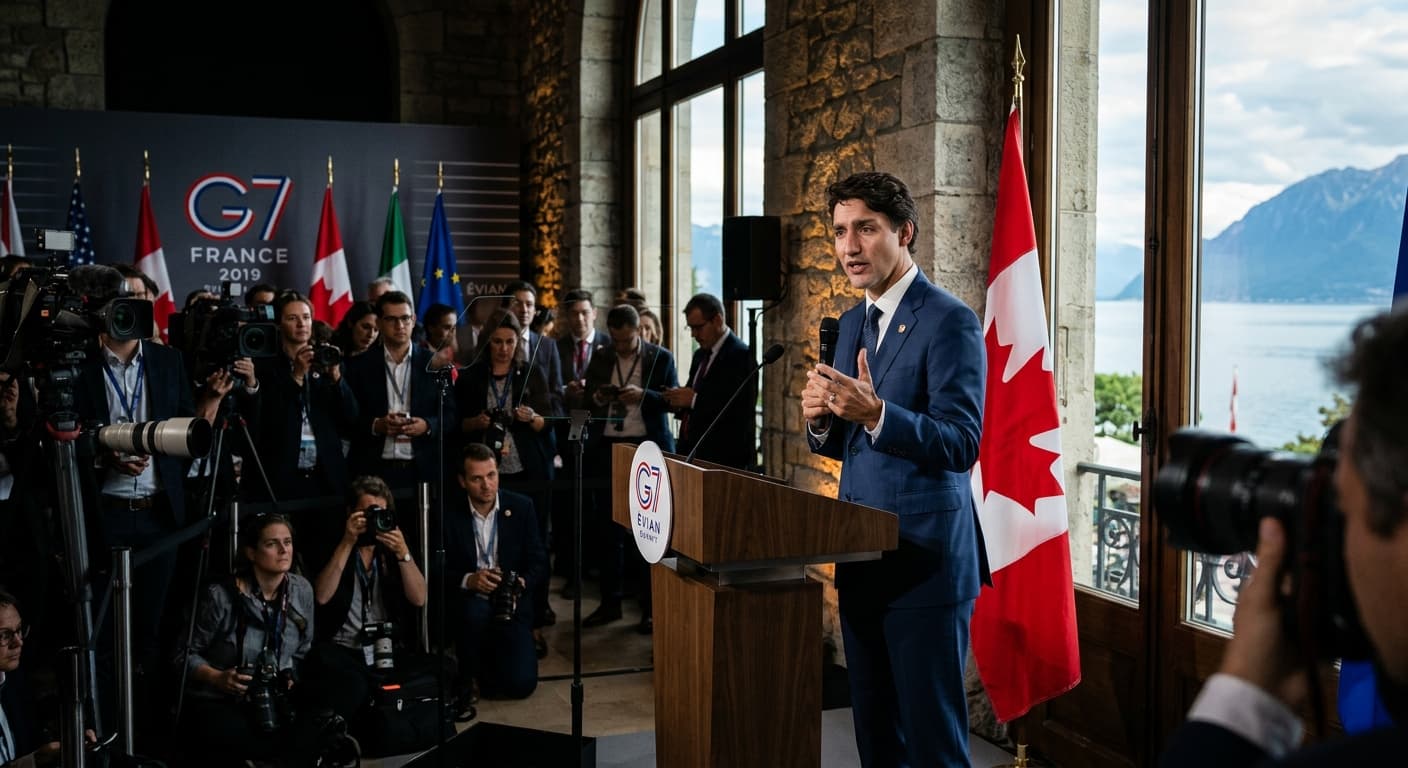
Évian's Real Deliverable: A Wartime Rewrite of the Energy Map
The G7 2026 summit fused Ukraine air defense, Russian oil sanctions and a critical-minerals alliance into one energy-security bet — with Canada as the quiet winner.
The G7's Évian communiqué reads like a war statement. Look closer and it is an energy document: the same three-day summit that promised Ukraine more Patriot interceptors also lowered the ceiling on Russian oil revenue, launched a Critical Minerals Resilience and Production Alliance targeting a 60% cap on Chinese rare-earth dependence by 2030, and singled out Canada as the swing supplier for a post-Hormuz world. The through-line is not sanctions policy. It is a coordinated attempt to lock in Western control of the commodities — hydrocarbons and rare earths alike — that will define both the war's endgame and the climate transition. The winner most named in the leaders' text is not Ukraine. It is Canada.
What Évian actually signed
The G7 leaders' statement on geopolitical issues, published by 10 Downing Street on June 17, 2026, commits the seven to "increase the delivery of air defence capacities, additional systems and interceptors, and long-range capabilities" for Ukraine and to "consider extending to Ukraine the benefit of licenses to allow for an increase in Ukraine's military production." On sanctions, the text is unambiguous:
"We commit to increase the pressure on the Russian war economy. In this context, we will strengthen our sanctions, including those on the oil and gas sectors. We consider this the right moment to proceed with additional measures, as President Trump has delivered a deal that we support in reopening the Strait of Hormuz."
The energy paragraph that follows is the analytically decisive one: leaders "commit to accelerate the diversification of energy supply routes in order to reduce global vulnerability to the Strait of Hormuz and to increase our energy stocks," welcoming "the potential for Canada to deliver significant additional capacity to global markets in coming years."
Two things are new. First, the sanctions escalation is tied — explicitly — to the June 16 US–Iran framework reopening Hormuz. That trade has been misread as a Middle East story. It is the price the Europeans paid Donald Trump to bring Washington back into a Russia sanctions consensus it had exited in early 2025. As the Council on Foreign Relations put it, "G7 countries appear to have reached consensus regarding new sanctions on Russia's oil and gas exports, especially on Moscow's shadow fleet," and the United States "has also indicated that it may not extend the waivers it created in response to the Iran war energy crisis that allowed for the sale of Russian crude oil and petroleum already at sea."
Second, the summit gave the critical-minerals track — long a French priority — its first hard number. According to the CSIS G7 critical minerals brief, "G7 leaders endorsed a measurable supply chain resilience target: reducing dependence on any single non-G7 supplier of rare earths and permanent magnets to below 60 percent by 2030, with the longer-term objective of lowering that figure to 50 percent." The
French institute IFRI confirmed the establishment of "a non-binding G7 Critical Minerals Resilience and Production Alliance," with the founding declaration published by the
Élysée on June 17.
Why these three files are one file
The instinct is to treat air defense, oil sanctions, and rare earths as three parallel workstreams. They are not. Each is a bet on the same proposition: that the West can simultaneously choke Russia's fossil-fuel rents, ring-fence China's leverage over transition minerals, and re-route enough hydrocarbons through friendly geographies to survive the shock of doing both at once.
The Russian oil track is where that logic bites first. The EU's 18th sanctions package, adopted on July 18, 2025, cut the crude oil price cap from $60 to $47.60 per barrel and installed an "automatic and dynamic mechanism" pegging the cap 15% below the six-month Urals average.
Commission Implementing Regulation (EU) 2026/124, published January 14, 2026, dropped the cap again to $44.10 on February 1. Warsaw's
OSW think tank reports that Russian oil and gas budget revenues fell 34% year-on-year in June 2025 alone.
For eleven months, Washington sat out. The Iran deal changed the arithmetic. With Hormuz reopening and Iranian barrels queueing to return to market, US treasury officials could accept lower Russian revenues without a global crude spike. That is why the Évian text pairs the two files in a single sentence.
The Ukraine air defense clause is an energy clause
Read the air defense pledge next to Ukraine's grid map and it stops being about interceptors. Warsaw's OSW assessed in April 2026 that Russia has now carried out nearly 6,000 attacks on Ukraine's energy system, destroying or damaging generating units with a combined capacity of "around 9 GW — more than half of that available prior to the winter." Between January 1 and February 24, 2026, transmission operator Ukrenergo alone absorbed 300 missiles and more than 7,000 drones.
The bottleneck is not money. It is PAC-3 interceptors. The Atlantic Council reports Lockheed Martin produced 620 PAC-3 missiles in 2025 against an estimated Ukrainian requirement of 2,000 per year. The
Congressional Research Service confirms the Army awarded Lockheed a $4.5 billion multiyear contract for 870 PAC-3 MSE missiles in June 2024, but each round still takes more than two years to build across a supply chain of 400-plus firms.
That is why the Évian licensing offer matters more than the volume pledge. On July 8, 2026 — the day this piece publishes — the BBC reported that Trump confirmed Ukraine will receive a licence to co-produce Patriot missiles. If Kyiv can build interceptors on its own soil, Russia loses the ability to systematically flatten Ukrainian thermal plants each winter, which is what the Kremlin's
2025–26 campaign was designed to accomplish when a million residents in Dnipropetrovsk and Zaporizhzhia lost heat and water in January.
The knock-on for European energy security is direct. The Atlantic Council notes Ukraine's parliament passed legislation in April 2026 integrating its spot electricity market with the European Network of Transmission System Operators for Electricity, potentially adding 5–10% to the continental market. A defended Ukrainian grid is European baseload. An undefended one is a permanent import shock.
The Canada clause
The single most consequential name in the Évian text is Canada — and the market has already priced it in. The C.D. Howe Institute argues bluntly that Canada "cannot offset a Gulf shock" today, but the Canadian Global Affairs Institute counters that
Prime Minister Mark Carney is now pursuing a doubling of non-US exports to $600 billion by 2035, backed by a November 27, 2025 federal–Alberta MoU for 1.3–1.4 million barrels per day of new oil export capacity.
The LNG pipeline is farther along. According to the Asia Pacific Foundation of Canada, LNG Canada Phase 1 at Kitimat began shipping in June 2025 with 14 million tonnes of annual capacity; Phase 2 doubles that to 28 mtpa, with a final investment decision expected in late 2026 or early 2027 from a consortium including Shell, Mitsubishi, Korea Gas Corporation, Petronas and PetroChina. Ksi Lisims LNG — a Nisga'a Nation project — would add another 12 mtpa, and the
BBC reported a 20-year, one-million-tonne-per-year offtake to Germany's SEFE utility.
The strategic point is not volume; it is geography. Canadian LNG and crude reach Asian buyers without passing Hormuz, Malacca or the Baltic. That is exactly the diversification the G7 text endorsed. In the 16 months following the Trans Mountain Expansion's May 2024 startup, Canadian crude exports to Indo-Pacific markets went from near zero to an average C$571 million per month, with China absorbing 61% of that flow.
The climate bill comes due at Santa Marta
The Évian energy-security push runs directly into a climate architecture that has just cracked. COP30 in Belém ended on November 22, 2025 without any mention of fossil fuels in the final Mutirão text, after Russia, Saudi Arabia and other producers blocked a "roadmap" for transition away from oil, gas and coal. The
UN's official COP30 outcome tripled adaptation finance for developing countries but conceded, in Secretary-General António Guterres's words, that "the gap between where we are and what science demands remains dangerously wide."
Berlin's SWP institute framed Belém as the definitive rupture between "petrostates and electrostates" in international climate politics. That rupture reshapes the G7 story. Every G7 government now needs Canadian LNG and TMX crude to backfill Russian gas losses without pushing global prices into a political crisis. Every G7 government also needs a critical-minerals supply that does not depend on Chinese refineries. Both goals extend fossil-fuel demand curves — LNG in particular — well into the 2030s, precisely as COP30's aborted roadmap suggested they must fall.
The European Commission's own December 2025 CRM communication acknowledges the trade-off: the EU intends "to develop and deploy a robust policy approach, including trade instruments" against Chinese "price manipulation" in critical minerals, and to leverage the G7 Critical Minerals Production Alliance "to de-risk CRMs projects in the EU and in partner countries." Translated: the climate-transition supply chain is now a national-security supply chain, and Beijing's October 2025 rare-earth export controls — extraterritorial, targeting anything containing certain CRMs — proved the vulnerability is not theoretical.
Diplomat View
Évian was not a Ukraine summit. It was the first G7 to publicly treat war-economy sanctions, transition-mineral security and hydrocarbon route diversification as one problem, and to name Canada as the pivot. The forecast: by the January 2027 Davos meeting, Canada's LNG Canada Phase 2 FID and the Ksi Lisims FID will together determine whether the Évian package holds — because without a credible Pacific hydrocarbon backstop, no G7 government can accept the political cost of another cut to the Russian oil price cap or a hard rare-earth cap on China. The Alliance is non-binding, as HCSS analysts note, and Trump's willingness to sustain sanctions consensus depends on Iran deal implementation surviving its 60-day negotiation window. What would falsify this thesis: a collapse of the US–Iran MoU before September 2026, which would push oil above $90 and unwind the political space that made the Évian sanctions consensus possible in the first place; or a Chinese counter-move — an export ban on gallium, germanium and heavy rare earths — that forces G7 members to negotiate rather than decouple.
What to watch next
- Late 2026 / early 2027: Final investment decisions on LNG Canada Phase 2 and Ksi Lisims LNG. If both go, Pacific LNG capacity reaches ~40 mtpa by the early 2030s and the Évian diversification pledge becomes real.
- September 15, 2026: Expiry of the 90-day US–Iran negotiation window opened by the June 16 MoU. Failure re-tightens Hormuz risk and reopens the American waiver on Russian crude.
- November 2026: APEC in Shenzhen and G20 in Miami. Watch whether the G7 rare-earth 60% target picks up Australian, Korean and Indian co-signers — or whether Beijing splits the coalition first.
- Winter 2026–27: Ukraine's next heating season. If Patriot licence production begins and 4 GW of thermal capacity is repaired, Kyiv holds. If not, the
OSW warning of "a severe systemic crisis" is the base case.
The bottom line: Évian's real deliverable was not the sanctions paragraph but the Canada clause underneath it. The G7 has decided that winning the Ukraine war, containing China's mineral leverage, and keeping global energy markets functional are the same problem — and that the answer runs through the Pacific coast of British Columbia, not the Champs-Élysées. That is the energy-security shift worth watching.
Discover more

US Politics
Senate Repeals Minnesota Mining Ban for Twin
The Senate's repeal of a 20-year mining moratorium in Minnesota allows Twin Metals to proceed, raising concerns over environmental impacts and foreign ownership.

India
Women’s Reservation Bill
Parliament weighs the Women's Reservation Bill to reserve 33% of seats for women in the Lok Sabha and state assemblies, a landmark gender-equality test.

India
Vijay's Political Rise vs Silent Tamil Nadu
Actor Vijay's popularity surges across Tamil Nadu even as campus student politics fades, raising fresh questions about youth engagement and future power.

Economics
Fed's Amex AML order puts correspondent banking on notice
Federal Reserve's Amex AML order requires board-level controls and a 90-day plan; OCC fined the bank $350 million over enterprise-wide deficiencies.