G7 Évian 2026: Ukraine's Air Defense Deal
How the G7's pledge reshapes energy security and climate policy.
Model Diplomat9 min readGlobal
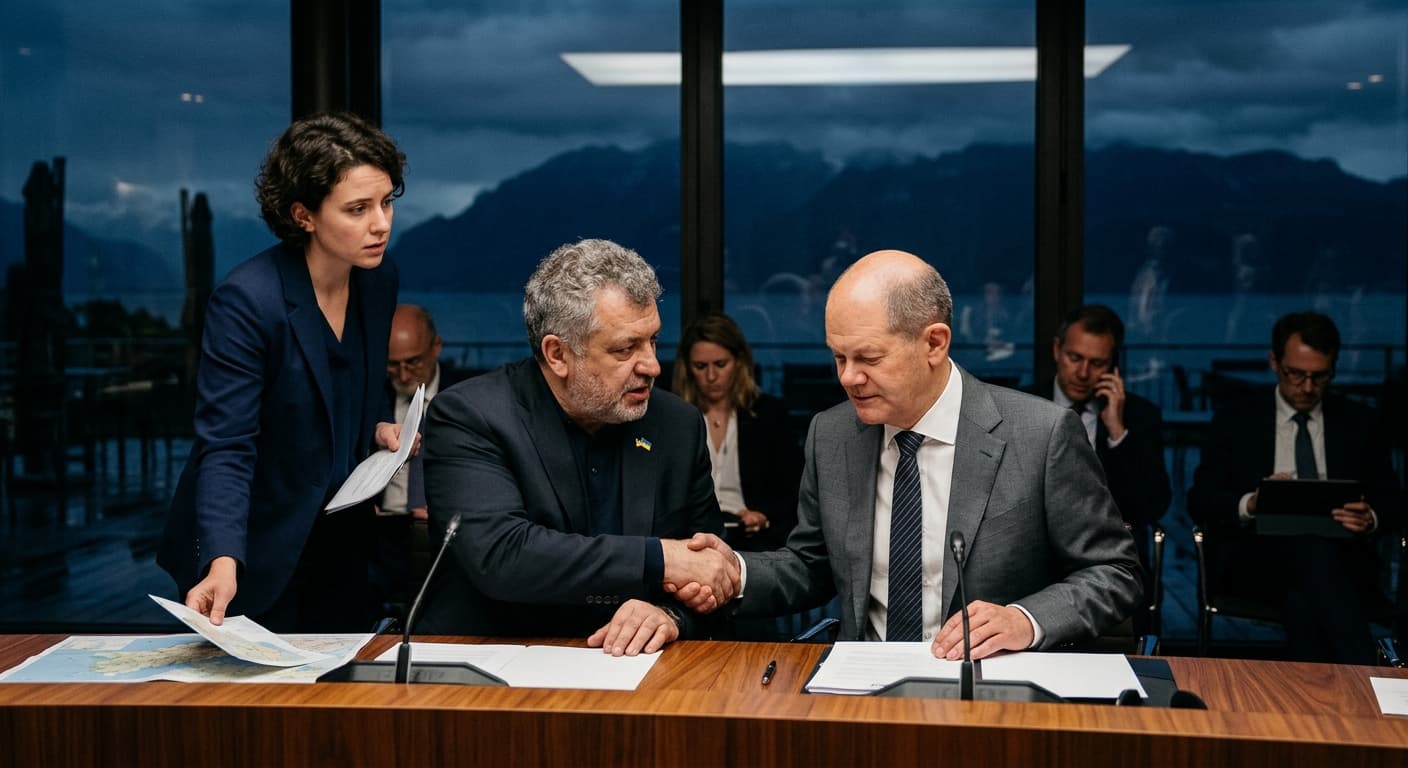
G7 Évian 2026: Ukraine's Air Defense Deal Rewires Energy Security
How the G7's June 17 pledge to arm Ukraine and squeeze Russian oil quietly reset the West's energy and climate playbook — and picked the winners of the transition.
The Évian communique the G7 signed on June 17, 2026, did two things at once: it promised Ukraine more Patriot interceptors and a licence to build them, and it re-baselined Western energy and climate policy around fossil-fuel security. Read together with the Élysée's critical minerals declaration and the UK's
shadow-fleet sanctions push, the summit's message is unambiguous: tighter sanctions on Russian oil and gas, a 60% ceiling on Chinese rare-earth exposure by 2030, and an open door for Canadian and US LNG to fill the gap. The winners are not in Kyiv. They are in British Columbia, Doha, Perth and — for now — Lockheed Martin's Camden, Arkansas assembly line.

The deal, in the words of the document
The primary text is short and blunt. "We agree to increase the delivery of air defence capacities, additional systems and interceptors, and long-range capabilities," the G7 leaders' statement on geopolitical issues, published by 10 Downing Street on June 17, 2026, reads. Leaders committed to "increase the pressure on the Russian war economy" and "strengthen our sanctions, including those on the oil and gas sectors," framing the moment as opportune because a US–Iran memorandum of understanding was reopening the Strait of Hormuz.
The same paragraph pivots to energy:
We commit to accelerate the diversification of energy supply routes in order to reduce global vulnerability to the Strait of Hormuz and to increase our energy stocks. We welcome the potential for Canada to deliver significant additional capacity to global markets in coming years.
That single sentence is the hinge. It fuses the sanctions push, the Iran deal and the LNG build-out into a single doctrine — one in which fossil-fuel supply security is a G7 war aim.
Volodymyr Zelenskyy left Évian with what Al Jazeera reported as "important commitments": additional interceptor missiles, production licences and a winter energy package, with US "backstop across these lines of effort." On July 8, 2026, US President Donald Trump confirmed to reporters that Ukraine would receive a licence to co-produce Patriot missiles,
the BBC reported — operationalising the Évian language exactly three weeks after the summit closed.
Why the arithmetic forces the pivot to LNG and mining
Ukraine's air-defence problem is a supply-chain problem before it is a diplomatic one. The Atlantic Council's Peter Dickinson reports that even if Ukraine received all 620 PAC-3 interceptors Lockheed produced in 2025, it would still fall short of the roughly 2,000 needed per year, and that the US-Israeli war with Iran consumed as many as 1,430 Patriot rounds in 39 days. New orders currently face delivery timelines of up to seven years. Licensed production in Ukraine — and, the Council notes, in Poland — is not a favour to Zelenskyy. It is the only route to closing the gap in time to matter.
Sanctions are subject to a similar arithmetic. Russia's shadow fleet numbered around 343 tankers, of which 264 had been sanctioned by some combination of the EU, UK and US by early 2025, according to a Brookings analysis by Robin Brooks and Ben Harris. The EU's 20th sanctions package, adopted in April 2026, added another 632 tankers to its list —
Stiftung Wissenschaft und Politik estimates roughly 17% of global oil tankers now trade under shadow-fleet conditions. The UK's Évian package pushed its own sanctioned-vessel tally past 600 and, notably, was "the first mover on sanctioning several Liquefied Natural Gas (LNG) vessels moving sanctioned Russian LNG," per the
10 Downing Street press release.
The unstated corollary: if you sanction Russian LNG carriers into obsolescence, someone else has to deliver the molecules. Energy Intelligence reports that Russian oil exports have started to wobble under US pressure, with India slashing Urals intake and tens of millions of barrels stranded at sea. Global refining loopholes are also closing — the UK's January 2026 ban on refined products from refineries processing Russian crude, documented in the
New Strategy Center's shadow-fleet report, removed the primary incentive for Turkish and Indian refiners to launder Russian barrels.
The Canadian LNG windfall, hiding in plain sight
The line about Canada is the sleeper clause. Two weeks before Évian, Canada's energy minister Tim Hodgson announced a long-term deal to ship one million tonnes per year of LNG from the Ksi Lisims project in British Columbia to Germany's SEFE for up to 20 years, the BBC reported. The project had been waiting on a final investment decision; Hodgson said the German off-take would help lock in financing "in a matter of months." Prime Minister Mark Carney has flagged Ksi Lisims for fast-track review as a project of national importance.
Évian did not announce this deal. It ratified it. By welcoming Canada's "significant additional capacity" in the leaders' statement, the G7 gave political cover to what is functionally a G7-backed replacement of Russian pipeline gas — and, secondarily, of Qatari LNG routed through the Strait of Hormuz — with North American molecules delivered on 20-year contracts that will run well past 2045. The Canadian Global Affairs Institute has been arguing exactly this framing for a year: LNG as an instrument of G7 diplomacy, not merely a commodity.
The climate implication is uncomfortable. Ukraine itself is now importing US LNG — 1 billion cubic metres planned for 2026 via Naftogaz through Orlen, according to Poland's OSW — with additional US LNG arriving through the Trans-Balkan pipeline via Greece from January,
the BBC reports. The war has done what a decade of gas diplomacy could not: it has turned North American LNG into the default backstop for European and Ukrainian energy security, with a G7 imprimatur.
The critical-minerals second front
Évian's most durable deliverable may be the least discussed. Leaders endorsed, per CSIS, "a measurable supply chain resilience target: reducing dependence on any single non-G7 supplier of rare earths and permanent magnets to below 60 percent by 2030, with the longer-term objective of lowering that figure to 50 percent." G7 ministers were tasked to set implementation plans for other critical minerals by year-end.
CSIS analysts are candid about the difficulty. China produces roughly 93% of the world's permanent magnets. Japan, "the largest rare earth magnet producer outside of China" and a 15-year veteran of diversification, was still the world's largest importer of Chinese rare earth metals in 2024. The French institute Ifri called the resulting Critical Minerals Resilience and Production Alliance "non-binding" but "the most promising area for agreement," combined with a Japan-led stockpiling initiative.
The alliance is where the Ukraine war, US–China rivalry and the energy transition converge. Rare earths are essential inputs for both defence electronics (radar, missile guidance, F-35 magnets) and clean-tech (EV motors, wind turbines). The Hague Centre for Strategic Studies notes that the alliance now includes "explicit commitments to local value creation and processing capacity in partner countries" — pulling Australia, Brazil, Saudi Arabia and select African states into the G7's economic orbit under the banner of Ukraine solidarity.
Where the fragility lives
The Council on Foreign Relations calls the Évian alignment "deeply fragile". European officials privately doubt the durability of the Iran framework and worry that Trump's return to Ukraine mediation — with envoys Steve Witkoff and Jared Kushner — will hand Moscow the concessions it could not win on the battlefield. The E3 (France, Germany, UK) plan, per CFR, is "to ramp up sanctions pressure on Russia while opening their own channels of communication" to convince Putin he holds the weaker hand.
The evidence supports E3 optimism at the margin. Energy Intelligence reports that Russia produced 8.92 million barrels per day of crude in May 2026 — 780,000 b/d below its OPEC+ target and its lowest since the sanctioning of Rosneft and Lukoil late in 2025. Drone strikes have knocked out roughly 30% of Russia's primary refining capacity, forcing Vladimir Putin to sign a law facilitating
petroleum-product imports. The Kyiv School of Economics, cited in the
New Strategy Center's report, estimates Russia has lost $166 billion in oil revenue between March 2022 and January 2026 — evidence the price cap and shadow-fleet designations have bitten, even if exports have not collapsed.
But sanctions work both ways. Novatek exported 21 cargoes of LNG to China from its sanctioned Arctic LNG 2 plant in 2025, OilPrice.com reports, with CNPC and CNOOC each holding 10% stakes. Every incremental G7 sanction on Russian gas that Europe cannot buy is a discounted cargo China can. The EU's own
phase-out regulation, finalised January 26, 2026, bans Russian LNG under long-term contracts from January 1, 2027 — but Hungary and Slovakia voted against, and MOL is building a new pipeline to extend Russian oil access into Serbia by 2027.
The climate collision course
Évian's official agenda scrubbed climate change from the debate — Ifri notes there was "no mention of climate change in the debates" out of deference to Trump. The Policy Center's post-summit analysis records that leaders reiterated the "necessity of diversifying energy routes and minimizing dependency on strategically vulnerable" chokepoints — with no accompanying decarbonisation language.
That absence lands in the middle of the COP31 season. The Turkey–Australia co-presidency proposed on June 10, 2026, a goal of raising electrification from 20% to 35% of final energy demand by 2035, the World Resources Institute reports. Transparency International
warns that Hormuz disruptions and Russian gas dependencies are being used as pretexts to slow the transition away from fossil fuels. Roughly 80 countries back phase-out language; only 24 have endorsed the Belém Declaration to advance the transition in 2026.
The awkward reality: the G7 is now the world's most powerful advocate of energy-security-first policy, with fossil-fuel diversification enshrined in a leaders' statement issued the same week COP31's presidency was pitching global electrification. Simon Stiell's warning, cited by Transparency International, that "fossil fuel dependency is ripping away national security and sovereignty" is being answered — but by locking in 20-year LNG contracts, not by phase-out.
Diplomat View
Évian will be remembered less as a Ukraine summit than as the moment Western energy-security doctrine formally decoupled from Western climate doctrine. The forecast: North American LNG take-off will accelerate through 2027 as EU long-term contracts on Russian LNG expire, Canadian export capacity at Ksi Lisims and LNG Canada reaches final investment decisions, and the 60% critical-minerals ceiling drives capital into Australian, Canadian and Brazilian refiners regardless of who wins the US midterms. Ukraine will get more interceptors, but its air-defence math still fails unless licensed PAC-3 production in Poland and Ukraine reaches serial output by the 2027 winter — the load-bearing assumption behind every other Évian pledge. Falsifiers: a US–Russia deal in the Witkoff/Kushner track that lifts oil sanctions in exchange for a ceasefire would gut the sanctions leg; a collapse of the Iran MoU would send Hormuz risk premia back into oil prices and re-open the political space Europeans just closed on Russian gas; a Chinese rare-earth export ban would test whether the Alliance is a plan or a press release. Watch the first two before the third.
Upcoming catalysts:
- November 2026 — COP31 in Antalya. First test of whether G7 energy-security language crowds out fossil-fuel phase-out.
- December 2026 — G20 Miami. US host year; the venue where the Critical Minerals Alliance either acquires financing or becomes a communique footnote.
- January 1, 2027 — EU Russian LNG long-term-contract ban. The date the Novatek-to-Europe route legally closes; watch Hungarian and Slovak compliance.
The Bottom Line
The G7's Évian communique bought Ukraine interceptors and Patriot licences with a currency the world has not yet priced: a formal G7 endorsement of accelerated fossil-fuel supply diversification and a hard ceiling on Chinese critical-minerals dependence. The war has become the operating brief for both energy security and climate policy — and the beneficiaries are Canadian LNG developers, US missile primes, and non-Chinese rare-earth refiners, in that order. If the Trump-led Ukraine talks hold and the Iran MoU survives, Évian will be remembered as the summit that quietly rewired the transition. If either collapses, it will be remembered as the moment the G7 mistook a ceasefire window for a doctrine.
Discover more
India
Congress Accuses Modi of Stalling Women's Law
Congress accuses Modi of stalling women's reservation law by linking it to delimitation, revealing a deeper electoral strategy.

India
Delhi CM Rekha Gupta Blasts Opposition's Delm
Delhi CM Rekha Gupta's remarks on women's quota defeat reveal BJP's strategy for the 2029 Lok Sabha elections, focusing on delimitation.

India
Congress Advocates 33% Women’s Quota
Congress calls for a 33% women's reservation in the existing 543 Lok Sabha seats, countering Modi's plan to expand the house to 850 seats.

Economics
Fed's Amex AML order puts correspondent banking on notice
Federal Reserve's Amex AML order requires board-level controls and a 90-day plan; OCC fined the bank $350 million over enterprise-wide deficiencies.