Fujimori's Bukele Blueprint for Peru
Fujimori's security agenda faces a fragmented Congress and weakened institutions
Model Diplomat9 min readAmericas
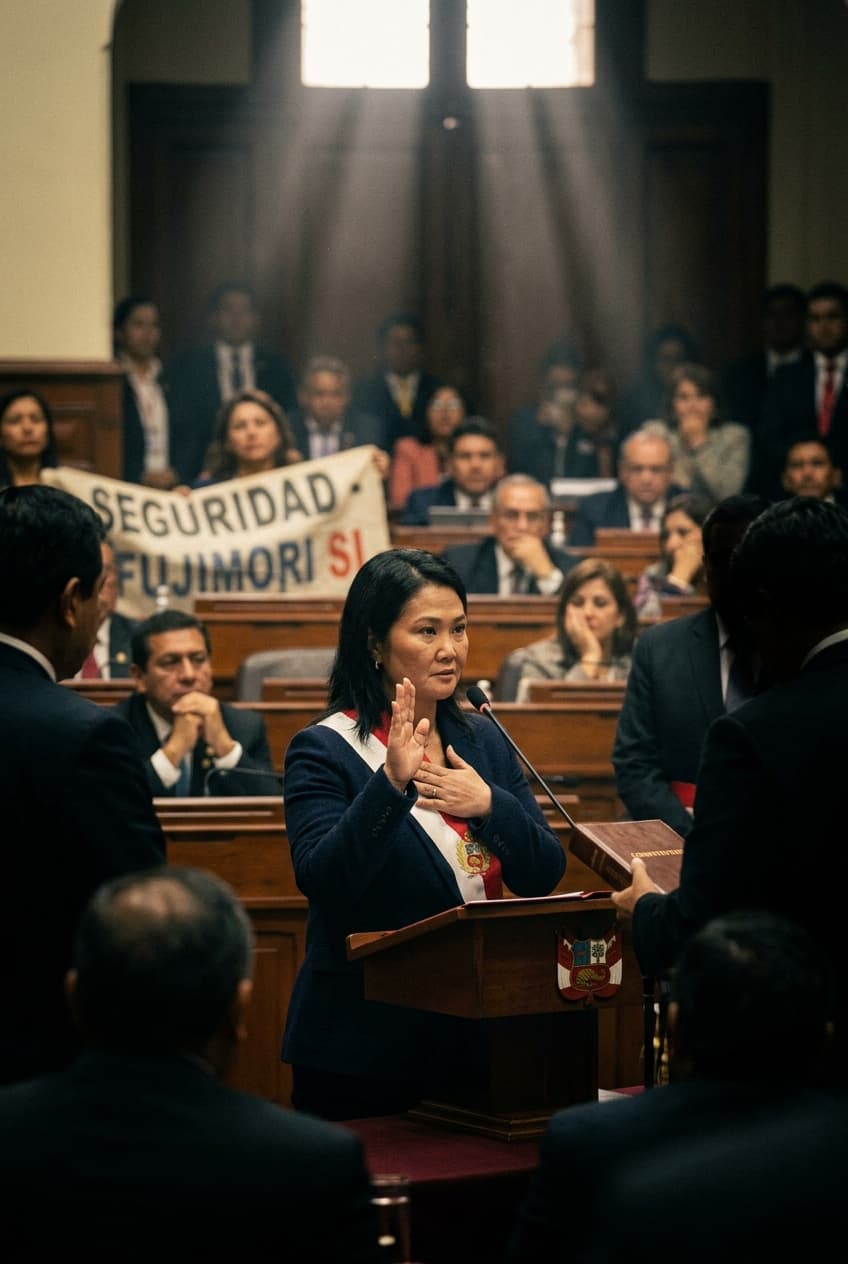
Fujimori's Bukele Blueprint: Can Peru's New President Replicate El Salvador's Security Model Without a Supermajority?
Keiko Fujimori assumes Peru's presidency on July 28, 2026, promising to overhaul the penal code, build four mega-prisons, and join a U.S.-backed military coalition — but she leads a fragmented Congress and inherits institutions her party has already weakened.
On July 28, 2026, Keiko Fujimori becomes Peru's seventh president in eight years — inheriting a Congress that vacated more heads of state than any legislature in the hemisphere and a security agenda she has promised to ram through regardless. Her margin over leftist Roberto Sánchez was 50.135% to 49.865%. Her security agenda is maximalist: amend the Código Penal and Código Procesal Penal, construct four mega-prisons modeled on El Salvador's CECOT, deploy the armed forces to borders and prisons, and integrate Peru into the U.S.-backed "Escudo de las Américas" military coalition, according to her own declarations to Colombian outlet Semana and Peruvian state media. The decisive question is not whether the agenda is popular — it is — but whether Peru's new bicameral Congress can actually pass it, and whether the institutions meant to check executive overreach will survive the process.
Fujimori has been explicit about her models. In an interview with Colombia's Semana magazine, she cited Nayib Bukele's prison-building speed ("Bukele lo hizo en ocho meses; acá será más rápido") and named Ecuador's Daniel Noboa as another reference point for combating organized crime, as reported by ANDINA. She announced plans to convene international bidding for four large penitentiaries plus one maximum-security facility for the most dangerous inmates, directly replicating El Salvador's Centro de Confinamiento del Terrorismo (CECOT), the megaprison that became the global symbol of Bukele's security doctrine. She also told Semana she would seek a meeting with Donald Trump to deepen bilateral security cooperation and expressed interest in joining the Escudo de las Américas, the regional military coalition Trump launched at a March 7, 2026, summit in Miami with 12 right-leaning Latin American leaders, as documented by
EFE.
The Escudo de las Américas is not a soft diplomatic framework. Trump signed a decree formalizing "a new military coalition to eradicate criminal cartels" and pledged to "use lethal military force to destroy" them, as reported by Prensa Latina. The agreement commits the United States to "train and mobilize the armed forces of partner countries" to dismantle cartels, which the Trump administration has designated as foreign terrorist organizations. Guyana's President Irfaan Ali described it as building "a common security platform" through intelligence sharing and joint operations, according to Guyana's
Department of Public Information. Peru was not among the 12 founding signatories — but Fujimori wants in, telling El Búho and other outlets that international support will be "an important component" of her strategy, "hasta donde la Constitución y la ley de nuestro país lo permitan" (as far as our Constitution and laws allow), as reported by
El Búho.
The Legislative Arithmetic
Fujimori's Fuerza Popular (FP) is the largest single bloc in Peru's new bicameral Congress, but it lacks an absolute majority in either chamber. FP holds 22 of 60 Senate seats and 41 of 130 in the Chamber of Deputies, according to official results from the Jurado Nacional de Elecciones, published via ANDINA. The opposition Juntos por el Perú (JP) — the party of imprisoned former president Pedro Castillo — holds 14 Senate seats and 32 in the lower chamber. The decisive swing votes belong to Popular Renewal (8 senators, 15 deputies), a far-right religious party with which FP had "strong disagreements" during the campaign, and the centre-right Good Governance Party (7 senators, 18 deputies), as Prensa Latina
reported.
This is the critical difference from El Salvador. Bukele's Nuevas Ideas controls a supermajority in the Legislative Assembly, enough to pass the state of exception, reform the criminal code, and stack the judiciary without negotiation. Fujimori has no such luxury. She has promised to request legislative faculties (decrees with force of law) from Congress on her first day in office, as she stated during the campaign, according to ANDINA. But granting those faculties requires a congressional majority, and FP does not control one. The arithmetic forces Fujimori into coalition-building with Popular Renewal's Rafael López Aliaga, a figure to her right on social issues and a potential liability for moderate voters, or into case-by-case negotiations with the centrist blocs.
The Senate as Institutional Gatekeeper
The new Senate's powers go far beyond reviewing legislation. Under Law 31988, the constitutional reform that restored bicameralism — promulgated in March 2024 by then-president Dina Boluarte and published in Peru's official gazette El Peruano — the Senate elects the Ombudsman, the magistrates of the Constitutional Court, three directors of the Central Reserve Bank, the Comptroller General, and ratifies the Superintendent of Banking and Insurance. It also reviews emergency decrees and decrees issued under states of exception — the very instruments Fujimori would need to deploy the armed forces domestically.
The Senate can also remove the heads of ONPE (the electoral authority) and RENIEC (the civil registry), according to a constitutional reform approved by the outgoing Congress's Constitution Commission, as ANDINA reported. That same reform eliminated the Junta Nacional de Justicia (JNJ) — the body responsible for appointing and disciplining judges and prosecutors — and replaced it with a National Magistracy School, transferring judicial-selection powers to a body whose governing council includes members chosen by the Supreme Court and the Supreme Prosecutors' Board, both of which have historically been susceptible to political pressure.
This is the institutional backdrop that makes Fujimori's security agenda qualitatively different from Bukele's. In El Salvador, Bukele replaced the attorney general and Constitutional Court magistrates in May 2021 with his own appointees, then used that institutional capture to enable the state of exception. In Peru, the groundwork for analogous capture has already been laid by the outgoing Congress — dominated by FP — before Fujimori takes office. The JNJ's elimination means that the next wave of judicial appointments will flow through a mechanism FP helped design and the new FP-led Senate will oversee.
The Bukele Precedent and Its Costs
Fujimori's invocation of the Bukele model is not merely rhetorical. She has proposed Armed Forces control of prisons and borders, joint military-police "rastrillaje" (sweep operations) in border zones, expansion of flagrancy courts to accelerate sentencing, and forced labor for inmates convicted of violent crimes, as reported by ANDINA. The outgoing Congress has already passed a law allowing military and police personnel to be tried in military rather than civilian courts for "delito de función" (duty-related offenses), a category that human rights lawyer Carlos Rivera of the Instituto de Defensa Legal warned is defined so broadly that it could shield uniformed personnel from accountability for abuses committed during domestic security operations, as
Prensa Latina reported.
The El Salvador record is instructive. Since March 2022, Bukele's state of exception has produced over 88,000 detentions, more than 6,400 documented human rights complaints — 98% for arbitrary detention — and over 400 deaths in custody, many with signs of violence, according to EFE's reporting on data from humanitarian organizations. The Inter-American Commission on Human Rights (IACHR) has repeatedly urged El Salvador to terminate the regime, noting it is being "improperly applied" to cases unrelated to organized crime, including the detention of human rights defenders, journalists, and activists. In March 2026, a panel of international experts (GIPES) presented a report to the IACHR concluding there are "reasonable grounds to believe" that crimes against humanity have been committed under the regime, as
EFE documented. Amnesty International in October 2025 denounced El Salvador's penal system as a "weapon to punish" dissidents, with its Americas director stating that "defending human rights or protesting peacefully today can cost your freedom," according to
EFE.
Analyst Ramiro Escobar captured the Peru-specific risk: "La política de mano dura, de militarizar las cárceles o de alguna manera 'bukelizar' las políticas contra la criminalidad en Ecuador y en cualquier otro país no resultaría factible en Perú por una razón fundamental y es que cada país tiene una situación distinta," as quoted by Prensa Latina. Peru's criminal landscape is dominated by extortion rackets (sicariato) and drug trafficking networks, not the mara gang structures that justified El Salvador's emergency regime. The institutional capacity gap is equally sharp: El Salvador's gang problem was geographically concentrated and operationally distinct from Peru's dispersed criminal economy, which is embedded in mining, logging, and informal transport sectors across a territory three times El Salvador's size.
The Personal Stake
Fujimori's own legal history makes the judicial-reform dimension of her agenda impossible to separate from self-interest. In January 2026, a Peruvian court ordered the definitive closure of the money-laundering trial against her in the "Caso Cokteles," executing a Constitutional Tribunal ruling that found the alleged conduct was not criminalized at the time it occurred, as EFE reported. The anti-corruption prosecutor who led the investigation, José Domingo Pérez, was suspended for six months by the National Control Authority of the Public Ministry. The case's resolution — which removed the most serious charges but preserved lesser imputations for false declaration — demonstrates how judicial-branch composition directly affects the legal exposure of sitting presidents. A Senate that appoints Constitutional Court magistrates sympathetic to the executive's interpretation of criminal law would make it structurally harder to prosecute any future abuse.
U.S. Alignment and Its Limits
The Trump administration has signaled enthusiastic support. Secretary of State Marco Rubio issued a statement congratulating Fujimori and expressing willingness to "deepen collaboration on security cooperation and to strengthen bilateral cooperation on investment and trade," as reported by ANDINA. The U.S. Embassy in Lima confirmed its interest in "regional security and trade for the prosperity of our peoples." The State Department's Bureau of International Narcotics and Law Enforcement has maintained decades of counternarcotics cooperation with Peru, including over $75 million in annual assistance and joint interdiction operations that seized 55.6 metric tons of narcotics in 2018 alone, according to the
U.S. State Department.
But the Escudo de las Américas comes with strings. The initiative frames cartel violence as a national-security threat requiring military responses, not a law-enforcement problem requiring judicial reform. Peru's 1993 Constitution — written under Alberto Fujimori's authoritarian government, as the Congressional Research Service noted — already permits states of emergency and the deployment of armed forces for internal security, but it also contains explicit rights protections that the Inter-American human rights system has upheld. If Fujimori deploys the military domestically under Escudo de las Américas auspices, she will face not only congressional negotiation but also constitutional challenges before the very Constitutional Court her Senate will help appoint.
Diplomat View
Fujimori's security package is the most ambitious attempt to transplant the Bukele doctrine to the Andes, but it will succeed or fail on three variables she does not fully control: the composition of her congressional coalition, the pace of constitutional challenges from Peru's still-independent legal advocacy sector, and the degree to which the Trump administration's military framework accommodates Peru's constitutional limits on foreign troop presence. If FP secures a working majority with Popular Renewal and the centre-right, the penal code reforms and mega-prison construction will proceed — but the institutional costs will compound, and the Senate's appointment powers over the Constitutional Court and the new National Magistracy School will make it structurally harder for any future opposition to challenge executive security measures. If the coalition fractures, Fujimori will govern by decree where possible and by negotiation where necessary, producing a patchwork of hardline measures without the systematic overhaul Bukele achieved — and likely without the dramatic crime-reduction numbers that would justify the institutional damage. The forecast turns negative if: (a) Fujimori requests a state of emergency within the first 90 days, (b) Popular Renewal breaks with FP over a cabinet appointment or social policy, or (c) the Constitutional Court — still composed of pre-2026 appointees — rules against an executive decree on military jurisdiction.
What to watch:
- July 27, 2026: New bicameral Congress installed; Senate elects its Mesa Directiva. FP's Miguel Torres is positioned to preside.
- July 28, 2026: Fujimori sworn in; first Cabinet named; expected request for legislative faculties.
- September 2026: First legislative package on penal code reform expected. FP's ability to hold a majority will be tested in the initial floor votes.
The Bukele doctrine travels poorly. Peru's institutions are weaker than El Salvador's were, but its Congress is stronger than Bukele's supermajority, and its criminal economy is harder to militarize. Fujimori will get pieces of her agenda. She will not get the Bukele result.
Discover more
India
Rajnath Singh's Durga Squad for 2026 Polls
Rajnath Singh's Durga Squad promised women's safety in Bengal but has since disappeared from the agenda, revealing BJP's true priorities.
US Politics
SNAP Food Assistance Faces Legal Challenges
In 2026, SNAP faces stricter eligibility rules and mounting legal challenges, threatening food assistance for the millions of Americans who rely on the program.
India
Modi's Women’s Convention in Varanasi
Modi's Varanasi rally frames women's reservation as a national mission, targeting the 2027 Uttar Pradesh elections with a strategic narrative.

Economics
Fed's Amex AML order puts correspondent banking on notice
Federal Reserve's Amex AML order requires board-level controls and a 90-day plan; OCC fined the bank $350 million over enterprise-wide deficiencies.