Fujimori Extends Velarde's Central Bank Term
Continuity in Peru's monetary policy amid political shifts
Model Diplomat8 min readLatin America
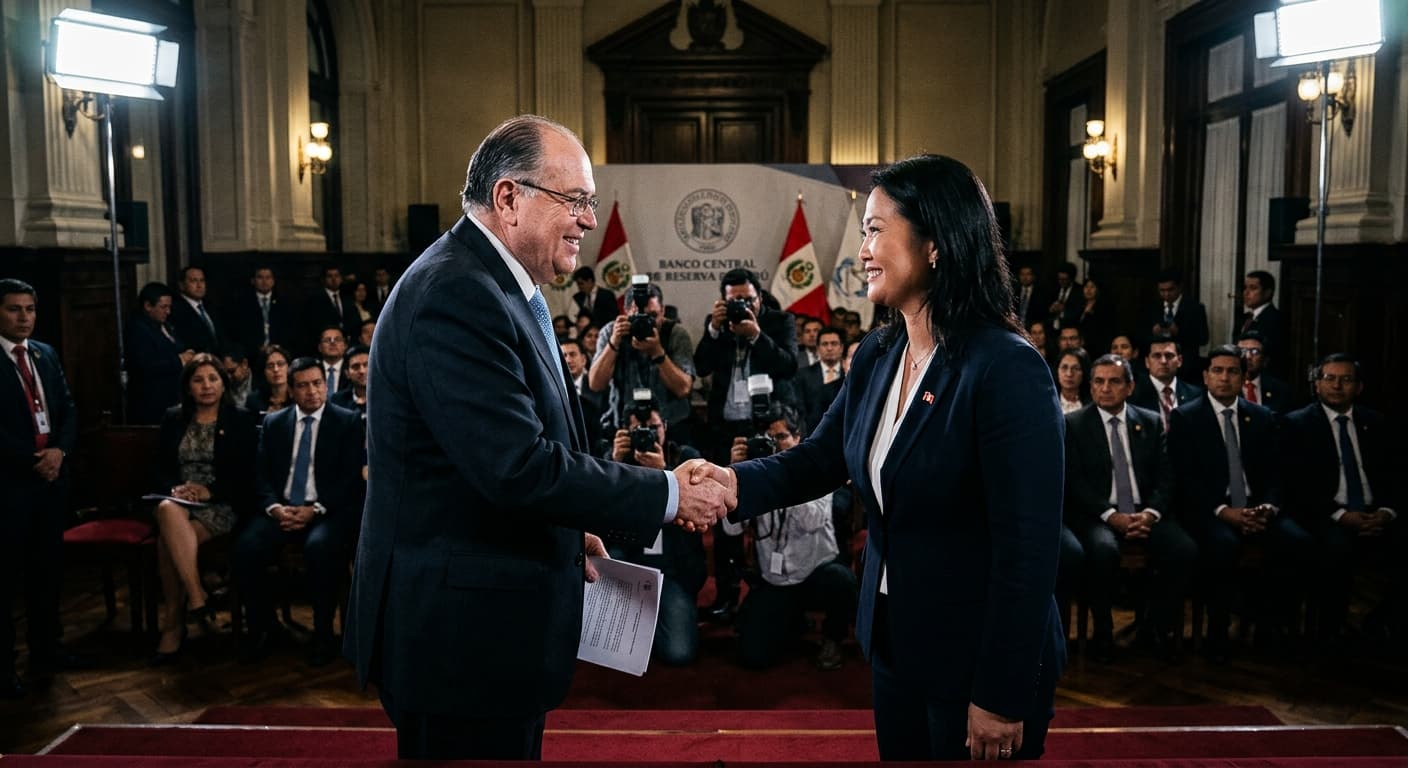
Peru's Velarde stays 5 more years: Fujimori bets on continuity
Keiko Fujimori will keep Julio Velarde, 74, at the helm of Peru's central bank through 2031 — a signal to markets that the fujimorismo restoration will not touch macro policy.
Peru's president-elect Keiko Fujimori announced on July 6, 2026 that Julio Velarde will serve a fourth five-year term as governor of the Banco Central de Reserva del Perú (BCRP), extending a tenure that will run from Alan García's second government through her own — and through 11 heads of state. The decision, made in a brief press appearance at the BCRP's Lima headquarters, is the single most important economic signal of Peru's political transition: it removes monetary policy from the political ledger before Fujimori has even been sworn in. The bet is that a technocratic anchor at the BCRP can absorb the shocks the next presidency cannot avoid — an El Niño season already forecast for late 2026, a fujimorista majority in a newly bicameral Congress under pressure to spend, and a political opposition that lost the runoff by 0.27%.
According to Infobae, Fujimori told reporters she had come to ask Velarde "to accompany us for five more years"; Velarde accepted "with the greatest pleasure," adding that "in other circumstances" he would have declined. His current term expires July 28, 2026 — the day Fujimori is inaugurated. His ratification now goes to Peru's incoming Senate, which begins sitting later this month under the bicameral system restored after the 2023 constitutional reform.
The trade Fujimori is making
Continuity at the BCRP is the cheapest concession a Peruvian president-elect can offer markets, and Velarde is the reason it works. First appointed in September 2006 by García, he has been ratified in 2011 by Ollanta Humala, in 2016 by Pedro Pablo Kuczynski, and — most consequentially — in October 2021 by leftist Pedro Castillo, whose transition had triggered a sharp sell-off in the sol before the confirmation, as BBC Mundo reported at the time. That pattern — "market panic → Velarde stays → sol stabilises" — has been repeated so consistently that his ratification is now priced in as a baseline scenario, not a surprise.
Eileen Gavin of Verisk Maplecroft told BBC Mundo before the election that "for the markets, all bets point to a Fujimori victory and continuity of the macroeconomic and monetary policy that has consolidated Peru as one of the most creditworthy countries in Latin America." The July 6 announcement pays out that bet in full.
What Fujimori gets is a costless credibility premium: she inherits an economy running near potential without having to design the anchor herself. What Velarde gets is political cover to run out the aftermath of the 2023 El Niño Costero and the 2026 climate cycle without a new governor learning the transmission mechanism in real time. What Peru's opposition loses is any leverage over the one policy portfolio that has held the country together through eight presidencies in a decade.
The numbers behind the anchor
The macroeconomic backdrop is more favourable than at any of Velarde's three previous ratifications. The IMF's 2026 Article IV concluding statement, published in March, described Peru as running "very strong macroeconomic policy frameworks" that had "helped sustain market confidence, lower financial volatility, and preserve market access on favorable terms" despite political turmoil. The BCRP policy rate stood at 4.25% at end-February 2026, an ex-ante real rate of 2.1% — slightly above the Fund's neutral-rate estimate of 2%. Inflation was anchored around the midpoint of the 1–3% target band, and the current account was in surplus at 3.1% of GDP for 2025.
The full 2026 Article IV Staff Report, released May 27, 2026, adds that Peru is "benefiting from its most favorable terms of trade since the 1950s" thanks to high metal prices — a windfall that has strengthened both the fiscal and external position. Fiscal deficit narrowed to 2.2% of GDP in 2025 and public debt is stabilising near 32% of GDP, one of the lowest ratios in the region.
That backdrop is not Velarde's doing alone. But it is the backdrop against which any successor would have been benchmarked, and it explains why Fujimori — who campaigned on "vuelve el orden" — had almost no incentive to change the face on the wall.
Why the BCRP is Peru's most consequential institution
Velarde's tenure is the operational payoff of an institutional bet Peru made a generation ago. IMF economist Luis Jácome, in a September 2022 working paper on central bank independence and inflation in Latin America, documented that the 1993 constitution and 1992 Ley Orgánica of the BCRP eliminated monetary financing of the fiscal deficit and gave the BCRP one of the highest legal-independence scores in the region. That is the statutory scaffold; Velarde is the human being who has, over 20 years, converted it into a de facto independence that survived Ollanta Humala's populist campaign, Kuczynski's impeachment, Vizcarra's dissolution of Congress, Castillo's attempted self-coup, Boluarte's ouster, and José Jerí's brief interim presidency last October.
Peru has had eight people occupy the presidency in the past decade; the BCRP has had one governor. That asymmetry is not a curiosity — it is the mechanism through which Peru retains investment-grade sovereign credit ratings while its politics runs a rolling constitutional crisis. As BCRP economist Vicente Tuesta showed in a 2007 working paper on effective vs. legal independence, the shift to explicit inflation targeting in 2002 raised Peru's effective independence score well above its legal one — a gap Velarde has personally maintained through the political turbulence that followed.
The Banker, the Financial Times' central-banking title, named him Global Central Banker of the Year in 2015 and Central Banker of the Americas in 2020. In practical terms, Fujimori's decision means that when a Fujimori-led congressional bloc tries — as fujimoristas have tried before — to force new pension withdrawals, cap interest rates or tap reserves for fiscal spending, the BCRP will push back with a governor who has done so under five previous administrations.
The El Niño problem — the real reason continuity matters now
Fujimori herself gestured at the operational risk when she told reporters "of course there is concern" about the impact of El Niño in the coming months. That is not political throat-clearing. A 2025 BCRP working paper by John Aguirre and co-authors, Economic Activity, Inflation, and Monetary Policy after Extreme Weather Events, models El Niño as a supply shock that "exerts inflationary pressures while simultaneously contracting GDP" — the worst possible combination for a central bank. An IMF working paper published in July 2025,
Building Macroeconomic Resilience to Natural Disasters, quantifies the damage: strong El Niño Costero episodes have historically pushed headline inflation up 4.4 percentage points year-on-year at peak, with non-core food inflation spiking 8.1 points. The 2023 event lifted fish and seafood CPI inflation by 11 points and fruit CPI by 22.6 points within months.
A NOAA-referenced ENSO forecasting paper for 2026 by Josef Ludescher and co-authors, posted to arXiv, gives an El Niño onset probability of 37.5% by their combined method, against a 61% probability in NOAA's January 2026 outlook. Even at the lower end, that is a live tail risk for a country that lost roughly 3% of GDP output in construction, fisheries and agriculture during the last strong event. Handing the response to a governor who has already navigated 2017's Niño Costero, the 2023 event and the pandemic is, on the merits, the lowest-risk choice available.
What could still derail this
The confirmation is not automatic. Under the bicameralism restored by the 2023 constitutional reform and effective this legislature, Velarde's re-appointment must be ratified by the incoming Senate, in which Fuerza Popular holds 22 of 60 seats — a plurality, not a majority. Fujimori will need votes from allied right-wing blocs. Analyst Martín Tanaka noted in an IEP column that the reform strips the Chamber of Diputados of impeachment power over the BCRP governor and vests approval and constitutional-accusation power in the Senate — meaning Velarde's political vulnerability now runs through a single, upper chamber that Fujimori's coalition does not fully control.
A second risk is the composition of the BCRP's seven-member board. Four directors — including the president — are named by the executive; three by Congress. As BBC Mundo noted during Castillo's 2021 confirmation of Velarde, "the composition of the BCRP board is key" and has historically been the pressure point when politicians want to constrain a governor without firing him. Under Humala, the bank operated for nearly two years with only two of seven directors. Fujimori's team has said nothing yet about the other three executive-appointed slots or whether the fujimorista bloc will attempt to seat allies in the congressional seats.
Diplomat View
Fujimori's Velarde announcement is not a policy decision; it is a policy non-decision — and that is precisely its value. Peru's political system has produced 11 presidents in a decade, an impeached predecessor, a fugitive one, and a runoff decided by roughly 49,700 votes according to BBC Mundo. The one variable investors can still price with confidence is the identity of the central-bank governor, and Fujimori has just re-anchored it for five more years. The forecast: sovereign spreads tighten modestly on Senate confirmation; the sol holds within its 2025 trading band through year-end absent an El Niño escalation; and the fujimorista bloc's fiscal ambitions — pension withdrawals, subsidies, a bigger cash-transfer envelope — collide with a BCRP that will not accommodate them. What would change this call: (a) the Senate rejecting or delaying ratification past July 28; (b) a strong El Niño Costero materialising in Q4 2026, which the BCRP model suggests could push inflation toward 6% and force a rate-hiking cycle Fujimori's coalition would resent; or (c) a directorate reshuffle that leaves Velarde isolated inside his own board.
What to watch next:
- Late July 2026: Senate ratification vote on Velarde's fourth term.
- July 28, 2026: Fujimori inaugurated; new BCRP term formally begins; nominees for other BCRP directorship slots expected.
- September–December 2026: NOAA ENSO update and BCRP monetary-policy meetings — the first test of whether Fujimori's cabinet respects the "no fiscal dominance" line Velarde has held for two decades.
The Bottom Line
Keiko Fujimori's decision to keep Julio Velarde is the clearest signal that Peru's macroeconomic constitution — inflation targeting, central-bank autonomy, no monetary financing of the deficit — is not on the table in her presidency, even as almost everything else is. In a country that has changed presidents more often than it has changed central-bank governors by a factor of eleven, that is not continuity. That is the institution doing what the political system cannot.
Discover more
India
Rajnath Singh's Durga Squad for 2026 Polls
Rajnath Singh's Durga Squad promised women's safety in Bengal but has since disappeared from the agenda, revealing BJP's true priorities.
Global Politics
Trump's Conflicting Messages on Iran War
Trump's mixed messages on Iran reflect a strategy of audience management, benefiting Tehran amid a complex geopolitical landscape.

US Politics
SNAP Food Assistance Faces Legal Challenges
In 2026, SNAP faces stricter eligibility rules and mounting legal challenges, threatening food assistance for the millions of Americans who rely on the program.

Economics
Fed's Amex AML order puts correspondent banking on notice
Federal Reserve's Amex AML order requires board-level controls and a 90-day plan; OCC fined the bank $350 million over enterprise-wide deficiencies.