France's Ouagadougou Exit Ends 65 Years
Burkina Faso cuts ties with France amid rising tensions.
Model Diplomat7 min readAfrica
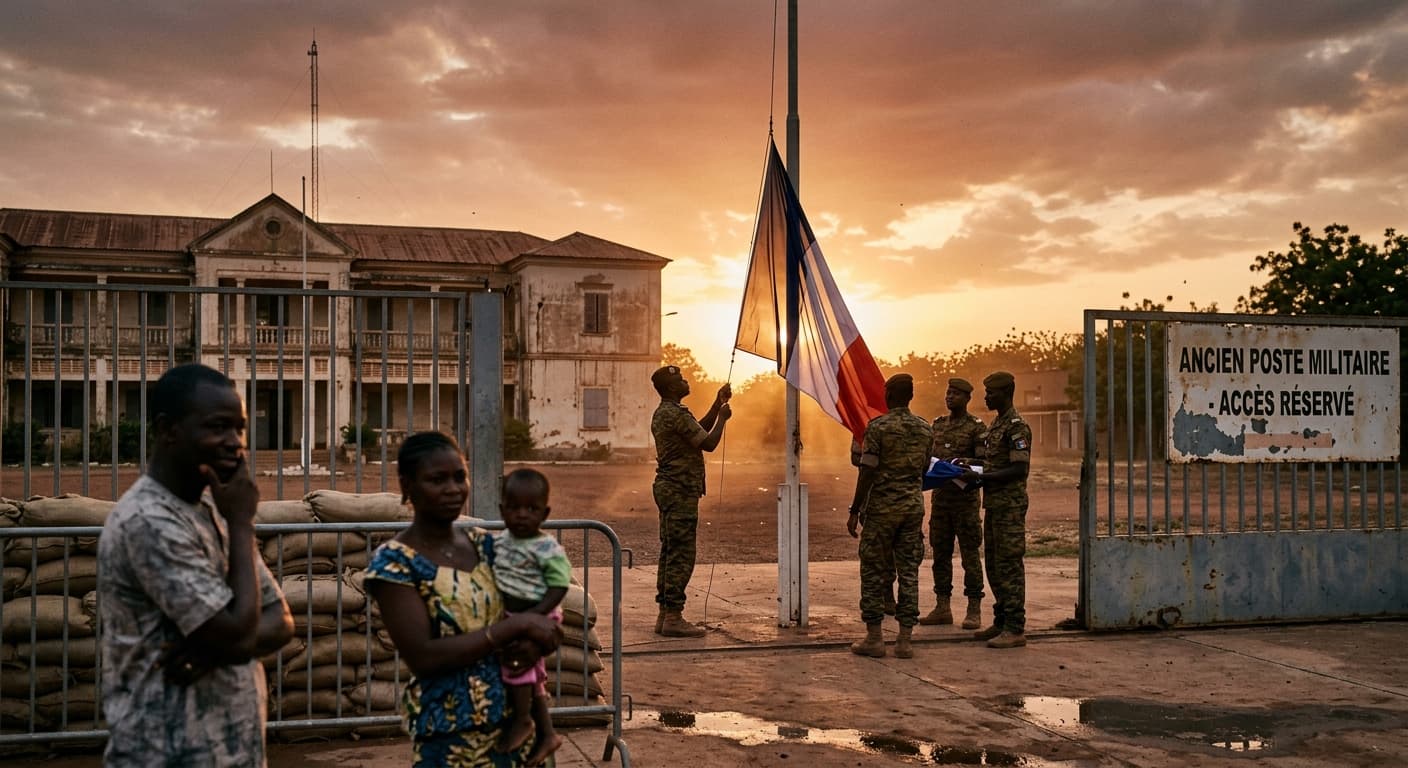
France's Ouagadougou Exit Closes 65 Years of Post-Colonial Ties
Burkina Faso severed diplomatic relations with France on June 26, 2026. The last French diplomats left by July 6 — completing Paris's Sahel eviction and exposing the limits of Macron's "new Africa" playbook.
The last French diplomatic staff left Ouagadougou on July 6, 2026, ten days after Burkina Faso's junta unilaterally severed relations — the fifth and cleanest break in a Sahel eviction that has cost France its military, monetary, and diplomatic footholds across Mali, Burkina Faso, and Niger in under four years. The rupture matters less for what France loses in Ouagadougou, where it had no ambassador since January 2023 and no troops since February that year, than for what it confirms: the Alliance of Sahel States has functionally closed the door on Paris, and neither Russia's Africa Corps nor Washington's transactional re-engagement fills the vacuum on France's terms. What comes next is a coastal-states containment game — Côte d'Ivoire, Senegal, Benin — under the shadow of a JNIM insurgency that is now blockading capitals.
The break, in the words of the two ministries
Burkinabè communications minister Pingdwendé Gilbert Ouédraogo, in a June 26 televised address reported by the BBC, accused France of "ceaseless activism" against his country and of harbouring "neo-colonial ambitions." The statement said "conditions for mutual respect no longer exist" and alleged French support for "subversive networks."
The French foreign ministry, in a travel-advisory notice dated 27 June 2026 and still live on the government's Fil d'Ariane portal, confirmed the notification and stated tersely:
Les autorités burkinabè ont notifié à la France le 26 juin 2026 leur décision de rompre les relations diplomatiques du Burkina Faso avec la République Française. À ce titre, le personnel diplomatique français quittera prochainement le territoire burkinabè.
The primary bulletin is published on the Quai d'Orsay's Burkina Faso page. Paris called the decision "hostile and unfounded" and warned French nationals — several thousand still resident — of a heightened risk of arrest on espionage allegations.
Al Jazeera reported that Burkinabè personnel were simultaneously ordered out of France, formalising a reciprocal expulsion.
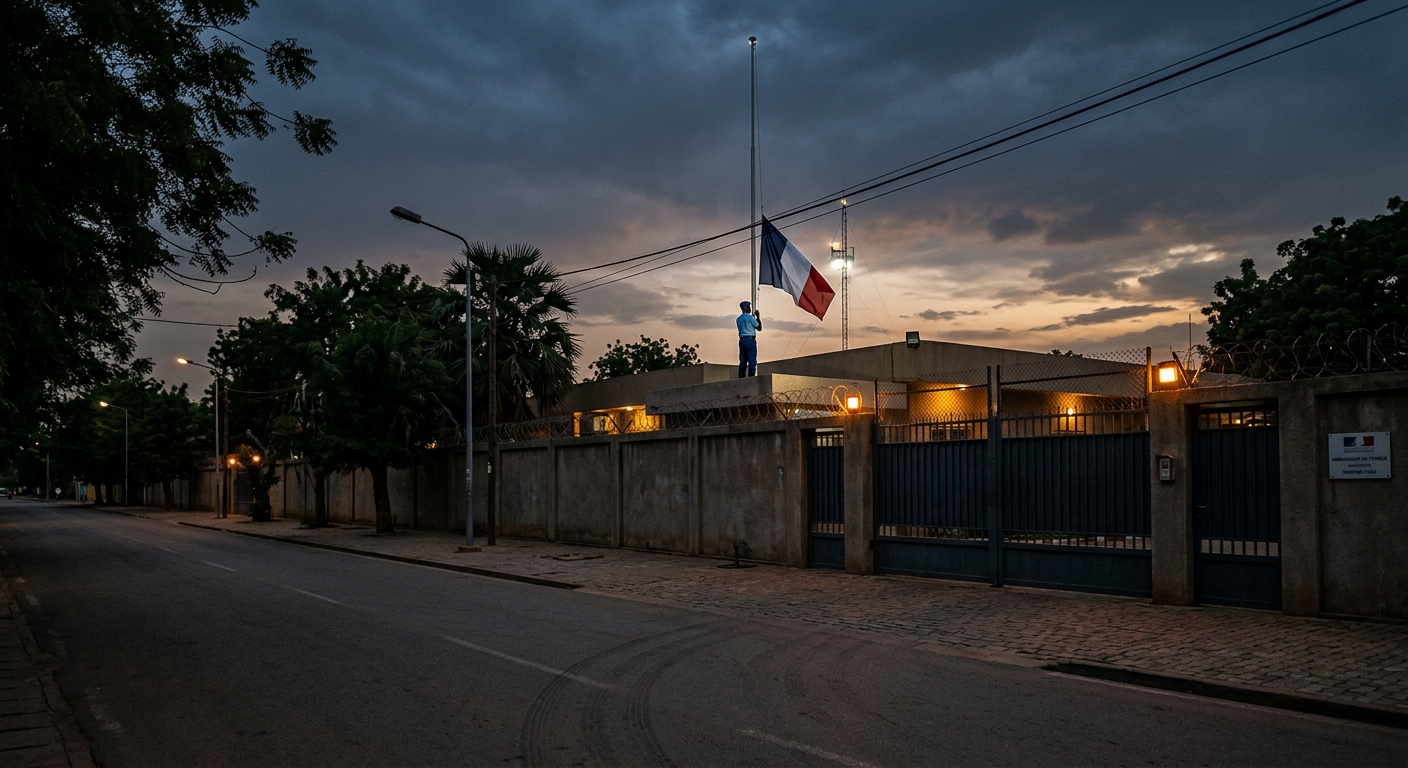
The four-year unravelling
The rupture is the terminal point of a sequence that began the day Capt. Ibrahim Traoré seized power in September 2022. According to the French foreign ministry's own bilateral dossier, Burkina Faso terminated the 2018 status-of-forces accord on 18 January 2023 and the 1961 military technical assistance accord on 28 February; the 400-strong Operation Sabre special-forces detachment withdrew "in good order" by 19 February 2023. Development aid — €83 million in AFD commitments in 2022 — was suspended on 6 August 2023, with only humanitarian assistance (€28 million) preserved.
The pattern accelerated in 2024. On 16 April, three French diplomats were declared persona non grata and given 48 hours to leave, an expulsion the BBC reported was tied to their meetings with local civil-society figures. By January 29, 2025, Burkina Faso, Mali and Niger completed their formal withdrawal from ECOWAS — a rupture with the Nigeria-headquartered bloc that
Reuters, via Al Jazeera, described as "unprecedented disintegration." From that point, the diplomatic tie with Paris was largely notional. The June 26 announcement closed it.
Who benefits
The immediate winner is Traoré's junta, whose domestic legitimacy runs on anti-French mobilisation. Denis M. Tull, writing for the Berlin-based SWP, argues that Macron's Africa policy failed because "the reformer Macron did not know how to break through path dependencies" — Barkhane became a "fiasco" that anti-French politics has since monetised. Traoré, whose transitional term was extended by five years in July 2024 and who dissolved all political parties in early 2025 per the
Atlantic Council, needs the "France as enemy" narrative to hold. The rupture manufactures it.
The strategic winner is Moscow, but less definitively than the narrative suggests. Russia reopened its Ouagadougou embassy in December 2023 after a 30-year absence, and Africa Corps — the Ministry of Defence successor to Wagner — is active in training and force protection. Yet the RAND Corporation notes that Russian deployments in Burkina Faso and Niger, signed in 2024 in "the post-Wagner period," remain smaller and less formalised than Mali's roughly 1,000-strong contingent. The BBC has separately reported that some
Russian paramilitary personnel are being pulled out of Burkina Faso to reinforce Ukraine. Russia is a partner of convenience, not a guarantor.
The quieter winner is Beijing, which has moved into gold, telecoms and infrastructure without the political conditionality Traoré uses to justify pushing France out. According to the Rabat-based Policy Center for the New South, the AES states are actively pursuing "partnership diversification" with China and BRICS+, treating the Russia relationship as one channel among several.
Who loses
France loses less in absolute economic terms than the symbolism suggests. The Quai d'Orsay's own filing shows Burkina Faso was France's 12th customer and 31st supplier in sub-Saharan Africa in 2023, a mid-tier bilateral relationship long outweighed by Côte d'Ivoire, Senegal and Nigeria. What Paris loses is intelligence, francophonie infrastructure, and the presumption of relevance in a region where five juntas (Mali, Burkina Faso, Niger, Guinea, Gabon) now sit outside the traditional Paris–ECOWAS orbit. The Clingendael Institute described the trajectory in The Twilight of French Influence in the Sahel: "France's influence in the Sahel is on life support today."
The bigger losers are ordinary Burkinabè. The Atlantic Council cites the 2025 Global Terrorism Index finding that Burkina Faso hosted a quarter of all extremist attacks worldwide in 2024, and nine of the twenty deadliest. Civilian killings by extremists are up 87 percent, and by state-aligned forces up 132 percent, since Traoré's coup. JNIM's blockade tactics — which the
Institute for Security Studies documented cutting off fuel supply to Bamako since September 2025 — are now spreading east: some 4,000 empty containers were stranded in the Malian capital by February 2026, and Burkina Faso's supply routes through Côte d'Ivoire and Ghana lie in JNIM's operational zone.
The West African re-arrangement
The diplomatic rupture caps a structural realignment that West African institutions have absorbed with more agility than Paris. ECOWAS, according to the Institute for Security Studies, continues to keep passport recognition and free-trade access open for the three AES states — a pragmatic bet on eventual reintegration. The IMF, in its
Fourth Review under Burkina Faso's Extended Credit Facility published January 30, 2026, disbursed further tranches on the basis that the country remains anchored inside the West African Economic and Monetary Union (WAEMU) and the CFA franc zone. The
World Bank Group, on April 7, 2026, launched a new 2026–2031 Country Partnership Framework covering Burkina Faso, Chad, Mali and Niger — signalling that multilateral engagement is decoupling from the French bilateral channel.
Threats to leave the CFA remain rhetorical. Traoré and Niger's Gen. Abdourahmane Tchiani have both called the currency a "sign of sovereignty" that must be recovered, but Al Jazeera reported no concrete timeline, and the IMF's January 2026 ECF review confirms continued WAEMU commitment. The paradox of the rupture: political ties with Paris are severed while the monetary umbilical, guaranteed by the French Treasury, holds.
Washington's cautious pivot
The Trump administration has read the Sahel weather differently than Paris. As the BBC reported, Nick Checker of the State Department's Bureau of African Affairs visited Bamako in early 2026 to convey "respect for Mali's sovereignty" and signal openness to Burkina Faso and Niger, dropping earlier Biden-era conditionality around democracy and human rights. Africom's Gen. John Brennan has confirmed continued intelligence support. Washington has not published a primary policy document on the pivot, but the operational signals are unambiguous. Washington's calculation is transactional: uranium in Niger, gold in Burkina Faso, counter-terrorism access against Islamic State in the Greater Sahara. It is also unmistakably a message to Paris — that the "West" the juntas rejected was, above all, France.
The insurgent shadow
None of the diplomatic manoeuvring changes the security ledger. The Stimson Center argues that "two decades of Western intervention, led above all by France, have established" that neither pure military solutions nor externally imposed models will stabilise the Sahel. JNIM and ISSP now operate across the Mali–Burkina Faso–Niger tri-border zone and have pushed south into Benin, Togo and Ghana's northern regions. The Volunteers for the Defense of the Homeland (VDP), Burkina Faso's roughly 50,000-strong civilian auxiliary, are implicated by
Human Rights Watch in ethnically targeted violence against Fulani communities — the recruitment pipeline JNIM depends on. Traoré's rupture with Paris does not touch the underlying conflict architecture. It merely removes one of the parties still notionally engaged in it.
Diplomat View
The rupture is not a swing in the pendulum — it is the pendulum being cut down. Paris will not recover diplomatic primacy in Burkina Faso under Traoré, and probably not under his successor either; the anti-French frame has become constitutive of Sahelian regime legitimacy in a way that outlives individual juntas. Our call: France will consolidate a coastal-states defensive perimeter — Côte d'Ivoire, Senegal, Benin, Togo — and treat the AES as a lost decade, while Washington and Beijing quietly divide the transactional space Paris vacates. Russia's role will plateau, constrained by Ukraine, not expand. The forecast reverses if two things happen: JNIM's blockade tactics reach Ouagadougou (forcing an AES state to accept Western logistics support on any terms), or a post-Traoré succession crisis fractures the AES from within. Absent either, the July 6 exit is permanent, and the "Françafrique" era ends not with reform but with eviction.
What to watch next
- AES Summit, September 2026 (Niamey): The confederation's third heads-of-state meeting tests whether the joint 5,000-troop force and Sahel Investment Bank move from press release to operational reality — the first concrete measure of whether the AES is a state or a slogan.
- Burkina Faso electoral deadline, July 2029: Traoré's five-year transition, extended in July 2024, formally ends. Any earlier signal — cabinet reshuffle, VDP restructuring, party ban revision — is the first crack.
- ECOWAS 51st Ordinary Summit, December 2026 (Abuja): The bloc's contingency plan for AES relations comes up for review; watch for a rupture or a soft-landing framework on trade and free movement.
- IMF Fifth Review under the ECF, expected H2 2026: Continued disbursement is the clearest signal that Burkina Faso's monetary anchor to Paris, via the CFA franc, holds — whatever the flags at the embassy say.
Discover more

US Politics
SNAP Food Assistance Faces Legal Challenges
In 2026, SNAP faces stricter eligibility rules and mounting legal challenges, threatening food assistance for the millions of Americans who rely on the program.

US Politics
Virginia GOP Rallies Rural Voters Against Red
Virginia Republicans are mobilizing rural voters against a Democratic-led redistricting referendum, a fight seen as pivotal to control in the 2026 midterms.
India
BJP's Misunderstanding of Women's Quota Needs
The BJP's linking of the Women Reservation Bill to delimitation risks delaying women's empowerment in India, misreading the aspirations of female voters.

Conflict & Security
Drone Warfare Killing Aid Workers at Unprec
Over 1,000 humanitarian workers killed in three years as cheap armed drones collapse legal protections. Gaza, Sudan, Ukraine, and DRC see deliberate targeting of aid convoys and hospitals with zero prosecutions.