France's Grid Breaks as Heat Hits Limits
Record heatwave triggers power failures across Europe.
Model Diplomat3 min readEurope
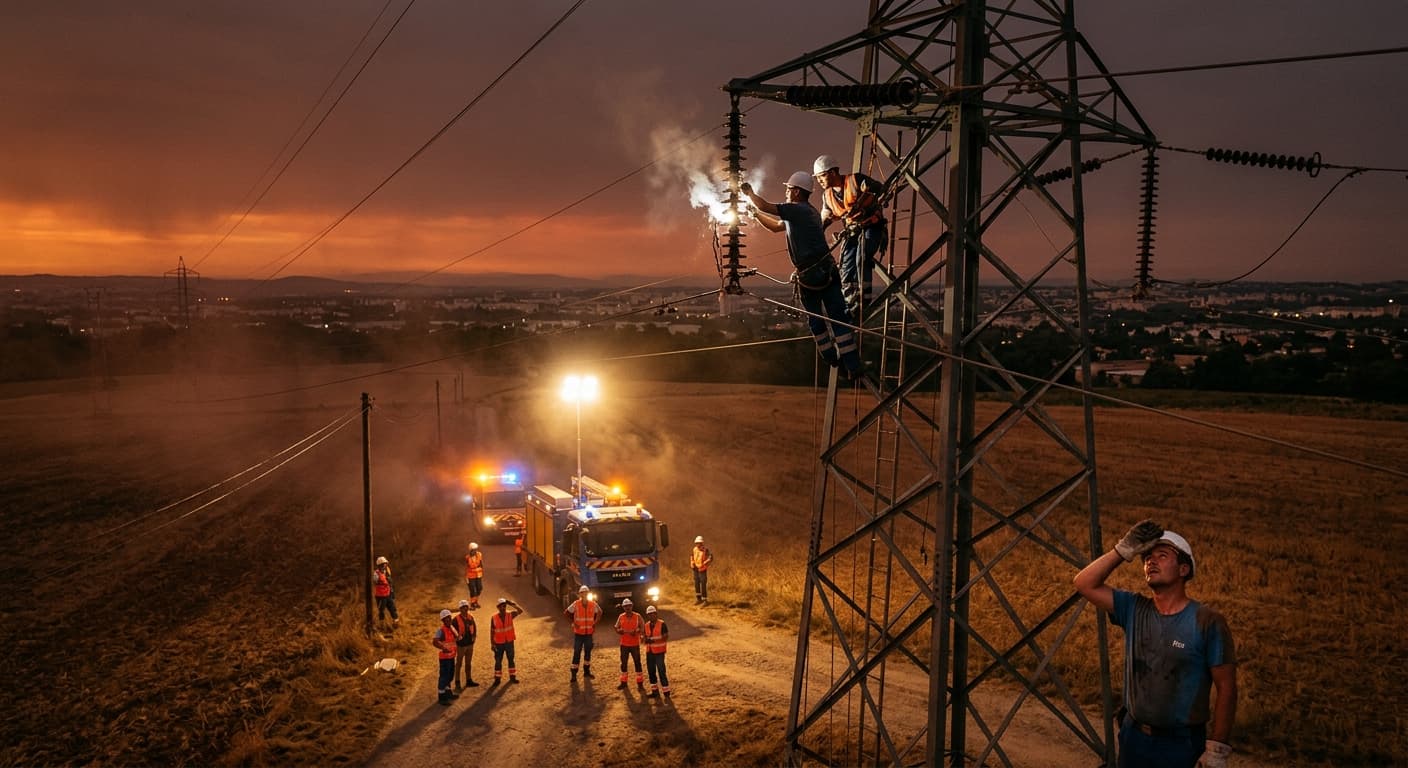
France's Grid Breaks as Heat Hits Infrastructure Limits
Record-breaking heatwave triggers power failures across Europe; nuclear output hit as temperatures strain aging infrastructure designed for cooler climates.
France is confronting a cascading energy crisis as its first major heatwave of summer breaks temperature records and cripples infrastructure built for an earlier climate. Al Jazeera reported up to 106,000 customers lost power by late Tuesday after a transformer failure in the northwestern Finistere department, with full restoration not expected until Wednesday's end at the earliest. The outage comes as
France's national temperature average reached 29.8°C—the hottest since records began in 1947—and more than 90 percent of the population faces extreme heat with highs of 39–41°C forecast through at least midweek.
The problem is architectural: France's grid and buildings were engineered for cooler baselines. Underground electrical cables reach temperatures of up to 80°C during heatwaves, according to Enedis, France's grid operator, which warned of additional network failures and faults as the heat persists. The country lacks widespread air-conditioning, so cooling demand surges precisely when the grid is most vulnerable. Meanwhile,
EDF shut down a reactor at its Golfech nuclear plant late Monday to avoid exceeding the Garonne River's 28°C warming threshold—a regulatory constraint designed to protect aquatic ecosystems but one that forces difficult choices between energy security and environmental protection.
The crisis is not confined to France. Across Italy, temporary power outages struck Milan and Turin as air-conditioning demand spiked, and
Spain's wholesale electricity market exceeded €100 per megawatt-hour for the first time since March. The underlying driver is a meteorological pattern called an Omega Block—a stalled high-pressure system that traps hot air over Western Europe and allows temperatures to ratchet upward each day without relief.
Times Now reported that this differs from typical moving weather systems; the pattern can persist for weeks, making the heatwave "longer and more intense" than normal.
The human toll compounds the infrastructure failure. France 24 reported that Prime Minister Sébastien Lecornu confirmed 40 drowning deaths since June 18, mostly young people seeking relief in unsupervised waterways.
Meteo France has placed 54 of the country's roughly 96 departments under red heat alert—half the nation living under the highest warning level.
What's at Stake
This heatwave exposes a hard limit of European infrastructure: grids, rail networks, and urban design assume cooler baselines that climate change has now rendered obsolete. The 2003 European heatwave killed an estimated 15,000 in France alone; this event, arriving abnormally early and with temperatures already exceeding 40°C, carries similar mortality risk. Recent WHO data found that over 200,000 people across Europe died from heat-related causes in the last four years, with most deaths preventable through infrastructure redesign and planning.
What to Watch
The immediate concern is whether the Omega Block breaks this week or sustains past Friday—forecasters say duration remains "uncertain." If it holds, grid failures will cascade across multiple countries simultaneously, forcing rationing of electricity or emergency nuclear restarts that violate environmental constraints. The longer-term signal: France and other European states cannot rely on aging infrastructure to manage the climate they are now entering. Grid investment and building retrofits—including mass air-conditioning installation—are no longer optional.
Discover more

Global Politics
US Seizes Iranian Ship, Tensions Surge
The US seizes the Iranian ship Touska near the Strait of Hormuz, escalating tensions and risking wider conflict in the region.
India
Romanian Coalition Party Demands PM Resign
Romania's PSD demands PM Ciolacu's resignation, risking a political crisis and economic instability. Will the coalition hold?

US Politics
SNAP Food Assistance Faces Legal Challenges
In 2026, SNAP faces stricter rules and legal challenges, impacting 42 million Americans reliant on food assistance amid budget cuts.
Economics
Zambia's developing international relations | Introduction
Zambia’s current foreign policy under President Hakainde Hichilema (since Aug 2021) centers on rebalancing international relations to support debt relief, investment, and economic development while maintaining relationships with Western partners and China, along with broader African and regional ties. Key points: - Debt and economics: Hichilema prioritizes renegotiating Zambia’s debt, seeking debt relief under the G20 Common Framework and leveraging inward investment, especi