France Withdraws Diplomats from Burkina Faso
A significant shift in Sahel's geopolitical landscape
Model Diplomat8 min readAfrica
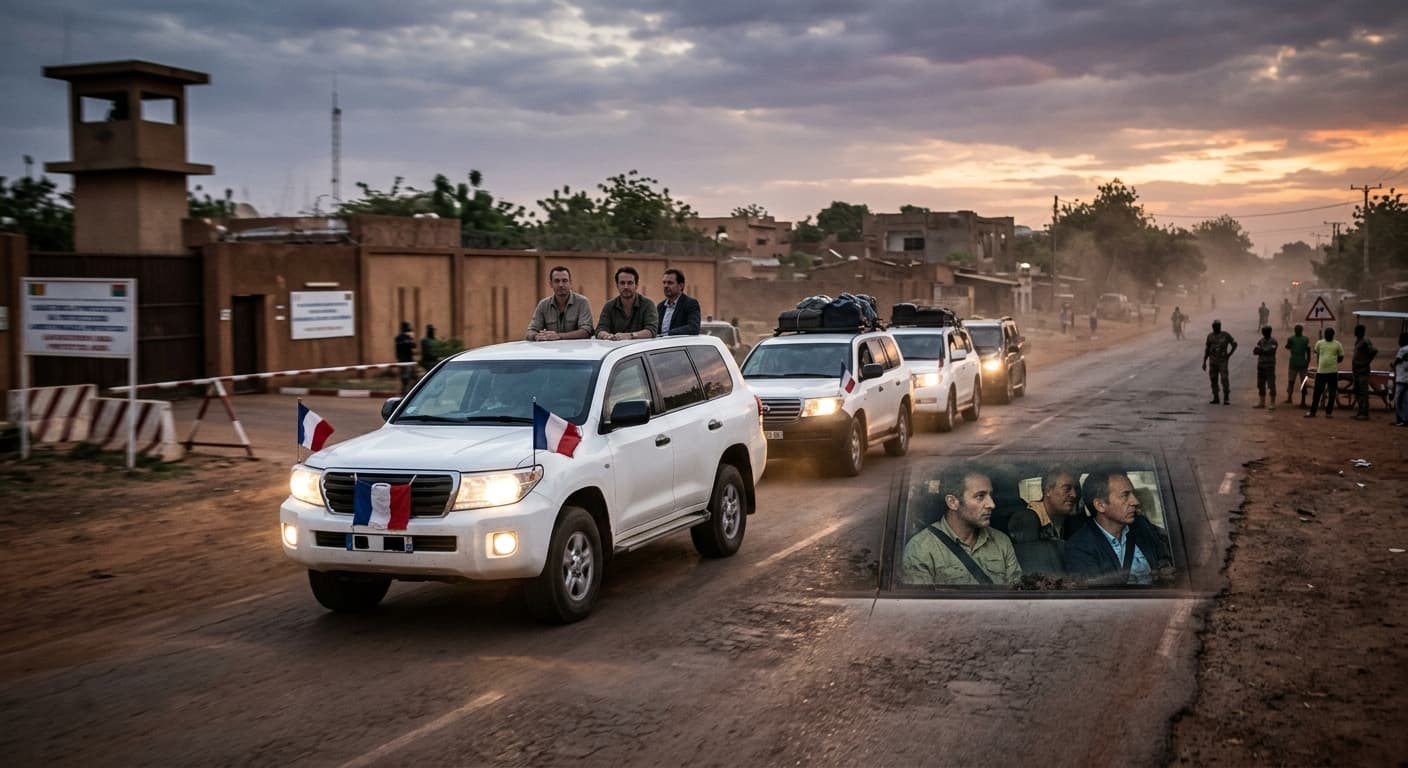
France closes its Burkina Faso embassy as the Sahel exit ends
France's July 6, 2026 pullout of its last diplomats from Ouagadougou completes a decade-long unwind — and cedes the Sahel's most contested state to Russia's Africa Corps and JNIM.
France completed the withdrawal of every diplomat from Burkina Faso by the evening of July 6, 2026, sealing the first outright rupture of bilateral relations Paris has suffered on the African continent in more than 60 years. Burkinabè counterparts had until the same hour to leave French soil. The story that matters is not the diplomatic optics: it is that a country of 24 million people, hosting 2.06 million internally displaced persons and losing 40% of its territory to al‑Qaeda's Sahel franchise, has just eliminated its last institutional channel to the West — and Paris has stopped fighting to keep one open. The Sahel is no longer a theatre of French influence. It is a Russian and jihadist theatre in which France now polls its citizens by phone from Paris.
The break, in precise detail
On June 26, 2026, Captain Ibrahim Traoré's communications minister, Pingdwendé Gilbert Ouédraogo, went on state television to announce that "conditions for mutual respect no longer exist" between Ouagadougou and Paris, citing French "ceaseless activism" and "neo-colonial ambitions," as BBC News reported the following day. Within hours the French foreign ministry called the move "hostile and unfounded" and posted a formal notice on its consular portal confirming that "les autorités burkinabè ont notifié à la France le 26 juin 2026 leur décision de rompre les relations diplomatiques," per
France Diplomatie.
Ten days later, foreign minister Jean-Noël Barrot signed off on the mirror measure: all Burkinabè diplomats were given until the evening of Monday July 6, 2026 to leave France, while Paris confirmed that its own mission in Ouagadougou had been evacuated the previous week. RFI framed it as "une étape de plus dans le refroidissement entre Paris et Ouagadougou";
Guinée Quotidien recorded Paris's denial of any support for "terrorist groups" and its insistence that humanitarian aid for civilian populations would continue.
The Quai d'Orsay's own bilateral page — updated March 27, 2026, three months before the break — already registered the trajectory: development aid and budget support suspended on August 6, 2023; the 1961 military assistance accord denounced by Ouagadougou on February 28, 2023; France's military detachment pulled out February 19, 2023, per France Diplomatie. What ended on July 6 was the residual civilian and consular architecture. There is nothing left to sever.
Why the timing is not accidental
Traoré chose the moment. The two-year anniversary of the Alliance of Sahel States (AES) — created September 16, 2023 and upgraded to a Confederation on July 6, 2024 — fell during the week of the rupture. The June 26 announcement is best read as a housekeeping move ahead of a summit calendar: closing the last Western institutional door before the AES fully operationalises its parallel architecture.
That architecture is now real, not rhetorical. The Confederal Bank for Investment and Development (BCID-AES) was inaugurated in Bamako at the December 2025 summit, with founding documents paraphed by the three finance ministers on December 12, 2025, according to BBC Afrique. At the same summit the trio launched a 5,000-strong joint counter-terrorism battalion and an "AES Television," and named Traoré chairman of the alliance, as
Al Jazeera documented. A biometric AES passport and a common currency are on the table. The three states completed their formal ECOWAS exit on January 29, 2025 — a decision the ECOWAS Commission has since ratified as irrevocable, per
BBC Afrique.
Cutting France is the ideological capstone. Traoré has told state television that Burkinabè must "forget about democracy," and his government dissolved all political parties in January 2026, as BBC News reported. A regime that no longer needs elections does not need a Western embassy to certify them.
Who benefits — and who loses
Russia inherits the pitch without paying for it. Moscow's Africa Corps, the post-Wagner formation controlled by GRU under Deputy Defence Minister Yunus-Bek Yevkurov, has been operational in Burkina Faso since 2024, joined by a paramilitary unit called Brigade Bear — reportedly the 81st Volunteer Spetsnaz Brigade "Bears" — providing close protection and training for the junta, per the RAND Corporation's 2025 study on Russian mercenaries in Africa. Payment increasingly flows in gold and mining rights: Burkina Faso is building its first gold refinery, forced foreign miners to cede a 15% state stake, and now sits inside a Mali‑Burkina‑Niger bloc producing roughly 230 tonnes of gold worth about $15 billion a year, according to a
BBC investigation of "blood gold" flows through the UAE.
JNIM benefits in a subtler way. The Group for Support of Islam and Muslims already controls or influences an estimated 40% of Burkinabè territory, as documented by FDD's Long War Journal. Central Sahel deaths from conflict hit 2,640 in the first quarter of 2026 alone across 1,179 security incidents, according to a
UN OCHA humanitarian overview. The Soufan Center noted a JNIM operational tempo that killed 60 Malian troops in Timbuktu in a single May 2025 raid and 60 more in Boulkessi 10 km from the Burkinabè border within 24 hours, warning that fatalities from JNIM operations could exceed 1,000 per month, per the
Soufan Center IntelBrief. With no Western embassies to gather ground truth, coordinate humanitarian corridors or route intelligence into the coastal states now hosting jihadist spillover, the group's freedom of action inside Burkina Faso widens.
Civilians lose twice. Human Rights Watch has documented 1,837 civilian deaths in 57 incidents between January 2023 and August 2025 in which Burkinabè forces and allied militias, alongside JNIM, killed non-combatants, per BBC News. France's rupture removes one channel — however discredited — through which such abuses were being publicly named. The
UN OCHA country page reports 4.5 million people needing aid in 2026 against a 2026 response plan only 9% funded as of April. That is not a gap donors can close by twitter.
France loses less than it claims. Paris ended Operation Barkhane, pulled special forces out of Ouagadougou in February 2023, and closed its Chad base in January 2025. Trade exposure is modest — the WTO Trade Policy Review shows gold and cotton account for 75% of Burkinabè exports, with Switzerland (not France) as the top gold destination. Direct French FDI was concentrated in a handful of mining and telecom firms already re-negotiating with the state. Symbolically the loss is heavy; materially, less so than the Mali withdrawal was.
Paris's new doctrine, tested
The Quai d'Orsay is running a deliberate pivot. Macron convened the "Africa Forward" summit in Nairobi in May 2026 — the first France–Africa summit ever held in an English-speaking country and with the AES trio explicitly not invited, as noted in an ISPI analysis by Roland Marchal. The framing is that Paris is done chasing former colonies that no longer want it, and is instead rebuilding influence through economics, culture and non‑francophone partners. Denis Tull of
SWP Berlin called the sequential expulsions from Mali (2022), Burkina Faso (2023) and Niger (2023) a "historic turning point" whose real question is "whether Paris will be able to shape this change or if it will be a mere bystander."
The July 6 rupture answers Tull's question in the direction of bystander. The absence of a formal chargé d'affaires, an interests section arrangement (via Switzerland or another third state), or even a visible protest at the UN suggests Paris has decided the marginal cost of engagement now exceeds the marginal return. That is a defensible cost-benefit calculation. It is also, structurally, an abdication.
What actually changes on the ground
Consular services for the roughly several thousand French nationals remaining in Burkina Faso will be re-routed through a third country — historically the pattern has been coverage from Abidjan or Dakar. The French ambassador post has been vacant since January 2023; the residence and chancery are now shuttered. French development finance via AFD, already suspended, will not resume. Visa processing for Burkinabè travelling to France collapses to third-country consulates and the Schengen network — a bureaucratic hardship that hits students, business travellers and medical evacuations before it hits the junta.
More consequentially, France loses its residual capacity to monitor Chinese and Russian penetration on the ground, to coordinate with the regional Africa Corps' internal movements, and to feed real-time intelligence to littoral partners — Benin, Togo, Ghana, Côte d'Ivoire — where jihadist spillover from Burkina Faso has driven cross-border displacement, with 39,899 IDPs in Benin alone as of February 2026, according to the IOM Displacement Tracking Matrix. Paris will have to buy that intelligence from Rabat, Nouakchott and Abidjan, or from the Americans.
Forward look: what to watch
- AES anniversary summit, July 6, 2026. The confederation's second birthday, with Traoré as chair. Watch for movement on the joint battalion's operational deployment, BCID-AES capitalisation figures, and any announcement on a common currency to replace the CFA franc.
- French Senate hearings on Sahel policy, autumn 2026. Barrot has been summoned; opposition figures will press for a doctrine that goes beyond Nairobi's culture-and-investment framing.
- JNIM's dry-season offensive, November 2026 – February 2027. The pattern of the last three years is a late-year push on provincial capitals. Djibo, Kaya and Fada N'Gourma are the tripwires.
- Macron's final year. His mandate ends May 2027. The next Élysée occupant inherits a France with no embassies in Mali, Burkina Faso or Niger, and a policy of substituting economics for security. Neither Marine Le Pen nor a Republican successor is likely to reverse the retreat; the more probable question is whether they formalise it.
Diplomat View
The break is not the story. The story is that neither side blinked, and neither side needed to. Traoré secured the domestic dividend of publicly humiliating the former colonial power at zero material cost — France was already out militarily and financially. Macron cut a losing hand in a theatre where Paris no longer has the appetite, the troops or the political runway to shape outcomes. This is what strategic retreat looks like when it stops pretending to be anything else.
The falsifiable call: within 18 months, expect (i) at least one AES member to test whether a rupture with France travels — most likely a downgrade of relations with an EU state that has taken over French positions on Sahel human rights, and (ii) a formal Africa Corps footprint expansion in Burkina Faso pegged to a mineral concession, not a security agreement. What would revise the forecast: a successful ECOWAS-mediated re-engagement with even one AES member (Faye's mandate was extended into 2025 for precisely this purpose), or a JNIM territorial reversal significant enough to force Ouagadougou back to Western intelligence-sharing. Neither looks likely on the current trajectory. The Sahel has voted with its embassies — and Paris, for the first time in a very long time, has stopped campaigning.
Discover more

US Politics
US Launches $166B Tariff Refund Portal
The US is launching a $166 billion tariff refund portal to aid importers hit by Trump-era tariffs, with major implications for trade and supply costs.

US Politics
House Ethics Committee Pushes Sexual Miscond.
The House Ethics Committee has shifted responsibility for sexual harassment settlement records to the Office of Congressional Workplace Rights, complicating disclosure efforts.
India
BJP's Misunderstanding of Women's Quota Needs
The BJP's linking of the Women Reservation Bill to delimitation risks delaying women's empowerment in India, misreading the aspirations of female voters.

Conflict & Security
Drone Warfare Killing Aid Workers at Unprec
Over 1,000 humanitarian workers killed in three years as cheap armed drones collapse legal protections. Gaza, Sudan, Ukraine, and DRC see deliberate targeting of aid convoys and hospitals with zero prosecutions.