France Returns to Syria: Macron's Diplomatic
Macron's ambassador gambit reshapes the Levant
Model Diplomat8 min readMiddle East
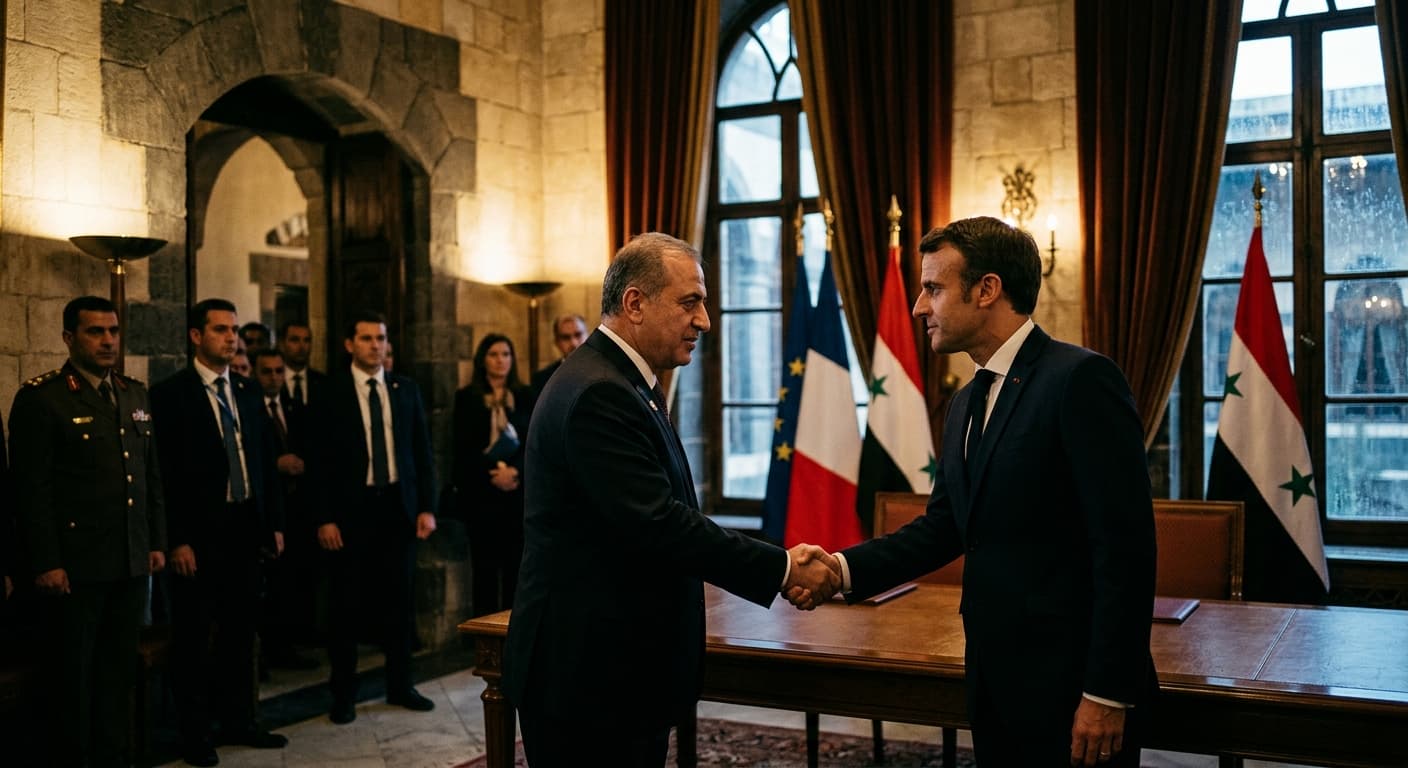
France returns to Damascus: Macron's ambassador gambit reshapes the Levant
France and Syria will exchange ambassadors for the first time since 2012 as Macron signs over a dozen deals in Damascus — a first-mover bet on a $400 billion reconstruction market that reframes Europe's role in the post-Assad Middle East.
France and Syria agreed on July 7, 2026 to reappoint ambassadors after a 14-year rupture, sealing the moment with more than a dozen bilateral agreements — Homs water and power, Central Bank technical assistance, cargo infrastructure at Damascus airport, and the return of €51 million in seized Assad-family assets. Emmanuel Macron, the first French head of state in Damascus in nearly two decades, is not just normalising ties; he is buying France pole position in a reconstruction market that neither Washington nor the Gulf can dominate alone, while reclaiming a Levantine role Paris has been quietly losing for 80 years. The deal was announced hours after two bombs detonated near the Four Seasons Hotel where Macron had stayed — a reminder that the political geometry Paris is now betting on remains, in the president's own convoy's shadow, physically fragile.
What was actually signed
The headline is the ambassador exchange, but the substance is commercial. According to the Associated Press wire published by the Las Vegas Sun, the two governments signed "over a dozen agreements" covering the return of roughly €51 million ($58.3 million) in illicit assets that belonged to Rifaat Assad, the ousted dictator's uncle, alongside deals to rebuild water and electricity infrastructure in Homs, technical assistance to Syria's central bank, and upgrades to Damascus airport's cargo capacity.
The Rifaat Assad line item is not incidental. As the BBC reported after his 2020 conviction, a Paris court sentenced him to four years and ordered confiscation of a €90 million French property portfolio built with embezzled Syrian state funds — a ruling
confirmed on appeal in 2021. Returning even a slice of those assets to Damascus turns a technical asset-recovery process into a political gift: it lets al-Sharaa's government publicly recover money looted from Syrians, and it lets Macron argue France's judiciary was on the right side of the transition years before the ambassadors came home.
"Our meeting marks a historical milestone," al-Sharaa said at the joint press conference, according to AP wire copy. Macron went further on X: "Nothing can smother the aspiration of Syrian women and men to live in a fully sovereign, safe, pluralistic, and united Syria."
The power calculation
The read on Macron's trip is not sentimental. France closed its Damascus embassy on March 2, 2012, according to the Quai d'Orsay's own country page, and spent the next 12 years demanding Bashar al-Assad's departure as a precondition for anything. That precondition was met, by force, on December 8, 2024. Since then Paris has moved faster than any other Western capital to bank the dividend.
The sequence is deliberate. Foreign Minister Jean-Noël Barrot went to Damascus with Germany's Annalena Baerbock on January 3, 2025 — the first Western top diplomats to meet al-Sharaa. Macron then hosted an
International Conference on Syria in Paris on February 13, 2025, where he pledged €50 million in humanitarian and stabilisation aid and pre-announced the "imminent" reopening of French diplomatic activity in Damascus. On May 7, 2025, according to the
Élysée readout, Macron received al-Sharaa at the Élysée — the first visit by a Syrian head of state to France in more than two decades — and used the moment to lobby the US and EU to lift sanctions.
That lobbying worked. Under Council Regulation (EU) 2025/1098 of 27 May 2025, the EU eliminated its sectoral restrictive measures on Syria, keeping only Assad-era listings, chemical-weapons controls, and security-based sanctions. The
Council statement of 20 May 2025 framed it as backing for "a new, inclusive, pluralistic and peaceful Syria free from harmful foreign interference." Trump lifted most US sanctions weeks later; Washington
revoked HTS's terrorist designation on July 7, 2025 — exactly a year before Macron's Damascus visit.
Every one of those moves was a precondition for the deals signed today. Without EU sanctions gone, French banks cannot service Syrian counterparts. Without US delisting, insurers will not underwrite reconstruction contracts. Macron spent 18 months clearing the legal runway so that the commercial delegation flying with him — including firms eyeing utilities, aviation, and banking — could actually close.
The historical parallel that reframes everything
France's return to Damascus is not a fresh start. It is a fifth act. Under the San Remo Agreement of 1920, France ran Syria as a League of Nations mandate for a quarter-century — a "colonial protectorate," in the words of an Ifri strategic study by Héloïse Fayet, that "sometimes used violence." Paris bombed Damascus in 1925 to suppress the Great Syrian Revolt and again in 1945 in a last-ditch attempt to block Syrian independence. As historian Elizabeth Thompson recently
told Carnegie's Diwan, the French colonial lobby under Robert de Caix "asserted a major influence on the decision to invade Syria, topple Faisal, and create Greater Lebanon as a separate state" — the geometry that still defines the region.
That history matters because it is precisely what French policy has been trying to convert into soft-power leverage. Paris has always claimed a special relationship with Syria's minorities — Christians, Alawites, and, in the current moment, the Kurdish-led Syrian Democratic Forces, whom Barrot called "France's allies" in Damascus in January 2025. Macron's January 22, 2026 Élysée communiqué made SDF integration into the new Syrian state an explicit French condition, invoking mediation by Iraqi Kurdish leader Nechirvan Barzani and warning against any settlement "by force" against the civilian population in Kobane or Hasakah.
That is the leverage Macron traded on this trip. Al-Sharaa needs French political cover to keep the Kurdish file — the single most dangerous fracture line in his new state — from collapsing back into open war. France offers legitimation, banking channels, and asset return. In exchange, it gets contracts, ambassadorial parity, and the right to remain the West's designated interlocutor with Damascus.
Who benefits, who loses
The immediate French winners are commercial. Before 2011, the EU was Syria's largest trading partner, according to an Atlantic Council analysis, and the bloc is now dangling a €175 million financial recovery package plus full resumption of its 1978 Cooperation Agreement. Rebuilding Syria will cost, by UN and World Bank estimates, several hundred billion dollars. French utilities, engineering firms, and banks are being handed a first look — with the Élysée's political guarantee that Paris will keep pushing sanctions relief and treat Syrian sovereign risk as an EU foreign-policy priority.
The losers are more subtle. Turkey, which spent a decade sponsoring HTS and its predecessors and expected to dominate reconstruction, now watches al-Sharaa signal that Damascus wants a European counterweight. At the joint press conference al-Sharaa called France a "primary partner" and framed Syria's role as a global transit hub in light of disruptions in the Strait of Hormuz — language that positions Syria inside the India–Middle East–Europe Economic Corridor architecture the Atlantic Council flagged, not the Ankara-dominated corridor Erdogan wants.
Russia is the second loser. Moscow spent a decade propping up Assad in return for basing rights at Hmeimim and Tartus. Its position in Syria is now on the sufferance of a government whose president spent that decade fighting Russian air power. The Valdai Club's Richard Lachmann noted that French policy in Syria has historically depended on parallel efforts by the US; the current alignment — Macron ahead, Trump close behind — is the first version of that dependency to run in France's favour in a generation.
Iran is the third. Hezbollah lost its Syrian land bridge in December 2024 and has not recovered it. Macron's presence in Damascus, with a French business delegation, formalises that loss.
The security shadow
The bombs matter. Two explosive devices detonated near the Four Seasons Hotel where Macron had stayed the night, injuring 18 people including four police officers, according to Syria's Interior Ministry via SANA. It was the second Damascus attack in a week — an
explosive device killed at least 10 at a cafe near the Justice Palace on July 3, 2026. No group claimed responsibility.
The analysts Al Jazeera cited were blunt: Kamal Abdeo of the University of Idlib called it a "big security breach" that "probably" involved IEDs planted overnight along Macron's convoy route. Syrian security expert Ismat al-Absi said the goal was to "create unrest and send a negative message." The fact that Macron did not hear the blasts and continued to the presidential palace is a political tell — both governments decided the story of the day would be the ambassador exchange, not the security failure. The bet is that Western capitals and boardrooms will read the calm as resilience, not as denial.
Diplomat View
The bottom line: Macron has effectively bought France a decade of privileged access to Syrian reconstruction for the price of political risk that no other Western leader was willing to absorb in 2025. The ambassador exchange is the ribbon; the substance is a French claim to be the West's primary broker in the Levant — the first time Paris has held that position since 1946.
The forecast is falsifiable. If al-Sharaa's government executes an inclusive transition and the Kurdish file is settled without further mass violence, French firms will lock in first-mover contracts and Paris will consolidate a role that the UK, Germany, and Italy will spend years catching up to. The revision conditions are specific and dated. Watch: (1) whether the July 2026 NATO summit sideline meeting between al-Sharaa and Trump, reported by NPR, produces US commercial follow-through that undercuts French positioning; (2) whether the EU's June 1, 2026 sanctions review — the sunset written into
Council Decision (CFSP) 2025/1096 — is renewed cleanly or reopens residual restrictions; (3) whether a third Damascus bombing forces al-Sharaa to widen security-service crackdowns in ways that trigger European human-rights conditionality. Any one of those breaks the trajectory. Absent them, France's return to Damascus is the most consequential European re-entry into the Arab world since the Elysée Treaty of 1963.
What to watch next
- July 7–8, 2026 — NATO Ankara summit sidelines. Al-Sharaa is expected to meet Trump; the readout will show whether Washington ratifies or contests France's lead role in Damascus.
- Before June 1, 2027 — EU sanctions review. The Council must decide whether to renew, tighten, or further lift the residual regime under Regulation 36/2012, as amended.
- September 2026 — UN General Assembly. Al-Sharaa's second UNGA appearance, after his
debut in September 2025, is the next set-piece test of his international legitimacy — and the next opportunity for Macron to bank the visit publicly.
Discover more
US Politics
Virginia's Redistricting Referendum
Virginia's redistricting referendum is drawing a flood of dark money, shaping future elections and the fight for congressional control amid party stakes.
US Politics
SNAP Food Assistance Faces Legal Challenges
In 2026, SNAP faces stricter eligibility rules and mounting legal challenges, threatening food assistance for the millions of Americans who rely on the program.

US Politics
US Launches $166B Tariff Refund Portal
The US is launching a $166 billion tariff refund portal to aid importers hit by Trump-era tariffs, with major implications for trade and supply costs.

Conflict & Security
Drone Warfare Killing Aid Workers at Unprec
Over 1,000 humanitarian workers killed in three years as cheap armed drones collapse legal protections. Gaza, Sudan, Ukraine, and DRC see deliberate targeting of aid convoys and hospitals with zero prosecutions.