France Reopens Damascus Embassy, Bets on Reco
Macron's move signals a new era in Syrian relations.
Model Diplomat7 min readMiddle East
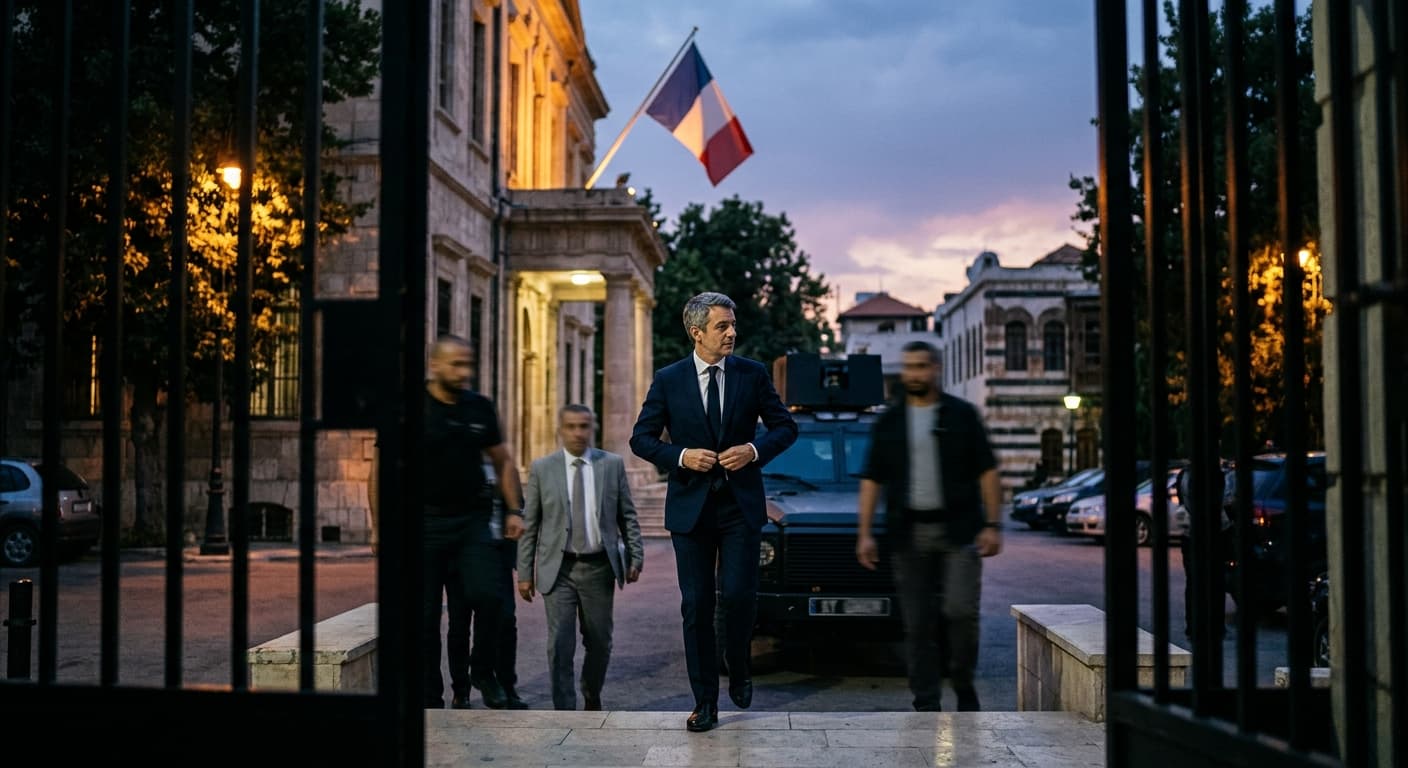
France Reopens Damascus Embassy, Bets on Syria's Reconstruction
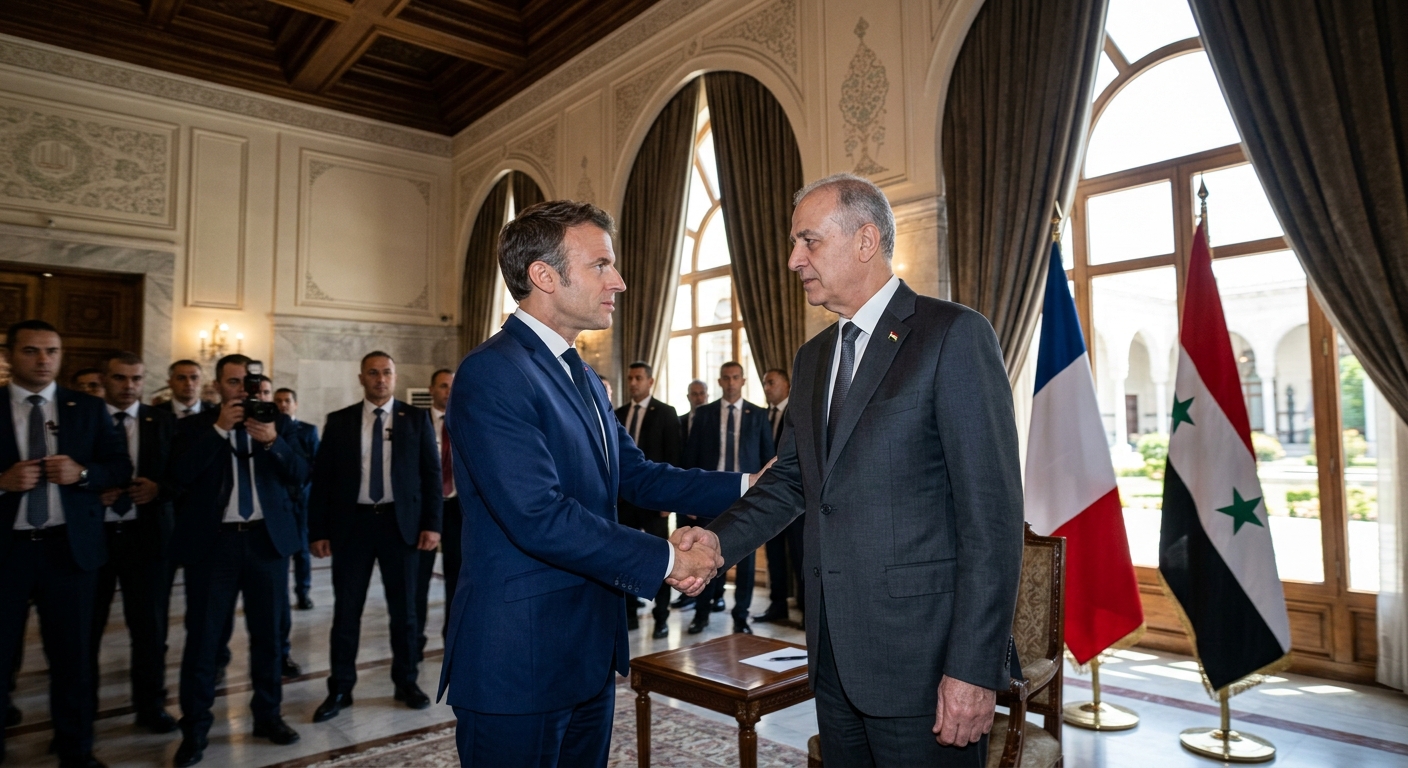
Macron and al-Sharaa agreed on July 7, 2026 to exchange ambassadors after a 12-year rupture, sealing France's return as the West's lead broker in post-Assad Syria.
France is buying influence at the moment the price is lowest. Emmanuel Macron's decision, announced in Damascus on July 7, 2026, to exchange ambassadors with Ahmed al-Sharaa after a 12-year hiatus is not a symbolic restoration — it is a bid to lock in commercial and security primacy in a country whose reconstruction the World Bank prices at $216 billion, roughly ten times Syria's 2024 GDP, according to The Economist. Fifteen bilateral agreements — banking, civil aviation, health, ports, hydrocarbons — were signed the same day,
BBC News reported. Two IEDs went off within the security perimeter of Macron's hotel as he moved to meet al-Sharaa; the visit continued. That, in a sentence, is the wager.
What was actually signed
The centerpiece is diplomatic: al-Sharaa and Macron agreed to install ambassadors "as soon as possible," ending a rupture that began when Paris shuttered its embassy in March 2012 over Bashar al-Assad's crackdown. Since Assad's fall in December 2024, France has been represented in Damascus only by a chargé d'affaires operating out of Beirut, according to France Diplomatie's bilateral relations page.
The commercial layer is more concrete than the communiqué language suggests. Macron's office confirmed that shipping group CMA CGM has signed a partnership handling air freight at Damascus International Airport, building on a May 2026 contract to operate two dry ports; TotalEnergies CEO Patrick Pouyanné met his Syrian counterparts the same day to discuss an exploration contract, Al Jazeera reported. France also began the process of returning €51 million ($58.3 million) in assets seized from Rifaat al-Assad — Bashar's uncle, convicted in Paris in 2020 for laundering embezzled Syrian public funds — to the new Syrian government.
Al-Sharaa framed the visit in terms that should focus European minds. He told the joint press conference he wants France as a "primary partner" and pitched Syria as a global transit corridor "following the disruptions in the Strait of Hormuz," according to Al Jazeera. That is the offer: a post-Iran, post-Russia land bridge from the Mediterranean to Iraq, with French firms in the ground floor.
Why France, and why now
Paris moved faster than any other Western capital after Assad fell. Foreign Minister Jean-Noël Barrot and Germany's Annalena Baerbock became the first senior Western officials to meet al-Sharaa on January 3, 2025. France then hosted the February 13, 2025 international conference on Syria's transition and welcomed al-Sharaa to the Élysée on May 7, 2025 — his first official European visit. In a communiqué dated January 22, 2026, Macron committed France to backing "a united, sovereign Syria that respects all its components," pushing hard on the SDF integration file, per the Élysée.
Why this speed? Three drivers. First, sanctions relief cleared the runway: the EU lifted its economic sanctions on May 20, 2025 after suspending sectoral measures on February 24, 2025, freeing Syrian banks from cutoff and unfreezing central-bank assets, Al Jazeera reported. Second, the field is already crowded — Saudi Arabia committed roughly $6.4 billion in July 2025, Qatar's UCC Holding took a $4 billion Damascus airport deal in August 2025, and by February 2026 Riyadh had signed further multi-billion-dollar aviation and telecom packages, per
Al Jazeera. France, absent from the Gulf-and-Turkey axis, needed a distinctive lane.
Third, Paris sees a chance to reset the regional balance at Iran and Russia's expense. As the Polish Institute of International Affairs notes, rebuilding a Syria ruled by former opposition groups "offers a chance to limit the destabilising influence of Russia and Iran," while the new U.S. administration's ambivalence about staying in Syria creates room for European initiative. On March 24, 2026, the World Bank's Paris office convened a French-Syrian investment session with the Syrian Investment Authority chairman Talal al-Hilali, MEDEF International and French ministries — a technocratic setup for a French corporate push, per the
World Bank.
The regional-stability calculus
The bet cuts two ways. Al-Sharaa now controls a country he did not control six months ago. After a lightning January 2026 offensive, government forces retook the northeast, and the Syrian Democratic Forces accepted a 14-point deal integrating Kurdish military and civilian institutions into the state, Al Jazeera reported. On paper, that resolves the country's most dangerous fracture. Macron endorsed it early, calling the January 18 ceasefire the basis for a "durable solution" that guarantees Syria's unity, per
France Diplomatie.
But the security backdrop is ugly. IS-linked attacks are rising: a cafe bombing killed at least nine people in Damascus days before Macron's arrival, and the two IEDs on July 7 detonated within meters of his hotel. Pro-government forces were accused of atrocities against Alawite civilians on the Mediterranean coast and against Druze in Suwayda in 2025, killing hundreds, per BBC News. Israel has struck Syrian territory repeatedly since December 2024 and holds ground it seized in the demilitarized zone; a US-mediated "communication cell" agreed in Paris on January 6, 2026 has not stopped the strikes,
Al Jazeera reported.
France's diplomatic capital is therefore doing two contradictory jobs at once: legitimising al-Sharaa's centralization while pressing him to protect the minorities his own forces have been accused of harming. Carnegie's Middle East program flags precisely this gap — the EU trails Turkey, Qatar and Saudi Arabia in Syria because it has yet to convert humanitarian commitments into conditional political leverage, per Carnegie Endowment. Macron's answer is to buy leverage with commerce, then spend it on the minority file.
The historical shadow
The optics carry weight Paris cannot fully control. France ran Syria as a League of Nations mandate from 1920 to 1946, twice bombing Damascus — in the 1925 Great Revolt and again in 1945 — to block independence, as historian Elizabeth Thompson recounts in a Carnegie interview. Macron's insistence on a "united and pluralistic" Syria echoes de Gaulle-era rhetoric that older Damascenes remember as the language of tutelage. Al-Sharaa's public greeting of Macron in French, per
BBC Arabic, was a courtesy — and a reminder that the last French president to visit Damascus was Nicolas Sarkozy in 2008, when Bashar al-Assad still wore the reformer's mask.
The non-obvious beneficiary of this rapprochement is not French industry, and not al-Sharaa. It is the European Union's argument that it can still shape a Middle East transition without deploying force. If France can convert its head start into a durable governance-and-reconstruction package — property registries, returnee protection, EU-monitored institution-building of the sort Carnegie recommends — Brussels acquires a template it currently lacks. If it cannot, Paris will have handed a Sunni-Islamist government legitimacy for a fistful of contracts, and the next round of sectarian violence will land on French policy.
What to watch next
Three near-term catalysts will decide whether this is a reset or a rebrand:
- Ambassador nominations and agrément. Al-Sharaa said the exchange should happen "as soon as possible." Watch for a French chargé upgraded to full ambassador in Damascus within weeks, and a Syrian ambassador received in Paris; each government's choice of envoy will signal how the file is being run — commercial, security, or political.
- SDF integration deadlines. The 14-point deal requires phased folding of Kurdish forces into the Syrian army and interior ministry. Delays or clashes over Kurdish cultural and linguistic guarantees, granted by al-Sharaa's decree earlier in 2026, will test Macron's public claim that separatism is off the table.
- TotalEnergies exploration contract. Pouyanné's Damascus meetings pointed toward a signed E&P deal. A signed contract — versus a memorandum — is the marker of whether French capital actually follows French diplomacy, or waits for the security picture to clarify.
The forecast that would kill this story is straightforward: another sectarian massacre attributed to government-aligned forces, or a successful IS attack that reaches a French delegation. Either would collapse the political permission slip Macron secured this week and hand the Syria file back to Ankara, Riyadh and Washington.
Diplomat View
France's ambassador exchange is not a normalisation — it is a leveraged buyout of political influence in a country too broken to price it properly. Macron is betting that being first through the door, with contracts and credit lines, purchases the standing to shape al-Sharaa's choices on minorities, on the SDF, and on Israel. That bet is defensible today because the alternatives are worse: a Gulf-Turkey duopoly that offers reconstruction cash without governance conditionality, or a U.S. drawdown that leaves IS detainees and refugee flows as Europe's inheritance. But the bet is falsifiable. If, by the end of 2026, France cannot point to (a) an operating embassy staffed by a full ambassador, (b) at least one binding French corporate contract at production stage, and (c) measurable protection of Alawite, Druze and Kurdish communities under central government authority, the trip to Damascus will be remembered as the moment Paris underwrote a strongman for spare change. The IEDs that went off within earshot of the French delegation on July 7 were the market's first quote on that risk. It was not low.
The Bottom Line
France's return to Damascus after 12 years is a calculated bid to convert diplomatic speed into commercial and political primacy before the Gulf states, Turkey and Russia lock Europe out of Syria's $216 billion reconstruction. Macron is spending French legitimacy to buy leverage over al-Sharaa on minorities and Kurdish integration — a wager that only pays off if the new Syrian state protects the people its own forces have been accused of killing. If it doesn't, Paris will have restored an embassy to underwrite the next round of sectarian violence.
Discover more
US Politics
SNAP Food Assistance Faces Legal Challenges
In 2026, SNAP faces stricter eligibility rules and mounting legal challenges, threatening food assistance for the millions of Americans who rely on the program.

US Politics
US Launches $166B Tariff Refund Portal
The US is launching a $166 billion tariff refund portal to aid importers hit by Trump-era tariffs, with major implications for trade and supply costs.
US Politics
Virginia's Redistricting Referendum
Virginia's redistricting referendum is drawing a flood of dark money, shaping future elections and the fight for congressional control amid party stakes.

Conflict & Security
Drone Warfare Killing Aid Workers at Unprec
Over 1,000 humanitarian workers killed in three years as cheap armed drones collapse legal protections. Gaza, Sudan, Ukraine, and DRC see deliberate targeting of aid convoys and hospitals with zero prosecutions.