Fossil Fuel Summit 2026: Key Takeaways
Insights from the Santa Marta climate summit
Model Diplomat7 min readGlobal
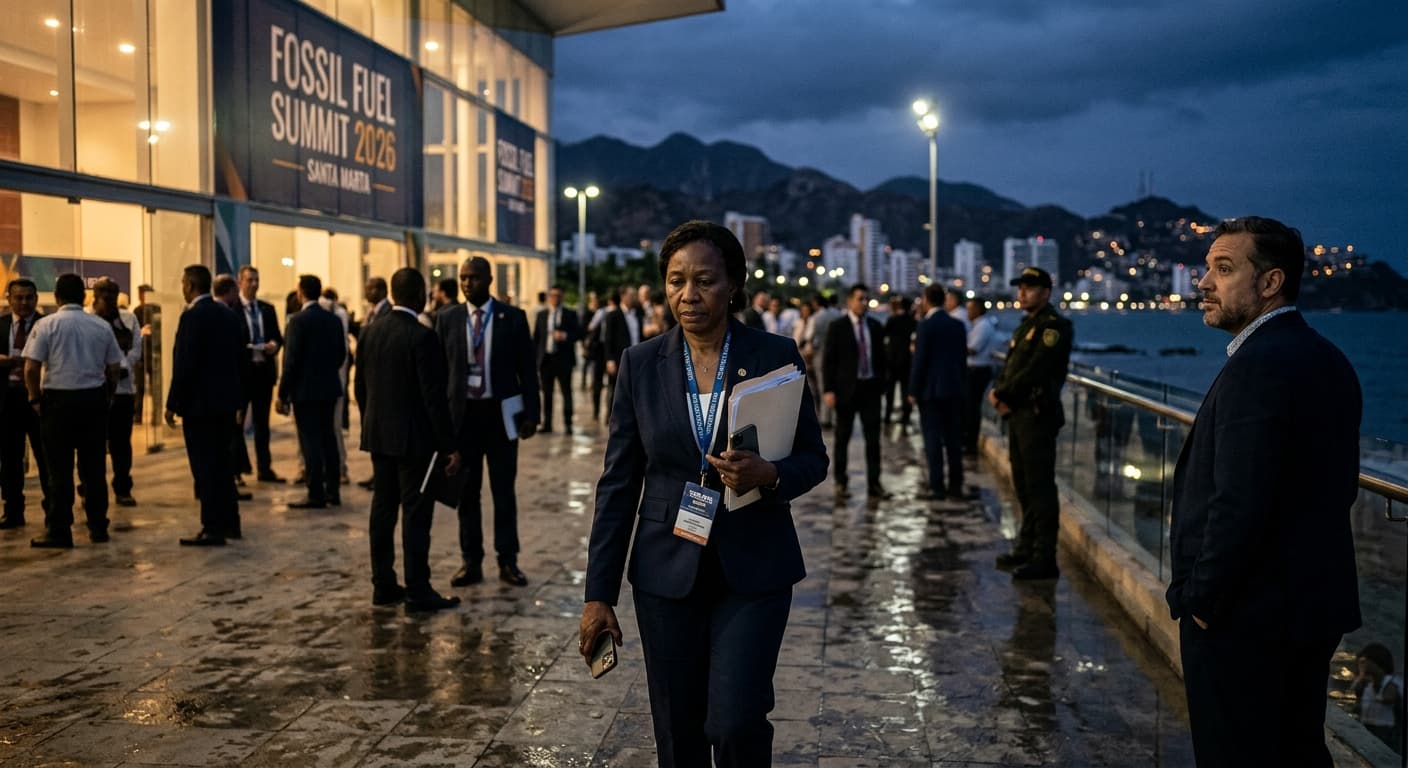
Fossil Fuel Summit 2026: 5 Takeaways from Santa Marta
Colombia's Santa Marta summit produced no treaty, no roadmap and no U.S. signature — yet it just quietly rewired global climate diplomacy.
The world's first intergovernmental conference dedicated to phasing out fossil fuels closed in Santa Marta, Colombia, on April 29, 2026, with 57 countries in the room, 24 signatures on the Belém Declaration, and every major emitter—the United States, China, India, Russia, Saudi Arabia—absent. The summit's real product is not a phase-out timetable but a procedural coup: after 30 years of UN consensus rules that let petrostates veto the words "fossil fuels," a coalition representing roughly a third of global GDP and a fifth of global supply walked out of that framework, armed with a July 2025 International Court of Justice opinion that makes new drilling licences a possible breach of international law — and did so during the worst oil-supply shock in market history. The bet is that scarcity, not conscience, finally moves the needle.
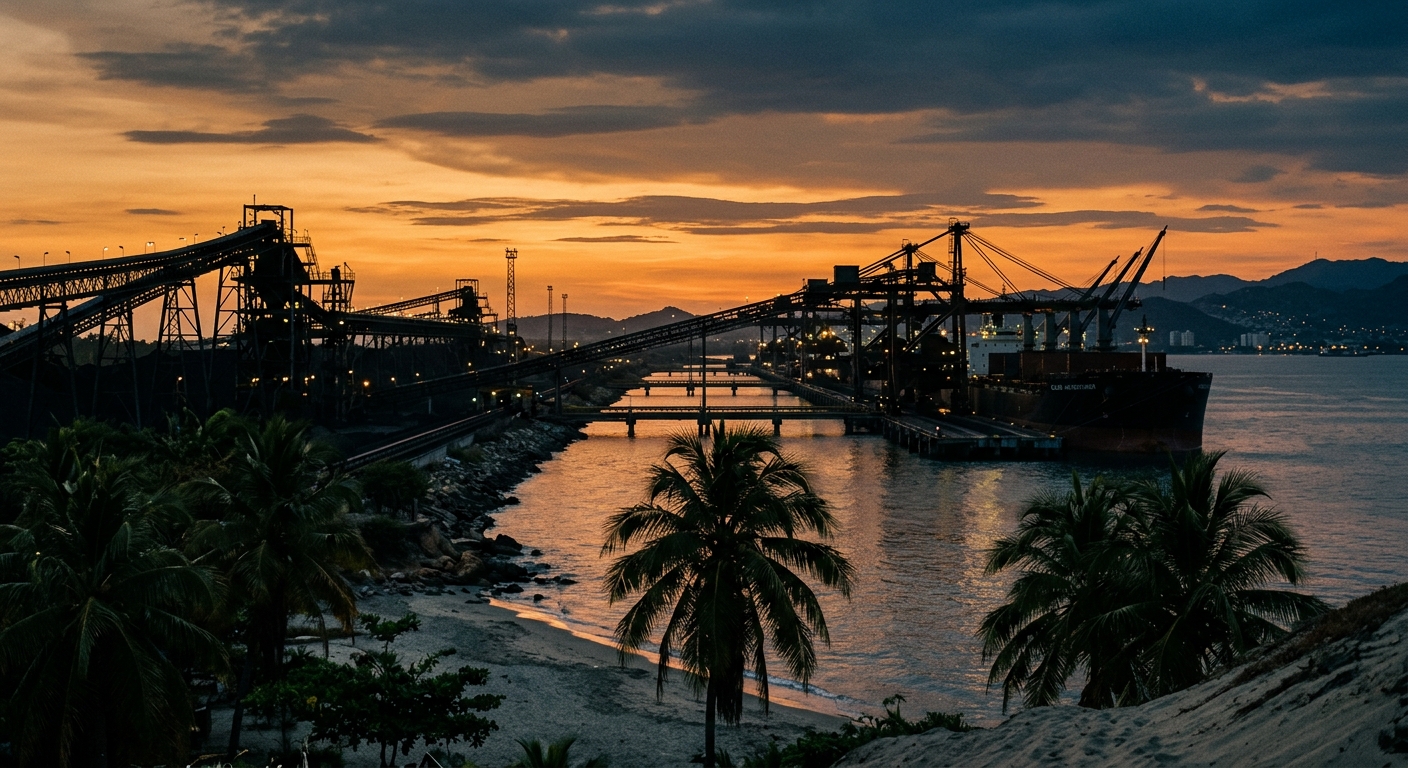
1. The setting was the message: a coal port hosts the phase-out
Santa Marta was chosen deliberately. The Caribbean city sits alongside the terminals that ship most of Colombia's coal to Europe and Asia, and hydrocarbons still account for more than 40% of Colombia's exports, according to Al Jazeera — a figure that predates the Hormuz shock and may now be higher given elevated commodity prices. The co-host, the Netherlands, is the birthplace of Shell. As
NPR reported from the ground, the plenary sessions were held "a hotel by the sea… just north of the coal port," an image the conveners embraced rather than hid.
President Gustavo Petro's government has suspended new exploration contracts for coal, oil and gas since 2022, and Colombia embodies what Sciences Po's European Chair for Sustainable Development called the transition's core tension: a government positioning itself as a climate leader while its fiscal base still runs on extraction. That is precisely why the venue matters. The countries that already have no fossil economy — Costa Rica, the Marshall Islands, Tuvalu — are not the audience. The producers watching from the fence are.
2. It breaks from the COP rather than supplementing it — despite what conveners say
Officially, TAFF (the Transition Away from Fossil Fuels conference) is a "complement" to the UN Framework Convention on Climate Change process. Practically, it is a workaround. At COP30 in Belém last November, roughly 80 countries pushed for a fossil-fuel phase-out roadmap; Saudi Arabia, Russia, India and China blocked it, per the BBC. The Colombian and Dutch governments announced Santa Marta the next week.
A European Parliament Research Service briefing describes the format bluntly: "two-tier multilateralism" that "does not require the agreement of all parties to the UNFCCC" (European Parliament). That is the diplomatic definition of a workaround. Colombia's TAFF director Andrea Durán told NPR the door remains open to any country "when they're ready," but added: "this is not a space for us to fight about whether we are going to do [the transition]." Translation: veto players are not welcome to veto.
Mary Robinson, the former Irish president attending as an Elder, called Santa Marta "a coalition of the doers." The Center for International Environmental Law's Nikki Reisch put it more pointedly: "We finally have a forum where fossil fuels are really the main conversation, and the task is really clear. It's not to debate whether to phase out fossil fuels but to determine how to do it."
3. France set the benchmark — and the ICJ set the legal floor
The concrete deliverable was national. French climate envoy Benoît Faraco tabled a roadmap ending coal by 2030, oil by 2045 and gas by 2050, framed explicitly as an invitation to others to publish comparable plans, the Financial Times reported. France is already legally bound to net-zero by 2050 under its 2019 Energy and Climate Act, and its 2024 revised National Energy and Climate Plan targets closure or decarbonisation of all remaining coal plants by 2027, according to a
European Parliament briefing. Colombia and Brazil are drafting equivalents.
The legal backdrop is what turns those roadmaps from communiqué language into liability. In its advisory opinion of July 23, 2025, the International Court of Justice ruled that the licensing, production, subsidising and consumption of fossil fuels can constitute internationally wrongful conduct where they breach states' due-diligence obligations to protect the climate system. Writing in the International & Comparative Law Quarterly,
Cambridge scholars noted the Court explicitly extended this to export of fossil fuels and to the granting of new exploration licences. The
BBC reported that developing states are already exploring cases citing the opinion. The Santa Marta process is now the political vehicle to translate that opinion into domestic legislation.
4. The energy crisis is the argument — and the risk
The summit convened during what IEA Executive Director Fatih Birol has called an energy crisis worse than the 1970s oil shocks and the Ukraine gas crunch combined. Speaking in Canberra on March 23, 2026, Birol told Al Jazeera that the effective closure of the Strait of Hormuz following U.S.–Israeli strikes on Iran on February 28 had knocked out roughly 11 million barrels per day of supply. The IEA's April monthly report clocked the March shortfall at 10.1 million bpd, which it called "the largest oil supply disruption in history."
Brookings' chokepoint analysis found U.S. retail gasoline hit $4.31/gallon by June 1, and IEA members coordinated the release of 400 million barrels of strategic reserves — a third of their total holdings — to cushion the shock. Turkey's energy minister told
Al Jazeera that a $1 rise in the barrel price costs Ankara $400 million a year in import bills.
That macro backdrop reframed the political pitch in Santa Marta. The World Resources Institute's official statement at the summit's close made the argument openly: "fossil fuels are a systemic source of economic and financial instability." For countries watching diesel and LNG spot prices in real time, decarbonisation is now indistinguishable from energy security. That is the strongest argument the coalition has ever had — and it is the reason petrostates worked hard, and successfully, to keep any binding treaty language out of the final documents.
5. Who's not in the room decides whether this scales
Look at the signatories of the Belém Declaration and the gaps are more informative than the names. Twenty-four states have signed: nine European, six Latin American and Caribbean, four Pacific micro-states, plus Australia, Cambodia, Kenya and Nepal. Absent as signatories: the United States (which under President Trump is actively promoting coal, oil and gas), China, India, Japan, Germany, Italy, Canada (attending but not signing), all Gulf producers, Russia, Norway, the United Kingdom (attending but not signing), and Brazil (attending as COP30 host but not committing).
Amnesty International, whose researcher Candy Ofime described the meeting as "political appetite" that "must now translate into concrete action rooted in human rights," warned in its own readout that the conference produced no negotiated outcome and no binding text. A subset of 18 nations, mostly small island states led by Colombia, called publicly for the launch of a fossil-fuel treaty; the co-hosts refused to make that the outcome. The synthesis report is due before COP31 in Türkiye in November 2026, with Australia leading the negotiations.
The second TAFF conference is set for Tuvalu in early 2027, co-hosted by Ireland — a pairing the Sciences Po chair called "symbolically powerful: a high-income European nation alongside one of the countries most existentially threatened by sea-level rise." According to the European Parliament briefing, that conference "may focus on securing a critical mass of nation-states to begin formal negotiations on an international legal instrument." That is when the coalition of the willing decides whether it becomes a treaty bloc.
Diplomat View
Santa Marta is best read not as a climate summit but as an institutional divorce filing — the UNFCCC's veto-wielding petrostates served with papers they cannot block. For three decades the UNFCCC has functioned like the UN Security Council with a veto for every petrostate; Colombia and the Netherlands have now built an alternative venue and populated it with roughly a fifth of global supply, on the theory that critical mass, not unanimity, will move the market. The forecast: the Santa Marta process becomes the operational core of climate diplomacy by COP32 in 2027, with the UNFCCC reduced to a finance and adaptation forum — provided three conditions hold. First, Brazil folds Santa Marta's outputs into the COP31 roadmap in November, giving the parallel track UN cover. Second, Tuvalu 2027 tables draft treaty language backed by an importers-exporters club and a just-transition fund large enough to peel off Nigeria, South Africa or Indonesia. Third, the ICJ opinion generates at least one adverse ruling against a Global North licensing decision in a domestic court before 2028. If Trump-era U.S. pressure fractures the European bloc, or if Brent settles back below $70 and dulls the security argument, the process stalls at the "coalition of the doers" stage — and Santa Marta becomes a footnote rather than a foundation.
What to watch next
- November 2026, COP31, Antalya: Whether Brazil's incoming presidency formally adopts the Santa Marta "Action Repertoire" into the UN roadmap on transitioning away from fossil fuels. Australia leads negotiations.
- Q3 2026: Publication of the Johan Rockström-led Science Panel synthesis report; the key question is whether it endorses a hard 2050 fossil-fuel end date, which would set the negotiating baseline for Tuvalu.
- Early 2027, Tuvalu TAFF-2: Whether the coalition tables formal draft language for a Fossil Fuel Non-Proliferation Treaty, and whether at least one G20 producer beyond Australia and Colombia signs.
- Ongoing: First national court ruling citing the July 2025 ICJ opinion to strike down an oil, gas or coal licence. Cases are being prepared in Vanuatu, the Philippines and Ireland, according to
BBC reporting.
Discover more

US Politics
SNAP Food Assistance Faces Legal Challenges
In 2026, SNAP faces stricter eligibility rules and mounting legal challenges, threatening food assistance for the millions of Americans who rely on the program.
India
Romanian Coalition Party Demands PM Resign
Romania's Social Democrats withdrew from coalition, joining far-right AUR to topple PM Bolojan, risking €10 billion in EU funds by August 2026.
India
UN Expert Albanese: India Violates Law
UN Rapporteur Francesca Albanese accuses India of breaching international law, spotlighting human rights concerns in Kashmir and prompting diplomatic pushback.

Economics
Fed's Amex AML order puts correspondent banking on notice
Federal Reserve's Amex AML order requires board-level controls and a 90-day plan; OCC fined the bank $350 million over enterprise-wide deficiencies.