Forrest Bets A$190M on Tungsten Before US Ban
Forrest bets A$190M on tungsten 164 days before US ban on Chinese supply
Model Diplomat9 min readAsia-Pacific
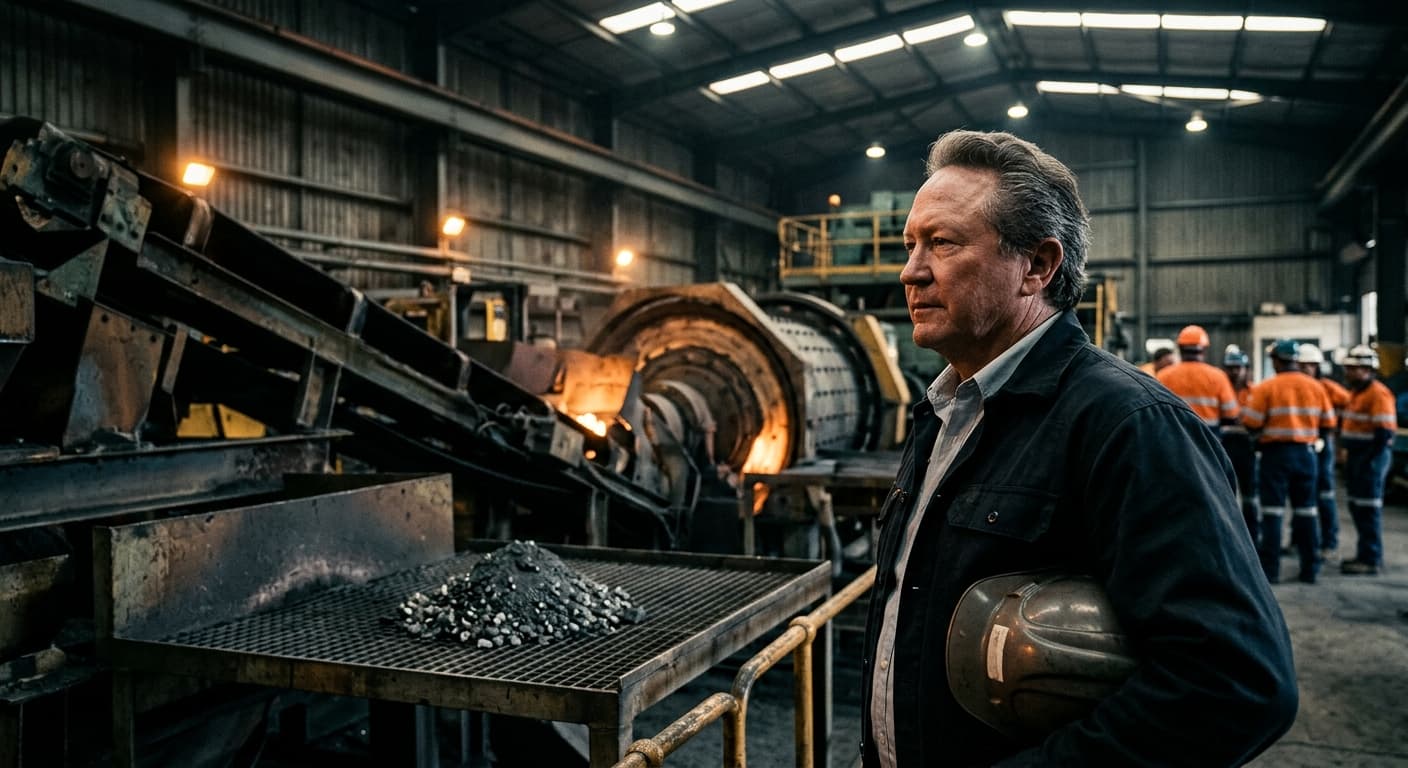
Forrest Bets A$190 Million on Tungsten — and the 164 Days That Matter
Andrew Forrest's 16.8% stake in the West's largest tungsten miner is a wager on the gap between a hard defense-procurement deadline and the West's ability to produce the metal it has outsourced to China for three decades.
On July 20, Andrew Forrest's investment vehicle Wonongarra acquired a 16.8% stake in EQ Resources — the largest tungsten producer outside Chinese control — from Oaktree Capital Management for approximately A$189.7 million (US$132.5 million), covering 862.1 million shares and 35.6 million options with the right to appoint a director to the board. Mining Digital
The trade lands 164 days before January 1, 2027 — the date a binding U.S. defense procurement regulation bars the Department of Defense from acquiring tungsten mined, refined, separated, or melted in China, Russia, Iran, or North Korea. U.S. Government Accountability Office That is the number that matters. Everything else in this story — the price spike, the exploration rush, the Forrest move — flows from it.
China controls roughly 80% of global tungsten production, according to Project Blue estimates cited by Reuters, which pegs total 2025 global output at around 129,000 metric tonnes. Reuters The United States has zero domestic commercial tungsten production, the last mine having closed in 2015.
ETTAC Recommendation 2026-13
This is not a rare-earths story with a long runway. Tungsten's clock is specific and unforgiving.
The China Squeeze
Beijing began tightening the vise in February 2025, when the Ministry of Commerce added tungsten products to its export control list — part of an escalating tit-for-tat with Washington that had previously covered gallium, germanium, antimony, and graphite. CSIS In December 2025, China limited tungsten export licenses for 2026–2027 to approximately 15 firms, giving the state direct control over volumes, timing, and destinations.
The Oregon Group
The market responded with violence. Rotterdam ammonium paratungstate (APT) — the benchmark intermediate product from which all downstream tungsten goods are made — surged from roughly US$300 per metric tonne unit in mid-2024 to approximately US$3,185 by April 2026, a roughly 900% increase. Reuters That is not a rally — it is a structural repricing of a metal the West cannot do without.
"The United States has no domestic tungsten mining... tungsten prices have surged ~900% year-over-year, with lead times expanding from 4–6 weeks to 12–20 weeks — and some suppliers declining new orders entirely."
That warning came from the U.S. Commerce Department's Emerging Technology Technical Advisory Committee (ETTAC) in an urgent June 5, 2026 recommendation to the Secretary of Commerce, which also noted that U.S. spot ammonium metatungstate (AMT) prices had increased by more than 1,000%. ETTAC Recommendation 2026-13
China's near-monopoly extends beyond mining. APT is the sole processing stage through which all tungsten downstream products pass — ore becomes APT, and APT becomes metal powder, tungsten hexafluoride (WF6) for semiconductors, or cemented carbide for tooling. There is no alternative pathway. ForcedAlpha Casefile When APT exports from China were effectively zero in January–February 2026, the global pipeline seized.
The January 1 Cliff
The DFARS 252.225-7052 restriction was first enacted in the FY2019 National Defense Authorization Act and codified at 10 U.S.C. §4872. Congressional Research Service The original rule prohibited melting or producing covered materials — tungsten metal powder, tungsten heavy alloy, and finished components containing them — in China, Russia, Iran, or North Korea.
In May 2024, the DOD finalized a rule that expanded the prohibition to cover all stages of the supply chain: mining, refining, separation, melting, and production. The effective date: January 1, 2027. GAO-24-107176 The rule also narrowed the commercial-off-the-shelf exemption, meaning items that are 50% or more tungsten by weight will lose their exemption after the deadline.
Crowell & Moring
"The U.S. defense industrial base will soon be legally required to source tungsten from outside China, even though it currently produces none of its own."
Congress has already shown a willingness to tamper with the timeline. Section 1 of H.R. 9073, introduced in the 119th Congress, would push the DFARS effective date to January 1, 2032 — or 180 days after the Secretary of Defense certifies sufficient non-covered-nation supply exists. Congress.gov That bill has not passed. For now, the deadline stands.
The tungsten market is worth an estimated US$18 billion globally in 2026. The Oregon Group Defense applications account for roughly 12% of demand, projected to reach 15% by 2027–2028 — and that share is growing at approximately 8% annually as rearmament cycles accelerate across NATO and the Indo-Pacific.
Reuters
The Supply Response — and Its Limits
The Western tungsten pipeline is thin, and the production clock is brutal. Mining projects take years — sometimes a decade — from discovery to first concentrate. The January 1, 2027 deadline leaves no time for greenfield development. Only existing or restart-ready operations matter.
Almonty Industries is the heavyweight. Its Sangdong mine in South Korea — historically one of the world's largest and highest-grade tungsten deposits — completed Phase 1 commissioning in March 2026 and began processing plant throughput on July 1, 2026. Almonty Industries Phase 1 is designed to handle approximately 640,000 tonnes of ore annually for roughly 2,300 tonnes of tungsten concentrate. A Phase 2 expansion expected in 2027 would double output to approximately 4,600 tonnes per year — potentially enough to supply roughly 40% of global tungsten demand outside China.
Almonty is also targeting production readiness at its Gentung Browns Lake project in Montana — what would be the first U.S. tungsten mine in roughly a decade — by the second half of 2026. The company relocated its corporate headquarters to Dillon, Montana, signaling the strategic pivot.
EQ Resources, the company Forrest just bought into, is the only other producing Western tungsten miner. It operates the Mt Carbine mine in North Queensland, Australia, and the Barruecopardo mine in Spain's Salamanca province. The company produced 1,189 tonnes of tungsten trioxide in the 2026 financial year. Mining Digital An A$39 million expansion at Mt Carbine targets commissioning in the third quarter of the 2027 financial year. EQ Resources' shares have risen more than 610% over the past 12 months, and the company is valued at roughly A$1.13 billion (US$791 million).
Financial Times
Tungsten West is racing to restart the Hemerdon mine in Devon, UK — a construction-ready, fully permitted deposit with over US$300 million in prior infrastructure investment. The company's feasibility study, released August 2025, targets steady-state production of 332,000 metric tonne units of WO₃ annually. Tungsten West First-phase fines gravity processing is targeted for Q3 2026, with full commissioning in Q1 2027.
Guardian Metal Resources completed a pre-feasibility study at its Pilot Mountain project in Nevada in June 2026, showing an after-tax net present value of US$660.3 million and an internal rate of return of 59.6% at base-case pricing — and an IRR of 101.6% at spot tungsten prices. Guardian Metal Resources The project was supported by a US$6.2 million Defense Production Act Title III investment.
Western Star Resources, a Canadian-listed junior, has filed an application with the U.S. Defense Industrial Base Consortium targeting tungsten, with a maiden drill program at its Rowland property in Nevada underway and multiple past-producing assets acquired across Nevada and New Mexico. The company holds no current resource estimate. Western Star Resources
The combined Western pipeline can, on paper, replace a meaningful share of Chinese supply. But "on paper" is not "in concentrate." Almonty's Sangdong Phase 1 is the only project actually processing ore today. EQ Resources is producing but at modest scale. Tungsten West and Guardian Metal have not yet broken ground on construction.
Forrest's Calculus
Andrew Forrest made his fortune — estimated at over US$20 billion — by breaking open the Pilbara iron ore duopoly through Fortescue Metals Group. He built US$50 billion in iron ore infrastructure at a fraction of competitors' costs. His strategic signature is simple: identify a structural deficit, move faster than the market expects, and use scale and political leverage to lock in first-mover advantage.
The EQ Resources stake fits the pattern. Forrest said the investment "backs an Australian producer, Australian jobs and Australian know-how at the moment the world has woken up to how fragile critical mineral supply chains have become." Mining Digital
The subtext is sharper. Forrest is not buying optionality on a future tungsten price — he is buying the only producing Western tungsten miner at the precise moment when a binding U.S. procurement regulation is about to make Chinese tungsten legally inadmissible for the world's largest defense budget. The 164 days between his purchase and January 1, 2027 are what the trade is priced on.
EQ Resources' Managing Director Craig Bradshaw called the transition from Oaktree — a financial investor — to Forrest "a strong endorsement," noting the "ownership baton passed from a financial investor to a stalwart of the Australian mining industry with a proven track record of developing and growing assets." Mining Digital
The removal of Oaktree's overhang — a financial investor holding a large block destined for eventual exit — clears the register. Forrest's right to appoint a director gives him line-of-sight into strategy, offtake negotiations, and expansion timelines. The transaction requires no regulatory approval.
The Second-Order Effects
The tungsten squeeze is not confined to the defense sector. Cemented tungsten carbide tooling accounts for 55–60% of total tungsten demand — it is the backbone of precision manufacturing, construction, mining, and oil and gas drilling. ForcedAlpha Casefile When APT prices rise 900%, the cost of every cutting tool, drill bit, and wear-resistant component in industrial supply chains absorbs the shock.
The semiconductor industry faces a narrower but more acute vulnerability. Tungsten hexafluoride (WF6) is used as a precursor for chemical vapor deposition of tungsten films in 3D NAND flash memory manufacturing. Inventory depletion projections cited by industry analysts suggest a critical supply pinch in the second half of 2026. ForcedAlpha Casefile
The IMF's April 2026 World Economic Outlook commodity special feature noted that advanced economies have responded to critical-mineral supply concentration through price floors, offtake agreements, direct financial support, and coordinated procurement — mobilizing an estimated US$6.4 billion in public and private funding to de-risk supply chains. IMF The U.S. has deployed the Defense Production Act, the EXIM Bank, and DFARS procurement rules. The EU has designated tungsten a Strategic Raw Material under the Critical Raw Materials Act.
The historical parallel is not rare earths — it is uranium. When the West's nuclear fuel cycle dependence on Russian enrichment became a liability after February 2022, the market repriced producers with Western-located conversion and enrichment capacity within months. Tungsten is following the same arc, compressed into an even tighter window by the January 1, 2027 deadline.
What to Watch
Three catalysts will determine whether the Forrest bet pays off before the clock runs out:
- The DFARS deadline: Whether H.R. 9073 or similar legislation extends the January 1, 2027 effective date to 2032. If Congress blinks, the forced repricing of Western tungsten assets softens immediately.
- Gentung Browns Lake: Whether Almonty's Montana project achieves production readiness by H2 2026 as targeted — making it the first U.S. tungsten mine in a decade.
- EQ Resources' Mt Carbine expansion: Whether the Q3 FY2027 commissioning stays on schedule, and whether Forrest's board appointee accelerates offtake or financing discussions.
Diplomat View
Forrest is not making a tungsten bet — he is making a DFARS bet. The A$189.7 million stake in EQ Resources is a wager that the United States will not extend its procurement deadline, that Chinese export controls will not loosen, and that the handful of non-Chinese producers actually delivering concentrate will command scarcity pricing for at least 24–36 months.
The logic is sound but the timing is everything. EQ Resources produced 1,189 tonnes of WO₃ in FY2026. Global demand is roughly 129,000 tonnes. The gap between what the West needs and what it can produce is not closing in 164 days — it is widening as defense spending accelerates. That structural deficit is what Forrest is pricing.
The risk is political. Congress has already introduced legislation to push the DFARS deadline to 2032. A Xi-Trump deal that loosens tungsten licensing — as the June 2025 rare-earths agreement temporarily did — would unwind the price signal overnight. And the exploration-stage developers promising to fill the pipeline — Western Star, Guardian Metal, even Tungsten West — are years from meaningful production.
The bottom line: Forrest bought the only producing Western tungsten miner 164 days before the U.S. military is legally required to stop buying from China. If the deadline holds, the trade is not about tungsten — it is about the price of time.
Discover more
Climate & Energy
US DFC Invests in Madagascar Rare Earths
US DFC commits $4.84 million to Harena Rare Earths' Ampasindava project in Madagascar, the first direct US government investment in a deposit that could break China's near-monopoly on heavy rare earths.
Climate & Energy
Pentagon's Supply-Chain Ultimatum for Defense
Trump's July 20 executive order compels defense contractors to map critical mineral supply chains and qualify domestic sources by January 1, 2027, when a ban on Chinese-origin magnets takes effect. With one rare earth mine and one magnet factory, the Pentagon bets on forced compliance to build a domestic industry.
Economics
Pentagon's 162-Day Supply Chain Reckoning
Trump's July 20 executive order closes the waiver loophole for Chinese-origin critical materials in defense systems and mandates full supply chain mapping. With zero U.S. heavy rare earth separation capacity and $7.6 billion in investments yet to produce output, the January 1, 2027 deadline faces a steep compliance cliff.
Climate & Energy
Harena's $4.84M DFC Deal Is a Strategic Down
The US DFC commits $4.84M to Harena Rare Earths' Madagascar project, signalling a strategic shift to secure critical mineral assets before China acquires them. The deal positions Washington as an anchor financier for one of the largest ionic clay heavy rare earth deposits outside China.