Falkland Islanders Appeal to UN C24
Legislators present personal testimonies at UN decolonization committee.
Model Diplomat4 min readamericas
At UN, Falkland Islanders Turn Personal — but the C24's Arithmetic Hasn't Changed
Two legislators brought personal testimony and a visiting-mission invitation to the C24 on June 25; the annual pro-Argentina resolution still sails through.
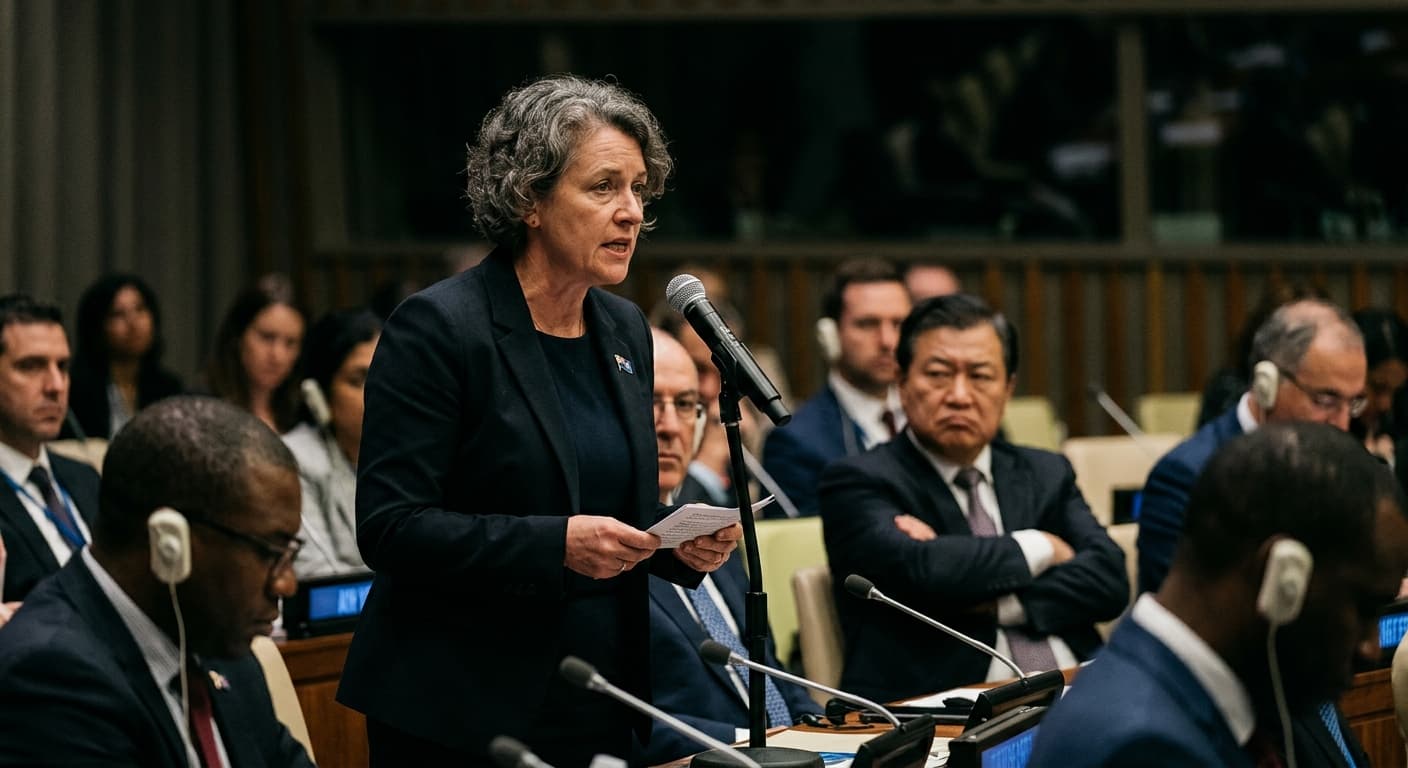
Two members of the Falkland Islands Legislative Assembly — Dorothy "Dot" Gould and Michael Goss — addressed the UN Special Committee on Decolonisation (C24) on June 25, making the Islanders' case directly to the body that has, for over 60 years, urged Britain and Argentina to negotiate sovereignty without them in the room. MercoPress Their presentation was calibrated, personal, and laced with an invitation no C24 member has ever accepted: send a visiting mission to the Islands and see for yourselves.
The power dynamic is unchanged. The C24 will adopt its annual resolution — without a vote, pushed by Latin American states — calling for bilateral UK-Argentina negotiations. But the Islanders' appearance this year matters because of what is happening outside the committee room.
Gould and Goss ran complementary lanes. Gould, who holds the Health and Social Services portfolio, delivered personal testimony: she moved to the Islands from England at age five, three years before Argentina's 1982 invasion. "I want this committee to understand what it feels like, as a child, to have someone try to take your home from you," she said. She framed the Islands as a self-sufficient community of roughly 3,600 people from over 70 countries of birth — one that funds its own healthcare and university education, takes no money from London, and carries an A+ credit rating from S&P Global.
Goss, a sixth-generation farmer and Natural Resources portfolio holder, took the legal argument. His core point: Argentina's constitution defines sovereignty recovery as a "permanent and non-renounceable" objective, meaning any negotiation would be "a transfer of ownership dressed as diplomacy." He cited the 2013 referendum — 92% turnout, 99.8% in favor of remaining a British Overseas Territory, observed by an international mission the US led — and noted that Argentina's section of the UN working paper falsely claims no organization observed the vote. He also flagged that the September 2024 UK-Argentina cooperation package remains half-delivered: the Islands facilitated cemetery visits for Argentine families in December 2024, but the promised São Paulo flight resumption and fisheries-data exchange never materialized.
The structural problem the Islanders face is that the C24's arithmetic is locked. The committee's membership tilts heavily toward states that back Argentina's position — that the Islanders are a "transplanted population" to whom General Assembly decolonization resolutions do not grant self-determination. The resolution passes every year. It will pass again.
What gives this year's appearance sharper edges is the diplomatic context swirling around the C24 session.
The same two legislators spent the previous week in Ottawa lobbying Canadian officials ahead of the OAS General Assembly in Panama. They asked Canada to break from the OAS consensus declaration on the Malvinas and publicly back self-determination — as it did in 2017, and as it has done for Greenland and Ukraine. Canada said no. A Global Affairs spokesperson confirmed Canada "plans to join the consensus on the OAS General Assembly Declaration on the Question of the Malvinas Islands, as it has done since 2018" and "maintains a neutral position." The Globe and Mail Canada is simultaneously negotiating a free-trade agreement with Mercosur and deepening mining investment in Argentina. The Islanders' ask collided with Ottawa's commercial calculus and lost.
Then there is Washington. The US has historically recognized de facto UK administration of the Islands while staying formally neutral on sovereignty. But Al Jazeera reported in May that the Pentagon prepared a memo for President Trump suggesting options to punish allies judged unhelpful during the Iran conflict — including a review of the US position on the Falklands. Secretary of State Marco Rubio has since reiterated neutrality, but the signal was sent. Benjamin Gedan of the Stimson Center assessed that the leak was "clearly designed to needle the British prime minister," not to shift policy. Even so, as Ed Arnold of RUSI noted, a US shift — even rhetorical — "might cause other countries to move that way as well."
BBC
The Islanders' leverage is narrow but real. Their economy is self-funding. Fisheries account for roughly 58% of GDP. They govern themselves on everything except defense and foreign affairs. Their argument is that a community this functional — one that needs nothing from the metropolitan power — cannot be dismissed as a colonial vestige. Goss drew the sharpest distinction: UN resolutions refer to the "interests" of the population, but "the difference is between being heard and being spoken for."
What to watch next
Three things. First, whether any C24 member — particularly one from outside Latin America — publicly entertains the visiting-mission invitation. That has not happened since 1965. A single acceptance would change the diplomatic geometry. Second, the OAS declaration language this week in Panama: any deviation from the standard consensus text — or any abstention — would be significant. Third, the fisheries file. Goss pointedly raised the unregulated "Blue Hole" waters, and if Argentina moves on that resource question independently of the sovereignty track, it could open a new front that bypasses the C24 entirely.
Discover more

US Politics
SNAP Food Assistance Faces Legal Challenges
In 2026, SNAP faces stricter eligibility rules and mounting legal challenges, threatening food assistance for the millions of Americans who rely on the program.
US Politics
Washington's Scrutiny of Iran War Prediction
The Iran war prediction market scandal exposes political ties and regulatory challenges in Washington, as insider trading concerns rise.
Global Politics
US-Iran Tensions Rise
Tensions escalate in the Strait of Hormuz as Iran and the US clash over maritime control, with a ceasefire hinging on a contested MoU paragraph.
Conflict & Security
Guatemala: El Niño 2026–27 becomes regional security test
UNICEF: 25.8M children face El Niño risks in Latin America; Guatemala maps 188 municipalities for drought and food insecurity amid regional security test.