Fed's June Minutes Signal Rate Hike
Emerging markets brace for impact as Fed leans hawkish
Model Diplomat7 min readGlobal
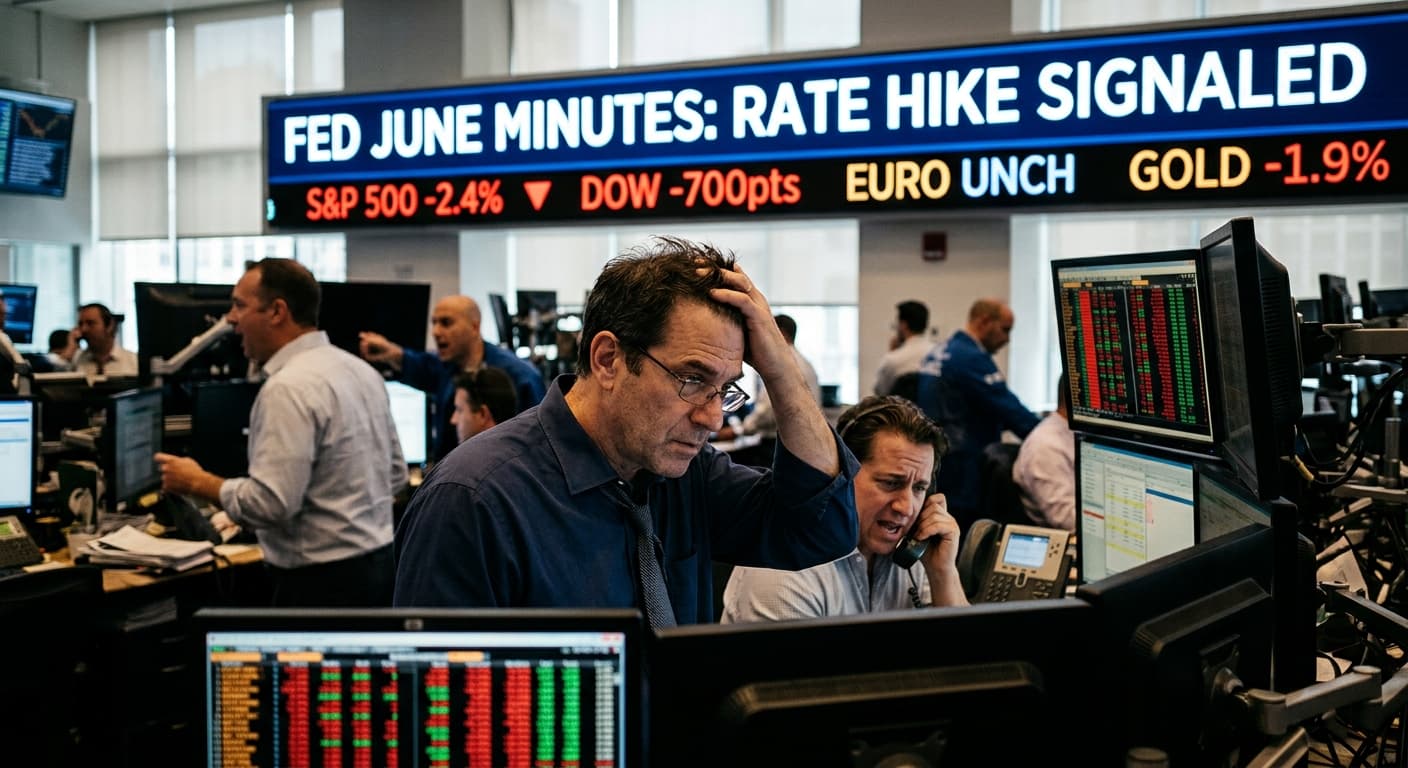
Fed's June Minutes Signal a Hike, Not a Cut — Emerging Markets Brace
The June 17 FOMC minutes reveal a Fed leaning toward another rate hike as inflation runs at 4.25%. The real losers sit outside America.
The Federal Reserve's June 16–17 minutes, released July 8, do more than record a "family fight" over inflation — they mark the moment global markets had to price in a Fed that may still be tightening in 2026, not easing. Nine of 18 policymakers now project a rate hike by year-end, only one expects a cut, and, according to the Financial Times, participants broadly agreed "some policy firming would likely be warranted" if inflation stays elevated. That reversal — from two cuts penciled in at the start of 2026 to a hike now the modal call — is the single most important variable for the dollar, for sovereign borrowers from Buenos Aires to Ankara, and for a White House that fired Jerome Powell to get lower rates. The real losers are not American homeowners; they are dollar-indebted emerging economies whose 2026 refinancing math just got harder.
What the minutes actually said
The Federal Open Market Committee held the target range at 3.50%–3.75% by a unanimous 12–0 vote and, in an unusually short statement, pledged that "the Committee will deliver price stability," according to the official minutes published by the Fed on July 8. That six-word sentence — inserted at Chair Kevin Warsh's insistence — replaces the forward guidance that had signaled a bias toward cuts.
Behind the unanimity, the minutes describe a committee visibly split. "Some" participants argued for an immediate hike given the Iran-driven inflation shock; "many" said further firming was likely warranted if price pressures persisted; a smaller group still saw scope for cuts if the Middle East ceasefire held. Reuters coverage relayed in The Straits Times noted Warsh's own description of a "good family fight" — the sharpest internal disagreement since the 2022 tightening cycle.
The dot plot underlines the shift. Nine of eighteen participants projected higher rates by December 2026, only one expected a cut, and eight saw rates unchanged, the BBC reported after the June decision. Warsh himself declined to submit a dot — a communications reform, not a policy signal — but publicly encouraged colleagues to do so.
The data made the hawks' case
Warsh took over a Fed where the inflation numbers had already turned against the doves. Headline CPI rose 4.25% in the year to May 2026, according to a Joint Economic Committee release citing BLS data, with energy up 23.54% year-on-year. Headline PCE — the Fed's preferred gauge — hit 4.07% in May, and core PCE printed at 3.41%, the highest since October 2023, per a subsequent
JEC update.
Both numbers are roughly double the Fed's 2% target, and the University of Michigan's one-year inflation expectations have drifted to 4.8%, a level American Enterprise Institute economist Desmond Lachman warned risks becoming unanchored. The Federal Reserve Bank of Dallas quietly published a scenario paper by Lutz Kilian and co-authors in April concluding that the Iran-war oil shock leaves a persistent imprint on both headline and core PCE,
according to the working paper — an in-house intellectual basis for the hawkish tilt.
The proximate cause is the war that began on February 28, when U.S. and Israeli strikes on Iran triggered Tehran's closure of the Strait of Hormuz. NPR, citing Moody's Analytics, put the war's cost to U.S. consumers and taxpayers at roughly $132 billion, with gasoline peaking at $4.56 a gallon. The April 8 ceasefire and a subsequent memorandum of understanding reopened Hormuz, but the
Center for American Progress notes that Treasury yields have barely retraced — 10-year yields sit near 4.6% and 30-year near 5.2%, the highest since 2007. The bond market, in other words, is not buying a return to disinflation.
The Warsh paradox
Kevin Warsh was hired to cut rates. President Donald Trump, at the May 22 White House swearing-in, publicly told Warsh to be "totally independent," but the political subtext — that Warsh's job depended on delivering lower borrowing costs — was widely reported at the time by the BBC. Instead, his first meeting delivered the opposite: a shorter, harder statement, an end to easing bias, and a dot plot pointing up.
The paradox is structural. Warsh has one vote among twelve on the FOMC and inherited a committee that spent April removing dovish language. LSE's Thomas Drechsel, in a June 18 analysis, estimated that historical episodes of half-Nixonian presidential pressure on the Fed have added roughly seven percentage points to the U.S. price level over the following decade — a lesson institutional memory at the Fed takes seriously. Warsh's response has been to lean into orthodoxy. The
Financial Times reported his press-conference rhetoric as "very hawkish indeed," with the chair refusing to elaborate beyond the statement itself.
Trump's reaction, per the BBC, was a shrugging "it's alright... whatever." That is not a peace offering. The July 28–29 meeting is the next flashpoint.
The global spillover — where the pain actually lands
Here is the analytical point the wires have buried: a hawkish Fed shock transmits abroad far more violently than at home. World Bank research from the 2022–23 cycle, published in the Global Economic Prospects topical chapter, distinguishes three drivers of rising U.S. rates: real shocks (benign for emerging markets), inflation shocks (moderately damaging), and "reaction shocks" — a perceived hawkish shift in the Fed's reaction function. Reaction shocks widen sovereign spreads, depress equity prices, depreciate currencies, and materially raise the probability of an emerging-market currency crisis within twelve months.
The June minutes are, by textbook definition, a reaction shock. Warsh has explicitly rewritten the Fed's communications, dropped forward guidance, and endorsed the framing that price stability trumps easing — a reaction-function change, not just a data reaction. IMF research by Engler, Piazza and Sher documented that a one-standard-deviation Fed monetary tightening surprise depreciates the average EM currency by 9.2 basis points and raises dollar-bond credit spreads by 2.4 basis points within two days — small per event, cumulative across a hiking cycle.
The Peterson Institute's Steven Kamin and Ángel Ubide warned in April that most EM central banks would be forced to follow the Fed rather than cut into their own slowdowns, because dollar depreciation of local currencies feeds directly into imported inflation. That prediction is now the base case. Argentina, which the Peterson Institute
described as running a "fragile monetary framework" with the peso stuck at the top of its band, is the most exposed sovereign; the JPMorgan EMBI spread on Argentine dollar bonds already blew out to nearly 1,500 basis points during last October's mini-crisis. Turkey, still carrying corporate dollar debt near 50% of GDP per
Brookings estimates, has kept its policy rate frozen at 37% since January precisely because the central bank cannot afford to ease into a strengthening dollar.
AEI's Steven Kamin decomposed the dollar's post-war path and concluded that by June, yield differentials — not oil or safe-haven flows — had become the dominant driver of dollar strength. In other words: the Fed's stance, not the war, is now the transmission channel to global markets. The June minutes just reinforced that stance.
Diplomat View
The forecast: the Warsh Fed hikes 25 basis points once before year-end 2026, most likely at the September meeting once August CPI is in hand, and holds through Q1 2027. That call rests on three named conditions, each falsifiable. First, core PCE stays above 3% through August — a break below 2.8% would neutralize the hawks. Second, the Iran ceasefire holds and oil stays under $85 — a Hormuz re-closure would flip the committee toward a larger hike, not a pause. Third, Trump does not attempt to fire or sideline a sitting governor before September; a credible independence shock would force Warsh to over-tighten defensively to protect the dollar. The consensus that Warsh is "Trump's guy" is quietly wrong: the AEI read of his first press conference — that he is signalling hawkish credibility precisely because his appointment looked dovish — is the more accurate one. The biggest risk to the forecast is not political capitulation. It is a sudden EM currency accident — Argentina or Turkey — that forces the Fed to soften faster than its own inflation data justify.
What to watch
- July 28–29, 2026 — Next FOMC meeting. First real test of whether the hawkish tilt in the minutes becomes a hike, or another hold.
- July 15, 2026 — June CPI release. A print above 4.3% headline or 3.5% core PCE would likely lock in a September hike.
- September 2026 — Argentina's October 2025 election precedent puts BCRA reserves and the peso band under renewed pressure if the Fed's hawkish path pushes the dollar higher.
The Bottom Line
The June FOMC minutes are not a story about American monetary policy — they are the moment the Fed's reaction function visibly shifted from cutting to hiking, and that shift will be felt hardest in Ankara, Buenos Aires, and every sovereign refinancing dollar debt in 2026. Warsh was hired to deliver Trump cheaper money; he is delivering the opposite, and the global cost of that credibility play is a stronger dollar, wider EM spreads, and rising odds of a currency crisis somewhere before Christmas.
Discover more
Global Politics
Xi Jinping Calls China-Russia Ties 'Precious'
Xi Jinping's description of China-Russia ties as 'precious' reflects a strategic imbalance, with Beijing dictating terms in the partnership.
India
Rajnath Singh's Durga Squad for 2026 Polls
Rajnath Singh's Durga Squad promised women's safety in Bengal but has since disappeared from the agenda, revealing BJP's true priorities.
US Politics
SNAP Food Assistance Faces Legal Challenges
In 2026, SNAP faces stricter eligibility rules and mounting legal challenges, threatening food assistance for the millions of Americans who rely on the program.

Conflict & Security
Drone Warfare Killing Aid Workers at Unprec
Over 1,000 humanitarian workers killed in three years as cheap armed drones collapse legal protections. Gaza, Sudan, Ukraine, and DRC see deliberate targeting of aid convoys and hospitals with zero prosecutions.