EU's AI Cyber Plan: Leverage, Not Sovereignty
Brussels' strategy aims for negotiation power, not independence.
Model Diplomat9 min readEurope
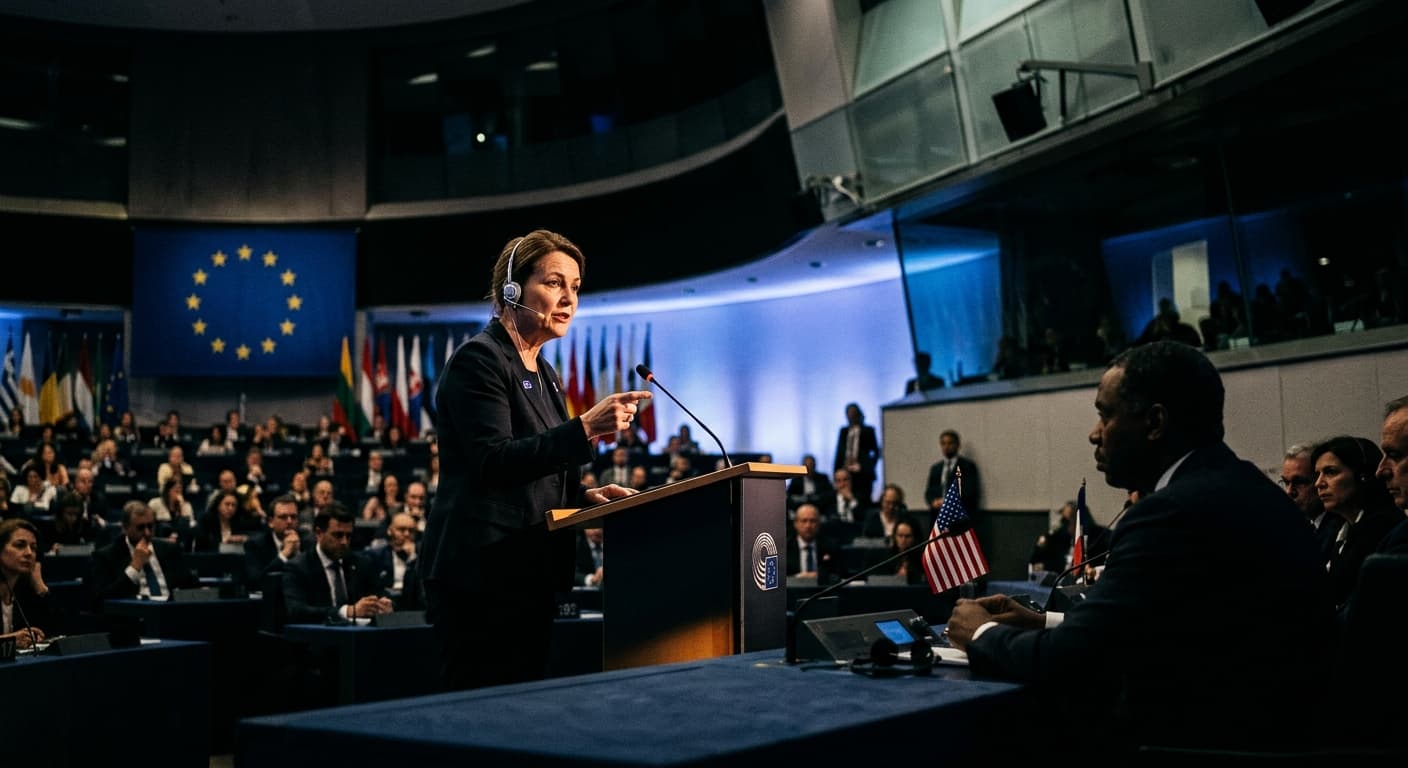
EU's AI cyber plan is a leverage play, not a sovereignty push
The European Commission's July 7 Action Plan on Cybersecurity and AI reacts to the Anthropic export-control shock — building an institutional counterparty to Washington, not a rival to Silicon Valley.
Brussels unveiled its Action Plan on Cybersecurity and Artificial Intelligence on July 7, 2026, and the shortest honest description is this: it is a negotiating instrument dressed up as an industrial strategy. Nine measures, a "European Blueprint" for secure access to frontier models, contingency provisions if US suppliers cut Europe off — the plan does almost nothing to close the capability gap with American labs. It does something more useful for the Commission's actual position: it builds an EU-level counterparty, hardened by the AI Act's enforcement powers, that Washington and the frontier labs will have to negotiate with the next time the White House flips a switch. That is the real story, and the trigger for it happened three weeks before the plan dropped.
The shock that wrote the plan
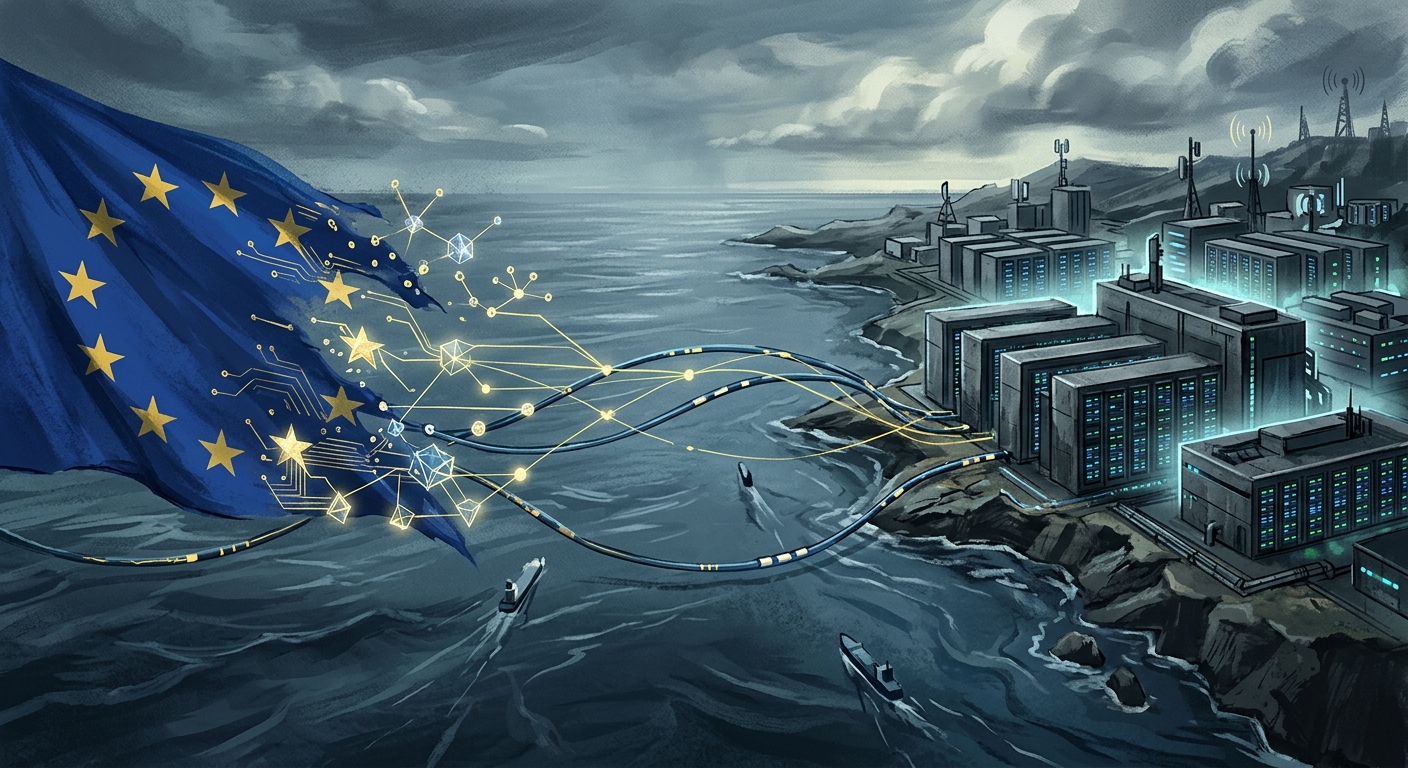
On June 12, 2026, the US Department of Commerce's Bureau of Industry and Security ordered Anthropic to impose export controls on its two most powerful models, Claude Fable 5 and Mythos 5. The company complied by taking both offline for every customer worldwide, including its own foreign employees. The BBC reported that Anthropic said US authorities had not identified a specific concern beyond a suspected "jailbreak" vulnerability, according to BBC News. The European Commission, which had negotiated access to Mythos only weeks earlier, said the episode underlined "Europe's need for technological sovereignty."
The controls lasted 18 days. Commerce Secretary Howard Lutnick lifted them on June 30 after Anthropic agreed to "proactively detect and address security risks" and share information with the US government, according to Al Jazeera. The precedent, however, is permanent: Washington demonstrated it can turn off a frontier model globally, without warning, and that the reversal is bilateral between the US government and a US company. Europe was a bystander in both directions.
That is the political fact the Commission's plan is designed to change. Henna Virkkunen, Executive Vice-President for Tech Sovereignty, Security and Democracy, framed it in the official press release as harnessing "existing capabilities, networks and the legal framework" rather than writing new law, according to the European Commission. Read the plan closely and the choice of verb — "harness," not "build" — is exact.
What the plan actually does
The Commission's own summary organises the plan around three objectives: promoting safe advanced AI, reinforcing EU cyber resilience, and scaling European AI capabilities for cybersecurity, per DG CNECT's policy library. The operational content, in plain English:
- ENISA and the Commission will draft a European Blueprint by end-2026 setting the criteria for EU-level access to frontier AI systems for cybersecurity work, alongside a secure testing platform for energy, transport, health, finance and public administration.
- The plan flags contingency measures — including joint EU procurement — if frontier providers restrict access. That is, in substance, an anti-Anthropic clause.
The Record first noted the procurement hook.
- An EU Grand Challenge on AI for cybersecurity will fund European labs to develop defensive tools, riding on the AI Factories and forthcoming Gigafactories programmes.
- Enforcement leans on the stack Brussels already has — the AI Act, the Cyber Resilience Act, NIS2, the Digital Operational Resilience Act (DORA), and the Cyber Solidarity Act. No new statute.
That final point is the tell. The Commission has chosen not to open another legislative front. Instead, it is loading capability into the enforcement bodies — the AI Office, ENISA, national market surveillance authorities — that already exist, and giving them the mandate to serve as the EU's technical interlocutor with frontier labs. Times News Network, covering the launch, noted that "Brussels has little to offer beyond recommendations and an attempt to negotiate early access with US AI companies," per Times News Network. That is a fair critique on industrial policy. It misses the point on governance leverage.
The capability gap is not closable — and Brussels knows it
The numbers are unforgiving. European cloud providers held a 15% share of the EU cloud market in 2022, down from 29% in 2017, and the share has not moved since, according to the Commission's own Cloud and AI Development Act proposal. Three US hyperscalers — AWS, Microsoft Azure and Google Cloud — control roughly 70%. A European Parliament briefing on software dependencies notes that even SAP, the EU's largest cloud player, captures around 2% of the European market, per
EPRS analysis. Mistral, the Paris-based startup Al Jazeera describes as "the EU's only major homegrown frontier-model competitor," is not close to matching Anthropic or OpenAI at the frontier.
RAND Europe's response to the Cloud and AI Development Act consultation makes the strategic argument for the position Brussels is now quietly adopting: rather than pursue "sovereignty across the entire AI stack — which remains constrained by upstream dependencies on non-EU chip manufacturers — the EU should focus on building AI-critical infrastructure that creates strategic indispensability within global value chains," according to RAND Europe. Translation: put compute physically on European soil, get ENISA to secure it to nation-state-grade standards, and use that as bargaining power for continued access to US frontier models and chips.
Chatham House reaches a similar conclusion. "The EU will not become a frontier AI leader, but by pooling sovereignty it can secure a degree of strategic autonomy and collective leverage vis-à-vis the US and China," analysts wrote in a February 2026 study on middle-power AI strategy, per Chatham House. The Action Plan operationalises exactly that logic — collective leverage through shared institutional capacity, not autonomy through domestic capability.
The August 2 hammer
Leverage without penalties is a press release. The plan's timing is not coincidental: on August 2, 2026, the general application date of the EU AI Act arrives, and with it the enforceable regime for general-purpose AI models with systemic risk. Article 55 requires providers of designated GPAI models to conduct evaluations, mitigate systemic risks, report serious incidents and ensure cybersecurity of the model — all supervised exclusively by the Commission's AI Office, according to a European Parliamentary Research Service briefing on enforcement, per EPRS.
The penalty structure is the leverage. The Council of the EU confirms fines can reach 3% of global annual turnover or €15 million, whichever is higher, for breaches of core AI Act obligations, according to Consilium. Withdrawal from the EU market is available as an ultimate remedy. Regulation (EU) 2024/1689 applies to any provider placing a model on the internal market regardless of establishment, per
EUR-Lex.
Set the pieces on the board together. The Action Plan gives ENISA the mandate to evaluate frontier models. The AI Act gives the Commission the power to compel evaluation access, or fine and expel the provider. The Blueprint gives European governments a queue-jump for secure access. Joint procurement gives Brussels a single wallet. If Washington repeats the Anthropic manoeuvre in 2027, the Commission will have a legal instrument to demand transparency from the affected lab, a technical body to assess the fallback, and a contingency framework to route procurement elsewhere. That is not sovereignty. It is a seat at a table the EU did not have on June 12, 2026.
The G7 shadow — and why the UK sits awkwardly
The Anthropic episode also detonated inside the G7. Al Jazeera reported that leaders discussed a potential "trusted partner" scheme for access to the most advanced AI models at their June 16 meeting, though details were withheld, per Al Jazeera. Canadian Prime Minister Mark Carney told reporters that "the situation we're in collectively right now with Mythos and Fable is something that can happen with over-reliance." French politicians used harsher language; Bruno Retailleau called Anthropic "a wake-up call" that "a nation that depends on others for its technology is a nation that can be unplugged overnight."
The Commission's plan is Brussels' bid to be the EU's negotiator in that "trusted partner" architecture. It also exposes a UK problem. The plan references the UK AI Security Institute — recently renamed from AI Safety Institute — as a benchmark for frontier model evaluation, and Chatham House notes that London has "focused on securing US investment and a business environment more closely aligned with the US" rather than parallel regulation, per Chatham House. Post-Brexit Britain has world-class evaluation capacity and no regulatory hammer. Brussels now has the reverse. Whichever transatlantic AI security regime emerges over the next 18 months, the EU has just positioned itself to be the party the frontier labs must legally engage — and the UK to be the party they can afford to consult.
Who wins, who loses
Winners are institutional, not corporate. ENISA graduates from a NIS2 coordination body to the EU's frontier-AI technical authority. The AI Office at DG CNECT gains an operational mandate to match its regulatory one. Member state cyber agencies get a queue for secure access to models they cannot afford to license bilaterally. Mistral and any future European lab that can meet the Blueprint's criteria get a demand-side floor via joint procurement — modest, but meaningful. RAND's exercises with German, Dutch and French officials found that governments in an AI crisis were "reliant on what information the developer chose to share"; the Blueprint attacks precisely that asymmetry, per RAND.
Losers are more subtle. Anthropic, OpenAI, Google DeepMind and Meta face a new EU technical counterparty with subpoena-adjacent powers over their systemic-risk models from August 2. They also face the reputational cost of the Anthropic precedent — CSIS noted the episode is "likely to drive potential foreign customers to consider options they deem more reliable," per CSIS. National champions in the largest member states lose too: the Centre for European Reform warns that similar sovereignty programmes have "led the EU's largest countries to benefit their own national cloud providers, rather than one or two genuinely European champions," per
CER. France's OVH and Germany's T-Systems will lobby to capture the joint-procurement flow. Brussels will spend political capital resisting them.
What to watch
Three concrete catalysts will determine whether the Action Plan is a leverage instrument or a filing-cabinet exercise:
- August 2, 2026 — AI Act GPAI systemic-risk regime applies. First test: does the AI Office designate specific models, and how do US providers respond?
- End-2026 — ENISA and the Commission publish the European Blueprint on secure access to frontier AI. The criteria for "trusted" access will show whether Brussels intends to be a serious counterparty or a rubber stamp.
- First half of 2027 — Cloud and AI Development Act negotiations enter substance. If the joint-procurement authority the Blueprint contemplates is codified there, the leverage becomes durable. If member states water it down, the plan reverts to a communications exercise.
Diplomat View
The Commission has quietly abandoned the fantasy of an EU frontier AI champion and adopted, in its place, a strategy of institutional indispensability: build the counterparty, arm it with the AI Act, and force Washington and the labs to negotiate rather than dictate. That is the correct read of the June 12 shock, and it is the most realistic play Brussels has. The plan will succeed only if the European Blueprint published this December contains hard criteria that a US model provider can fail — not aspirational language about "trusted access." If the Blueprint is toothless, or if the first AI Office enforcement action against a US GPAI provider is settled quietly for reputational cover, the leverage evaporates and Europe reverts to bystander status the next time Washington cuts a switch. Revise this forecast if the Commission designates fewer than three GPAI models by year-end, if joint procurement is dropped from the Cloud and AI Development Act text, or if the UK signs a bilateral "trusted partner" deal with Washington that bypasses Brussels — any of those would signal the leverage play has failed before it started.
Discover more

India
Delhi CM Rekha Gupta Blasts Opposition's Delm
Delhi CM Rekha Gupta's remarks on women's quota defeat reveal BJP's strategy for the 2029 Lok Sabha elections, focusing on delimitation.

India
Congress Accuses Modi of Stalling Women's Law
Congress accuses Modi of stalling women's reservation law by linking it to delimitation, revealing a deeper electoral strategy.

US Politics
SNAP Food Assistance Faces Legal Challenges
In 2026, SNAP faces stricter eligibility rules and mounting legal challenges, threatening food assistance for the millions of Americans who rely on the program.

Conflict & Security
Drone Warfare Killing Aid Workers at Unprec
Over 1,000 humanitarian workers killed in three years as cheap armed drones collapse legal protections. Gaza, Sudan, Ukraine, and DRC see deliberate targeting of aid convoys and hospitals with zero prosecutions.