EU's €4.1B Ruling on Google Android Sets DMA
Court ruling shapes future EU tech enforcement in AI era.
Model Diplomat8 min readEurope
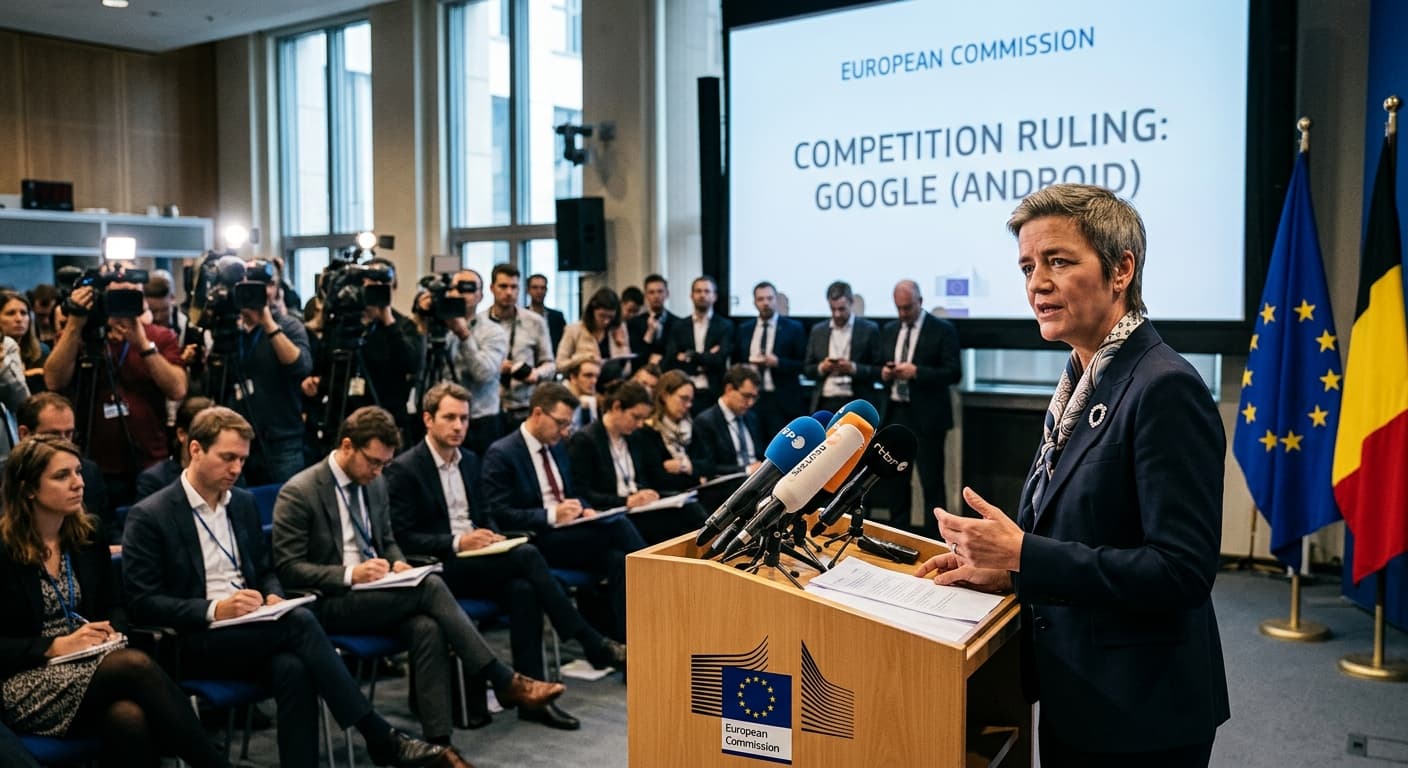
EU's Final €4.1 Billion Google Android Ruling Sets the DMA Template
The Court of Justice upheld a €4.125bn fine on July 2, 2026. The doctrine behind it — not the money — is what will govern EU tech enforcement in the AI era.
The Court of Justice of the European Union dismissed Google's last appeal on July 2, 2026, locking in a €4.125 billion ($4.7 billion) fine for Android monopoly abuse and, more consequentially, hard-coding the legal theory that Brussels will now weaponise against every AI-era gatekeeper. The money is a rounding error for Alphabet. The doctrine — that packaging "must-have" services with a dominant platform forecloses rivals as a matter of law, even absent proof of consumer harm — is the reusable template. It arrives three weeks before the Commission must issue binding Digital Markets Act (DMA) orders on Google Search data sharing and Android AI interoperability, and 12 days after Donald Trump threatened 100% tariffs on any country that "attacks" US digital firms. That collision — a settled EU legal doctrine meeting a live transatlantic trade war — is the story.
What the Court actually decided
The judgment in Case C-738/22 P, delivered by the Court's Second Chamber, disposed of six grounds of appeal brought by Google and Alphabet against the General Court's 2022 ruling. According to the EUR-Lex case record, the fine stands at €4,125,000,000, with Alphabet Inc. jointly and severally liable for €1,520,605,895 — the portion attributable to the period after it became Google's parent in October 2015.
The underlying conduct, first sanctioned by Commission Decision C(2018) 4761 in Case AT.40099, comprises three practices Brussels treated as a single, continuous infringement of Article 102 TFEU: tying Google Search and the Chrome browser to licences for the Play Store; exclusivity payments to manufacturers and carriers for pre-installing Google Search; and anti-fragmentation obligations that blocked device makers from selling any handset running a non-Google-approved Android "fork." At the time of the original decision, according to the Commission's 2018 press release, about 80% of European smartphones ran Android, Google held more than 95% of the market for licensable smart mobile operating systems outside China, and its search share exceeded 90% in most EEA states.
Google's response was terse. A company spokesperson told the BBC the judgment "fails to recognise" its "significant investment to ensure Android remains open, interoperable and free," and noted the firm had already "adapted our agreements to comply with the initial decision back in 2018." The Court largely disagreed on the first point and treated the second as legally irrelevant: a fine sanctions past conduct, not present compliance.
The doctrine that outlives the fine
Read narrowly, the ruling is an artefact. It concerns contracts from 2011 to 2018 that Google restructured seven years ago. Read as competition law, it does something far more durable — it validates the Commission's "ecosystem" theory of abuse, in which a dominant firm's leveraging of one product to entrench another is unlawful without the Commission having to prove that an equally efficient rival was actually foreclosed.
That is the framework the Court of Justice's Grand Chamber adopted on September 10, 2024, when it upheld the €2.4 billion Google Shopping fine in Case C-48/22 P. Two years later, the Android judgment extends the same logic from a comparison-shopping unit to an entire operating system. Zach Meyers of the Centre for European Reform, quoted in
CER analysis, argued that the Android case does not merely challenge a business practice but "potentially Google's underlying business strategy of offering services … which make no revenue — to drive consumers towards services which Google can monetise." That description now describes Amazon Prime, Meta's family of apps, and — most consequentially — every free AI assistant being pushed into a proprietary hardware and software stack.
That is not an academic point. The Commission's Bruegel-affiliated economists have argued for two years that the 2018 Android remedies were "widely thought to have evaded" rather than enforced, and that the DMA's designation of Google Play Services — not merely the Play Store — as part of the Android core platform service was the substantive fix. In effect, the Commission has treated antitrust enforcement as the legal foundation and the DMA as the operational remedy. The July 2 ruling is what welds those two layers together.
Why the money doesn't matter and the timing does
Alphabet reported over $350 billion in 2025 revenue. A €4.1 billion penalty accrued over eight years is what the Finance and Money blog accurately called a "parking ticket." The 2018 fine, according to
Al Jazeera's coverage, amounted to roughly a fortnight of Google's operating profit at the time. What matters is not the cheque but the calendar.
Twelve days before the ruling, on June 26, 2026, President Trump threatened 100% tariffs on any country imposing digital services taxes on US firms — an escalation of the February 2025 White House memo, "Defending American Companies and Innovators from Overseas Extortion and Unfair Fines and Penalties," that Brookings analyst Tom Wheeler characterised as
a shift from protecting production to protecting Big Tech's profits. The Android judgment is the first post-memo enforcement outcome the White House cannot appeal, veto or negotiate away. It is a settled European legal fact.
Twenty-five days after the ruling, on July 27, 2026, the Commission's competition directorate must adopt two binding DMA specification decisions. The first, according to the Commission's April 16 preliminary findings, will order Alphabet to share ranking, query, click and view data from Google Search with rival search engines and AI chatbots on FRAND terms, under Article 6(11) of Regulation 2022/1925. The second, described in the Commission's
April 27 consultation notice, will force Android to allow third-party AI assistants — from OpenAI, Anthropic, Mistral or Perplexity — to bind to custom "wake words" and execute in-phone tasks such as sending mail, ordering food or sharing photos, capabilities Google today reserves for its own Gemini assistant.
Ribera's language was blunt: the DMA measures aim to ensure that "competing AI services can effectively interact with applications on users' Android devices." Read alongside the Court's July 2 judgment, the message to Alphabet is coherent and closed-loop: your Android business model was unlawful in 2011, you fixed it too narrowly in 2018, and the DMA will now impose what you should have done. Between the antitrust ruling and the DMA orders, Google's freedom to design Android around its own AI shrinks materially.
Who benefits
The obvious loser is Alphabet, but the interesting winners are neither obviously European nor obviously the intended beneficiaries. First-order winners are the AI-native rivals — OpenAI, Anthropic, Perplexity, and the French-flagged Mistral — who gain a legally guaranteed on-ramp to two billion Android users' voice, search and task-execution surfaces without needing to strike a deal with Mountain View. According to the Commission's DMA case file, search data must be shared for at least five years per beneficiary — long enough to build a competing search or chat product that can plausibly train on it.
The second-order winner is Samsung. Anti-fragmentation clauses of the kind the Court just condemned once blocked the Korean firm from shipping devices with a serious non-Google search and assistant stack. A binding DMA remedy, backed by a final antitrust judgment, makes that possibility a commercial reality — a Galaxy phone with Perplexity as the default assistant, or a Bing-powered browser, is now a lawful and enforceable product configuration inside the EEA.
The under-noticed loser is the Digital Services Act's political cover story. The Commission has spent three years insisting the DMA is regulation, not competition enforcement, and therefore not "targeting American firms." The July 2 judgment, coming from the EU's supreme court and directed at the same conduct the DMA now polices, collapses that distinction. As the CSIS's Charting Geoeconomics blog observed, five of the seven designated DMA gatekeepers are American; the political cost of that concentration is now denominated in tariff threats rather than legal appeals.
Diplomat View
The Google Android judgment is not a landmark. The landmarks were the 2018 Commission decision that established the theory of harm and the 2024 Google Shopping ruling that validated it at the Court of Justice. What July 2, 2026 does is remove the last live legal argument against the Commission's ecosystem-tying doctrine at the precise moment the Commission is applying that doctrine, via the DMA, to the AI assistant layer of the smartphone.
Our call is specific and falsifiable. By the end of Q1 2027, at least one non-Google AI assistant will ship as a factory default on a European-market Android device from a top-five OEM. The judgment plus the July 27 DMA decisions create the legal room; Trump's tariff threats create the political incentive for OEMs to hedge; and Alphabet, having lost every appeal it has bothered to file, has run out of delay tactics. The forecast revises if two things happen: the Commission dilutes its July 27 decisions in the face of White House pressure, or Alphabet secures a settlement package — likely bundled with an EU AI Act concession — that trades away the interoperability remedy. Both are plausible. Neither is currently the base case.
The historical parallel is not Microsoft's browser ballot, which is where most coverage lands. It is the 1984 breakup of AT&T, another vertically integrated communications monopoly whose regulators eventually concluded that behavioural remedies were insufficient and structural ones necessary. On September 5, 2025, when the Commission fined Google €2.95 billion on ad tech, Executive Vice-President Teresa Ribera warned, in remarks reported by the BBC, that "the only way for Google to end its conflict of interest effectively is with a structural remedy, such as selling some part of its ad tech business." The July 2 judgment is the doctrinal permission slip for exactly that kind of remedy — applied not just to ad tech but to any layer of the Google stack where tying can be shown. The DMA is the delivery mechanism.
What to watch
- July 27, 2026 — Commission adopts final binding DMA specification decisions on Google Search data sharing (Article 6(11)) and Android AI interoperability. Watch whether the interoperability order names Gemini as a covered service.
- Q3 2026 — Alphabet's expected response to the September 2025 ad tech decision, including any proposed divestiture of AdX. A refusal triggers structural-remedy proceedings under Article 18(1) of Regulation 1/2003.
- Q4 2026 — Expected White House retaliation on European digital services under the February 2025 tariff memo. The trigger will be the DMA orders, not the Court ruling.
The bottom line: The €4.1 billion fine is a legal artefact of a decade-old case, but the doctrine it locks in — that ecosystem tying is unlawful under Article 102 TFEU without proof of foreclosure — is the operative theory Brussels is already applying to the AI layer of Android under the DMA. The next binding step is a Commission decision due July 27, not another court date. That is where the enforcement action, and the transatlantic fight, now sits.
Discover more

India
Rajnath Singh's Durga Squad for 2026 Polls
Rajnath Singh's Durga Squad promised women's safety in Bengal but has since disappeared from the agenda, revealing BJP's true priorities.
India
Congress Accuses Modi of Stalling Women's Law
Congress accuses Modi of stalling women's reservation law by linking it to delimitation, revealing a deeper electoral strategy.

US Politics
SNAP Food Assistance Faces Legal Challenges
In 2026, SNAP faces stricter eligibility rules and mounting legal challenges, threatening food assistance for the millions of Americans who rely on the program.

Economics
Fed's Amex AML order puts correspondent banking on notice
Federal Reserve's Amex AML order requires board-level controls and a 90-day plan; OCC fined the bank $350 million over enterprise-wide deficiencies.