Europe's Economic Recovery and Gulf Tensions
How the Gulf war impacts Europe's growth prospects
Model Diplomat8 min readEurope
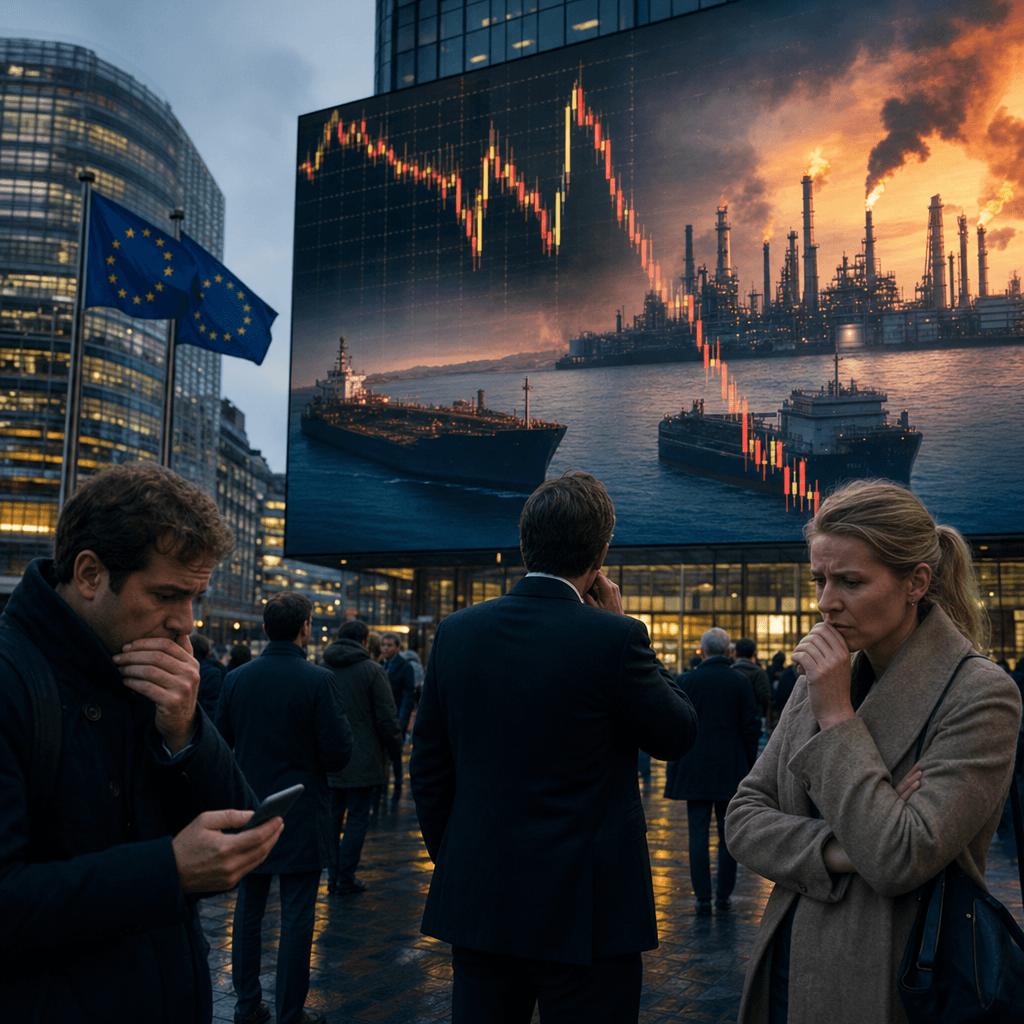
Europe's Economic Recovery Meets the Gulf: One Shock, Two Bosses
Europe's recovery has been overtaken by the Iran war and a fragile Hormuz ceasefire — the ECB, ESM and Eurostat data show a euro area now hostage to Gulf supply and US markets.
Europe's 2026 recovery is not being written in Frankfurt. It is being written in Ras Laffan and along the Strait of Hormuz — and, as a new European Stability Mechanism paper laid out on July 6, in the price of a US Treasury. The euro area contracted 0.2% in the first quarter, according to Eurostat, and the European Central Bank now expects only 0.8% growth this year. The thesis is simple: Europe's recovery has been quietly annexed by two external bosses — a Gulf energy war it cannot police and a US financial cycle it cannot hedge — and the policy tools built after 2022 do not neutralise either. The story of European growth in the second half of 2026 is really a story about who owns the leverage.
The shock: a Gulf supply war Europe cannot contain
The war began on February 28, 2026, when the United States and Israel launched coordinated strikes on Iran, killing Supreme Leader Ali Khamenei on the first day, the BBC reported. Iran retaliated not with a naval blockade but with cheap drones aimed at insurance underwriters: within days, traffic through the Strait of Hormuz collapsed and,
as NPR documented, Iraq began shutting in fields it could no longer export. On March 2, Iranian drones hit QatarEnergy's Ras Laffan complex; the world's largest LNG producer declared force majeure, and benchmark European TTF gas jumped almost 25% intraday,
according to Al Jazeera.
The damage is not a headline; it is a decade. QatarEnergy's CEO Saad al-Kaabi told Reuters that two of the fourteen LNG trains and one of two gas-to-liquids facilities were destroyed, sidelining 12.8 million tonnes of annual LNG output for three to five years, according to Al Jazeera's reporting on the force majeure notices. Italy, Belgium, Poland and Spain — buyers of long-term Qatari cargoes — are now inside a global bidding war for spot LNG. The
International Energy Agency counted more than 80 Gulf facilities hit since February 28, with a third severely damaged.
A conditional US–Iran ceasefire signed by Donald Trump and Masoud Pezeshkian at Versailles on April 8 reopened the strait — briefly. The Council on Foreign Relations tracked how Hormuz was closed again within 24 hours, reopened, and closed once more; Iran's parliament speaker Mohammad Bagher Ghalibaf later said the waterway "will not return to pre-war conditions," raising the prospect of transit fees after the 60-day negotiating window lapses. On June 26, Trump publicly accused Iran of breaching the truce after fresh attacks in the strait,
the BBC reported. Brent, which traded near $70 before the war, sat around $92–96 through early July after peaking above $120 in April.
The transmission belt: ECB does the maths, and it is worse than it looks
The ECB has now put numbers on what the war costs Europe. In an Economic Bulletin box published June 24, staff estimated the Middle East oil shock will shave roughly 0.4 percentage points off euro area real GDP growth in 2026, with the drag building through the year as the futures curve prices in persistent tightness. A July 2 blog by ECB economists Pablo Aguilar and Lukas Boeckelmann extended the analysis:
persistent input shortages from Gulf supply chains alone could put up to 3% of euro area production at risk in a worst-case fragmentation scenario — a shock closer to COVID than to 2022.
Executive Board member Isabel Schnabel warned on July 6 that the euro area's economy is "not back to its state before the Iran war" despite easing oil prices, with core inflation and services inflation still sticky at around 3.5%, Reuters reported via Global Banking and Finance. Her framing matters: it signals that the ECB will not cut through this shock the way it cut through the disinflation of 2024. In a May 6 speech, Schnabel also flagged an "adverse scenario" in which cumulative euro area growth is 0.8 percentage point lower than the December 2025 baseline through 2028 — with inflation 1.5 percentage points higher,
per the ECB text.
The good news, such as it is: Europe is not 2022. In a June 3 blog, ECB economists argued the current episode is an oil shock hitting a demand-constrained economy with a neutral policy stance — the mirror image of the gas shock that hit an overheated economy with negative rates. Cinzia Alcidi at CEPS reached the same conclusion in
a briefing for the European Parliament: the ECB starts from normalised policy, national fiscal measures are smaller, and gas prices — even after Ras Laffan — remain well below the 2022 peaks. But she adds the sting: if Hormuz stays effectively closed, the shock "may eventually become as big as in 2022," because roughly 20% of global oil supply is being kept off the market entirely.
The second boss: America owns Europe's balance sheet now
The under-reported story is that even a full Gulf ceasefire would not restore autonomy. On July 6, the ESM published a paper arguing that the euro area's two biggest tail risks — a new Middle East war and a US assets sell-off — could, if twinned, tip Europe into recession and push inflation near 5%. Crucially, the ESM highlighted that euro area GDP exposure to the US stood at 47% last year, up from 18% in 2013. European investors,
a Sciences Po/NYU study commissioned by the ECON committee found, now hold roughly USD 1.6 trillion in US Treasuries, and 53% of their external portfolios in long US risk — an "exorbitant privilege" loop that recycles European savings into US deficits while mechanically importing US financial conditions.
That structure is what turns a Gulf oil shock into a European growth shock rather than a US one. The IMF's Helge Berger noted in a May speech that European industrial gas prices were already two to three times US levels before the Middle East war; Germany's added defence and infrastructure spending is expected to lift growth by 0.3 percentage points in 2026, but nowhere near enough to offset an energy hit that also erodes cost competitiveness. Meanwhile, US LNG exporters are the war's clearest corporate winners:
NPR reported that US producers sourcing gas at roughly $3/MMBtu have been selling cargoes into Europe and Asia at around $20/MMBtu, with Cheniere, Woodside and Venture Global stocks up 10–30% since February 28. A Congressional Research Service note dated the pain precisely:
between February and May 2026, European gas prices rose 44%, Asian prices 66% — while US Henry Hub fell 6%.
The European Commission's own June 24 convergence report put the political frame on it: the war created "the most significant global energy supply disruption in recent history," followed by "the virtual closure of the Strait of Hormuz." That is Brussels admitting, in a document with treaty force, that its convergence assumptions have been rewritten by events outside its jurisdiction.
The response: a Europe–Gulf pivot that is real, and too slow
Brussels is not passive. On March 5, GCC and EU foreign ministers held an extraordinary meeting condemning Iran's strikes on Gulf states and endorsing EU naval operations ASPIDES and ATALANTA to protect shipping lanes — read the Council joint statement here. In May, more than twenty European and Gulf heads of government met at the inaugural Europe Gulf Forum in Costa Navarino, alongside Christine Lagarde and IMF chief Kristalina Georgieva,
according to the Atlantic Council's readout. France's Technip Energies is the primary engineer on the Ras Laffan rebuild — the single most consequential Europe–Gulf industrial contract of the decade,
per the Gulf International Forum.
Yet the shape of the pivot reveals the leverage problem. GCC–EU trade totalled €161.7 billion in 2024, down 5% year-on-year — trivial next to Europe's transatlantic exposure. A regional free trade agreement, discussed at the
2024 EU–GCC summit, has moved slowly; the next summit is scheduled in Saudi Arabia later in 2026. Carnegie's Marc Pierini argued in March that
Europe and the Arab Gulf "must come together" precisely because a compromised Hormuz "will likely stunt European reindustrialization efforts." Translation: Berlin's fiscal expansion and the €150 billion SAFE defence instrument cannot deliver an industrial renewal that gas at €50+/MWh will strangle.
The Atlantic Council frames Europe and the Gulf as "middle powers" both in range of Iran's missiles and both dependent on Hormuz, in a June dispatch — a diagnosis that is correct and inconvenient. The Trump administration's blockade-and-insurance approach, its refusal to force open Hormuz militarily, and its evident satisfaction with a US LNG-driven windfall have shown that the security guarantee underwriting the Carter Doctrine is now transactional. Europe's honest option is to build a Gulf policy that no longer runs through Washington. It has neither the naval assets nor the political consensus to do so before the next storm.
Diplomat View
The consensus that Europe "absorbed" the 2026 oil shock is technically correct and analytically wrong. The euro area absorbed the first-round price hit because 2026 is not 2022 — normalised rates, softer demand, an oil rather than gas shock, and better-diversified LNG sourcing. But the second-round bill is being paid in structure, not headlines: 0.4 points of growth this year, three to five years of Qatari capacity lost, a 47% GDP linkage to a US market that the ESM itself now names as Europe's other tail risk, and a Gulf security order that Washington has re-priced. The forecast that would flip our view: a durable Hormuz reopening with commercial insurance rates back to January levels, plus a euro-denominated safe-asset instrument (through the ESM's unused 86% lending capacity, or a scaled successor to NextGenerationEU) that starts to redirect European savings home before the next US risk-off event. Absent both, the euro area's recovery will keep looking less like autonomy and more like weather — determined elsewhere, priced in dollars.
What to watch next
- Late August 2026 — expiry of the 60-day US–Iran negotiating window on Iran's nuclear programme; Ghalibaf's threatened Hormuz transit fees take effect if no deal.
- September 2026 — ECB projections update; whether Schnabel's hawks hold the line on further tightening despite sub-1% growth.
- Q4 2026 — Saudi-hosted second EU–GCC summit; watch for a concrete FTA roadmap or, absent that, bilateral Qatari-French LNG contracts filling the multilateral gap.
- Winter 2026–27 — EU gas storage below the 90% mandate is the shock that could still turn a 0.4-point drag into the ESM's recession scenario.
The Bottom Line
Europe's 2026 recovery has been requisitioned by a Gulf war it did not start and a US financial cycle it cannot exit — the ECB estimates a 0.4-point growth hit this year, the ESM warns of recession if the two shocks recombine, and Qatar's 12.8 million tonnes of lost annual LNG will not return for half a decade. The winner is US LNG and the American Treasury market; the loser is the European industrial base still paying gas prices two to three times US levels. Unless Brussels turns the Europe–Gulf Forum into a hard energy and financial architecture — a genuine euro safe asset, a Gulf FTA, a naval posture that does not depend on Washington's mood — "recovery" will remain a word Europe uses to describe a decision made somewhere else.
Discover more

Global Politics
US Seizes Iranian Ship, Tensions Surge
The US seizure of the Iranian ship Touska highlights a shift in control over the Strait of Hormuz, favoring Iran's strategic position.

International Relations
Pakistan's Key Role in US-Israel-Iran Meddle
Pakistan is seeking to mediate the US-Israel-Iran conflict, balancing high-stakes diplomacy against severe economic pressures and steep regional challenges.

Conflict & Security
Drone Warfare Killing Aid Workers at Unprec
Over 1,000 humanitarian workers killed in three years as cheap armed drones collapse legal protections. Gaza, Sudan, Ukraine, and DRC see deliberate targeting of aid convoys and hospitals with zero prosecutions.

Global
World Normalises Taliban as Afghan Women Eras
UN data shows Afghan women erased from public life as Russia recognises the Taliban, EU hosts officials in Brussels, and ICC warrants for gender persecution go unenforced.