EU Sanctions Israeli Settlers After Hungary V
EU takes action against settler violence in the West Bank.
Model Diplomat3 min readEurope
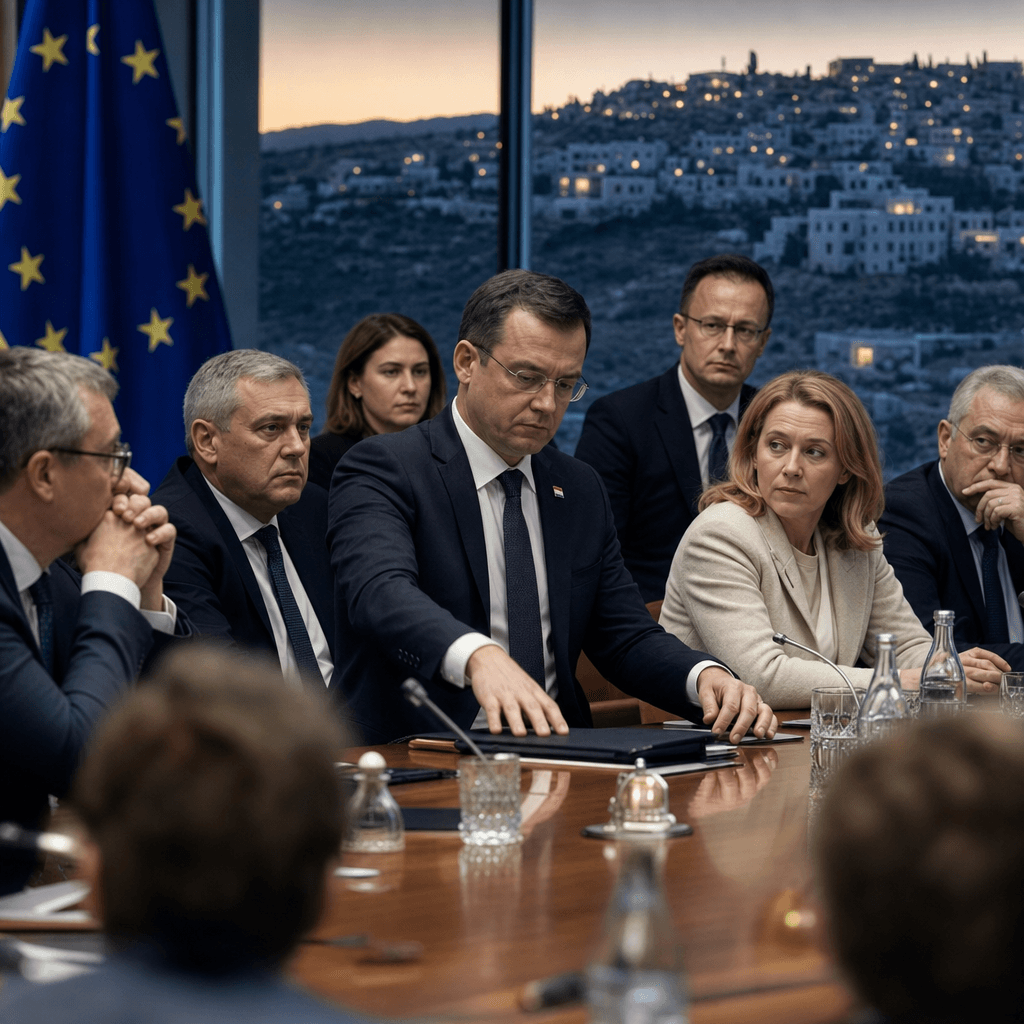
EU Sanctions Israeli Settlers After Hungary Drops Veto
The bloc has finally moved against West Bank settler violence, but only after Hungary stopped blocking it — and Brussels still lacks consensus on tougher Israel measures.
The European Union has adopted sanctions on Israeli settlers and settler-linked groups over violence in the occupied West Bank, with EU foreign policy chief Kaja Kallas saying it was “high time we move from deadlock to delivery” and French Foreign Minister Jean-Noël Barrot saying “it’s done” (BBC,
POLITICO). The immediate political driver was not a sudden shift in EU doctrine; it was the removal of Hungary’s veto after Budapest changed government, clearing the way for unanimity in Brussels (
BBC,
Le Monde).
Who holds leverage
The real leverage sits with the member states that can block unanimity — and with Hungary, that blockage is gone. That matters because the EU is still not unified on anything broader than targeted punishment. The ministers agreed on blacklisting some settlers and organizations, but they did not endorse tougher economic steps such as curbing trade with settlement goods or suspending the EU-Israel association framework (POLITICO,
NPR/AP). In other words, Brussels is willing to raise the price of settler violence, but not yet to confront Israel at the level that would bite across its economy.
That gives two actors the advantage. First, Israel’s government avoids a bloc-wide trade response for now. Second, the most hardline settler organizations face targeted travel and asset restrictions rather than a broader shift in EU-Israel relations. This is a narrow sanctioning package, not a strategic rupture.
Why this matters on the ground
The sanctions land in a West Bank environment that has already deteriorated sharply. The BBC reports the UN documented more than 1,800 settler attacks in 2025 that caused casualties or property damage across roughly 280 communities, while AP says at least 40 Palestinians have been killed since the start of this year, including a record 11 by settlers (BBC,
NPR/AP). That is the context for the EU’s move: it is trying to signal that violence by civilians on the Israeli side will not be treated as politically cost-free.
But the signal cuts both ways. Israel’s foreign minister Gideon Sa’ar denounced the decision as “arbitrary and political,” and accused the EU of a “distorted moral equivalence” for pairing settler sanctions with measures on Hamas figures (BBC,
POLITICO). That response is meant to rally domestic support and pressure sympathetic EU capitals, especially those still resisting wider penalties.
What to watch next
The next decision point is whether Brussels moves from symbolic targeting to market pressure. France, Sweden and others are already pushing to restrict settlement products, while Italy and Germany remain central holdouts on any tougher line (POLITICO,
NPR/AP). Watch the next Foreign Affairs Council in May: if the EU cannot agree on trade measures then, this sanctions package will look less like a turning point than a ceiling. For
Conflict and
Global Politics, that is the real story — Europe has found a narrow consensus, but not a strategy.
Discover more

Global Politics
US Seizes Iranian Ship, Tensions Surge
The US seizure of the Iranian ship Touska highlights a shift in control over the Strait of Hormuz, favoring Iran's strategic position.
India
UN Expert Albanese: India Violates Law
UN Rapporteur Francesca Albanese accuses India of breaching international law, spotlighting human rights concerns in Kashmir and prompting diplomatic pushback.
India
Romanian Coalition Party Demands PM Resign
Romania's Social Democrats withdrew from coalition, joining far-right AUR to topple PM Bolojan, risking €10 billion in EU funds by August 2026.

Conflict & Security
Drone Warfare Killing Aid Workers at Unprec
Over 1,000 humanitarian workers killed in three years as cheap armed drones collapse legal protections. Gaza, Sudan, Ukraine, and DRC see deliberate targeting of aid convoys and hospitals with zero prosecutions.