Erdogan-Starmer Defence Pact Strengthens NATO
New UK-Türkiye partnership enhances security ties.
Model Diplomat3 min readEurope
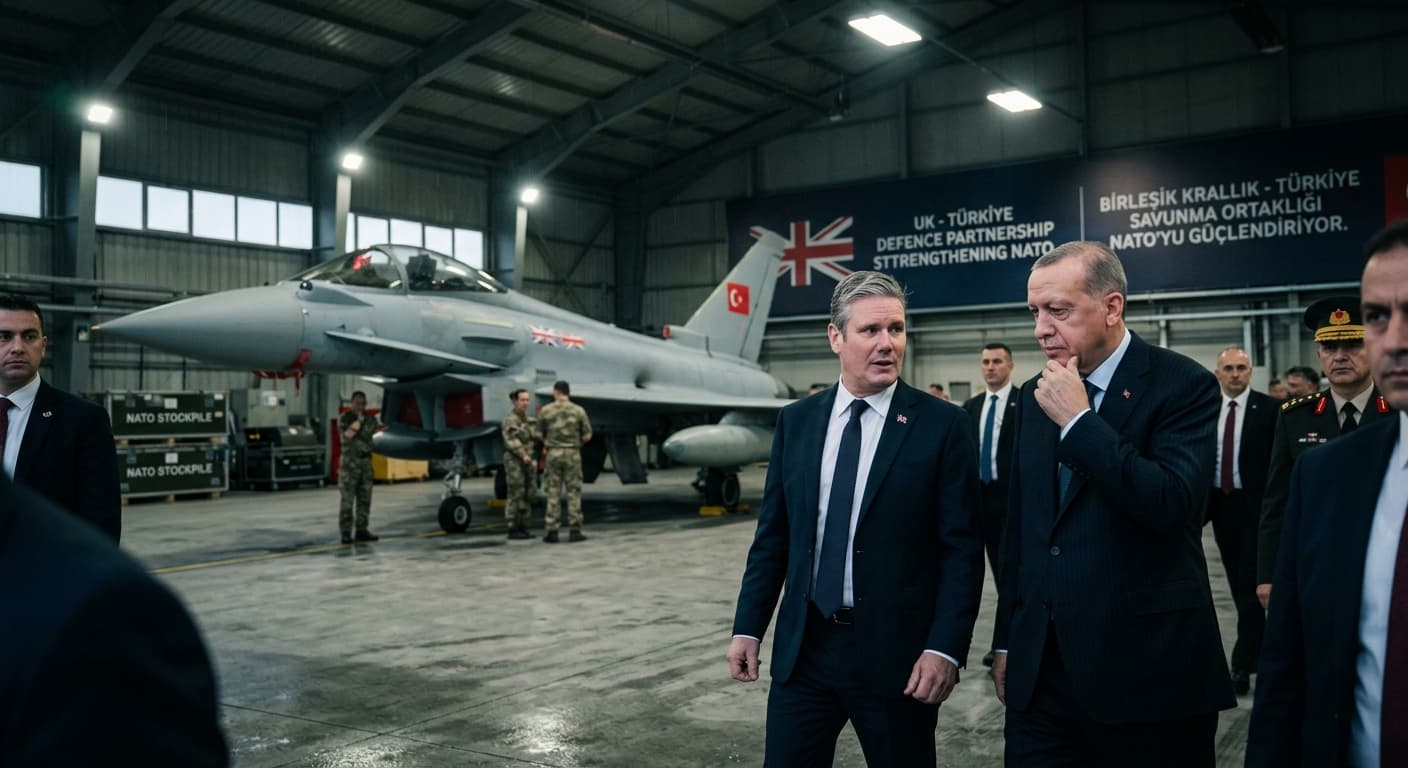
Erdogan-Starmer defence pact anchors NATO's southern flank
The UK-Türkiye Security and Defence Partnership signed in Ankara on July 8, 2026 locks in industrial and intelligence ties across seven domains — and pre-commits the next British government.
Turkish President Recep Tayyip Erdogan and outgoing British Prime Minister Keir Starmer signed a UK-Türkiye Security and Defence Partnership on the closing day of NATO's 36th summit in Ankara on July 8, 2026 — an eight-paragraph framework covering deterrence, defence industry, cyber, hybrid threats, counter-terrorism, civil resilience and space. The document does not create new spending. It does something more consequential: it institutionalises the UK as Türkiye's principal Western industrial partner and intelligence interlocutor at the exact moment Washington is drawing down its European footprint and Iranian ballistic missiles are landing on NATO's southeastern edge. The signing also binds a government that will not exist in twelve days — Starmer resigns on July 20 and Andy Burnham inherits both the pact and its bill.
What was actually signed
The joint statement, published by 10 Downing Street, describes the partnership as institutionalising "new mechanisms on the politico-military aspects of security and defence policy, including deterrence and defence, military co-operation, defence industry and technology, cyber security and hybrid threats, counter-terrorism, resilience and civil preparedness and space." Turkish state media, in a readout from Erdogan's
Directorate of Communications, added operational detail: closer intelligence sharing, joint work on defence technology, and specific reference to countering hybrid threats — the same architecture the UK already uses with the EU and with Poland. The BBC's Frank Gardner reported that the deal "will pave the way for closer intelligence sharing between the countries," a line that does not appear in the sanitised joint statement but was briefed to
British media at the summit.
The pact is the third rung of a fast-built ladder. On March 7, 2026, Starmer and Erdogan agreed by phone — hours after an Iranian ballistic missile bound for Türkiye was shot down by NATO air defences — that their teams should "continue the work towards a new bilateral defence and security agreement ahead of the NATO summit in Türkiye in July." On April 23, foreign ministers signed a broader
Strategic Partnership Framework in London that flagged "enhancing defence capability and industry co-operation" as a core pillar. Ankara delivered the third rung on July 8. Four months from concept to treaty is fast even by wartime standards, and the pace tells you which capital feels most exposed on NATO's flank.
Why this is not the usual bilateral
Read against the UK-EU Security and Defence Partnership signed in May 2025, and the Trinity House agreement with Germany, the Türkiye document is architecturally near-identical: the same seven domains, the same six-monthly ministerial dialogues, the same emphasis on hybrid threats, cyber and space. That is the point. London is stitching a mesh of interlocking strategic partnerships — Norway, Germany, Poland, France, Ukraine, now Türkiye — each pledged to routinised dialogue and joint industrial work. The
UK's 2025 National Security Strategy explicitly frames Türkiye as sitting "at the crossroads between the Black Sea, the Caucasus, the Middle East and Africa" and calls it "imperative to UK security interests across Europe and on NATO's flanks."
The mesh has a purpose the strategy prefers not to spell out: to survive the American drawdown. In the run-up to the summit Al Jazeera reported that Washington has "announced a phased withdrawal of warplanes, destroyers and submarines from NATO countries," with RUSI's Jack Watling warning that the withdrawal of US air power in particular carries "tangible impact." Trump used the Ankara summit to bash Spain as "a terrible partner" and to threaten Greenland, per the
BBC's summit dispatch. The UK's answer is bilateralism at scale. Ankara is the last major NATO capital that had not been formally bracketed into that mesh, and it is arguably the most strategically important one — the guardian of the Turkish Straits, hosting Incirlik air base, straddling every theatre where Russia, Iran and NATO now brush against each other.
Discover more
US Politics
Congress Targets AI Chatbot Access for Terror
The House passed the Generative AI Terrorism Risk Assessment Act, focusing on AI's role in terrorism and potential surveillance implications.
US Politics
SNAP Food Assistance Faces Legal Challenges
In 2026, SNAP faces stricter eligibility rules and mounting legal challenges, threatening food assistance for the millions of Americans who rely on the program.

India
BJP's Misunderstanding of Women's Quota Needs
The BJP's linking of the Women Reservation Bill to delimitation risks delaying women's empowerment in India, misreading the aspirations of female voters.

Conflict & Security
Drone Warfare Killing Aid Workers at Unprec
Over 1,000 humanitarian workers killed in three years as cheap armed drones collapse legal protections. Gaza, Sudan, Ukraine, and DRC see deliberate targeting of aid convoys and hospitals with zero prosecutions.