Egypt's Refugee Crisis: UN Alarm Raised
UN experts warn of Egypt's deportation violations
Model Diplomat5 min readMiddle East
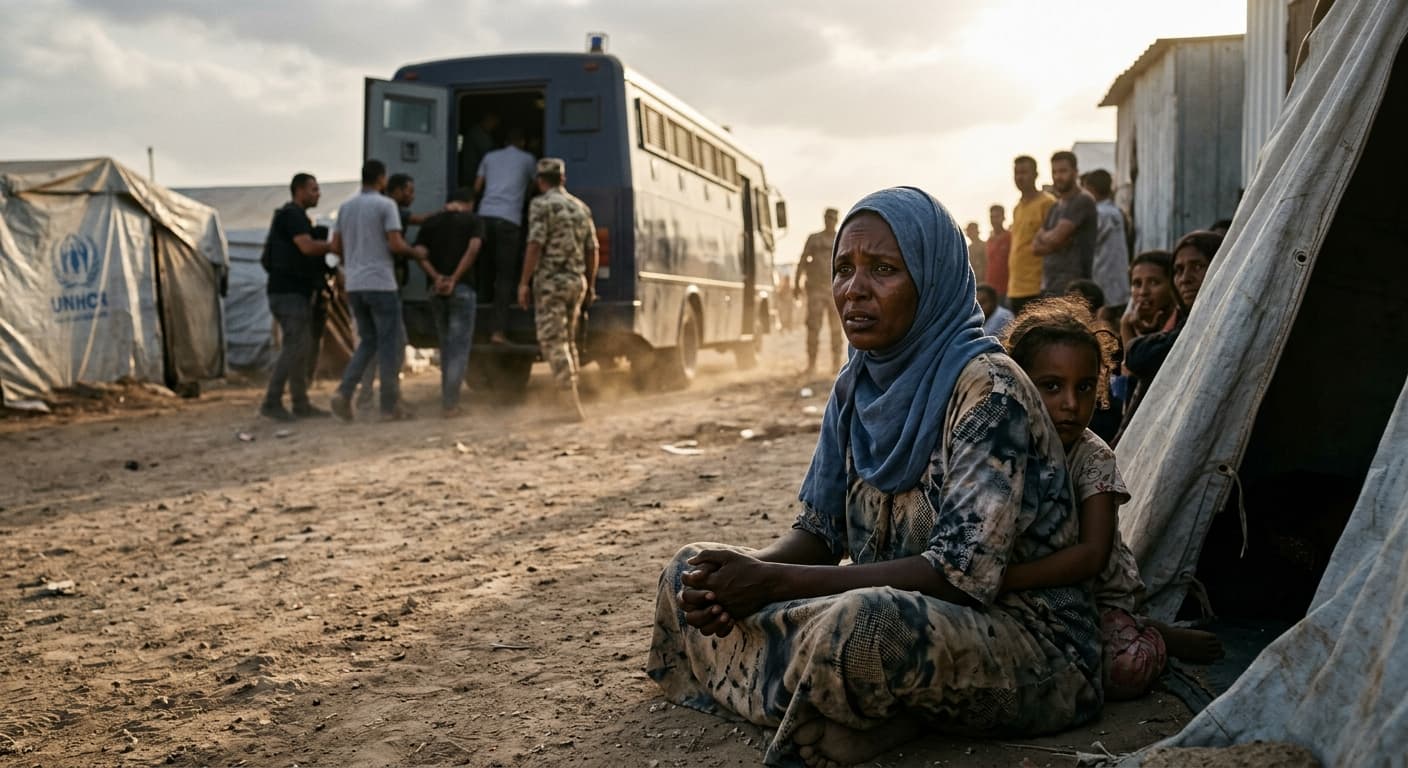
Egypt has been arresting and deporting refugees carrying valid UNHCR cards, and as of March 2026 five UN Special Rapporteurs are on the record saying deportations were carried out without individualized refoulement assessments. The story is not simply about statute — a formal UN human rights mechanism has now named the violation.
The UN treaty-body dimension
The story is not simply about statute; a formal UN human rights mechanism is now on the record. On March 6, 2026, five UN Special Rapporteurs and the Working Group on Arbitrary Detention issued a joint alarm published by OHCHR, warning that deportations from Egypt "were reportedly carried out without individualized assessments to determine the risk of refoulement."
The underlying joint communication to the Egyptian government (AL EGY 6/2025) contains the granular data Cairo has otherwise refused to release. According to information received by the mandate holders and posted to the OHCHR Special Procedures database, one local monitoring actor recorded 1,128 arrests of migrants, refugees and asylum seekers in the first quarter of 2025 alone, up from an average of 250 per month previously. Comparing January–August 2024 with the same period in 2025, arrests of asylum seekers holding residence permits rose 56 percent, and arrests of UNHCR-registered persons rose 121 percent. Different reports recorded more than 10,000 refugees and asylum seekers arrested across 2024, and roughly 22,000 Sudanese deported to Sudan that year — "all of whom were reportedly detained prior to deportation."
Egypt's reply to the mandate holders is on the record and worth quoting in full because it establishes the government's legal position:
"No one is arrested for being a refugee or asylum-seeker but only for violating residency laws or crossing borders unlawfully… Persons are not deported if they can produce an identity card issued by the Office of the United Nations High Commissioner for Refugees (UNHCR). In such cases, the authorities coordinate immediately with UNHCR."
That defence is precisely what HRW's fieldwork contradicts. The 27-year-old deported to Juba was carrying a UNHCR card.
Who benefits, who pays
The non-obvious beneficiary here sits in Brussels. Egypt now hosts the world's largest UNHCR Refugee Status Determination operation, more than 1.1 million registered refugees, and — per the UN Resident Coordinator in Cairo — as many as 1.5 million Sudanese in country. It is also the linchpin of the EU's southern migration architecture.
On March 17, 2024, the European Commission and Egypt signed a Strategic and Comprehensive Partnership worth €7.4 billion. The EU's
Decision 2024/1144 allocated €5 billion in macro-financial assistance — €200 million of it earmarked for migration management across six intervention pillars. In a submission to the OHCHR Special Rapporteur on migration, the Refugees Platform in Egypt argued that EU externalization funds have "directly contributed" to arbitrary detention and mass deportations, and that the partnership rests on the "false assumption that Egypt is a 'safe third country.'"
The Carnegie Endowment put it more bluntly: the Cairo package follows the same template as the July 2023 Tunisia deal, cash for containment with human rights conditionality on paper only. The
Arab Center Washington analysis noted that Cairo pushed Law 164 through parliament in a rushed process precisely as EU disbursements accelerated.
The losers are specific. Sudanese refugees — the largest cohort, fleeing a war the UN calls the world's worst current humanitarian crisis — bear the brunt of arrests concentrated in Cairo neighborhoods with visible refugee populations. Eritreans face refoulement to a state under a UN Commission of Inquiry finding of crimes against humanity; in a 2021 case documented in Special Procedures communication EGY 12/2021, Egyptian authorities deported eight Eritrean asylum seekers, including children as young as three, after coordinating with the Eritrean embassy.

The historical parallel Cairo would rather forget
Twenty years ago this December, Egyptian riot police cleared a Sudanese protest camp outside UNHCR's Cairo office, killing at least 25 asylum seekers including children, as Al Jazeera reported at the time. Antonio Guterres, then UN High Commissioner for Refugees and now UN Secretary-General, called it a "terrible tragedy." The immediate catalyst then was UNHCR's decision to stop hearing new Sudanese cases after the 2005 north–south peace deal.
The 2025–2026 crackdown has different mechanics but the same structural logic: an administrative status change strands a large Sudanese population without documents, and Egyptian authorities respond with force. The difference is scale. In 2005, roughly 30,000 Sudanese were registered as refugees. In 2026, the registered caseload alone is more than 30 times larger, and the transitional gap between UNHCR and the Permanent Committee has no defined bridge.
What to watch
- August 21, 2026 — the Executive Regulations of Law 164 enter into force, three months after publication, formally ending UNHCR's status determination role even though the Permanent Committee is not yet constituted. EIPR warns this creates a protection vacuum for new arrivals.
- UN Human Rights Council session, September 2026 — the joint communication AL EGY 6/2025 and Egypt's reply are now public; special procedures may escalate to a country-specific resolution or formal follow-up.
- EU macro-financial assistance disbursement — the second tranche of the €4 billion medium-term MFA under Decision 2024/1144 is conditional on reform benchmarks. Whether the European Parliament attaches refugee-protection conditionality, as some MEPs demanded in 2024, will test whether Brussels' "do no harm" language has any operational meaning.
- UNHCR case transfer — no bilateral memorandum has been published governing the transfer of more than a million refugee files from UNHCR to the still-nonexistent Permanent Committee. Egypt's
reply to UN experts states it will extend residency to 12 months and provide "temporary legal protection" during processing delays; whether the bylaws operationalise that pledge is the near-term test.
The Bottom Line
Egypt's 2024 Asylum Law is not a failed transition. It is a functioning one, designed to convert refugee status into a revocable administrative permit under executive control, with no statutory bar on refoulement and no meaningful judicial review. The 5,000-plus detentions and 22,000 deportations documented since the war in Sudan began are the predictable output of that design, not a bureaucratic accident. Brussels financed the enforcement architecture and cannot credibly claim surprise when Egypt uses it.
Human Rights Watch's July 7 report matters less for what it reveals than for what it forecloses. After March's UN special procedures alarm and Cairo's on-the-record reply, the "we did not know" defence is no longer available to any state party still routing migration funds through Egypt.
Discover more

US Politics
House Ethics Committee Pushes Sexual Miscond.
The House Ethics Committee has shifted responsibility for sexual harassment settlement records to the Office of Congressional Workplace Rights, complicating disclosure efforts.

India
Congress Accuses Modi of Stalling Women's Law
Congress accuses Modi of stalling women's reservation law by linking it to delimitation, revealing a deeper electoral strategy.

India
Romanian Coalition Party Demands PM Resign
Romania's Social Democrats withdrew from coalition, joining far-right AUR to topple PM Bolojan, risking €10 billion in EU funds by August 2026.

Conflict & Security
Drone Warfare Killing Aid Workers at Unprec
Over 1,000 humanitarian workers killed in three years as cheap armed drones collapse legal protections. Gaza, Sudan, Ukraine, and DRC see deliberate targeting of aid convoys and hospitals with zero prosecutions.

