Egypt's Asylum Law Fuels Refugee Crackdown
New law leads to mass detentions of refugees in Egypt.
Model Diplomat8 min readMiddle East
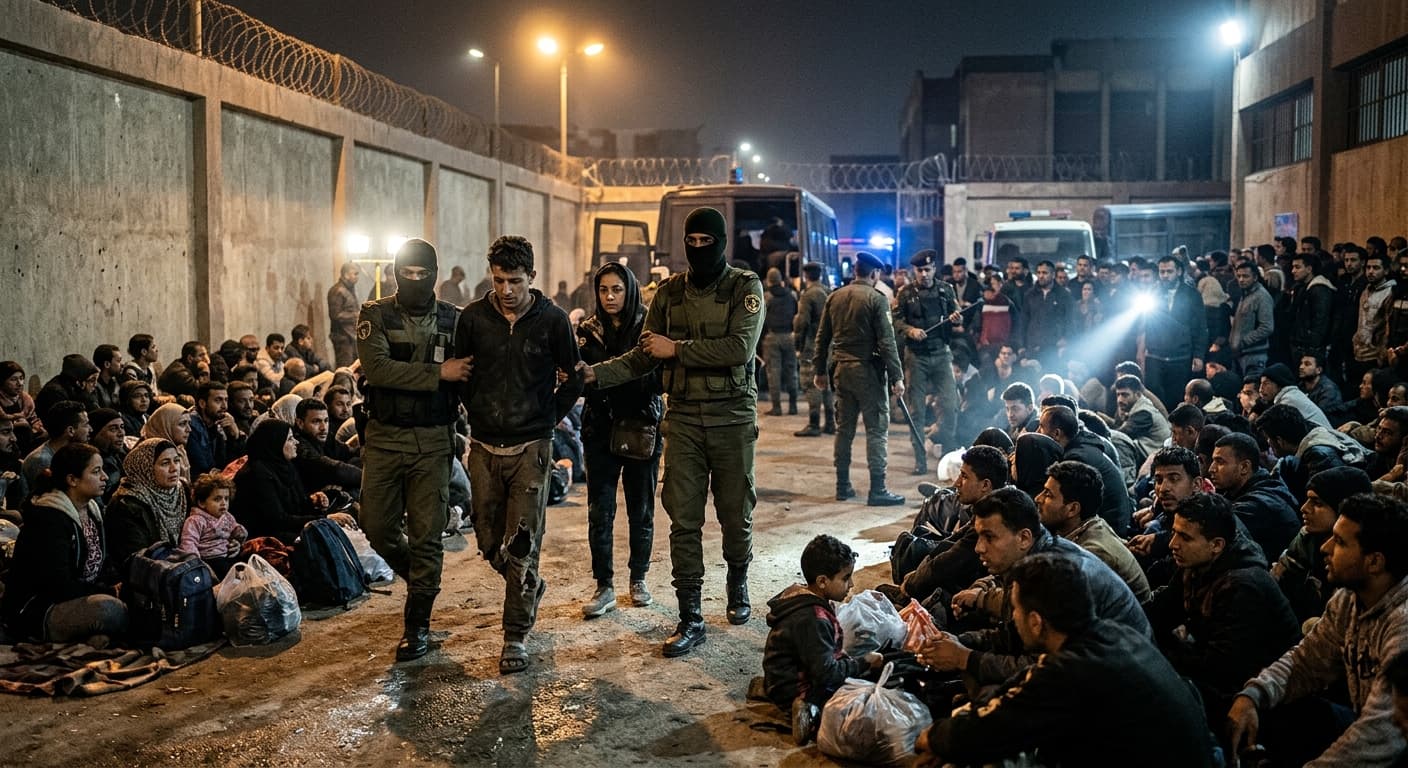
Egypt's new asylum law is criminalizing the refugees it was meant to protect
Egypt's 2024 Asylum Law transferred refugee protection from UNHCR to the state — then triggered a crackdown that has detained over 5,000 people, most from Sudan and South Sudan, in 2026 alone.
Egypt's first-ever asylum statute was sold as a modernization; in practice it has become the legal architecture for the largest campaign of arbitrary detention of refugees in the country's modern history. Since January 2026, at least 5,000 refugees and asylum seekers have been detained and at least 15 have died in custody, according to the Egyptian Initiative for Personal Rights, even as the government has yet to stand up the national body that Law No. 164 of 2024 designated to replace the UN refugee agency. The thesis is simple and load-bearing: Cairo has dismantled the UNHCR-run asylum system before building a domestic one, and refugees registered with the UN are now being deported for not holding documents the Egyptian state has refused to issue.

The crackdown, in numbers
Human Rights Watch's July 7, 2026 report documents interviews with 19 refugees from Sudan, South Sudan, Eritrea, and Ethiopia arrested between late 2025 and mid-2026, some of them holding valid UNHCR cards and residency renewal appointments as far off as September 2028. According to Human Rights Watch, Egyptian authorities have "intensified a campaign of arrests, detention, and deportations, targeting asylum seekers and refugees often based solely on their expired residency permits" — expiries generated by the state's own backlog, not by any lapse of the refugees themselves.
The scale is unprecedented. The Egyptian Initiative for Personal Rights, in a June 30, 2026 legal analysis of the newly issued executive regulations, put the floor at 5,000 detentions and 15 deaths in custody since the start of 2026 — a "conservative estimate" and, in EIPR's phrasing, "unprecedented compared to the past decades." Separately,
Amnesty International reported that Sudan's ambassador to Cairo confirmed 207 Sudanese returns in December 2025 and 371 in January 2026, and told a press conference that roughly 400 Sudanese nationals were then in Egyptian detention — figures the Egyptian government itself does not publish.
Egypt hosts one of the world's largest refugee populations. UNHCR registrations rose from about 290,000 in 2022 to 1,099,024 by January 2026, a 281% jump driven overwhelmingly by Sudan's war, according to
UN News. In 2025, Egypt received the most new asylum applications of any country in the world, and the UNHCR Cairo office ran the agency's single largest Refugee Status Determination operation globally — the very operation the 2024 law was designed to terminate.
The law was the trigger, not the fix
Parliament approved the asylum bill on November 19, 2024, and President Abdel Fattah al-Sisi signed it into law on December 17. It was Egypt's first national asylum framework, and international NGOs warned immediately that it inverted the point of an asylum regime. According to Human Rights Watch's December 2024 analysis, the statute was rushed through "without meaningful consultation with the UN Refugee Agency (UNHCR) or civil society," omitted an explicit non-refoulement clause, and imposed a 45-day filing deadline on irregular arrivals — a bright-line rule that contradicts Article 31 of the 1951 Refugee Convention.
Amnesty International warned before ratification that the law would enable "arbitrary detention of asylum seekers and refugees solely on migration grounds," "unlawful returns without procedural safeguards," and criminalize the sheltering of asylum seekers under Article 37, which penalizes anyone who "employs or shelters an asylum seeker" without notifying the police. Its detailed submission to al-Sisi flagged that Article 7 grants the Permanent Committee for Refugee Affairs power to request unspecified "measures and procedures" from the Interior Ministry on "national security and public order" grounds — a phrase Amnesty argued could authorize removal itself, according to its
briefing document (MDE 12/8804/2024).
The executive regulations arrived more than a year late, published in the Official Gazette on May 21, 2026 under Prime Ministerial Decree No. 1568 of 2026, per EIPR. The bylaws enter force three months from publication — meaning UNHCR's operational role terminates in late August 2026. But the Standing Committee expected to replace UNHCR "has not been established, and does not even have a physical address yet," EIPR notes. There is also no transitional protocol for the tens of thousands of open UNHCR files. The predictable result: a legal vacuum that police in the field are filling with detention.
The historical parallel is Egypt–Sudan, September 2023
This is the second Egyptian mass-deportation campaign in three years, and comparing them is what makes the current one legally novel. In September 2023, before any domestic asylum law existed, Egypt's Border Guard Forces and police carried out mass roundups of Sudanese who had crossed the border after the outbreak of war. UNHCR estimated 3,000 people were expelled to Sudan in September 2023 alone, and Amnesty documented forced returns of roughly 800 detainees between January and March 2024, according to Amnesty's June 2024 report. Refugee protection actors told Amnesty an estimated 18,000 people were deported from Egypt to Sudan in 2024.
Those earlier expulsions targeted the undocumented — people arrested at the border before they could reach UNHCR. The 2026 campaign is categorically different. As HRW documented, current detainees include people with valid UNHCR cards, prosecutorial release orders, and formal appointments for residency renewal — the paperwork Cairo told them to obtain. In the words of a 22-year-old South Sudanese man interviewed by HRW: "They asked for residency, I gave them my yellow card, but they said this doesn't work." He was deported to Juba on April 16.
That distinction is the story. The pre-law crackdown could be framed as border enforcement; the post-law crackdown is the state deporting the people its own registration system has recognized.
Who benefits — and who is paying for it
The European Union is the load-bearing external actor. In March 2024, Brussels announced an €7.4 billion strategic partnership with Cairo, including migration cooperation, and had already signed an €80 million border-management package in October 2022, according to
Al Jazeera. Under that architecture, EU-funded Border Guard Forces are the same units Amnesty accuses of the 2023–24 forced returns. Chatham House's Kalam publication argued in 2026 that
"the EU's actions in Egypt appear to contradict its refugee rights commitments", citing UN experts' concern over "arbitrary arrest and deportations."
The European Commission went further in April 2025, proposing that Egypt be added to the EU list of "safe countries of origin" — a designation the UN Committee on Migrant Workers, in its concluding observations on Egypt (CMW/C/EGY/CO/2-4), warned against by flagging "collective expulsions of migrant workers and members of their families, including asylum-seekers and refugees, from countries such as the Sudan and Eritrea," per the
UN treaty body's report. The safe-country designation would blunt asylum claims by Egyptians in Europe even as Cairo removes non-Egyptian refugees from Egyptian territory — a two-way ratchet against protection.
UNHCR loses too, and quietly. The agency's Cairo cash-assistance program received just 2% of required funding for 2026, cutting beneficiary families by more than half, and per-refugee monthly support has fallen from $11 to $4, according to UNHCR spokesperson Christine Beshay. A donor pullback — driven substantially by U.S. cuts under the Trump administration — is squeezing the agency at precisely the moment Cairo is stripping its legal mandate. Egypt gains a freer hand; refugees lose both institutional protectors at once.
Who loses
The losers are named and numerous. Sudanese and South Sudanese nationals dominate the caseload; the International Organization for Migration counted more than 620,000 Sudanese returns from Egypt within two years of the war's outbreak, per EIPR. Syrians who have lived in Egypt for over a decade are being deported despite prosecutorial release orders, according to Amnesty's case files. Eritreans and Ethiopians report the same street-level identity checks and racial profiling.
The 27-year-old South Sudanese man deported to Juba on April 1, 2026 told HRW: "They said, 'You don't have residency, you Sudanese are too many in this country, we don't want you anymore.'" He held a UNHCR card and a residency appointment scheduled for September 2028.
What the treaty bodies can do — and probably won't
Egypt is a state party to the 1951 Refugee Convention, the 1967 Protocol, the 1969 OAU Convention, and the Convention Against Torture, all of which prohibit refoulement. In March 2026, UN Special Rapporteurs issued a joint alarm that Egyptian deportations "were reportedly carried out without individualized assessments to determine the risk of refoulement." Under the African Charter, the Special Rapporteur on Refugees, Asylum Seekers, IDPs and Migrants has flagged the pattern, according to
Amnesty's activity brief.
None of this has coercive force. Treaty bodies can issue concluding observations, as the Committee on Migrant Workers has done, but Egypt has ignored those recommendations before and the Committee's language on "the lack of transparency in the decision-making process for expulsion and appeals" landed without visible policy consequence. The operational choke point is European: any EU designation of Egypt as a "safe country of origin," and any migration disbursement tranche, is where refugee-protection benchmarks can bite. Brussels has so far preferred not to bite.
What to watch
- Late August 2026: Bylaws to Law 164/2024 take effect three months after their May 21 publication. Watch whether the Permanent Committee for Refugee Affairs is actually staffed and housed — EIPR says it has no address — and whether UNHCR is granted any transitional role for open files.
- EU migration disbursements: The next tranche under the €7.4 billion partnership is the leverage point. The European Parliament's LIBE committee is the venue where benchmarks, if they come, would be forced.
- UN Human Rights Council: Egypt's next Universal Periodic Review cycle and any follow-up communication from the Special Rapporteurs on migrants and on torture. A joint communication citing specific deportation cases would raise the diplomatic cost.
- The el-Obeid front in Sudan: If the RSF takes el-Obeid, half a million more civilians are displaced and Egypt's northward pressure intensifies, per
Al Jazeera. The crackdown's political logic in Cairo tightens accordingly.
The Bottom Line
Egypt's 2024 Asylum Law was billed as compliance with the 1951 Convention. In effect, it is the legal instrument through which Cairo has ended UNHCR's protection mandate before building a functioning replacement — and the gap has become a detention pipeline for at least 5,000 registered refugees in six months. The decisive actor is not the treaty body issuing another concerned communiqué; it is the European Union, whose migration money underwrites the border force doing the arresting, and whose next disbursement decision will determine whether "non-refoulement" survives as anything more than a phrase Cairo declined to write into its own statute.
Discover more
US Politics
House Ethics Committee Pushes Sexual Miscond.
The House Ethics Committee has shifted responsibility for sexual harassment settlement records to the Office of Congressional Workplace Rights, complicating disclosure efforts.

India
Congress Accuses Modi of Stalling Women's Law
Congress accuses Modi of stalling women's reservation law by linking it to delimitation, revealing a deeper electoral strategy.

India
Modi's Women’s Convention in Varanasi
Modi's Varanasi rally frames women's reservation as a national mission, targeting the 2027 Uttar Pradesh elections with a strategic narrative.

Economics
Fed's Amex AML order puts correspondent banking on notice
Federal Reserve's Amex AML order requires board-level controls and a 90-day plan; OCC fined the bank $350 million over enterprise-wide deficiencies.