Egypt's Asylum Law Fuels Refugee Crackdown
Mass arrests of refugees amid stalled asylum regulations
Model Diplomat8 min readMiddle East
Egypt's Asylum Law Becomes a Deportation Engine as Bylaws Stall
Human Rights Watch documents mass arrests of UNHCR-registered refugees in Egypt as the 2024 Asylum Law's missing bylaws leave 1.1 million people in legal limbo.
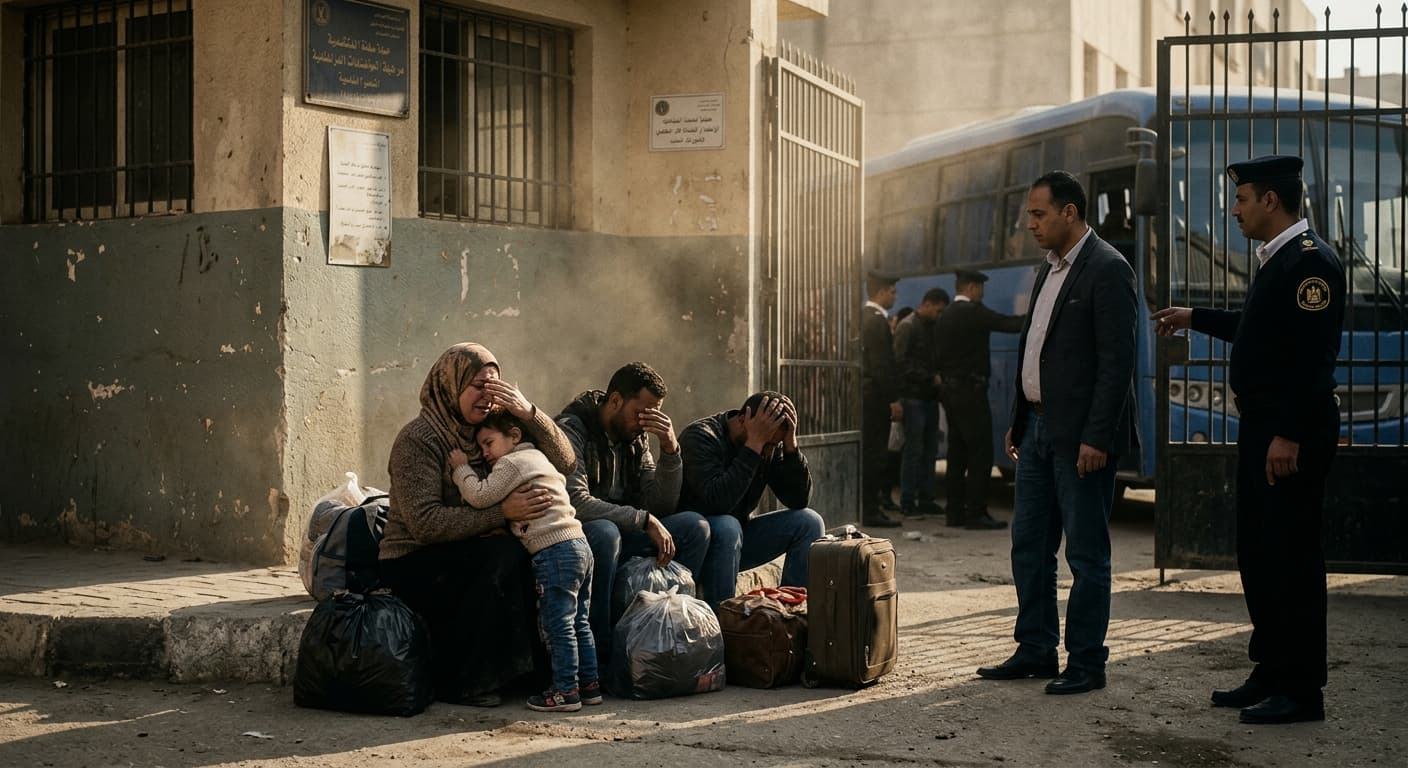
Human Rights Watch reported on July 7, 2026 that Egyptian authorities have run a months-long campaign of arbitrary arrest, unlawful detention and deportation targeting refugees and asylum seekers — most of them Sudanese and South Sudanese — including people carrying valid UN High Commissioner for Refugees (UNHCR) cards whose government residency-renewal appointments extend as late as September 2028. The finding matters beyond Cairo: it shows that Egypt's first-ever Asylum Law, ratified in December 2024 and marketed to European partners as a modernisation of refugee protection, is functioning in practice as a legal architecture for refoulement — because its executive bylaws are still unissued 18 months on, and its text omits the one clause international law makes non-negotiable.
The HRW report, based on interviews with 19 refugees in April and May 2026, found that people are being "jailed and deported for lacking the very documents the government has failed to provide," in the words of Michelle Randhawa, HRW's senior refugee and migrant rights officer. The Egyptian Foreign Ministry did not answer detailed questions HRW sent on June 23, 2026.
The number that makes the crackdown work: 80 percent
The Egyptian government's public defence is procedural. "No one is arrested for being a refugee or asylum-seeker but only for violating residency laws," Cairo told UN Special Rapporteurs in a December 2025 reply cited in a June 2026 report by the Egyptian Initiative for Personal Rights (EIPR).
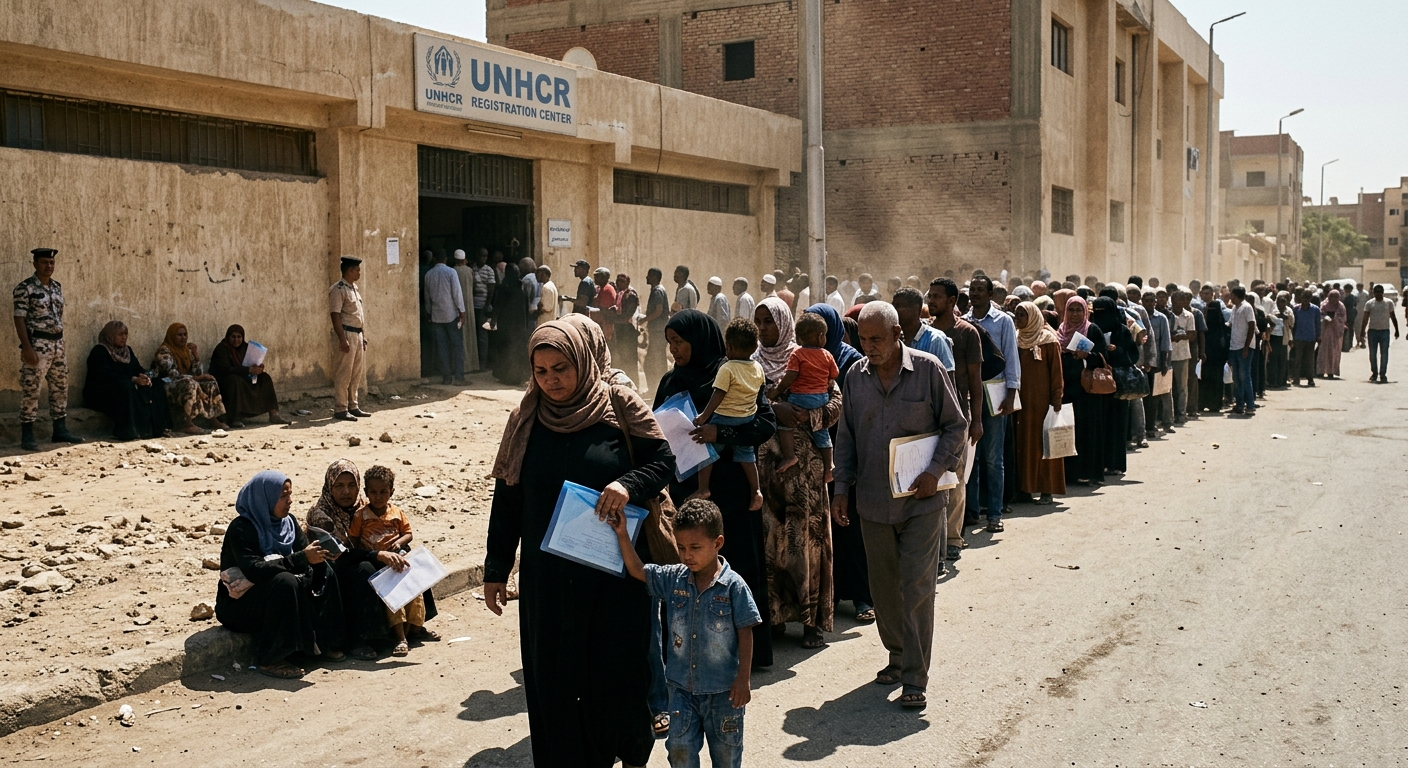
That defence collapses on one figure. Approximately 80% of refugees in Egypt do not hold valid residency permits issued by the Ministry of Interior, according to EIPR, because appointment backlogs at the Passports and Immigration Directorate now extend into 2029. Even with additional processing capacity, waiting times will remain at 19 months. The state has, in effect, engineered the very irregularity it now punishes. A 27-year-old South Sudanese man deported to Juba on April 1, 2026 told HRW that his UNHCR card and 2028 renewal appointment did not stop the police: "They said, 'You don't have residency, you Sudanese are too many in this country, we don't want you anymore.'"
The scale of enforcement is consistent with policy, not incident. EIPR cites UNHCR sources estimating at least 3,000 arrests in the first two months of 2026, with lawyers putting the figure between 5,000 and 10,000; one protection actor recorded close to 5,000 arrests in the last two weeks of January alone. Amnesty International, in a February 2026 statement, documented 22 cases of plain-clothes police hauling Syrians, Sudanese and South Sudanese from streets, workplaces and homes across Cairo, Giza, Alexandria and Qalyubia; 15 of the 22 were UNHCR-registered.
What the 2024 Asylum Law actually does — and doesn't
The Law Regarding the Asylum of Foreigners was passed by Egypt's parliament on November 19, 2024 and ratified by President Abdel Fattah al-Sisi on December 16, 2024, ending a 70-year arrangement under which UNHCR had handled registration and refugee status determination on behalf of the state through a 1954 memorandum of understanding. It creates a Permanent Committee for Refugee Affairs (PCRA) composed of interior, justice, foreign affairs and finance ministry officials under the prime minister's office.
Four features of the statute drive the current crisis, as detailed in a December 2024 Amnesty International legal briefing:
- No explicit non-refoulement clause. Article 13 bars extradition of "recognised refugees" but leaves asylum seekers and those whose status has been revoked exposed; broad "national security and public order" exceptions permit removal without individualised risk assessment.
- A 45-day filing deadline for irregular arrivals to lodge asylum claims, on pain of imprisonment for at least six months and forcible removal — a provision the
1951 Refugee Convention prohibits under Article 31.
- No legal status for asylum seekers during the up-to-one-year PCRA processing window, and silence on the fate of the hundreds of thousands already in UNHCR's pipeline when the law entered into force.
- Bylaws unissued. The executive regulations were supposed to be adopted within six months, i.e. by mid-2025. As of the European Commission's humanitarian
2026 planning document for Egypt, interministerial meetings were still "currently taking place to draft respective bylaws." The first head of the PCRA was appointed only in February 2026, according to Mada Masr.
The result is a two-track collapse. UNHCR retains its 1954 mandate on paper but faces its own backlog; the government's replacement mechanism does not yet legally exist. HRW's own December 2024 warning that the law would create "legal limbo" has been vindicated in an ugly way.
The UN treaty-body finding Cairo is ignoring
On March 26, 2026, five UN Special Rapporteurs — on trafficking, migrants' human rights, sexual orientation and gender identity, torture, and the Working Group on Discrimination against Women — issued a public alert warning that deportations were being carried out "without individualized assessments to determine the risk of refoulement." Their
joint communication to Cairo — the second in six months — invokes Article 3 of the Convention against Torture, which Egypt acceded to in June 1986 and which admits no derogation. The communication reminds the government that non-refoulement is a customary rule "regardless of the status or grounds for seeking protection."
The rapporteurs' October 2025 letter, cited by EIPR, documented a 150% year-on-year rise in refoulement of registered refugees between 2024 and 2025, alongside a 56% rise in arrests of registered refugees and asylum seekers. Cairo's December 2025 reply denied any refoulement of registered persons or deportation of children — a claim contradicted by HRW's April–May 2026 interviews and Amnesty's February 2026 case files.
Egypt is also bound by Article II(3) of the 1969 OAU Convention Governing the Specific Aspects of Refugee Problems in Africa, which forbids any measure that would "compel [a refugee] to return to or remain in a territory where his life, physical integrity or liberty would be threatened." That treaty language covers the exact scenario refugees are describing: expulsion to South Sudan and Sudan while active conflict continues.
The EU pays, Cairo delivers — and the numbers move
The pattern maps almost cleanly onto the €7.4 billion EU–Egypt Strategic and Comprehensive Partnership, signed on March 17, 2024. The Joint Declaration lists migration and mobility as one of six pillars; the package includes €200 million for migration programmes under the Neighbourhood, Development and International Cooperation Instrument, on top of a €5 billion macro-financial assistance loan formalised by
Council Decision (EU) 2024/1144 on April 12, 2024.
An EU diplomat told the Refugee Platform in Egypt, in a submission to the UN Special Rapporteur on migration, that "the authorities' rush to enact this law was geared by pressure from the EU as part of the EU–Egypt partnership." The
Middle East Institute has documented that the EU Asylum Agency provided drafting support. The independent monitoring mechanism attached to the €200 million migration envelope — the safeguard against exactly this kind of outcome — has not been made public.
Cairo's leverage is structural. Egypt hosts more UNHCR-registered refugees than Germany did at the peak of the 2015–16 European crisis, and Sudan's war shows no sign of ending: UNHCR and 123 partners appealed for $1.6 billion on February 17, 2026 to support Sudanese refugees across seven countries. Every deportation to Port Sudan or Juba reduces the number of onward movers toward the Mediterranean; every UN treaty-body finding that Brussels fails to act on cheapens the EU's own asylum jurisprudence.
The pattern in the jails
The most concrete evidence that this is enforcement policy rather than street-level improvisation comes from EIPR's June 2026 report. Lawyers working immigration cases have seen "official police documents containing instructions to systematically target refugee and migrant communities." Arrests occur at door-to-door checks inside private homes, at checkpoints deliberately positioned outside refugee schools, and in public hospitals where refugees have gone for treatment. Children in school uniform have been detained.
Conditions in detention are becoming lethal. On June 24, 2026, Reuters reported via The Star that Al-Nazir Al-Sadig, an 18-year-old Sudanese high-school student, died of pneumonia after more than three weeks in a Cairo jail where relatives said he had been beaten and extorted by other inmates. He had been detained during the sweep that followed the December 2025 escalation.
Egypt's own Refugee Platform in Egypt submission to OHCHR documented the deportation of more than 20,000 Sudanese, "including women and children," across 2023–2024. Amnesty International separately learned from refugee-protection actors that an estimated 18,000 individuals were deported from Egypt to Sudan in 2024 alone. The 2026 numbers, EIPR concedes, are impossible to verify because access to police stations and border areas has been closed to lawyers.
The Sudanese Foreign Ministry said on January 31, 2026, in remarks reported by Amnesty, that thousands were "returned" from Egypt in December 2025 and January 2026 — without specifying how many were deported and how many chose "voluntary" return to escape indefinite detention. That ambiguity is convenient for both governments; it is not exculpatory.
"Refugees and asylum seekers in Egypt are losing their residency status because of bureaucratic delays, and are being jailed and deported for lacking the very documents the government has failed to provide. Detaining asylum seekers and refugees simply because their documents expired due to the government's administrative delays is both arbitrary and draconian." — Michelle Randhawa, Human Rights Watch, July 7, 2026
What to watch
- Egyptian bylaws. The executive regulations to the 2024 Asylum Law remain unissued more than 18 months after ratification. Their text — specifically whether it enshrines non-refoulement, protects asylum seekers awaiting PCRA decisions, and grandfathers UNHCR-registered persons — will determine whether the law can be brought inside Egypt's treaty obligations or entrenches the current regime.
- UN treaty-body response. The Committee against Torture and the Human Rights Committee have both received the Special Rapporteurs' communications. Watch for a formal General Comment or urgent action letter naming refoulement to Sudan as a CAT Article 3 violation; a finding would give litigants in European jurisdictions grounds to challenge EU cooperation.
- EU disbursement schedule. The second tranche of the €5 billion macro-financial assistance under Council Decision (EU) 2024/1144 remains subject to reform benchmarks. European Parliament questions on human-rights conditionality attached to the migration envelope are pending; a public reply from the Commission is the next scheduled catalyst.
- UNHCR handover. The Permanent Committee for Refugee Affairs, whose first chair was appointed in February 2026, has no announced start date for taking over refugee status determination from UNHCR. Any premature transfer while backlogs run to 2029 would strip legal protection from tens of thousands overnight.
The Bottom Line
Egypt's 2024 Asylum Law is not a modernisation of refugee protection; it is a legal container being built around a mass-deportation policy that predates it and now runs faster than any bylaw process can catch up. The decisive fact is not the crackdown itself but the 80% of registered refugees the state has pushed into engineered irregularity while UN treaty bodies file letters and the EU keeps paying. If the bylaws arrive without a non-refoulement clause — or if they never arrive at all — the July 7 HRW report will read, in retrospect, as the moment international refugee law was quietly rewritten on Egypt's terms, with European money.
Related: Global Politics
Discover more

Global Politics
US Seizes Iranian Ship, Tensions Surge
The US seizure of the Iranian ship Touska highlights a shift in control over the Strait of Hormuz, favoring Iran's strategic position.
US Politics
House Ethics Committee Pushes Sexual Miscond.
The House Ethics Committee has shifted responsibility for sexual harassment settlement records to the Office of Congressional Workplace Rights, complicating disclosure efforts.

India
Congress Accuses Modi of Stalling Women's Law
Congress accuses Modi of stalling women's reservation law by linking it to delimitation, revealing a deeper electoral strategy.

Conflict & Security
Drone Warfare Killing Aid Workers at Unprec
Over 1,000 humanitarian workers killed in three years as cheap armed drones collapse legal protections. Gaza, Sudan, Ukraine, and DRC see deliberate targeting of aid convoys and hospitals with zero prosecutions.

