Egypt's Asylum Law Fuels Refugee Crackdown
New law enables mass deportations of refugees in Egypt.
Model Diplomat7 min readAfrica
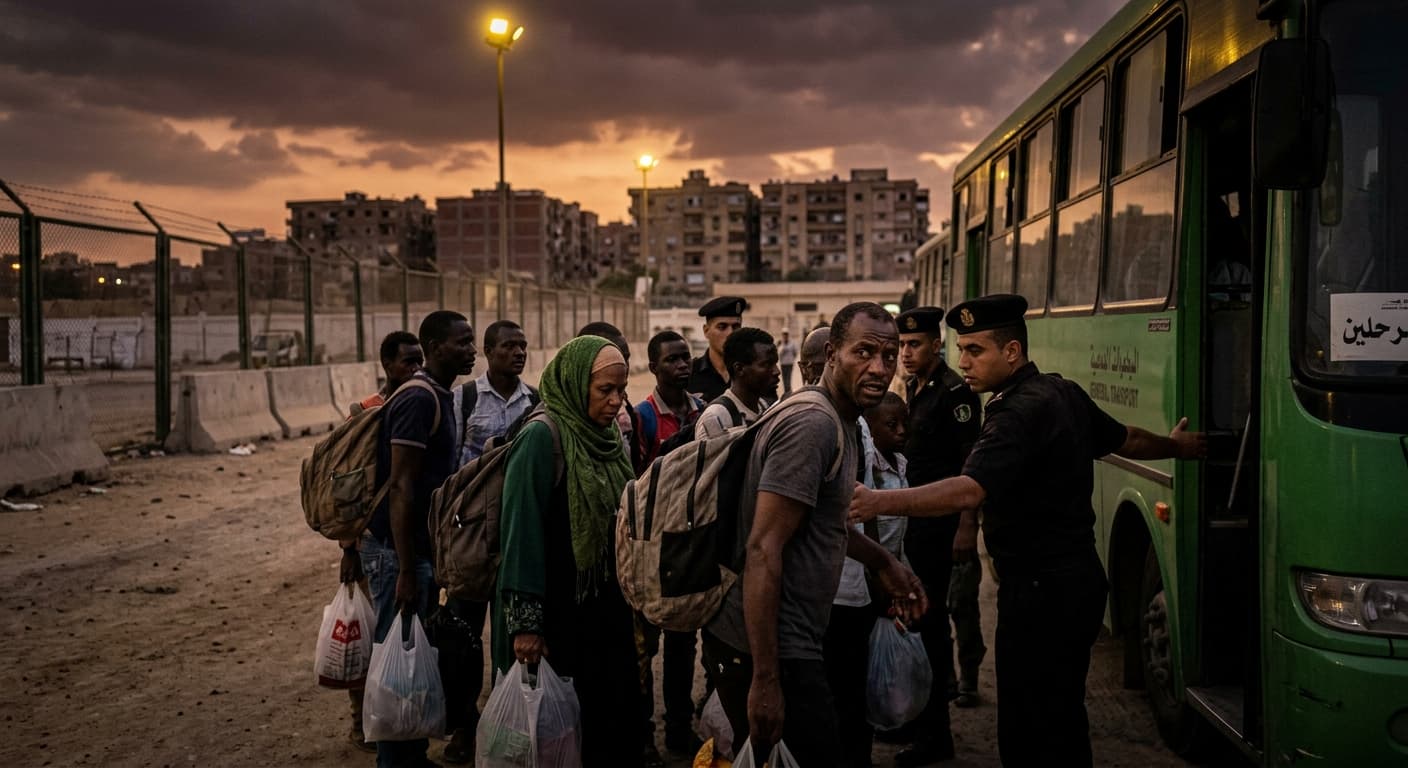
Egypt's Asylum Law Becomes a Deportation Machine
Egypt's 2024 asylum law was meant to bring the country into line with the Refugee Convention. Eighteen months in, it is enabling the largest state-run refugee crackdown since the Sudan war began.
Egypt's first-ever asylum law — passed in November 2024 to institutionalise protection for the 1.1 million refugees the country hosts — has become the legal scaffolding for its opposite: a months-long campaign of arbitrary arrests, detention and forced returns that Human Rights Watch documents in a July 7 report. The mechanism is bureaucratic rather than punitive on its face. Refugees are required to hold Interior Ministry residency permits; the ministry hands out renewal appointments as late as 2028 or 2029; police then arrest UNHCR-registered refugees whose permits have "expired." The result, as Human Rights Watch puts it, is that refugees are "being jailed and deported for lacking the very documents the government has failed to provide" — a system engineered so that legal limbo produces removable bodies, mostly Sudanese, on demand.
The law that codified the crackdown
Egypt's parliament approved the Law Regarding the Asylum of Foreigners on November 19, 2024, and President Abdel Fattah al-Sisi signed it into force on December 17, 2024. It was drafted in secrecy, without meaningful consultation with UNHCR or civil society, and, per Amnesty International, the text itself was never officially published — a leaked draft circulated only after the parliamentary vote.
The law was pitched as compliance. Egypt had operated since a 1954 memorandum of understanding under which UNHCR handled refugee status determination on the government's behalf; Cairo now transfers those functions to a Permanent Committee for Refugee Affairs, chaired by the prime minister and staffed by the interior, defence, foreign-affairs, justice and finance ministries. But the substance moves in the opposite direction. According to Human Rights Watch's December 2024 analysis, the law fails to explicitly prohibit refoulement — the single most important obligation Egypt owes under the 1951 Convention and the 1969 OAU Convention — and criminalises irregular-entry asylum seekers who miss a 45-day application deadline with at least six months in prison.
Amnesty's public statement to al-Sisi in December 2024 warned that the law "allows for the arbitrary detention of asylum-seekers and refugees solely on migration grounds" and "enables unlawful returns without procedural safeguards," per Amnesty International. Both warnings have been vindicated within eighteen months.
What "administrative" detention looks like
The scale of what followed is difficult to hide. The Egyptian Initiative for Personal Rights (EIPR) — the most systematic domestic monitor — records that UNHCR sources estimated at least 3,000 refugees and asylum seekers arrested in the first two months of 2026, with lawyers putting the true figure at 5,000 to 10,000. One local protection actor cited by EIPR estimated close to 5,000 arrests in the final two weeks of January alone, "the majority of them Sudanese."
The mechanics are not incidental. EIPR's field data show that roughly 90% of arrests among refugees and asylum seekers are for lack of residency, and 80% of refugees do not hold valid Interior Ministry residency permits — because the ministry's own appointment queues run into 2028 and 2029, with waiting times projected to settle at 19 months even after additional capacity is added. Refugees are, in EIPR's phrase, forced into a "condition of forced irregularity" that is then used to justify their removal.
Amnesty's February 2026 update, based on documentation of 22 arrests in Cairo, Giza, Qalyubia and Alexandria between late December 2025 and 5 February 2026, found that 15 of the 22 were UNHCR-registered. Prosecutors ordered release in 19 documented cases; police continued to hold the detainees regardless, and in at least one case demanded the family purchase a flight ticket to Syria before releasing a man who had lived legally in Egypt for 12 years.
Reuters, in reporting picked up by The Star in June 2026, documented the death of 18-year-old Al-Nazir Al-Sadig — a high-school student who had fled Sudan's civil war — of pneumonia after more than three weeks in a Cairo jail where he was beaten and extorted by other inmates. His case is not the outlier; it is the case that got reported.
The primary document: what UN experts told Cairo
The strongest paper trail is the UN Special Procedures communication AL EGY 6/2025, sent on 16 October 2025 by four UN Special Rapporteurs and cited in the EIPR report. It flagged a 150% year-on-year increase in refoulement incidents involving registered refugees between 2024 and 2025, and a 56% rise in arrests of registered refugees and asylum seekers. Egypt's December 2025 reply, according to EIPR, denied any refoulement of registered refugees or detention of children — a denial that the January 2026 raids and the March 2026 follow-up statement by the same UN experts effectively repudiated within weeks.
That March 2026 warning is unusually direct. UN experts said the deportations "were reportedly carried out without individualized assessments to determine the risk of refoulement," per Human Rights Watch — the technical language for the exact violation the 1951 Convention was built to prevent. The 27-year-old South Sudanese man interviewed by HRW, who was deported to Juba on April 1 despite holding a UNHCR card and a residency appointment scheduled for September 2028, was told by Egyptian police: "You don't have residency, you Sudanese are too many in this country, we don't want you anymore."
Who benefits: the EU deal in the background
The crackdown does not sit in a vacuum. On 17 March 2024, the European Union announced a €7.4 billion strategic partnership package with Egypt, with migration control one of six pillars. The EUR-Lex decision formalising a €5 billion macro-financial assistance component was adopted the same year; the accompanying
joint declaration committed Egypt and the EU to "combating smuggling of migrants" and "strengthening border management." €200 million was earmarked specifically for migration, per
Al Jazeera's reporting on the deal.
The sequencing matters. Egypt introduced a visa requirement for all Sudanese nationals in May 2023, weeks after the war began; the prime ministerial decree requiring foreign nationals to "regularise" their status was issued in August 2023; the asylum bill went to cabinet in June 2023 and was passed a month after the EU package was locked in. The Amnesty report from June 2024 had already documented 800 forced returns to Sudan between January and March 2024, with UNHCR estimating 3,000 deported in September 2023 alone. The EU signed anyway.
The winners in this arrangement are legible. The European Commission gets to point to falling Central Mediterranean crossings from Egypt's north coast — an achievement Cairo has claimed since 2016. Egypt gets balance-of-payments support in the middle of an IMF programme. UNHCR's Cairo office, which as of August 2025 had registered 1,034,524 asylum seekers — 74% of them Sudanese, per the European Commission's 2026 humanitarian implementation plan — is left running the world's largest refugee status determination operation while its files are set to be transferred to a committee it will not control.
The losers are the roughly 900,000 refugees whose files sit somewhere between UNHCR and the not-yet-operational Permanent Committee. The bylaws were published in May 2026; per BBC Arabic, they are due to enter into force in late August 2026, with the prime minister empowered to extend the transitional period. Nour Khalil, director of the Refugees Platform in Egypt, told the BBC that implementation this year "seems difficult" given that the committee's technical secretariat is not yet formed and no clear mechanism exists to transfer more than a million case files.
The historical parallel Cairo would prefer not to draw
Egypt has done this before, on a smaller scale. In November 2011, Human Rights Watch documented Egypt's deportation of Eritrean asylum seekers despite UNHCR registration, and in April 2008 the forcible return of at least 11 recognised Sudanese refugees who ended up in Kobar prison in Juba. What is different in 2026 is the industrial scale — thousands, not dozens — and the legal architecture. In 2008 and 2011, deportations happened against the backdrop of a 1954 MoU that at least required UNHCR access to detainees. Under the 2024 law, an Egyptian committee decides who is a refugee, and detention on migration grounds alone is permitted by statute.
The Institute for Security Studies notes that Egypt hosts 36.6% of Sudan's refugees, according to ISS Africa, and that the 2026 humanitarian appeal for Sudan is 13% funded. As UN human rights chief Volker Türk warned on July 3, 2026, another mass-atrocity event is unfolding around el-Obeid, with up to 500,000 civilians at risk, per
Al Jazeera. Every Sudanese refugee deported from Cairo is being returned to that.
What to watch
- Late August 2026: scheduled entry into force of the 35-article executive bylaws to Law 164/2024. Watch whether the Permanent Committee is actually stood up with a technical secretariat, whether the prime minister invokes his authority to extend the transitional period, and whether UNHCR's 1.1 million-file caseload is transferred on paper only.
- Interior Ministry appointment queue: EIPR's data show waits into 2028–2029. Any commitment to a temporary-status provision for those awaiting appointments — the specific fix HRW is demanding — would be the clearest signal of good faith. None has been announced.
- EU review: the €7.4 billion partnership includes conditionality tied to human rights, at least on paper. The next EU–Egypt Association Council meeting is the venue where suspension or benchmarking of the migration component could be tabled. It has not been.
- UN Special Procedures: a third communication from the Rapporteurs, following the October 2025 and March 2026 letters, is the diplomatic escalation point short of Human Rights Council action. Watch for it before year-end.
The Bottom Line
Egypt's 2024 Asylum Law was sold as a step toward international standards; in practice, its silences — no explicit refoulement ban, a 45-day filing deadline, detention on migration grounds alone — have paired with an Interior Ministry backlog stretching to 2029 to produce a system that manufactures deportable "irregulars" out of UNHCR-registered refugees. The €7.4 billion EU migration deal has given Cairo cover to industrialise what it did quietly in 2008 and 2011. Until the bylaws include a temporary-status provision for refugees waiting on appointments the government cannot deliver, the law is not a protection framework — it is the paperwork for a removal pipeline.
Discover more

US Politics
House Ethics Committee Pushes Sexual Miscond.
The House Ethics Committee has shifted responsibility for sexual harassment settlement records to the Office of Congressional Workplace Rights, complicating disclosure efforts.

Global Politics
US Seizes Iranian Ship, Tensions Surge
The US seizure of the Iranian ship Touska highlights a shift in control over the Strait of Hormuz, favoring Iran's strategic position.

International Relations
Pakistan's Key Role in US-Israel-Iran Meddle
Pakistan is seeking to mediate the US-Israel-Iran conflict, balancing high-stakes diplomacy against severe economic pressures and steep regional challenges.

Economics
Fed's Amex AML order puts correspondent banking on notice
Federal Reserve's Amex AML order requires board-level controls and a 90-day plan; OCC fined the bank $350 million over enterprise-wide deficiencies.