Ecuador's Recall Push Tests Democracy
Noboa's recall drive reveals deep political fractures.
Model Diplomat9 min readLatin America
Ecuador's Recall Push Against Noboa Tests a Broken Democracy
The revocatoria drive against Daniel Noboa is unlikely to succeed — but it exposes how Ecuador's democratic backsliding is now running in both directions at once.
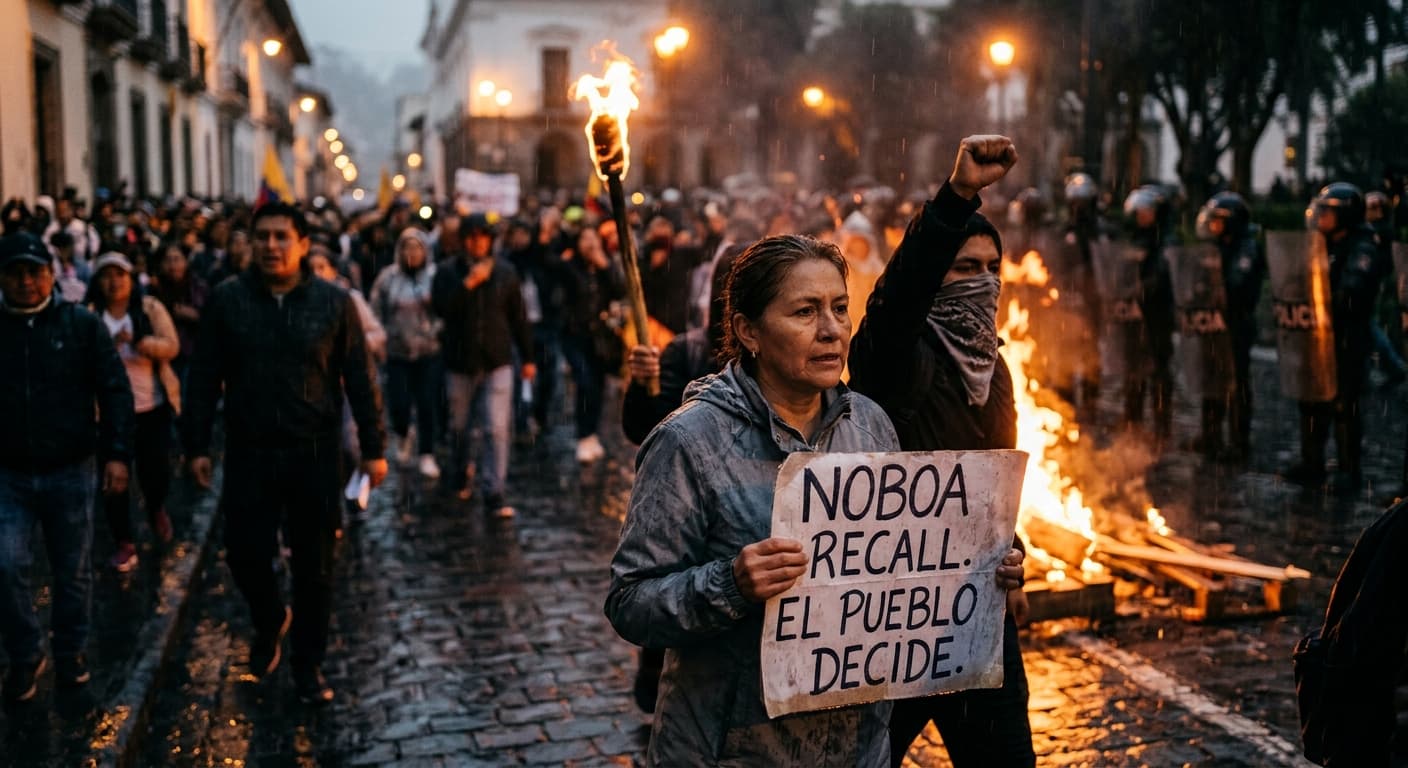
Ecuadorian social movements will stage nationwide vigils on July 11 and 15 outside the offices of the National Electoral Council (CNE), pressuring the body to admit two separate petitions to recall President Daniel Noboa and Vice President María José Pinto — a mobilisation that matters less for its slim chance of forcing Noboa out than for what it reveals about the collapse of his political capital eight months after he lost a signature referendum and 14 months into a four-year term. The Revoca EC platform's slogan — "La revocatoria va, porque va" — is being read in Quito as a legal long-shot, according to Prensa Latina. It is also the clearest signal yet that Ecuador has joined the region's pattern of executive-versus-street stalemate — Peru without an impeachment, Colombia without a Congress in play — with a Bukele-aligned right now on the defensive.
What actually happened this week
The Presidency's legal secretary, Enrique Herrería, walked into the CNE headquarters in Quito on July 7 to formally challenge the second of two recall petitions, filed by the Fenocin peasant-Indigenous-Black-Montubio confederation together with the teachers' union UNE and the labour federation UGTE. Herrería argued the request is "unconstitutional" because it attacks "public policy" — specifically Noboa's four-year, US$5 billion Extended Fund Facility with the International Monetary Fund — which he said is the exclusive domain of the executive, according to ABC Color citing EFE. He warned that these petitions could constitute a "distracción" of the president and floated the possibility of "destabilisation" intent, in comments to
Ecuavisa.
A first petition was filed weeks earlier by Leonidas Iza — the former CONAIE president who ran fourth in the 2025 first round — and lawyer Washington Andrade. That request is already in the CNE's analytical phase. Both petitions cite Article 105 of Ecuador's 2008 Constitution, which allows citizens to seek the removal of any elected authority after the first year of the mandate. The Constitution text grants the CNE wide discretion over both procedural admissibility and the substantive "motivos" — a power that, as a 2019
International Political Science Review study by researcher Yanina Welp documents, has made Ecuador's electoral body the single most decisive actor in whether recalls ever reach the ballot. Herrería's framing — recall attempts as sabotage rather than a constitutional right — is the tell.
The power dynamic: a CNE Noboa does not fully control — yet
Ecuador's recall mechanism looks permissive on paper. Article 105 sets a one-year waiting period; Article 106 puts the signature threshold at 10% of the electoral roll for the presidency — roughly 1.4 million valid signatures collected within 180 days. In practice, the Welp study found that Ecuador ran 78 recall processes between 2010 and 2011, mostly against local officials. A 2011 legal reform then granted the CNE the power to judge the reasons — not only the formalities — of a request, and activation rates collapsed. In 2015, the CNE rejected a request from the Democracia Sí movement against Rafael Correa on the same grounds Herrería now invokes: that policy disagreements do not qualify as "just cause." That precedent is why most Ecuadorian jurists interviewed by Confirmado expect both petitions to be archived.
The catch: the current CNE plenary, chaired by Diana Atamaint, is serving on an extension of its mandate. According to a legal opinion analysed by the Konrad Adenauer Stiftung, the five councillors' terms expired in November 2024, but the Attorney General's office ruled they must stay on until the Council of Citizen Participation appoints replacements. That replacement process is one of 14 institutional appointments — including the Attorney General, the Ombudsman and Constitutional Court seats — that Noboa is expected to influence through his expanded ADN bench of at least 66 of 151 Assembly seats, an analyst told
BBC Mundo after his April 2025 re-election. In short: the recall petitions will almost certainly be archived, but the fight is really about who controls the electoral referee for the rest of Noboa's term.
Why the street matters more than the signatures
The recall is one front. The other is a broader crisis of governance that arrived faster than any Ecuadorian analyst forecast on election night. Ecuador recorded 8,393 killings by late November 2025 — an average of 25 murders per day — according to the Freedom House 2026 country report, which scored Ecuador at 64 out of 100 ("partly free") and flagged Organization of American States and European Union election-observer concerns about Noboa's attempts to influence the CNE during the April 2025 campaign. That homicide figure is barely below the 46 per 100,000 rate that helped elect him in the first place, as noted by
BBC Mundo.
Then came the diesel decree. On September 12, 2025, Noboa eliminated the fuel subsidy, pushing prices from US$1.80 to US$2.80 per gallon. CONAIE — Ecuador's largest Indigenous confederation — called an indefinite strike. Within three weeks, Al Jazeera reported, 5,000 troops had been deployed to Quito, one protester was dead, more than 100 people arrested. On October 7, 2025, protesters attacked Noboa's motorcade with rocks in the southern province of Cañar; Environment Minister Inés Manzano told
Al Jazeera the vehicle showed "signs of bullet damage" and filed a report alleging an assassination attempt. CONAIE denied any organised attack and accused the government of orchestrating violence against peaceful protesters. Ecuador's Alliance of Human Rights Organizations counted 473 injured, 206 detained and three killed by the time the protests wound down, per Freedom House.
Six weeks later, voters delivered the political verdict. On November 16, 2025, Ecuadorians rejected all four of Noboa's referendum proposals: 61.58% against the constituent assembly, 60.55% against foreign military bases, 58.06% against ending state financing of parties, 53.46% against cutting the Assembly's size, according to CNE data reported by the BBC. Turnout topped 80%. Only one of 24 provinces — Tungurahua — backed all four questions. Flacso Ecuador political analyst Sofía Cordero told
BBC Mundo the result showed voters "decided not to give the government total freedom to fight crime with almost no real control." Cristian Carpio of the political-risk firm Profitas called it evidence of "desgaste" — wear-and-tear — in Noboa's management.
That referendum defeat is the missing context in most wire coverage of the recall push. It stripped Noboa of the political mandate to rewrite the 2008 Constitution and — crucially — invite back a U.S. military base at Manta that Homeland Security Secretary Kristi Noem had toured on horseback with him earlier in the month, according to NPR's Carrie Kahn. A Journal of Democracy essay on
crime, crackdowns and democracy in Ecuador argues the outcome "exposed limits to Noboa's mandate" and that his militarised strategy has "weakened judicial independence, constrained protest, and raised human-rights concerns" without reducing violence.
The regional pattern — and why Ecuador breaks it
The temptation is to file Noboa's crisis under "another Latin American president in trouble." But the mechanics differ in ways that matter for regional analysts.
Peru removed Dina Boluarte on October 10, 2025 through congressional impeachment on grounds of "permanent moral incapacity," with 122 of 130 lawmakers voting to oust her at a 2–4% approval rating, per the BBC. Ecuador's Assembly cannot deliver that outcome: ADN plus allies effectively block any two-thirds threshold, and Rafael Correa's Revolución Ciudadana lacks the cross-bench allies to pull it off alone.
Venezuela in 2016 showed how a captured electoral council kills a recall in the cradle. The CNE suspended signature collection against Nicolás Maduro on the basis of state-court fraud petitions, as Al Jazeera documented. Opposition leaders were then barred from leaving the country. Ecuador's CNE is not yet Venezuela's — but Herrería's framing of the recall as "destabilisation" borrows directly from that playbook, and the mechanism is the same: force the electoral body to rule on political intent, not procedural compliance.
Bolivia in 2008 offers the counter-example: Evo Morales agreed to face a recall vote, won 67% and used the mandate to consolidate power, as NPR reported at the time. That path — turn the recall into a plebiscite you win — is closed to Noboa after the November 2025 defeat.
Colombia's Gustavo Petro is pursuing the mirror-image move — trying to trigger a constituent process against a hostile Congress, described by the Atlantic Council as an executive-aggrandisement risk from the left. The Ecuadorian case cuts differently. Noboa is the region's most prominent Trump-aligned young conservative — he congratulated Colombia's far-right president-elect Abelardo De la Espriella on June 22, 2026 after publicly lobbying for him days before the vote, per
BBC Mundo. His governance model is Nayib Bukele's El Salvador: mega-prisons, states of exception, foreign contractors — a partnership with Erik Prince's outfit is public, as the
Carnegie Endowment documented. What Noboa lacks is Bukele's supermajority and captured court. That absence is why the street matters: without institutional cover, every mobilisation is a solvency test.
The IMF anchor that Fenocin is really attacking
Herrería's argument to the CNE — that Fenocin's petition attacks "public policy," specifically the IMF programme — inadvertently reveals the government's tightest constraint. According to the IMF's Fifth Review of the Extended Arrangement, published April 9, 2026, Ecuador missed its end-January 2026 fiscal quantitative performance criteria, but the authorities enacted measures projected to deliver a 6.6% of GDP improvement in the non-financial public sector primary balance by 2028. The Fund flagged that Ecuador executed a US$3 billion bond buyback in January 2026, cutting external debt service by US$1.2 billion through 2028, and that EXIM China received US$275 million in Q1 2026 repayments — Ecuador's largest official bilateral creditor is quietly being unwound.
Translation: fiscal consolidation locked in by treaty is what forced the diesel decree, the VAT hike from 12% to 15%, and thousands of public-sector layoffs — steps Al Jazeera itemised in its account of the fuel-subsidy protests. That is exactly what Fenocin, UNE and UGTE are trying to relitigate through the recall, according to
Prensa Latina. The government's line — that these are exclusive-executive policy calls — is legally sound under Ecuadorian jurisprudence but politically radioactive. It hands the opposition a clean narrative: an unelected foreign lender dictates Ecuadorian austerity, and any citizen who objects gets called a destabiliser. It is the same fault line that produced Ecuador's 2019 uprising against Lenín Moreno's fuel-subsidy cut, and CONAIE's institutional memory of that victory is now working against Noboa.
What to watch next
Three catalysts will determine whether this becomes a slow-motion Boluarte or a survivable political scare:
- The CNE ruling on admissibility. If Atamaint's plenary archives both petitions, Revoca EC has signalled — through
Confirmado — it will escalate to the Tribunal Contencioso Electoral and, potentially, the Constitutional Court. That could take months and consume executive bandwidth.
- The July 11 and 15 mobilisations. CONAIE has not formally endorsed Revoca EC, but Fenocin's parallel filing and the July 4 Marcha de las Antorchas in Quito, reported by
La República, suggest an emerging coalition. Turnout on these dates will signal whether Iza can force CONAIE back onto the field.
- The next IMF review. Ecuador's programme runs through 2028. Missing another QPC while facing street pressure would force Noboa into a choice — negotiate with unions or double down on austerity — that would define the second half of his term.
The Bottom Line
The Noboa recall will almost certainly not remove him, but it does not need to. Its function is to convert every unpopular austerity measure into a constitutional confrontation, and to expose that Ecuador's democratic guardrails — an electoral council operating on an expired mandate, a Constitutional Court whose replacements Noboa will help pick, an Assembly he cannot fully control — are being contested from every direction at once. The pattern to watch is not Peru's impeachment nor Venezuela's blockade, but the slow drift toward an Ecuadorian democracy where both the executive and the street increasingly reach past institutions rather than through them.
Discover more
US Politics
House Ethics Committee Pushes Sexual Miscond.
The House Ethics Committee has shifted responsibility for sexual harassment settlement records to the Office of Congressional Workplace Rights, complicating disclosure efforts.

India
Yamini Aiyar on Modi's Federalism Shift
Yamini Aiyar critiques Modi's shift from equity-based to performance-based federalism, highlighting implications for India's political landscape.
US Politics
SNAP Food Assistance Faces Legal Challenges
In 2026, SNAP faces stricter eligibility rules and mounting legal challenges, threatening food assistance for the millions of Americans who rely on the program.

Economics
Fed's Amex AML order puts correspondent banking on notice
Federal Reserve's Amex AML order requires board-level controls and a 90-day plan; OCC fined the bank $350 million over enterprise-wide deficiencies.